Stay Ahead in Fast-Growing Economies.
Browse Reports Now
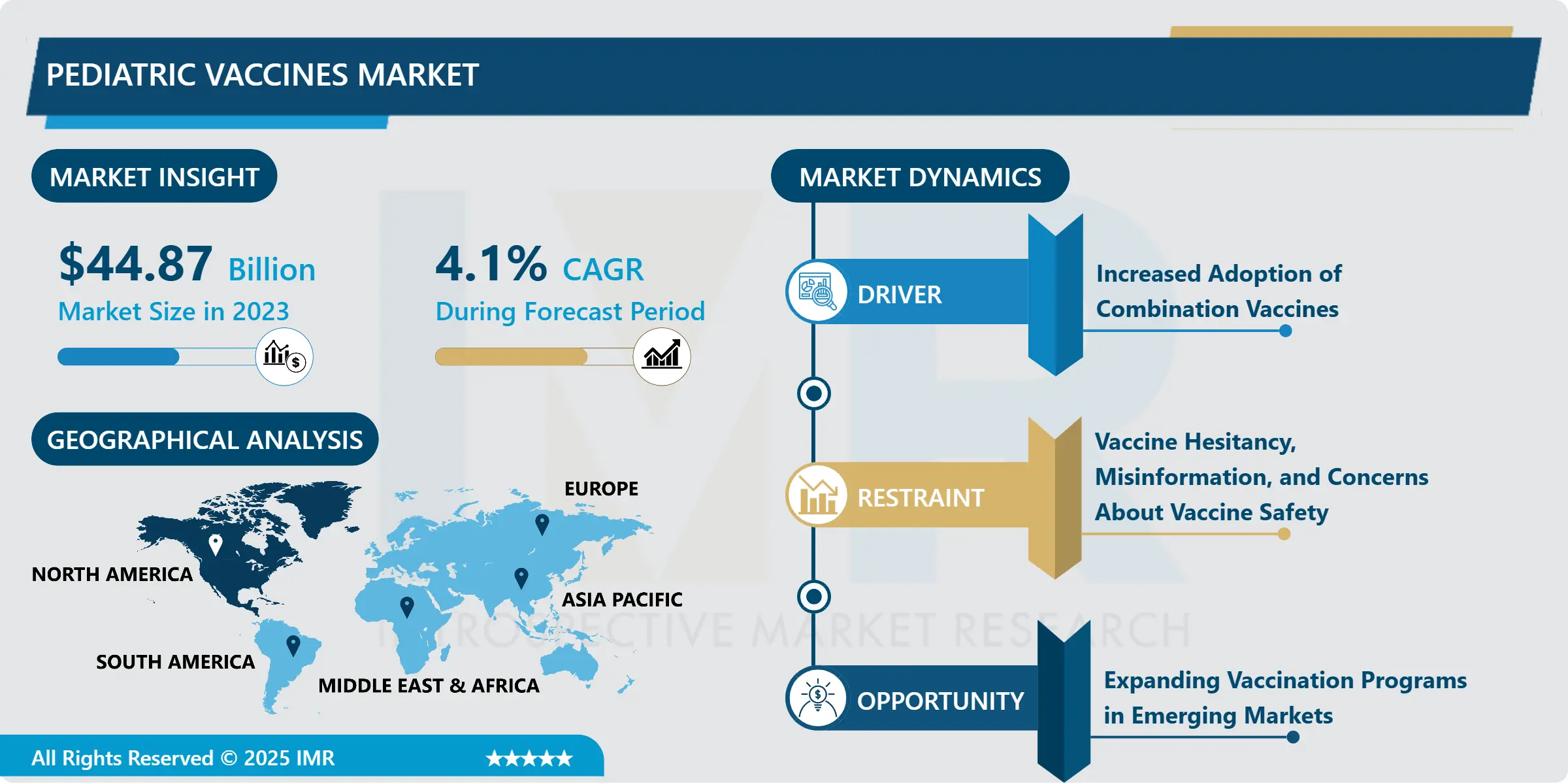
Pediatric Vaccines Market Size, Share, Growth & Forecast (2024-2032)
Pediatric Vaccines Market Size Was Valued at USD 44.87 Billion in 2023, and is Projected to Reach USD 61.58 Billion by 2032, Growing at a CAGR of 4.1% From 2024-2032.

IMR Group
Description
Pediatric Vaccines Market Synopsis:
Pediatric Vaccines Market Size Was Valued at USD 44.87 Billion in 2023, and is Projected to Reach USD 61.58 Billion by 2032, Growing at a CAGR of 4.1% From 2024-2032.
The Pediatric Vaccines Market is referred to the global market of vaccines that are manufactured and administered to children, infants and adolescents for the purpose of prevention of various diseases. This market is made up of vaccines that relate to measles, mumps, rubella, diphtheria, tetanus, pertussis, poliomyelitis, hepatitis, HIV and many others. Vaccine can be pediatric vaccines or preventive vaccines; it can be a primary vaccines or an atypical vaccines. The market is growing due to enhanced awareness of immunization, government immunization campaigns, innovations in technological areas including mRNA vaccines, growth of health expenditure, especially in developing countries.” It does have such issues as vaccine avoidable disease, cost of developing the cold chain, and high cost of some vaccines but indeed, it progresses as more vaccine is developed and administered across the world.
The global Pediatric Vaccines Market is a burgeoning division of the entire global health care industry that is fueled by factors such as rising governmental support, growing awareness of vaccine preventable diseases and innovations in the field of vaccines. This market also comprises of vaccines for maladies that affect children like measles, mumps, rubella, diphtheria, pertussis and pneumonia among others. This growth is mainly attributed to increased immunization programme, especially in the developing countries. Other factors that are driving the vehicle include combination vaccines, mRNA vaccines as well as improvements in the formulation of vaccines. Furthermore, international organizations WHO and UNICEF are instrumental in the provision of imprint vaccines to low- resourced areas.
Pediatric Vaccines Market Trend Analysis:
Increased Adoption of Combination Vaccines
One major development in the pediatric vaccines market concerns combination vaccines more children who require several vaccinations are now being vaccinated by a single dose thus reducing the complexity of their immunization schedules. These vaccines are packaged in a manner that they work for several diseases and one injection is enough which has an impact of sparing the parents and the healthcare services a lot of trips to the healthcare facilities. For example, DTP-HepB-Hib (Diphtheria, Tetanus, Pertussis, Hepatitis B, and Haemophilus influenzae type b) and Hexavalent, vaccines for six diseases are popular since they work in one attempt. But this is not only more convenient, but also cheaper in terms of the number of vaccinations, distribution of vaccines, and their storage.
Specifically, the increased use of combination vaccines has made a positive effect in developing countries because it prevented children morbidity and mortality through increasing the immunization coverage. Organizations such as Gavi have sponsored programs that enable the introduction of these vaccines for low middle-income regions which facilitate better frequency of a vaccination campaign. Despite the challenges of creating combination vaccines, combining antigens have their advantages that may result in improved protection against disease, and improved vaccine compliance. Continued growth in the market is assumed with the increased use of combined vaccines in conjunction with the further development of multi-pathogen vaccines.
Expanding Vaccination Programs in Emerging Markets
There is a high growth potential in expanding the vaccination campaigns in the emerging markets, which is a central feature in the pediatric vaccines market. Where and when the health care infrastructure is advancing in Asia-Pacific, Africa, and Latin America markets the uptake of vaccines is rapidly shifting. It is evident that donor governments and global health organizations including Gavi and UNICEF are scaling up efforts to raise coverage levels, and particularly in LMICs which continue to exhibit low rates. These regions remain underpenetrated, and there will be strong growth in vaccination across measles, pneumonia, diarrheal diseases. The ability to use cheaper combination vaccines and multi-dose vaccines to address logistical issues and increase the coverage of vaccines deployed are boosters for multi-vaccines.
Besides, growth is another advantage that emerging markets have to present for vaccine manufactures especially due to increase of national immunization campaigns by governments as well as increase in funding for vaccines worldwide—internationally. The governments and private sectors are stepping in, as they are partner in delivering an increased amount of vaccines as well as ensuring the cost of these vaccines is affordable. For instance, Gavi was involved in launching a funding platform for vaccine and healthcare systems in the developing nations. But this growth is not only effective in enhancing childhood health and preventing vaccine-preventable diseases; it is equally efficient in supporting long-term economic growth as healthier populations enhance productivity. In the future, specifically with improvements in availability of vaccines, the pediatric vaccines market within these regions is projected to continue its growth in the ensuing years as many opportunities are anticipated for the pharmaceutical company, health organizations and policymaker.
Pediatric Vaccines Market Segment Analysis:
Pediatric Vaccines Market is Segmented on the basis of Type, Application, End User, and Region.
By Type, Combination Vaccines segment is expected to dominate the market during the forecast period
Combination Vaccines segment is anticipated to hold the largest market share of the pediatric vaccines market throughout the forecast period (2024-2032) due to the rising visibility of those methods that provide coverage against numerous diseases with a single drive. This makes several immunizations for children easier because multiple antigens can be administered at once, thus cutting on the number of trips an individual has to make to the health facility. This is convenient since it increase vaccine compliance, particularly in areas of low health facilities or in places whose inhabitants may find it difficult to visit different outlets to take separate vaccines. That they provide wider coverage yet require fewer injections has made combination vaccines very popular with care providers as well as parents.
Besides enhancing compliance, combination vaccines are less expensive to national immunization programs and the overall health systems. These vaccines have few injections hence implying low cost in the overall vaccine distribution, storage and administration costs. This is particularly the case in L&M countries where immunisation is key to lowering under five mortalities from diseases that can be prevented. With ever increasing expansion of vaccination programs by governments and organizations such as Gavi, there is projected to be rapid growth in the uptake of combination vaccines. Continued advancement of multiple disease vaccines and products, the immediate further domination of the segment of combination vaccines in the course of the forecast period.
By Application, Infectious Diseases segment expected to held the largest share
Based on the segmental analysis, the Infectious Diseases segment is predicted to maintain the highest market share for pediatric vaccines market in the course of the forecast period (2024-2032) since infectious diseases continue to recurrently threaten the lives of children. Measles, pneumonia, polio, hepatitis, and rotavirus vaccines, again remain the key focus of international organizations and national immunization initiatives. Vaccines like MMR, DTP, pneumococcal vaccines are important because it helps decrease morbidity and mortality mostly amongst children in developing nations where infectious diseases are most noted to be the main cause of death amongst children.
Special stress is laid on infection control and it appears that passage of time along with advancements of immunization programs is going to tighten the screws even more in the low and middle income nations. Today, the various international organisations including UNICEF, WHO, and Gavi are striving to enhance reliability and affordability of various vaccines in these areas, thereby boosting the demand for the virus combating vaccines in the regions. Also, as new vaccines are introduced with emerging infectious threats and the diseases such as RSV and malaria, the segment for infectious diseases will have potential growth. The future trends of decrease of the number of the vaccine-preventable diseases as a result of vaccination programs with support of the government for children vaccination will strengthen the important factor in focusing on the infectious diseases prevention in the pediatric vaccines market.
Pediatric Vaccines Market Regional Insights:
North America is Expected to Dominate the Market Over the Forecast period
Market Analysis: Geographical Analysis North America is expected to lead the pediatric vaccines market to the well-developed health care sector in the United State of America, high immunization rate, and better health care facility in the Canada. The general vaccination programmes are strong in both countries; governmental and private sector coverage for routine childhood vaccinations are valid. The region can also boast of on-going investments in research and development aimed at accommodating the introduction of new and innovative vaccines for pediatric groups. Besides, we have seen that both clients in North America region have high level of health care awareness and the regulatory framework in this region is also profoundly supportive of the safety and efficacy of vaccines for pediatric use.
Besides, the region is home to some of the world’s leading pharmaceutical manufacturing companies for vaccines. This promotes and encourage the growth of the vaccine through its rapid production, approval and distribution. Due to the growing trends in health and wellbeing, and late innovative vaccines for newly emergent diseases like RSV, Influenza, and COVID-19 for children, North America is still leading in the provision of pediatric vaccines. Vaccines for Children in the US is a government program that supports the market by distributing vaccines free of charge to eligible kids. Consequently, the strategic management of pediatric vaccine market assess that North America will continue their market leadership until the year 2020.
Active Key Players in the Pediatric Vaccines Market:
AbbVie Inc. (United States)
Baxter International Inc. (United States)
Bayer AG (Germany)
Cipla Limited (India)
Emergent BioSolutions Inc. (United States)
GlaxoSmithKline Plc (GSK) (United Kingdom)
Hoffmann-La Roche Ltd (Switzerland)
Johnson & Johnson (United States)
LG Life Sciences (South Korea)
MedImmune (AstraZeneca) (United States)
Merck & Co., Inc. (United States)
Novartis International AG (Switzerland)
Pfizer Inc. (United States)
Sanofi S.A. (France)
Serum Institute of India Pvt. Ltd. (India)
Sinovac Biotech Ltd. (China)
Takeda Pharmaceutical Company Limited (Japan)
Walvax Biotechnology Co., Ltd. (China)
Other Active Players
Chapter 1: Introduction
1.1 Scope and Coverage
Chapter 2:Executive Summary
Chapter 3: Market Landscape
3.1 Market Dynamics
3.1.1 Drivers
3.1.2 Restraints
3.1.3 Opportunities
3.1.4 Challenges
3.2 Market Trend Analysis
3.3 PESTLE Analysis
3.4 Porter’s Five Forces Analysis
3.5 Industry Value Chain Analysis
3.6 Ecosystem
3.7 Regulatory Landscape
3.8 Price Trend Analysis
3.9 Patent Analysis
3.10 Technology Evolution
3.11 Investment Pockets
3.12 Import-Export Analysis
Chapter 4: Pediatric Vaccines Market by Type
4.1 Pediatric Vaccines Market Snapshot and Growth Engine
4.2 Pediatric Vaccines Market Overview
4.3 Monovalent Vaccine
4.3.1 Introduction and Market Overview
4.3.2 Historic and Forecasted Market Size in Value USD and Volume Units (2017-2032F)
4.3.3 Key Market Trends, Growth Factors and Opportunities
4.3.4 Monovalent Vaccine: Geographic Segmentation Analysis
4.4 Combination Vaccine
4.4.1 Introduction and Market Overview
4.4.2 Historic and Forecasted Market Size in Value USD and Volume Units (2017-2032F)
4.4.3 Key Market Trends, Growth Factors and Opportunities
4.4.4 Combination Vaccine: Geographic Segmentation Analysis
4.5 Inactivated Vaccine
4.5.1 Introduction and Market Overview
4.5.2 Historic and Forecasted Market Size in Value USD and Volume Units (2017-2032F)
4.5.3 Key Market Trends, Growth Factors and Opportunities
4.5.4 Inactivated Vaccine : Geographic Segmentation Analysis
4.6 Live Attenuated VaccinesSubunit
4.6.1 Introduction and Market Overview
4.6.2 Historic and Forecasted Market Size in Value USD and Volume Units (2017-2032F)
4.6.3 Key Market Trends, Growth Factors and Opportunities
4.6.4 Live Attenuated VaccinesSubunit: Geographic Segmentation Analysis
4.7 Recombinant
4.7.1 Introduction and Market Overview
4.7.2 Historic and Forecasted Market Size in Value USD and Volume Units (2017-2032F)
4.7.3 Key Market Trends, Growth Factors and Opportunities
4.7.4 Recombinant: Geographic Segmentation Analysis
4.8 Polysaccharide
4.8.1 Introduction and Market Overview
4.8.2 Historic and Forecasted Market Size in Value USD and Volume Units (2017-2032F)
4.8.3 Key Market Trends, Growth Factors and Opportunities
4.8.4 Polysaccharide: Geographic Segmentation Analysis
4.9 and Conjugate Vaccines
4.9.1 Introduction and Market Overview
4.9.2 Historic and Forecasted Market Size in Value USD and Volume Units (2017-2032F)
4.9.3 Key Market Trends, Growth Factors and Opportunities
4.9.4 and Conjugate Vaccines: Geographic Segmentation Analysis
4.10 mRNA Vaccines
4.10.1 Introduction and Market Overview
4.10.2 Historic and Forecasted Market Size in Value USD and Volume Units (2017-2032F)
4.10.3 Key Market Trends, Growth Factors and Opportunities
4.10.4 mRNA Vaccines: Geographic Segmentation Analysis
Chapter 5: Pediatric Vaccines Market by Application
5.1 Pediatric Vaccines Market Snapshot and Growth Engine
5.2 Pediatric Vaccines Market Overview
5.3 Infectious Diseases
5.3.1 Introduction and Market Overview
5.3.2 Historic and Forecasted Market Size in Value USD and Volume Units (2017-2032F)
5.3.3 Key Market Trends, Growth Factors and Opportunities
5.3.4 Infectious Diseases : Geographic Segmentation Analysis
5.4 Cancer Prevention
5.4.1 Introduction and Market Overview
5.4.2 Historic and Forecasted Market Size in Value USD and Volume Units (2017-2032F)
5.4.3 Key Market Trends, Growth Factors and Opportunities
5.4.4 Cancer Prevention: Geographic Segmentation Analysis
5.5 Autoimmune Diseases
5.5.1 Introduction and Market Overview
5.5.2 Historic and Forecasted Market Size in Value USD and Volume Units (2017-2032F)
5.5.3 Key Market Trends, Growth Factors and Opportunities
5.5.4 Autoimmune Diseases: Geographic Segmentation Analysis
Chapter 6: Pediatric Vaccines Market by End User
6.1 Pediatric Vaccines Market Snapshot and Growth Engine
6.2 Pediatric Vaccines Market Overview
6.3 Hospitals
6.3.1 Introduction and Market Overview
6.3.2 Historic and Forecasted Market Size in Value USD and Volume Units (2017-2032F)
6.3.3 Key Market Trends, Growth Factors and Opportunities
6.3.4 Hospitals: Geographic Segmentation Analysis
6.4 Clinics and Pediatric Care Centers
6.4.1 Introduction and Market Overview
6.4.2 Historic and Forecasted Market Size in Value USD and Volume Units (2017-2032F)
6.4.3 Key Market Trends, Growth Factors and Opportunities
6.4.4 Clinics and Pediatric Care Centers: Geographic Segmentation Analysis
6.5 Government Vaccination Programs
6.5.1 Introduction and Market Overview
6.5.2 Historic and Forecasted Market Size in Value USD and Volume Units (2017-2032F)
6.5.3 Key Market Trends, Growth Factors and Opportunities
6.5.4 Government Vaccination Programs: Geographic Segmentation Analysis
Chapter 7: Company Profiles and Competitive Analysis
7.1 Competitive Landscape
7.1.1 Competitive Benchmarking
7.1.2 Pediatric Vaccines Market Share by Manufacturer (2023)
7.1.3 Industry BCG Matrix
7.1.4 Heat Map Analysis
7.1.5 Mergers and Acquisitions
7.2 ABBVIE INC. (UNITED STATES)
7.2.1 Company Overview
7.2.2 Key Executives
7.2.3 Company Snapshot
7.2.4 Role of the Company in the Market
7.2.5 Sustainability and Social Responsibility
7.2.6 Operating Business Segments
7.2.7 Product Portfolio
7.2.8 Business Performance
7.2.9 Key Strategic Moves and Recent Developments
7.2.10 SWOT Analysis
7.3 BAXTER INTERNATIONAL INC. (UNITED STATES)
7.4 BAYER AG (GERMANY)
7.5 CIPLA LIMITED (INDIA)
7.6 EMERGENT BIOSOLUTIONS INC. (UNITED STATES)
7.7 GLAXOSMITHKLINE PLC (GSK) (UNITED KINGDOM)
7.8 HOFFMANN-LA ROCHE LTD (SWITZERLAND)
7.9 JOHNSON & JOHNSON (UNITED STATES)
7.10 LG LIFE SCIENCES (SOUTH KOREA)
7.11 MEDIMMUNE (ASTRAZENECA) (UNITED STATES)
7.12 MERCK & CO. INC. (UNITED STATES)
7.13 NOVARTIS INTERNATIONAL AG (SWITZERLAND)
7.14 PFIZER INC. (UNITED STATES)
7.15 SANOFI S.A. (FRANCE)
7.16 SERUM INSTITUTE OF INDIA PVT. LTD. (INDIA)
7.17 SINOVAC BIOTECH LTD. (CHINA)
7.18 TAKEDA PHARMACEUTICAL COMPANY LIMITED (JAPAN)
7.19 WALVAX BIOTECHNOLOGY CO. LTD. (CHINA)
7.20 .
7.21 OTHER ACTIVE PLAYERS
Chapter 8: Global Pediatric Vaccines Market By Region
8.1 Overview
8.2. North America Pediatric Vaccines Market
8.2.1 Key Market Trends, Growth Factors and Opportunities
8.2.2 Top Key Companies
8.2.3 Historic and Forecasted Market Size by Segments
8.2.4 Historic and Forecasted Market Size By Type
8.2.4.1 Monovalent Vaccine
8.2.4.2 Combination Vaccine
8.2.4.3 Inactivated Vaccine
8.2.4.4 Live Attenuated VaccinesSubunit
8.2.4.5 Recombinant
8.2.4.6 Polysaccharide
8.2.4.7 and Conjugate Vaccines
8.2.4.8 mRNA Vaccines
8.2.5 Historic and Forecasted Market Size By Application
8.2.5.1 Infectious Diseases
8.2.5.2 Cancer Prevention
8.2.5.3 Autoimmune Diseases
8.2.6 Historic and Forecasted Market Size By End User
8.2.6.1 Hospitals
8.2.6.2 Clinics and Pediatric Care Centers
8.2.6.3 Government Vaccination Programs
8.2.7 Historic and Forecast Market Size by Country
8.2.7.1 US
8.2.7.2 Canada
8.2.7.3 Mexico
8.3. Eastern Europe Pediatric Vaccines Market
8.3.1 Key Market Trends, Growth Factors and Opportunities
8.3.2 Top Key Companies
8.3.3 Historic and Forecasted Market Size by Segments
8.3.4 Historic and Forecasted Market Size By Type
8.3.4.1 Monovalent Vaccine
8.3.4.2 Combination Vaccine
8.3.4.3 Inactivated Vaccine
8.3.4.4 Live Attenuated VaccinesSubunit
8.3.4.5 Recombinant
8.3.4.6 Polysaccharide
8.3.4.7 and Conjugate Vaccines
8.3.4.8 mRNA Vaccines
8.3.5 Historic and Forecasted Market Size By Application
8.3.5.1 Infectious Diseases
8.3.5.2 Cancer Prevention
8.3.5.3 Autoimmune Diseases
8.3.6 Historic and Forecasted Market Size By End User
8.3.6.1 Hospitals
8.3.6.2 Clinics and Pediatric Care Centers
8.3.6.3 Government Vaccination Programs
8.3.7 Historic and Forecast Market Size by Country
8.3.7.1 Russia
8.3.7.2 Bulgaria
8.3.7.3 The Czech Republic
8.3.7.4 Hungary
8.3.7.5 Poland
8.3.7.6 Romania
8.3.7.7 Rest of Eastern Europe
8.4. Western Europe Pediatric Vaccines Market
8.4.1 Key Market Trends, Growth Factors and Opportunities
8.4.2 Top Key Companies
8.4.3 Historic and Forecasted Market Size by Segments
8.4.4 Historic and Forecasted Market Size By Type
8.4.4.1 Monovalent Vaccine
8.4.4.2 Combination Vaccine
8.4.4.3 Inactivated Vaccine
8.4.4.4 Live Attenuated VaccinesSubunit
8.4.4.5 Recombinant
8.4.4.6 Polysaccharide
8.4.4.7 and Conjugate Vaccines
8.4.4.8 mRNA Vaccines
8.4.5 Historic and Forecasted Market Size By Application
8.4.5.1 Infectious Diseases
8.4.5.2 Cancer Prevention
8.4.5.3 Autoimmune Diseases
8.4.6 Historic and Forecasted Market Size By End User
8.4.6.1 Hospitals
8.4.6.2 Clinics and Pediatric Care Centers
8.4.6.3 Government Vaccination Programs
8.4.7 Historic and Forecast Market Size by Country
8.4.7.1 Germany
8.4.7.2 UK
8.4.7.3 France
8.4.7.4 The Netherlands
8.4.7.5 Italy
8.4.7.6 Spain
8.4.7.7 Rest of Western Europe
8.5. Asia Pacific Pediatric Vaccines Market
8.5.1 Key Market Trends, Growth Factors and Opportunities
8.5.2 Top Key Companies
8.5.3 Historic and Forecasted Market Size by Segments
8.5.4 Historic and Forecasted Market Size By Type
8.5.4.1 Monovalent Vaccine
8.5.4.2 Combination Vaccine
8.5.4.3 Inactivated Vaccine
8.5.4.4 Live Attenuated VaccinesSubunit
8.5.4.5 Recombinant
8.5.4.6 Polysaccharide
8.5.4.7 and Conjugate Vaccines
8.5.4.8 mRNA Vaccines
8.5.5 Historic and Forecasted Market Size By Application
8.5.5.1 Infectious Diseases
8.5.5.2 Cancer Prevention
8.5.5.3 Autoimmune Diseases
8.5.6 Historic and Forecasted Market Size By End User
8.5.6.1 Hospitals
8.5.6.2 Clinics and Pediatric Care Centers
8.5.6.3 Government Vaccination Programs
8.5.7 Historic and Forecast Market Size by Country
8.5.7.1 China
8.5.7.2 India
8.5.7.3 Japan
8.5.7.4 South Korea
8.5.7.5 Malaysia
8.5.7.6 Thailand
8.5.7.7 Vietnam
8.5.7.8 The Philippines
8.5.7.9 Australia
8.5.7.10 New Zealand
8.5.7.11 Rest of APAC
8.6. Middle East & Africa Pediatric Vaccines Market
8.6.1 Key Market Trends, Growth Factors and Opportunities
8.6.2 Top Key Companies
8.6.3 Historic and Forecasted Market Size by Segments
8.6.4 Historic and Forecasted Market Size By Type
8.6.4.1 Monovalent Vaccine
8.6.4.2 Combination Vaccine
8.6.4.3 Inactivated Vaccine
8.6.4.4 Live Attenuated VaccinesSubunit
8.6.4.5 Recombinant
8.6.4.6 Polysaccharide
8.6.4.7 and Conjugate Vaccines
8.6.4.8 mRNA Vaccines
8.6.5 Historic and Forecasted Market Size By Application
8.6.5.1 Infectious Diseases
8.6.5.2 Cancer Prevention
8.6.5.3 Autoimmune Diseases
8.6.6 Historic and Forecasted Market Size By End User
8.6.6.1 Hospitals
8.6.6.2 Clinics and Pediatric Care Centers
8.6.6.3 Government Vaccination Programs
8.6.7 Historic and Forecast Market Size by Country
8.6.7.1 Turkiye
8.6.7.2 Bahrain
8.6.7.3 Kuwait
8.6.7.4 Saudi Arabia
8.6.7.5 Qatar
8.6.7.6 UAE
8.6.7.7 Israel
8.6.7.8 South Africa
8.7. South America Pediatric Vaccines Market
8.7.1 Key Market Trends, Growth Factors and Opportunities
8.7.2 Top Key Companies
8.7.3 Historic and Forecasted Market Size by Segments
8.7.4 Historic and Forecasted Market Size By Type
8.7.4.1 Monovalent Vaccine
8.7.4.2 Combination Vaccine
8.7.4.3 Inactivated Vaccine
8.7.4.4 Live Attenuated VaccinesSubunit
8.7.4.5 Recombinant
8.7.4.6 Polysaccharide
8.7.4.7 and Conjugate Vaccines
8.7.4.8 mRNA Vaccines
8.7.5 Historic and Forecasted Market Size By Application
8.7.5.1 Infectious Diseases
8.7.5.2 Cancer Prevention
8.7.5.3 Autoimmune Diseases
8.7.6 Historic and Forecasted Market Size By End User
8.7.6.1 Hospitals
8.7.6.2 Clinics and Pediatric Care Centers
8.7.6.3 Government Vaccination Programs
8.7.7 Historic and Forecast Market Size by Country
8.7.7.1 Brazil
8.7.7.2 Argentina
8.7.7.3 Rest of SA
Chapter 9 Analyst Viewpoint and Conclusion
9.1 Recommendations and Concluding Analysis
9.2 Potential Market Strategies
Chapter 10 Research Methodology
10.1 Research Process
10.2 Primary Research
10.3 Secondary Research
Q1: What would be the forecast period in the Pediatric Vaccines Market research report?
A1: The forecast period in the Pediatric Vaccines Market research report is 2024-2032.
Q2: Who are the key players in the Pediatric Vaccines Market?
A2: AbbVie Inc. (United States), Baxter International Inc. (United States), Bayer AG (Germany), Cipla Limited (India), Emergent BioSolutions Inc. (United States), GlaxoSmithKline Plc (GSK) (United Kingdom), Hoffmann-La Roche Ltd (Switzerland), Johnson & Johnson (United States), LG Life Sciences (South Korea), MedImmune (AstraZeneca) (United States), Merck & Co., Inc. (United States), Novartis International AG (Switzerland), Pfizer Inc. (United States), Sanofi S.A. (France), Serum Institute of India Pvt. Ltd. (India), Sinovac Biotech Ltd. (China), Takeda Pharmaceutical Company Limited (Japan), Walvax Biotechnology Co., Ltd. (China), and Other Active Players.
Q3: What are the segments of the Pediatric Vaccines Market?
A3: The Pediatric Vaccines Market is segmented into Type, Application, End User, and region. By Type, the market is categorized into Monovalent Vaccine, Combination Vaccine, Inactivated Vaccine, Live Attenuated VaccinesSubunit, Recombinant, Polysaccharide, and Conjugate Vaccines, mRNA Vaccines. By Application, the market is categorized into Infectious Diseases, Cancer Prevention, and Autoimmune Diseases. By End User, the market is categorized into Hospitals, Clinics and Pediatric Care Centers, and Government Vaccination Programs. By region, it is analyzed across North America (U.S., Canada, Mexico), Eastern Europe (Russia, Bulgaria, The Czech Republic, Hungary, Poland, Romania, Rest of Eastern Europe), Western Europe (Germany, UK, France, Netherlands, Italy, Spain, Rest of Western Europe), Asia Pacific (China, India, Japan, South Korea, Malaysia, Thailand, Vietnam, The Philippines, Australia, New Zealand, Rest of APAC), Middle East & Africa (Turkiye, Bahrain, Kuwait, Saudi Arabia, Qatar, UAE, Israel, South Africa), South America (Brazil, Argentina, Rest of SA).
Q4: What is the Pediatric Vaccines Market?
A4: The Pediatric Vaccines Market is referred to the global market of vaccines that are manufactured and administered to children, infants and adolescents for the purpose of prevention of various diseases. This market is made up of vaccines that relate to measles, mumps, rubella, diphtheria, tetanus, pertussis, poliomyelitis, hepatitis, HIV and many others. Vaccine can be pediatric vaccines or preventive vaccines; it can be a primary vaccine or an atypical vaccines. The market is growing due to enhanced awareness of immunization, government immunization campaigns, innovations in technological areas including mRNA vaccines, growth of health expenditure, especially in developing countries.” It does have such issues as vaccine avoidable disease, cost of developing the cold chain, and high cost of some vaccines but indeed, it progresses as more vaccine is developed and administered across the world.
Q5: How big is the Pediatric Vaccines Market?
A5: Pediatric Vaccines Market Size Was Valued at USD 44.87 Billion in 2023, and is Projected to Reach USD 61.58 Billion by 2032, Growing at a CAGR of 4.1% From 2024-2032.
How to Buy a Report from eminsights.jp
On the product page, choose the license you want: Single-User License, Multi-User License or Enterprise License.
If you required report in your native language, then you can click on Translated Report button and fill out the form with report name and language you want, then our team will contact you as soon as possible.
Click the Buy Now button.
You will be redirected to the checkout page. Enter your company details and payment information.
Click Place Order to complete the purchase.
Confirmation: You’ll receive an order confirmation and our team will contact you shortly with your ordered report.
If you have any questions, fill out the contact form below or email us at [email protected].
Thank you for choosing eminsights.jp!