Stay Ahead in Fast-Growing Economies.
Browse Reports Now
Enzyme Inhibitors Market Size, Share, Growth & Forecast (2024-2032)
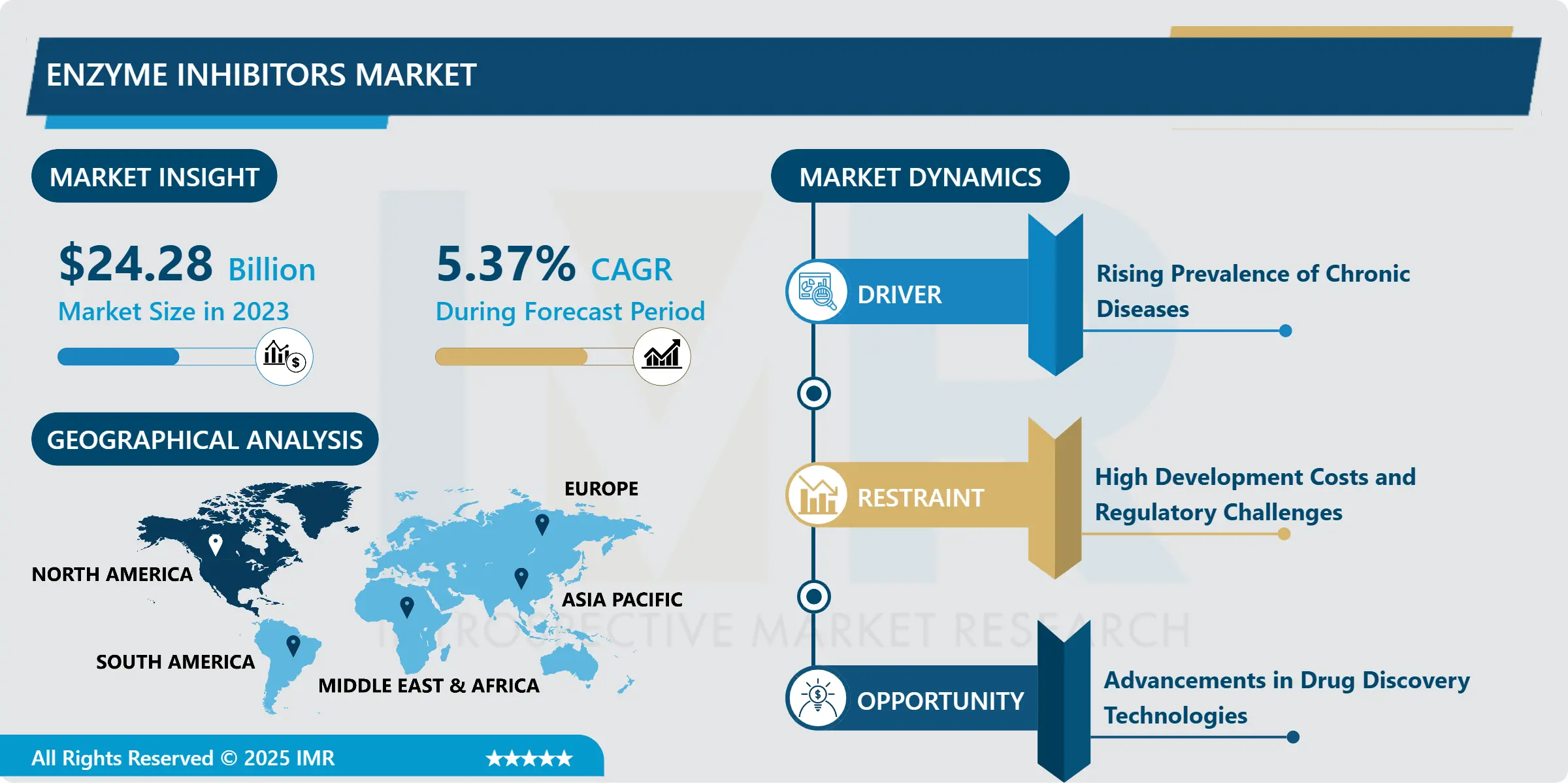
Enzyme Inhibitors Market Size Was Valued at USD 24.28 Billion in 2023, and is Projected to Reach USD 38.9 Billion by 2032, Growing at a CAGR of 5.37% From 2024-2032.

IMR Group
Description
Enzyme Inhibitors Market Synopsis:
Enzyme Inhibitors Market Size Was Valued at USD 24.28 Billion in 2023, and is Projected to Reach USD 38.9 Billion by 2032, Growing at a CAGR of 5.37% From 2024-2032.
Global market for enzyme inhibitors is the business that is involved in the manufacture, research, and supply of chemical substances with capability of preventing enzymatic actions selectively. These inhibitors are important in therapeutic applications especially in diseases such as cancer, cardiovascular disorders and metabolic diseases and also in agriculture and industrial processes.
There is a high growth in enzyme inhibitors market due to increase in pharmaceutical and biotechnology sectors resulting in development of targeted therapies. To note, the drugs that require enzymes inhibitors are used in many chronic diseases, such as cancers, diabetes, and neurological diseases, because of the modulation of biological pathways at the molecular level. The growth incidence of these diseases, alongside the advancements in research and development of pharmaceutical corporations encourages innovativeness.
The market is also experiencing increased research linkages between academia and players in the market in order to broaden knowledge on enzyme mechanisms and disease. Recent advancement in precision medicine, is a therapeutic approach that is based on the individual genetic makeup, has also further enhanced the concept of enzyme inhibitors. This systematic study of kinase inhibitors also highlights that new rich classes of inhibitors like covalent inhibitors and allosteric modulators are opening up new therapeutic opportunities. The introduction of enzyme inhibitors in agriculture for better crop protection and for industrial bioprocessing has made the market diverse in its applications.
Enzyme Inhibitors Market Trend Analysis:
Growth of Covalent Inhibitors
There is a trend towards covalent inhibitors playing a major role as a factor defining the enzyme inhibitors market. Covalent reversible inhibitors are also different from purely reversible inhibitors because the inhibitor becomes permanently attached to the enzymes. Unlike traditional drug discovery and development, this mechanism provides increased effectiveness and has recently found application in the creation of targeted therapies in the oncology industry.
Some of the newest developments in the fields of computational chemistry and structural biology have led to the development of even sharper covalent inhibitors that may suppress off-target effects. Moreover, approval for covalent drugs in last few years has given confidence to market them into clinical practice which in turn has started the interest of pharma companies to invest on covalent drugs.
Expansion in Emerging Markets
There is a great potential for growth in enzyme inhibitors in the emerging markets of Asia-Pacific and Latin America. Rising prevalence of chronic diseases in these regions due to aging population and changes in lifestyle has increase the need for higher level of interventional care. Those countries’ governments raised the healthcare funds and optimize the regulatory requirements for the market Lawn, Speaking of the legislative regulation, modern governments in these regions pump the healthcare funds and simplify the requirements for the market.
The favourable ratio of skilled labour and cheap production centres makes the country more appropriate for MLPs to build manufacturing centres. As seen above, this expansion not only highly benefits local economies but also quickly brings underdeveloped markets access to new treatment.
Enzyme Inhibitors Market Segment Analysis:
Enzyme Inhibitors Market is Segmented on the basis of Type, Application, Drug Type, and Region
By Type, Reversible Inhibitors segment is expected to dominate the market during the forecast period
The enzyme inhibitors market is witnessing significant growth, with reversible inhibitors poised to dominate the segment during the forecast period. Reversible inhibitors are widely preferred due to their ability to bind to enzymes temporarily, enabling precise modulation of enzyme activity without permanent alterations. This feature makes them highly advantageous in pharmaceutical and biotechnology applications, where targeted therapy and safety are paramount.
The increasing demand for reversible inhibitors is driven by their applications in drug development, particularly in the treatment of chronic diseases and cancers. With advancements in enzymology and the growing focus on personalized medicine, the market for reversible inhibitors is expected to expand, positioning them as a key driver in the enzyme inhibitors market, both in research and therapeutic industries.
By Application, Pharmaceuticals segment expected to held the largest share
The enzyme inhibitors market is anticipated to witness substantial growth, with the pharmaceuticals segment projected to hold the largest share. Enzyme inhibitors play a crucial role in the development of therapeutic agents used to treat a variety of diseases, including cancer, cardiovascular disorders, and neurological conditions. As the global healthcare landscape continues to evolve, the increasing prevalence of chronic diseases and the growing demand for targeted therapies are expected to drive the demand for enzyme inhibitors in drug development and clinical applications.
advancements in biotechnology and pharmaceutical research have led to the creation of novel enzyme inhibitors with enhanced efficacy and fewer side effects. This, coupled with a rising focus on precision medicine, is likely to fuel the growth of the pharmaceuticals segment, positioning it as a key driver in the enzyme inhibitors market’s overall expansion.
Enzyme Inhibitors Market Regional Insights:
North America is Expected to Dominate the Market Over the Forecast period
North America is projected to lead the global enzyme inhibitors market during the forecast period, driven by a robust healthcare infrastructure, strong R&D investment, and the presence of major pharmaceutical players. The region benefits from high prevalence rates of chronic diseases such as cancer, cardiovascular conditions, and metabolic disorders, which continue to drive demand for advanced therapeutics involving enzyme inhibition technologies.
Favorable regulatory frameworks, rising adoption of targeted therapies, and increased awareness of precision medicine further contribute to North America’s market dominance. Strategic collaborations and product innovations by key industry stakeholders are accelerating clinical development and commercial expansion, positioning the region as a critical hub for innovation and revenue generation in the global enzyme inhibitors landscape.
Active Key Players in the Enzyme Inhibitors Market:
AbbVie (United States)
Amgen (United States)
AstraZeneca (United Kingdom)
Bayer AG (Germany)
Biogen (United States)
Boehringer Ingelheim (Germany)
Bristol Myers Squibb (United States)
F. Hoffmann-La Roche (Switzerland)
Gilead Sciences (United States)
GlaxoSmithKline (United Kingdom)
Merck & Co. (United States)
Novartis (Switzerland)
Pfizer (United States)
Sanofi (France)
Takeda Pharmaceutical (Japan)
Other Active Players
Chapter 1: Introduction
1.1 Scope and Coverage
Chapter 2:Executive Summary
Chapter 3: Market Landscape
3.1 Market Dynamics
3.1.1 Drivers
3.1.2 Restraints
3.1.3 Opportunities
3.1.4 Challenges
3.2 Market Trend Analysis
3.3 PESTLE Analysis
3.4 Porter’s Five Forces Analysis
3.5 Industry Value Chain Analysis
3.6 Ecosystem
3.7 Regulatory Landscape
3.8 Price Trend Analysis
3.9 Patent Analysis
3.10 Technology Evolution
3.11 Investment Pockets
3.12 Import-Export Analysis
Chapter 4: Enzyme Inhibitors Market by Type
4.1 Enzyme Inhibitors Market Snapshot and Growth Engine
4.2 Enzyme Inhibitors Market Overview
4.3 Reversible Inhibitors
4.3.1 Introduction and Market Overview
4.3.2 Historic and Forecasted Market Size in Value USD and Volume Units (2017-2032F)
4.3.3 Key Market Trends, Growth Factors and Opportunities
4.3.4 Reversible Inhibitors: Geographic Segmentation Analysis
4.4 Irreversible Inhibitors
4.4.1 Introduction and Market Overview
4.4.2 Historic and Forecasted Market Size in Value USD and Volume Units (2017-2032F)
4.4.3 Key Market Trends, Growth Factors and Opportunities
4.4.4 Irreversible Inhibitors: Geographic Segmentation Analysis
Chapter 5: Enzyme Inhibitors Market by Application
5.1 Enzyme Inhibitors Market Snapshot and Growth Engine
5.2 Enzyme Inhibitors Market Overview
5.3 Pharmaceuticals
5.3.1 Introduction and Market Overview
5.3.2 Historic and Forecasted Market Size in Value USD and Volume Units (2017-2032F)
5.3.3 Key Market Trends, Growth Factors and Opportunities
5.3.4 Pharmaceuticals: Geographic Segmentation Analysis
5.4 Agriculture
5.4.1 Introduction and Market Overview
5.4.2 Historic and Forecasted Market Size in Value USD and Volume Units (2017-2032F)
5.4.3 Key Market Trends, Growth Factors and Opportunities
5.4.4 Agriculture: Geographic Segmentation Analysis
5.5 Industrial Processes
5.5.1 Introduction and Market Overview
5.5.2 Historic and Forecasted Market Size in Value USD and Volume Units (2017-2032F)
5.5.3 Key Market Trends, Growth Factors and Opportunities
5.5.4 Industrial Processes: Geographic Segmentation Analysis
Chapter 6: Enzyme Inhibitors Market by Drug Type
6.1 Enzyme Inhibitors Market Snapshot and Growth Engine
6.2 Enzyme Inhibitors Market Overview
6.3 Protease Inhibitors
6.3.1 Introduction and Market Overview
6.3.2 Historic and Forecasted Market Size in Value USD and Volume Units (2017-2032F)
6.3.3 Key Market Trends, Growth Factors and Opportunities
6.3.4 Protease Inhibitors: Geographic Segmentation Analysis
6.4 Kinase Inhibitors
6.4.1 Introduction and Market Overview
6.4.2 Historic and Forecasted Market Size in Value USD and Volume Units (2017-2032F)
6.4.3 Key Market Trends, Growth Factors and Opportunities
6.4.4 Kinase Inhibitors: Geographic Segmentation Analysis
6.5 Lipase Inhibitors
6.5.1 Introduction and Market Overview
6.5.2 Historic and Forecasted Market Size in Value USD and Volume Units (2017-2032F)
6.5.3 Key Market Trends, Growth Factors and Opportunities
6.5.4 Lipase Inhibitors: Geographic Segmentation Analysis
6.6 Others
6.6.1 Introduction and Market Overview
6.6.2 Historic and Forecasted Market Size in Value USD and Volume Units (2017-2032F)
6.6.3 Key Market Trends, Growth Factors and Opportunities
6.6.4 Others: Geographic Segmentation Analysis
Chapter 7: Company Profiles and Competitive Analysis
7.1 Competitive Landscape
7.1.1 Competitive Benchmarking
7.1.2 Enzyme Inhibitors Market Share by Manufacturer (2023)
7.1.3 Industry BCG Matrix
7.1.4 Heat Map Analysis
7.1.5 Mergers and Acquisitions
7.2 ABBVIE
7.2.1 Company Overview
7.2.2 Key Executives
7.2.3 Company Snapshot
7.2.4 Role of the Company in the Market
7.2.5 Sustainability and Social Responsibility
7.2.6 Operating Business Segments
7.2.7 Product Portfolio
7.2.8 Business Performance
7.2.9 Key Strategic Moves and Recent Developments
7.2.10 SWOT Analysis
7.3 AMGEN
7.4 ASTRAZENECA
7.5 BAYER AG
7.6 BIOGEN
7.7 BOEHRINGER INGELHEIM
7.8 BRISTOL MYERS SQUIBB
7.9 F. HOFFMANN-LA ROCHE
7.10 GILEAD SCIENCES
7.11 GLAXOSMITHKLINE
7.12 MERCK & CO.
7.13 NOVARTIS
7.14 PFIZER
7.15 SANOFI
7.16 TAKEDA PHARMACEUTICAL
7.17 OTHER ACTIVE PLAYERS
Chapter 8: Global Enzyme Inhibitors Market By Region
8.1 Overview
8.2. North America Enzyme Inhibitors Market
8.2.1 Key Market Trends, Growth Factors and Opportunities
8.2.2 Top Key Companies
8.2.3 Historic and Forecasted Market Size by Segments
8.2.4 Historic and Forecasted Market Size By Type
8.2.4.1 Reversible Inhibitors
8.2.4.2 Irreversible Inhibitors
8.2.5 Historic and Forecasted Market Size By Application
8.2.5.1 Pharmaceuticals
8.2.5.2 Agriculture
8.2.5.3 Industrial Processes
8.2.6 Historic and Forecasted Market Size By Drug Type
8.2.6.1 Protease Inhibitors
8.2.6.2 Kinase Inhibitors
8.2.6.3 Lipase Inhibitors
8.2.6.4 Others
8.2.7 Historic and Forecast Market Size by Country
8.2.7.1 US
8.2.7.2 Canada
8.2.7.3 Mexico
8.3. Eastern Europe Enzyme Inhibitors Market
8.3.1 Key Market Trends, Growth Factors and Opportunities
8.3.2 Top Key Companies
8.3.3 Historic and Forecasted Market Size by Segments
8.3.4 Historic and Forecasted Market Size By Type
8.3.4.1 Reversible Inhibitors
8.3.4.2 Irreversible Inhibitors
8.3.5 Historic and Forecasted Market Size By Application
8.3.5.1 Pharmaceuticals
8.3.5.2 Agriculture
8.3.5.3 Industrial Processes
8.3.6 Historic and Forecasted Market Size By Drug Type
8.3.6.1 Protease Inhibitors
8.3.6.2 Kinase Inhibitors
8.3.6.3 Lipase Inhibitors
8.3.6.4 Others
8.3.7 Historic and Forecast Market Size by Country
8.3.7.1 Russia
8.3.7.2 Bulgaria
8.3.7.3 The Czech Republic
8.3.7.4 Hungary
8.3.7.5 Poland
8.3.7.6 Romania
8.3.7.7 Rest of Eastern Europe
8.4. Western Europe Enzyme Inhibitors Market
8.4.1 Key Market Trends, Growth Factors and Opportunities
8.4.2 Top Key Companies
8.4.3 Historic and Forecasted Market Size by Segments
8.4.4 Historic and Forecasted Market Size By Type
8.4.4.1 Reversible Inhibitors
8.4.4.2 Irreversible Inhibitors
8.4.5 Historic and Forecasted Market Size By Application
8.4.5.1 Pharmaceuticals
8.4.5.2 Agriculture
8.4.5.3 Industrial Processes
8.4.6 Historic and Forecasted Market Size By Drug Type
8.4.6.1 Protease Inhibitors
8.4.6.2 Kinase Inhibitors
8.4.6.3 Lipase Inhibitors
8.4.6.4 Others
8.4.7 Historic and Forecast Market Size by Country
8.4.7.1 Germany
8.4.7.2 UK
8.4.7.3 France
8.4.7.4 The Netherlands
8.4.7.5 Italy
8.4.7.6 Spain
8.4.7.7 Rest of Western Europe
8.5. Asia Pacific Enzyme Inhibitors Market
8.5.1 Key Market Trends, Growth Factors and Opportunities
8.5.2 Top Key Companies
8.5.3 Historic and Forecasted Market Size by Segments
8.5.4 Historic and Forecasted Market Size By Type
8.5.4.1 Reversible Inhibitors
8.5.4.2 Irreversible Inhibitors
8.5.5 Historic and Forecasted Market Size By Application
8.5.5.1 Pharmaceuticals
8.5.5.2 Agriculture
8.5.5.3 Industrial Processes
8.5.6 Historic and Forecasted Market Size By Drug Type
8.5.6.1 Protease Inhibitors
8.5.6.2 Kinase Inhibitors
8.5.6.3 Lipase Inhibitors
8.5.6.4 Others
8.5.7 Historic and Forecast Market Size by Country
8.5.7.1 China
8.5.7.2 India
8.5.7.3 Japan
8.5.7.4 South Korea
8.5.7.5 Malaysia
8.5.7.6 Thailand
8.5.7.7 Vietnam
8.5.7.8 The Philippines
8.5.7.9 Australia
8.5.7.10 New Zealand
8.5.7.11 Rest of APAC
8.6. Middle East & Africa Enzyme Inhibitors Market
8.6.1 Key Market Trends, Growth Factors and Opportunities
8.6.2 Top Key Companies
8.6.3 Historic and Forecasted Market Size by Segments
8.6.4 Historic and Forecasted Market Size By Type
8.6.4.1 Reversible Inhibitors
8.6.4.2 Irreversible Inhibitors
8.6.5 Historic and Forecasted Market Size By Application
8.6.5.1 Pharmaceuticals
8.6.5.2 Agriculture
8.6.5.3 Industrial Processes
8.6.6 Historic and Forecasted Market Size By Drug Type
8.6.6.1 Protease Inhibitors
8.6.6.2 Kinase Inhibitors
8.6.6.3 Lipase Inhibitors
8.6.6.4 Others
8.6.7 Historic and Forecast Market Size by Country
8.6.7.1 Turkiye
8.6.7.2 Bahrain
8.6.7.3 Kuwait
8.6.7.4 Saudi Arabia
8.6.7.5 Qatar
8.6.7.6 UAE
8.6.7.7 Israel
8.6.7.8 South Africa
8.7. South America Enzyme Inhibitors Market
8.7.1 Key Market Trends, Growth Factors and Opportunities
8.7.2 Top Key Companies
8.7.3 Historic and Forecasted Market Size by Segments
8.7.4 Historic and Forecasted Market Size By Type
8.7.4.1 Reversible Inhibitors
8.7.4.2 Irreversible Inhibitors
8.7.5 Historic and Forecasted Market Size By Application
8.7.5.1 Pharmaceuticals
8.7.5.2 Agriculture
8.7.5.3 Industrial Processes
8.7.6 Historic and Forecasted Market Size By Drug Type
8.7.6.1 Protease Inhibitors
8.7.6.2 Kinase Inhibitors
8.7.6.3 Lipase Inhibitors
8.7.6.4 Others
8.7.7 Historic and Forecast Market Size by Country
8.7.7.1 Brazil
8.7.7.2 Argentina
8.7.7.3 Rest of SA
Chapter 9 Analyst Viewpoint and Conclusion
9.1 Recommendations and Concluding Analysis
9.2 Potential Market Strategies
Chapter 10 Research Methodology
10.1 Research Process
10.2 Primary Research
10.3 Secondary Research
Q1: What would be the forecast period in the Enzyme Inhibitors Market research report?
A1: The forecast period in the Enzyme Inhibitors Market research report is 2024-2032.
Q2: Who are the key players in the Enzyme Inhibitors Market?
A2: AbbVie (United States), Amgen (United States), AstraZeneca (United Kingdom), Bayer AG (Germany), Biogen (United States), Boehringer Ingelheim (Germany), Bristol Myers Squibb (United States), F. Hoffmann-La Roche (Switzerland), Gilead Sciences (United States), GlaxoSmithKline (United Kingdom), Merck & Co. (United States), Novartis (Switzerland), Pfizer (United States), Sanofi (France), Takeda Pharmaceutical (Japan), and Other Active Players.
Q3: What are the segments of the Enzyme Inhibitors Market?
A3: The Enzyme Inhibitors Market is segmented into Type, Application, Drug type and Region. By Type, the market is categorized into (Reversible Inhibitors, Irreversible Inhibitors), Application the market is categorized into (Pharmaceuticals, Agriculture, Industrial Processes), by Drug Type, the market is categorized into (Protease Inhibitors, Kinase Inhibitors, Lipase Inhibitors, Others). By Region, it is analyzed across North America (U.S., Canada, Mexico),Eastern Europe (Russia, Bulgaria, The Czech Republic, Hungary, Poland, Romania, Rest of Eastern Europe),Western Europe (Germany, UK, France, Netherlands, Italy, Spain, Rest of Western Europe),Asia Pacific (China, India, Japan, South Korea, Malaysia, Thailand, Vietnam, The Philippines, Australia, New-Zealand, Rest of APAC),Middle East & Africa (Turkiye, Bahrain, Kuwait, Saudi Arabia, Qatar, UAE, Israel, South Africa),South America (Brazil, Argentina, Rest of SA).
Q4: What is the Enzyme Inhibitors Market?
A4: Global market for enzyme inhibitors is the business that is involved in the manufacture, research, and supply of chemical substances with capability of preventing enzymatic actions selectively. These inhibitors are important in therapeutic applications especially in diseases such as cancer, cardiovascular disorders and metabolic diseases and also in agriculture and industrial processes.
Q5: How big is the Enzyme Inhibitors Market?
A5: Enzyme Inhibitors Market Size Was Valued at USD 24.28 Billion in 2023, and is Projected to Reach USD 38.9 Billion by 2032, Growing at a CAGR of 5.37% From 2024-2032.
How to Buy a Report from eminsights.jp
On the product page, choose the license you want: Single-User License, Multi-User License or Enterprise License.
If you required report in your native language, then you can click on Translated Report button and fill out the form with report name and language you want, then our team will contact you as soon as possible.
Click the Buy Now button.
You will be redirected to the checkout page. Enter your company details and payment information.
Click Place Order to complete the purchase.
Confirmation: You’ll receive an order confirmation and our team will contact you shortly with your ordered report.
If you have any questions, fill out the contact form below or email us at [email protected].
Thank you for choosing eminsights.jp!