Stay Ahead in Fast-Growing Economies.
Browse Reports Now




Adaptive Clothing Market Insights, Dynamics, and Growth Forecast (2024-2032)
Adaptive clothing is clothing that has been designed for people with certain disabilities as well as seniors. These garments are designed with the concept of need for comfort and convenience for the wearer through details like Velcro instead of zippers, magnetic buttons instead of metal zippers, elastic bottom and back as well as consideration for use of fabrics friendly to the touch sensation.

IMR Group
Description
Adaptive Clothing Market Synopsis:
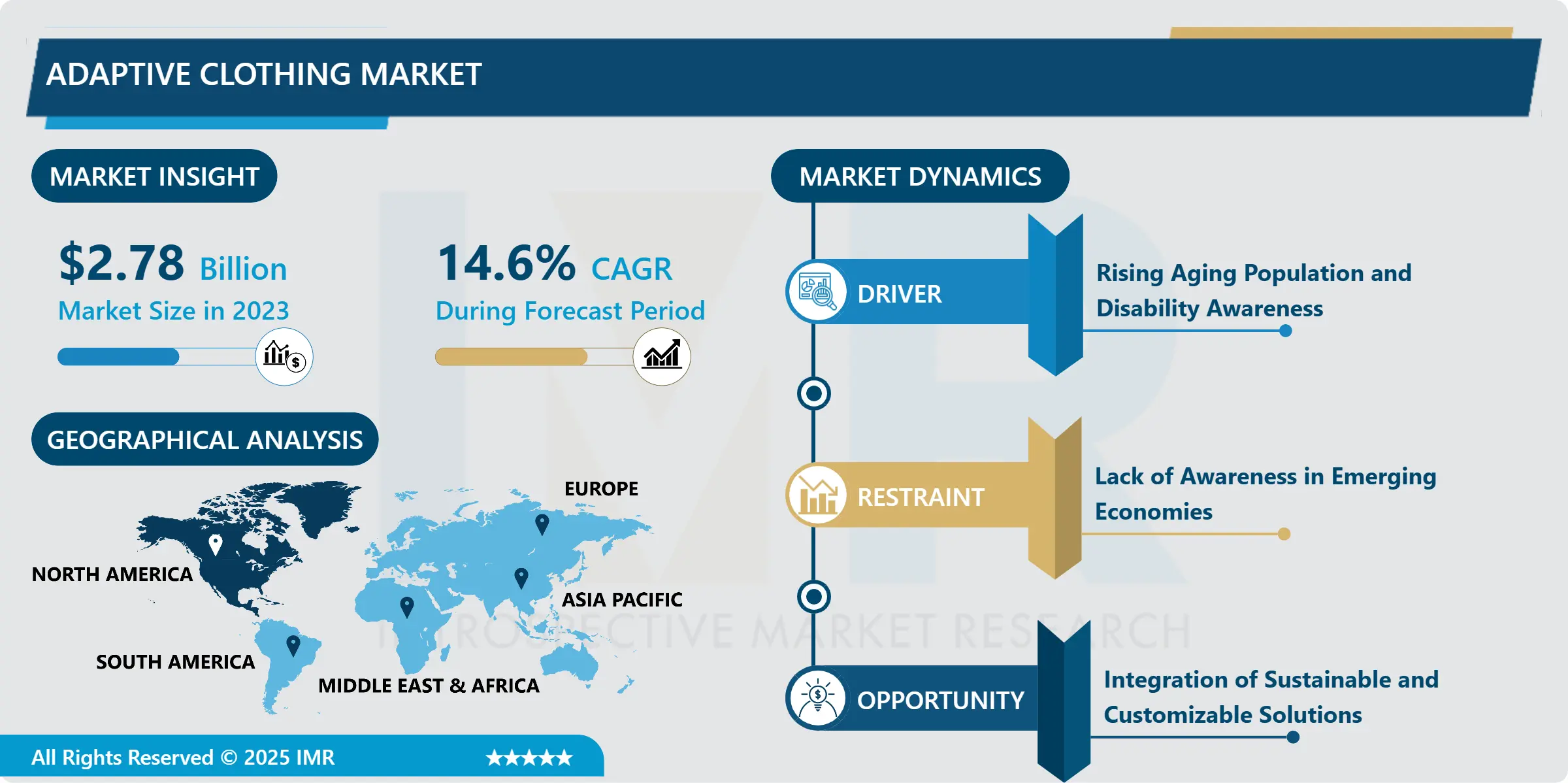
Adaptive Clothing Market Size Was Valued at USD 2.78 Billion in 2023, and is Projected to Reach USD 9.49 Billion by 2032, Growing at a CAGR of 14.60% From 2024-2032.
Adaptive clothing is clothing that has been designed for people with certain disabilities as well as seniors. These garments are designed with the concept of need for comfort and convenience for the wearer through details like Velcro instead of zippers, magnetic buttons instead of metal zippers, elastic bottom and back as well as consideration for use of fabrics friendly to the touch sensation. Courage: The purpose is to give more independence and dignity to the person wearing the product and/or create a piece that responds to the individual’s requirements.
Adaptive clothing market is fostered by the niche shift towards fashion inclusiveness. Since the population of the world is growing older and people start paying much attention to disability, there is a growing demand for clothes for people with different physical and mental disabilities. Advancements in garments technology in conjunction with increased conscious efforts at creating disability friendly environment has enhanced the use of adaptive wear across the strata. Besides, social organizations and non-governmental advocating for universal design in daily use have also contributed to the increasing popularity of these products.
Another important factor is technological factors namely technological developments have been another decisive fact. The use of stretchable fabrics, moisture wear fabrics as well as magnetic closure has not only improved the utility of the adaptive wear but also the style quotient. Together with the growth of e-commerce, the consumption segment has become more diverse and that in turn contributes to the market growth.
Adaptive Clothing Market Trend Analysis:
A Paradigm Shift to Inclusion for Fashion
The adaptive clothing market is closely observing the change that is being registered in the fashion world where many internationally acclaimed brands are adopting diverse sizes of clothes. As the pandemic continues, more businesses are designing chic garments that are both comfortable and practical. This trend has assisted in demystifying stigma and increasing social perception as a functional aspect of apparel to the greater audience.
There has also been differentiation as a theme, so that several brands present persons with options that suit their wants. Also, there is an upsurge towards the increased incorporation of sustainability, where most manufacturing companies are incorporating environmentally friendly materials, and methods in their production to fit the global embracing sustainable environment and consumers.
E-Commerce Expansion
That is why the development of e-commerce can be regarded as a rather important opportunity for the market of adaptive clothing. Internet allows brands to target areas that are not served adequately and help consumers find many variations of adaptive wear goods. More so, with most businesses incorporating features like AR in analyzing the dimension and size of a product that is to be purchases online, there is increased chance of going for an online shopping. In a broader sense, there are widely discussing Emerging Markets within the Asia-Pacific countries, but the scope of such a discussion is beyond the case.
they remain unsaturated due to the huge population base in the Asia-Pacific region, increasing disposable income as well as improved consciousness of adaptive wear. Measures being taken by the government to provide accessibility and inclusion for the differently abled also open door for business to venture out into this burgeoning market.
Adaptive Clothing Market Segment Analysis:
Adaptive Clothing Market is Segmented on the basis of Type, Material, Application, End User, and Region.
By Type, Adaptive Tops segment is expected to dominate the market during the forecast period
Adaptive clothing can be divided into different types of adaptive clothing for individual use and purpose. Wear to work upper bodies, lower bodies, and outer clothes are most comfortable and convenient to wear with magnetic buttons or Velcro. Adaptation measures are incorporated in the design of the footwear in form of adjustable straps and slip resistant soles. Clothing that touches the skin directly avoids materials that may cause itchiness and the seams are well hidden. There are also other minor requirements such as adaptive belts and gloves that mean patrons with disability or mobility problems have functional and fashionable clothing.
By Application, Physical Disabilities segment expected to held the largest share
Adaptive clothing is well suited to three major classifications of use. For physical disabilities the emphasis is on comfort with a design that allows the person to put on and take off the garment independently. People with cognitive disability disparities need products with limited impact and cause sensations of discomfort; loose and smooth clothes. The disabled or persons with the restricted mobility form – the elderly or aging benefits from adaptive clothing because it makes the clothes fully functional without compromising the looks or the privacy and dignity of the wearer.
Adaptive Clothing Market Regional Insights:
North America is Expected to Dominate the Market Over the Forecast period
The North American adaptive clothing market, which accounts for 40% of the global revenue, is extending its category fashion products for the elderly and disablety people with a willingness to embrace diversity. The United States is leading this growth with the help of innovations in garment technology such as magnetic fastenings and sensory friendly fabrics. Enhanced consumers’ awareness of accessible fashion and sound e-commerce platforms have triggered an increase in the availability of adaptive garments for consumers. Today’s representatives in the area focus on the functional and aesthetic solutions for as many aspects of mobility and sensitivity as possible.
Canada and Mexico are also proved to be important in this market contribution, where Canada has the advantage in governmental and society support for people with impairments and Mexico has the constant increase because of the growing awareness. It is established that charitable organisations and advocacy groups are key in the promotion of Adaptive apparel in the region. Having considered this, North America is poised for long term growth in adaptive clothing due to the arrival of the concept of inclusion in mainstream markets.
Active Key Players in the Adaptive Clothing Market
Able2Wear (United Kingdom)
Adaptations by Adrian (United States)
Buck & Buck (United States)
Creation Confort (France)
Izzy Camilleri Adaptive Clothing (Canada)
Lycra Company (United States)
NBZ Apparel International (United States)
Professional Fit Clothing (United States)
PVH Corp. (United States)
Silvert’s Adaptive Clothing & Footwear (Canada)
Other Active Players.
Chapter 1: Introduction
1.1 Scope and Coverage
Chapter 2:Executive Summary
Chapter 3: Market Landscape
3.1 Market Dynamics
3.1.1 Drivers
3.1.2 Restraints
3.1.3 Opportunities
3.1.4 Challenges
3.2 Market Trend Analysis
3.3 PESTLE Analysis
3.4 Porter’s Five Forces Analysis
3.5 Industry Value Chain Analysis
3.6 Ecosystem
3.7 Regulatory Landscape
3.8 Price Trend Analysis
3.9 Patent Analysis
3.10 Technology Evolution
3.11 Investment Pockets
3.12 Import-Export Analysis
Chapter 4: Adaptive Clothing Market by Type
4.1 Adaptive Clothing Market Snapshot and Growth Engine
4.2 Adaptive Clothing Market Overview
4.3 Adaptive Tops
4.3.1 Introduction and Market Overview
4.3.2 Historic and Forecasted Market Size in Value USD and Volume Units (2017-2032F)
4.3.3 Key Market Trends, Growth Factors and Opportunities
4.3.4 Adaptive Tops: Geographic Segmentation Analysis
4.4 Adaptive Bottoms
4.4.1 Introduction and Market Overview
4.4.2 Historic and Forecasted Market Size in Value USD and Volume Units (2017-2032F)
4.4.3 Key Market Trends, Growth Factors and Opportunities
4.4.4 Adaptive Bottoms: Geographic Segmentation Analysis
4.5 Adaptive Outerwear
4.5.1 Introduction and Market Overview
4.5.2 Historic and Forecasted Market Size in Value USD and Volume Units (2017-2032F)
4.5.3 Key Market Trends, Growth Factors and Opportunities
4.5.4 Adaptive Outerwear: Geographic Segmentation Analysis
4.6 Adaptive Footwear
4.6.1 Introduction and Market Overview
4.6.2 Historic and Forecasted Market Size in Value USD and Volume Units (2017-2032F)
4.6.3 Key Market Trends, Growth Factors and Opportunities
4.6.4 Adaptive Footwear: Geographic Segmentation Analysis
4.7 Adaptive Undergarments
4.7.1 Introduction and Market Overview
4.7.2 Historic and Forecasted Market Size in Value USD and Volume Units (2017-2032F)
4.7.3 Key Market Trends, Growth Factors and Opportunities
4.7.4 Adaptive Undergarments: Geographic Segmentation Analysis
4.8 Adaptive Accessories
4.8.1 Introduction and Market Overview
4.8.2 Historic and Forecasted Market Size in Value USD and Volume Units (2017-2032F)
4.8.3 Key Market Trends, Growth Factors and Opportunities
4.8.4 Adaptive Accessories: Geographic Segmentation Analysis
Chapter 5: Adaptive Clothing Market by Material
5.1 Adaptive Clothing Market Snapshot and Growth Engine
5.2 Adaptive Clothing Market Overview
5.3 Cotton
5.3.1 Introduction and Market Overview
5.3.2 Historic and Forecasted Market Size in Value USD and Volume Units (2017-2032F)
5.3.3 Key Market Trends, Growth Factors and Opportunities
5.3.4 Cotton: Geographic Segmentation Analysis
5.4 Polyester
5.4.1 Introduction and Market Overview
5.4.2 Historic and Forecasted Market Size in Value USD and Volume Units (2017-2032F)
5.4.3 Key Market Trends, Growth Factors and Opportunities
5.4.4 Polyester: Geographic Segmentation Analysis
5.5 Nylon
5.5.1 Introduction and Market Overview
5.5.2 Historic and Forecasted Market Size in Value USD and Volume Units (2017-2032F)
5.5.3 Key Market Trends, Growth Factors and Opportunities
5.5.4 Nylon: Geographic Segmentation Analysis
5.6 Others
5.6.1 Introduction and Market Overview
5.6.2 Historic and Forecasted Market Size in Value USD and Volume Units (2017-2032F)
5.6.3 Key Market Trends, Growth Factors and Opportunities
5.6.4 Others: Geographic Segmentation Analysis
Chapter 6: Adaptive Clothing Market by Application
6.1 Adaptive Clothing Market Snapshot and Growth Engine
6.2 Adaptive Clothing Market Overview
6.3 Physical Disabilities
6.3.1 Introduction and Market Overview
6.3.2 Historic and Forecasted Market Size in Value USD and Volume Units (2017-2032F)
6.3.3 Key Market Trends, Growth Factors and Opportunities
6.3.4 Physical Disabilities: Geographic Segmentation Analysis
6.4 Cognitive Disabilities
6.4.1 Introduction and Market Overview
6.4.2 Historic and Forecasted Market Size in Value USD and Volume Units (2017-2032F)
6.4.3 Key Market Trends, Growth Factors and Opportunities
6.4.4 Cognitive Disabilities: Geographic Segmentation Analysis
6.5 Elderly/ Aging Population
6.5.1 Introduction and Market Overview
6.5.2 Historic and Forecasted Market Size in Value USD and Volume Units (2017-2032F)
6.5.3 Key Market Trends, Growth Factors and Opportunities
6.5.4 Elderly/ Aging Population: Geographic Segmentation Analysis
Chapter 7: Adaptive Clothing Market by End User
7.1 Adaptive Clothing Market Snapshot and Growth Engine
7.2 Adaptive Clothing Market Overview
7.3 Men
7.3.1 Introduction and Market Overview
7.3.2 Historic and Forecasted Market Size in Value USD and Volume Units (2017-2032F)
7.3.3 Key Market Trends, Growth Factors and Opportunities
7.3.4 Men: Geographic Segmentation Analysis
7.4 Women
7.4.1 Introduction and Market Overview
7.4.2 Historic and Forecasted Market Size in Value USD and Volume Units (2017-2032F)
7.4.3 Key Market Trends, Growth Factors and Opportunities
7.4.4 Women: Geographic Segmentation Analysis
7.5 Children
7.5.1 Introduction and Market Overview
7.5.2 Historic and Forecasted Market Size in Value USD and Volume Units (2017-2032F)
7.5.3 Key Market Trends, Growth Factors and Opportunities
7.5.4 Children: Geographic Segmentation Analysis
Chapter 8: Company Profiles and Competitive Analysis
8.1 Competitive Landscape
8.1.1 Competitive Benchmarking
8.1.2 Adaptive Clothing Market Share by Manufacturer (2023)
8.1.3 Industry BCG Matrix
8.1.4 Heat Map Analysis
8.1.5 Mergers and Acquisitions
8.2 SILVERT’S ADAPTIVE CLOTHING & FOOTWEAR (CANADA)
8.2.1 Company Overview
8.2.2 Key Executives
8.2.3 Company Snapshot
8.2.4 Role of the Company in the Market
8.2.5 Sustainability and Social Responsibility
8.2.6 Operating Business Segments
8.2.7 Product Portfolio
8.2.8 Business Performance
8.2.9 Key Strategic Moves and Recent Developments
8.2.10 SWOT Analysis
8.3 IZZY CAMILLERI ADAPTIVE CLOTHING (CANADA)
8.4 NBZ APPAREL INTERNATIONAL (UNITED STATES)
8.5 ABLE2WEAR (UNITED KINGDOM)
8.6 ADAPTATIONS BY ADRIAN (UNITED STATES)
8.7 PROFESSIONAL FIT CLOTHING (UNITED STATES)
8.8 CREATION CONFORT (FRANCE)BUCK & BUCK (UNITED STATES)
8.9 PVH CORP. (UNITED STATES)
8.10 LYCRA COMPANY (UNITED STATES)
8.11 OTHER ACTIVE PLAYERS
Chapter 9: Global Adaptive Clothing Market By Region
9.1 Overview
9.2. North America Adaptive Clothing Market
9.2.1 Key Market Trends, Growth Factors and Opportunities
9.2.2 Top Key Companies
9.2.3 Historic and Forecasted Market Size by Segments
9.2.4 Historic and Forecasted Market Size By Type
9.2.4.1 Adaptive Tops
9.2.4.2 Adaptive Bottoms
9.2.4.3 Adaptive Outerwear
9.2.4.4 Adaptive Footwear
9.2.4.5 Adaptive Undergarments
9.2.4.6 Adaptive Accessories
9.2.5 Historic and Forecasted Market Size By Material
9.2.5.1 Cotton
9.2.5.2 Polyester
9.2.5.3 Nylon
9.2.5.4 Others
9.2.6 Historic and Forecasted Market Size By Application
9.2.6.1 Physical Disabilities
9.2.6.2 Cognitive Disabilities
9.2.6.3 Elderly/ Aging Population
9.2.7 Historic and Forecasted Market Size By End User
9.2.7.1 Men
9.2.7.2 Women
9.2.7.3 Children
9.2.8 Historic and Forecast Market Size by Country
9.2.8.1 US
9.2.8.2 Canada
9.2.8.3 Mexico
9.3. Eastern Europe Adaptive Clothing Market
9.3.1 Key Market Trends, Growth Factors and Opportunities
9.3.2 Top Key Companies
9.3.3 Historic and Forecasted Market Size by Segments
9.3.4 Historic and Forecasted Market Size By Type
9.3.4.1 Adaptive Tops
9.3.4.2 Adaptive Bottoms
9.3.4.3 Adaptive Outerwear
9.3.4.4 Adaptive Footwear
9.3.4.5 Adaptive Undergarments
9.3.4.6 Adaptive Accessories
9.3.5 Historic and Forecasted Market Size By Material
9.3.5.1 Cotton
9.3.5.2 Polyester
9.3.5.3 Nylon
9.3.5.4 Others
9.3.6 Historic and Forecasted Market Size By Application
9.3.6.1 Physical Disabilities
9.3.6.2 Cognitive Disabilities
9.3.6.3 Elderly/ Aging Population
9.3.7 Historic and Forecasted Market Size By End User
9.3.7.1 Men
9.3.7.2 Women
9.3.7.3 Children
9.3.8 Historic and Forecast Market Size by Country
9.3.8.1 Russia
9.3.8.2 Bulgaria
9.3.8.3 The Czech Republic
9.3.8.4 Hungary
9.3.8.5 Poland
9.3.8.6 Romania
9.3.8.7 Rest of Eastern Europe
9.4. Western Europe Adaptive Clothing Market
9.4.1 Key Market Trends, Growth Factors and Opportunities
9.4.2 Top Key Companies
9.4.3 Historic and Forecasted Market Size by Segments
9.4.4 Historic and Forecasted Market Size By Type
9.4.4.1 Adaptive Tops
9.4.4.2 Adaptive Bottoms
9.4.4.3 Adaptive Outerwear
9.4.4.4 Adaptive Footwear
9.4.4.5 Adaptive Undergarments
9.4.4.6 Adaptive Accessories
9.4.5 Historic and Forecasted Market Size By Material
9.4.5.1 Cotton
9.4.5.2 Polyester
9.4.5.3 Nylon
9.4.5.4 Others
9.4.6 Historic and Forecasted Market Size By Application
9.4.6.1 Physical Disabilities
9.4.6.2 Cognitive Disabilities
9.4.6.3 Elderly/ Aging Population
9.4.7 Historic and Forecasted Market Size By End User
9.4.7.1 Men
9.4.7.2 Women
9.4.7.3 Children
9.4.8 Historic and Forecast Market Size by Country
9.4.8.1 Germany
9.4.8.2 UK
9.4.8.3 France
9.4.8.4 The Netherlands
9.4.8.5 Italy
9.4.8.6 Spain
9.4.8.7 Rest of Western Europe
9.5. Asia Pacific Adaptive Clothing Market
9.5.1 Key Market Trends, Growth Factors and Opportunities
9.5.2 Top Key Companies
9.5.3 Historic and Forecasted Market Size by Segments
9.5.4 Historic and Forecasted Market Size By Type
9.5.4.1 Adaptive Tops
9.5.4.2 Adaptive Bottoms
9.5.4.3 Adaptive Outerwear
9.5.4.4 Adaptive Footwear
9.5.4.5 Adaptive Undergarments
9.5.4.6 Adaptive Accessories
9.5.5 Historic and Forecasted Market Size By Material
9.5.5.1 Cotton
9.5.5.2 Polyester
9.5.5.3 Nylon
9.5.5.4 Others
9.5.6 Historic and Forecasted Market Size By Application
9.5.6.1 Physical Disabilities
9.5.6.2 Cognitive Disabilities
9.5.6.3 Elderly/ Aging Population
9.5.7 Historic and Forecasted Market Size By End User
9.5.7.1 Men
9.5.7.2 Women
9.5.7.3 Children
9.5.8 Historic and Forecast Market Size by Country
9.5.8.1 China
9.5.8.2 India
9.5.8.3 Japan
9.5.8.4 South Korea
9.5.8.5 Malaysia
9.5.8.6 Thailand
9.5.8.7 Vietnam
9.5.8.8 The Philippines
9.5.8.9 Australia
9.5.8.10 New Zealand
9.5.8.11 Rest of APAC
9.6. Middle East & Africa Adaptive Clothing Market
9.6.1 Key Market Trends, Growth Factors and Opportunities
9.6.2 Top Key Companies
9.6.3 Historic and Forecasted Market Size by Segments
9.6.4 Historic and Forecasted Market Size By Type
9.6.4.1 Adaptive Tops
9.6.4.2 Adaptive Bottoms
9.6.4.3 Adaptive Outerwear
9.6.4.4 Adaptive Footwear
9.6.4.5 Adaptive Undergarments
9.6.4.6 Adaptive Accessories
9.6.5 Historic and Forecasted Market Size By Material
9.6.5.1 Cotton
9.6.5.2 Polyester
9.6.5.3 Nylon
9.6.5.4 Others
9.6.6 Historic and Forecasted Market Size By Application
9.6.6.1 Physical Disabilities
9.6.6.2 Cognitive Disabilities
9.6.6.3 Elderly/ Aging Population
9.6.7 Historic and Forecasted Market Size By End User
9.6.7.1 Men
9.6.7.2 Women
9.6.7.3 Children
9.6.8 Historic and Forecast Market Size by Country
9.6.8.1 Turkiye
9.6.8.2 Bahrain
9.6.8.3 Kuwait
9.6.8.4 Saudi Arabia
9.6.8.5 Qatar
9.6.8.6 UAE
9.6.8.7 Israel
9.6.8.8 South Africa
9.7. South America Adaptive Clothing Market
9.7.1 Key Market Trends, Growth Factors and Opportunities
9.7.2 Top Key Companies
9.7.3 Historic and Forecasted Market Size by Segments
9.7.4 Historic and Forecasted Market Size By Type
9.7.4.1 Adaptive Tops
9.7.4.2 Adaptive Bottoms
9.7.4.3 Adaptive Outerwear
9.7.4.4 Adaptive Footwear
9.7.4.5 Adaptive Undergarments
9.7.4.6 Adaptive Accessories
9.7.5 Historic and Forecasted Market Size By Material
9.7.5.1 Cotton
9.7.5.2 Polyester
9.7.5.3 Nylon
9.7.5.4 Others
9.7.6 Historic and Forecasted Market Size By Application
9.7.6.1 Physical Disabilities
9.7.6.2 Cognitive Disabilities
9.7.6.3 Elderly/ Aging Population
9.7.7 Historic and Forecasted Market Size By End User
9.7.7.1 Men
9.7.7.2 Women
9.7.7.3 Children
9.7.8 Historic and Forecast Market Size by Country
9.7.8.1 Brazil
9.7.8.2 Argentina
9.7.8.3 Rest of SA
Chapter 10 Analyst Viewpoint and Conclusion
10.1 Recommendations and Concluding Analysis
10.2 Potential Market Strategies
Chapter 11 Research Methodology
11.1 Research Process
11.2 Primary Research
11.3 Secondary Research
Q1: What would be the forecast period in the Adaptive Clothing Market research report?
A1: The forecast period in the Adaptive Clothing Market research report is 2024-2032.
Q2: Who are the key players in the Adaptive Clothing Market?
A2: Able2Wear (United Kingdom), Adaptations by Adrian (United States), Buck & Buck (United States), Creation Confort (France), Izzy Camilleri Adaptive Clothing (Canada), Lycra Company (United States), NBZ Apparel International (United States), Professional Fit Clothing (United States), PVH Corp. (United States), Silvert’s Adaptive Clothing & Footwear (Canada), Other Active Players.
Q3: What are the segments of the Adaptive Clothing Market?
A3: The Adaptive Clothing Market is segmented into by Type (Adaptive Tops, Adaptive Bottoms, Adaptive Outerwear, Adaptive Footwear, Adaptive Undergarments, Adaptive Accessories), Material (Cotton, Polyester, Nylon, Others), Application (Physical Disabilities, Cognitive Disabilities, Elderly/ Aging Population), End User (Men, Women, Children). By region, it is analyzed across North America (U.S., Canada, Mexico), Eastern Europe (Russia, Bulgaria, The Czech Republic, Hungary, Poland, Romania, Rest of Eastern Europe), Western Europe (Germany, UK, France, The Netherlands, Italy, Russia, Spain, Rest of Western Europe), Asia Pacific (China, India, Japan, South Korea, Malaysia, Thailand, Vietnam, The Philippines, Australia, New-Zealand, Rest of APAC), Middle East & Africa (Turkiye, Bahrain, Kuwait, Saudi Arabia, Qatar, UAE, Israel, South Africa), South America (Brazil, Argentina, Rest of SA).
Q4: What is the Adaptive Clothing Market?
A4: Adaptive clothing is clothing that has been designed for people with certain disabilities as well as seniors. These garments are designed with the concept of need for comfort and convenience for the wearer through details like Velcro instead of zippers, magnetic buttons instead of metal zippers, elastic bottom and back as well as consideration for use of fabrics friendly to the touch sensation. Courage: The purpose is to give more independence and dignity to the person wearing the product and/or create a piece that responds to the individual’s requirements.
Q5: How big is the Adaptive Clothing Market?
A5: Adaptive Clothing Market Size Was Valued at USD 2.78 Billion in 2023, and is Projected to Reach USD 9.49 Billion by 2032, Growing at a CAGR of 14.60% From 2024-2032.
How to Buy a Report from eminsights.jp
On the product page, choose the license you want: Single-User License, Multi-User License or Enterprise License.
If you required report in your native language, then you can click on Translated Report button and fill out the form with report name and language you want, then our team will contact you as soon as possible.
Click the Buy Now button.
You will be redirected to the checkout page. Enter your company details and payment information.
Click Place Order to complete the purchase.
Confirmation: You’ll receive an order confirmation and our team will contact you shortly with your ordered report.
If you have any questions, fill out the contact form below or email us at [email protected].
Thank you for choosing eminsights.jp!