Stay Ahead in Fast-Growing Economies.
Browse Reports Now
Congenital Hyperinsulinism Treatment Market Trends, Analysis & Future Outlook (2024-2032)
Congenital Hyperinsulinism (CHI) is a severe disease with an incidence of one per 25 000 live births in which the pancreas produces too much insulin and does not permit the blood-glucose concentration to rise above a certain level.

IMR Group
Description
Congenital Hyperinsulinism Treatment Market Synopsis:
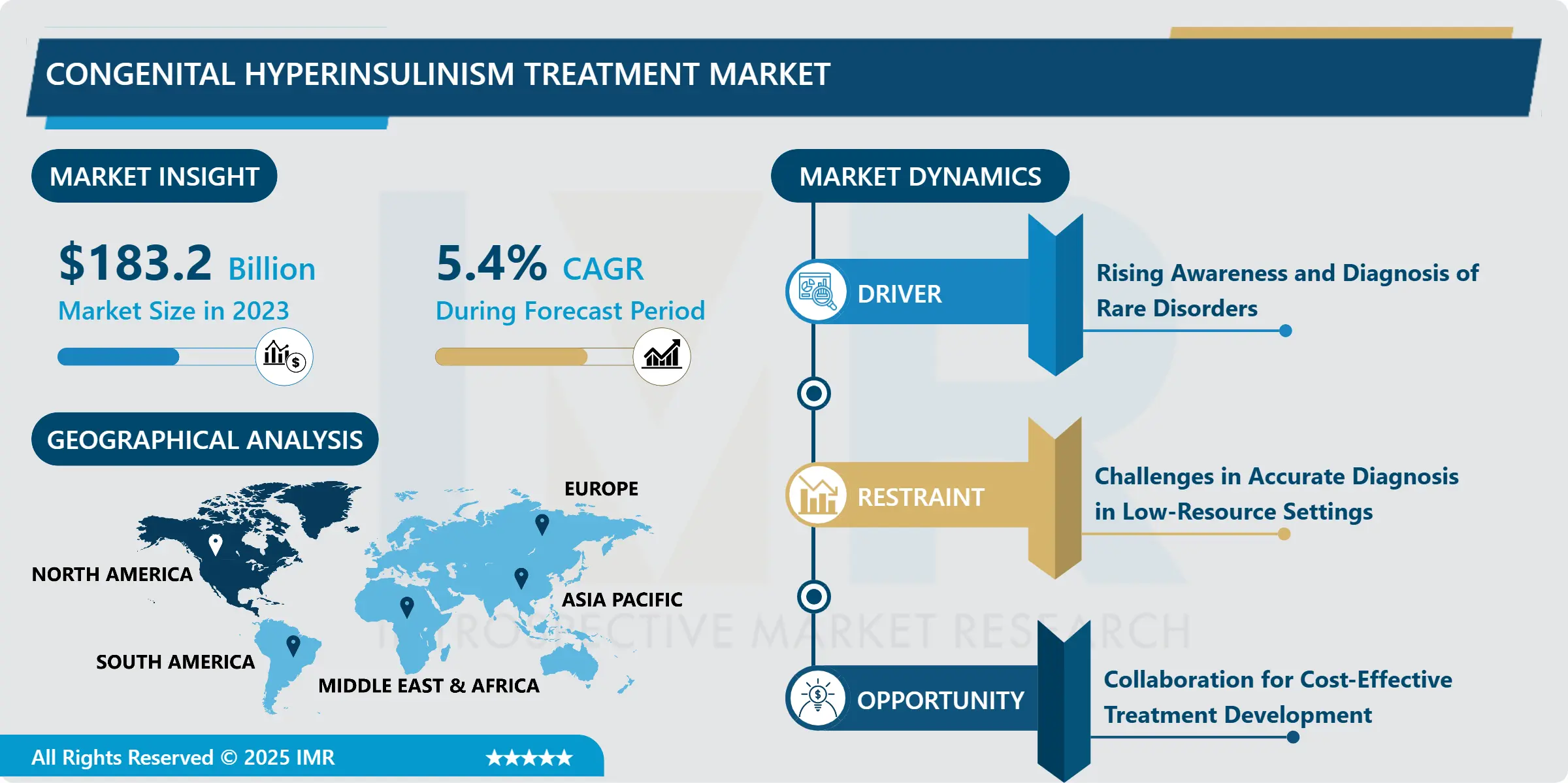
Congenital Hyperinsulinism Treatment Market Size Was Valued at USD 183.20 Billion in 2023, and is Projected to Reach USD 294.10 Billion by 2032, Growing at a CAGR of 5.40% From 2024-2032.
Congenital Hyperinsulinism (CHI) is a severe disease with an incidence of one per 25 000 live births in which the pancreas produces too much insulin and does not permit the blood-glucose concentration to rise above a certain level. It mainly presents in neonates and infants and whenever the disease is diagnosed, it should be treated without being delayed since it may have very terrible neurological consequences and the child may fail to grow and develop as required.
With the raise of incidence of congenital hyperinsulinism, the market has shown the ongoing tendency to grow. Development of molecular diagnostics has also increased the early diagnoses thus improving the chances of treatment by doctors. Further awareness campaigns by governments and non-profit organizations have however advanced the knowledge levels among several doctors and care givers leading to present increased need for proper treatment methods.
Increasing expenditure towards R&D for the availability of rare diseases also acts as a market driver. The health care industry is majorly emphasizing on bringing new drug delivery systems and LESS surgery to the market. Due to issues relating to CHI, orphan drug designations for related treatments benefit manufacturers financially and so promote this field further.
Congenital Hyperinsulinism Treatment Market Trend Analysis:
Shift toward personalized medicine
One of the trends being observed in the congenital hyperinsulinism treatment market is the move towards a more personalised approach to treatment. Personalized therapy allows practicing physicians to affect the very source of the problems, which in turn minimizes the use of surgical interventions. It is encouraging the biotech companies to partner with academic institutions to create precision medicines for CHI patients.
Surgery: technology advancement is also another trend that is growing in the market the technological advancement in surgical techniques is another trend that is growing. Laparoscopic pancreatectomy and other minimized procedures have improved surgical benefits including short recovery period and lowered morbidity. Such innovations have made it possible to increase chances of patients with severe or drug-resistant CHI.
Large neonatal population and improving healthcare infrastructure
Large population of neonates and continuously enhancing health care facilities make the Asia-Pacific region very lucrative market. Authorities of emerging economies, in turn, are actively investing in rare disease treatment programs and thus contribute to the creation of a favorable market environment. Additionally, it is revealed that the early detection rate of CHI in this region is likely to increase coupled with higher availability of advanced diagnostic tools.
Engagement of strategic stakeholders in the provision of treatment options, which are inexpensive, is another promising area. Since current therapy options entail a number of costs, it may be difficult to implement them in developing countries. The collaboration between the drug manufacturers and the non-governmental organizations might present the key to affordable solutions to extend the availability of CHI treatments all over the world.
Congenital Hyperinsulinism Treatment Market Segment Analysis:
Congenital Hyperinsulinism Treatment Market is Segmented on the basis of Treatment type, Drug Class, Route of Administration, End User, and Region.
By Treatment Type, Drug Therapy segment is expected to dominate the market during the forecast period
Drug Therapy can be done with the Oral Agents which consists of Diazoxide and Somatostatin Analogs. It is common to treat CHI patients with this form of treatment initially. Surgical Treatment Partial or Near-Total Pancreatectomy is considered in treatment resistant cases. Depending on the stage and cause of the condition both strategies are of significant importance to the management of the condition.
By Drug Class, Diazoxide segment expected to held the largest share
Diazoxide is the antagonist of potassium channel and it suppresses insulin secretion; It is one of the first-choice drugs. Somatostatin Analogues for example Octreotide, inhibit insulin release through the action of natural somatostatin. Glucagon injections are occasionally administered to the patient in case of emergencies: to increase blood glucose concentration rapidly. Others are special and investigative/treatment-aspect treatments aimed at individual patient requirements and also offer other ways of managing.
Congenital Hyperinsulinism Treatment Market Regional Insights:
North America is Expected to Dominate the Market Over the Forecast period
North America, the market of congenital hyperinsulinism treatment of the market share of the entire world. The region’s leadership is due to the well-developed health care facilities, high incidence of CHI, and good knowledge among the population and healthcare personnel. It is also backed by the presence of key industry players and consistent R&D activities in the region, most particularly in North America.
Beside Funding Orphan Drugs by Government grant, Orphan drug designation by Government also stimulates the market. Also, the strategic partnership between hospitals, research institutes, and bio-tech companies enhances delivery of drug and surgical solutions, keeping North America on top.
Active Key Players in the Congenital Hyperinsulinism Treatment Market
Crinetics Pharmaceuticals (USA)
Ipsen (France)
Medtronic Plc (Ireland)
Novo Nordisk (Denmark)
Pfizer Inc. (USA)
Rezolute, Inc. (USA)
Sanofi (France)
Teva Pharmaceuticals (Israel)
Xeris Biopharma (USA)
Zealand Pharma (Denmark)
Other Active Players.
Chapter 1: Introduction
1.1 Scope and Coverage
Chapter 2:Executive Summary
Chapter 3: Market Landscape
3.1 Market Dynamics
3.1.1 Drivers
3.1.2 Restraints
3.1.3 Opportunities
3.1.4 Challenges
3.2 Market Trend Analysis
3.3 PESTLE Analysis
3.4 Porter’s Five Forces Analysis
3.5 Industry Value Chain Analysis
3.6 Ecosystem
3.7 Regulatory Landscape
3.8 Price Trend Analysis
3.9 Patent Analysis
3.10 Technology Evolution
3.11 Investment Pockets
3.12 Import-Export Analysis
Chapter 4: Congenital Hyperinsulinism Treatment Market by Treatment Type
4.1 Congenital Hyperinsulinism Treatment Market Snapshot and Growth Engine
4.2 Congenital Hyperinsulinism Treatment Market Overview
4.3 Drug Therapy
4.3.1 Introduction and Market Overview
4.3.2 Historic and Forecasted Market Size in Value USD and Volume Units (2017-2032F)
4.3.3 Key Market Trends, Growth Factors and Opportunities
4.3.4 Drug Therapy: Geographic Segmentation Analysis
4.4 Surgical Therapy
4.4.1 Introduction and Market Overview
4.4.2 Historic and Forecasted Market Size in Value USD and Volume Units (2017-2032F)
4.4.3 Key Market Trends, Growth Factors and Opportunities
4.4.4 Surgical Therapy: Geographic Segmentation Analysis
Chapter 5: Congenital Hyperinsulinism Treatment Market by Drug Class
5.1 Congenital Hyperinsulinism Treatment Market Snapshot and Growth Engine
5.2 Congenital Hyperinsulinism Treatment Market Overview
5.3 Diazoxide
5.3.1 Introduction and Market Overview
5.3.2 Historic and Forecasted Market Size in Value USD and Volume Units (2017-2032F)
5.3.3 Key Market Trends, Growth Factors and Opportunities
5.3.4 Diazoxide: Geographic Segmentation Analysis
5.4 Somatostatin Analogs
5.4.1 Introduction and Market Overview
5.4.2 Historic and Forecasted Market Size in Value USD and Volume Units (2017-2032F)
5.4.3 Key Market Trends, Growth Factors and Opportunities
5.4.4 Somatostatin Analogs: Geographic Segmentation Analysis
5.5 Glucagon
5.5.1 Introduction and Market Overview
5.5.2 Historic and Forecasted Market Size in Value USD and Volume Units (2017-2032F)
5.5.3 Key Market Trends, Growth Factors and Opportunities
5.5.4 Glucagon: Geographic Segmentation Analysis
5.6 Others
5.6.1 Introduction and Market Overview
5.6.2 Historic and Forecasted Market Size in Value USD and Volume Units (2017-2032F)
5.6.3 Key Market Trends, Growth Factors and Opportunities
5.6.4 Others: Geographic Segmentation Analysis
Chapter 6: Congenital Hyperinsulinism Treatment Market by Route of Administration
6.1 Congenital Hyperinsulinism Treatment Market Snapshot and Growth Engine
6.2 Congenital Hyperinsulinism Treatment Market Overview
6.3 Oral
6.3.1 Introduction and Market Overview
6.3.2 Historic and Forecasted Market Size in Value USD and Volume Units (2017-2032F)
6.3.3 Key Market Trends, Growth Factors and Opportunities
6.3.4 Oral: Geographic Segmentation Analysis
6.4 Parenteral
6.4.1 Introduction and Market Overview
6.4.2 Historic and Forecasted Market Size in Value USD and Volume Units (2017-2032F)
6.4.3 Key Market Trends, Growth Factors and Opportunities
6.4.4 Parenteral: Geographic Segmentation Analysis
Chapter 7: Congenital Hyperinsulinism Treatment Market by End User
7.1 Congenital Hyperinsulinism Treatment Market Snapshot and Growth Engine
7.2 Congenital Hyperinsulinism Treatment Market Overview
7.3 Hospitals
7.3.1 Introduction and Market Overview
7.3.2 Historic and Forecasted Market Size in Value USD and Volume Units (2017-2032F)
7.3.3 Key Market Trends, Growth Factors and Opportunities
7.3.4 Hospitals: Geographic Segmentation Analysis
7.4 Specialty Clinics
7.4.1 Introduction and Market Overview
7.4.2 Historic and Forecasted Market Size in Value USD and Volume Units (2017-2032F)
7.4.3 Key Market Trends, Growth Factors and Opportunities
7.4.4 Specialty Clinics: Geographic Segmentation Analysis
7.5 Others
7.5.1 Introduction and Market Overview
7.5.2 Historic and Forecasted Market Size in Value USD and Volume Units (2017-2032F)
7.5.3 Key Market Trends, Growth Factors and Opportunities
7.5.4 Others: Geographic Segmentation Analysis
Chapter 8: Company Profiles and Competitive Analysis
8.1 Competitive Landscape
8.1.1 Competitive Benchmarking
8.1.2 Congenital Hyperinsulinism Treatment Market Share by Manufacturer (2023)
8.1.3 Industry BCG Matrix
8.1.4 Heat Map Analysis
8.1.5 Mergers and Acquisitions
8.2 XERIS BIOPHARMA (USA)
8.2.1 Company Overview
8.2.2 Key Executives
8.2.3 Company Snapshot
8.2.4 Role of the Company in the Market
8.2.5 Sustainability and Social Responsibility
8.2.6 Operating Business Segments
8.2.7 Product Portfolio
8.2.8 Business Performance
8.2.9 Key Strategic Moves and Recent Developments
8.2.10 SWOT Analysis
8.3 REZOLUTE INC. (USA)
8.4 CRINETICS PHARMACEUTICALS (USA)
8.5 ZEALAND PHARMA (DENMARK)
8.6 NOVO NORDISK (DENMARK)
8.7 TEVA PHARMACEUTICALS (ISRAEL)
8.8 PFIZER INC. (USA)
8.9 MEDTRONIC PLC (IRELAND)
8.10 SANOFI (FRANCE)
8.11 IPSEN (FRANCE)
8.12 OTHER ACTIVE PLAYERS
Chapter 9: Global Congenital Hyperinsulinism Treatment Market By Region
9.1 Overview
9.2. North America Congenital Hyperinsulinism Treatment Market
9.2.1 Key Market Trends, Growth Factors and Opportunities
9.2.2 Top Key Companies
9.2.3 Historic and Forecasted Market Size by Segments
9.2.4 Historic and Forecasted Market Size By Treatment Type
9.2.4.1 Drug Therapy
9.2.4.2 Surgical Therapy
9.2.5 Historic and Forecasted Market Size By Drug Class
9.2.5.1 Diazoxide
9.2.5.2 Somatostatin Analogs
9.2.5.3 Glucagon
9.2.5.4 Others
9.2.6 Historic and Forecasted Market Size By Route of Administration
9.2.6.1 Oral
9.2.6.2 Parenteral
9.2.7 Historic and Forecasted Market Size By End User
9.2.7.1 Hospitals
9.2.7.2 Specialty Clinics
9.2.7.3 Others
9.2.8 Historic and Forecast Market Size by Country
9.2.8.1 US
9.2.8.2 Canada
9.2.8.3 Mexico
9.3. Eastern Europe Congenital Hyperinsulinism Treatment Market
9.3.1 Key Market Trends, Growth Factors and Opportunities
9.3.2 Top Key Companies
9.3.3 Historic and Forecasted Market Size by Segments
9.3.4 Historic and Forecasted Market Size By Treatment Type
9.3.4.1 Drug Therapy
9.3.4.2 Surgical Therapy
9.3.5 Historic and Forecasted Market Size By Drug Class
9.3.5.1 Diazoxide
9.3.5.2 Somatostatin Analogs
9.3.5.3 Glucagon
9.3.5.4 Others
9.3.6 Historic and Forecasted Market Size By Route of Administration
9.3.6.1 Oral
9.3.6.2 Parenteral
9.3.7 Historic and Forecasted Market Size By End User
9.3.7.1 Hospitals
9.3.7.2 Specialty Clinics
9.3.7.3 Others
9.3.8 Historic and Forecast Market Size by Country
9.3.8.1 Russia
9.3.8.2 Bulgaria
9.3.8.3 The Czech Republic
9.3.8.4 Hungary
9.3.8.5 Poland
9.3.8.6 Romania
9.3.8.7 Rest of Eastern Europe
9.4. Western Europe Congenital Hyperinsulinism Treatment Market
9.4.1 Key Market Trends, Growth Factors and Opportunities
9.4.2 Top Key Companies
9.4.3 Historic and Forecasted Market Size by Segments
9.4.4 Historic and Forecasted Market Size By Treatment Type
9.4.4.1 Drug Therapy
9.4.4.2 Surgical Therapy
9.4.5 Historic and Forecasted Market Size By Drug Class
9.4.5.1 Diazoxide
9.4.5.2 Somatostatin Analogs
9.4.5.3 Glucagon
9.4.5.4 Others
9.4.6 Historic and Forecasted Market Size By Route of Administration
9.4.6.1 Oral
9.4.6.2 Parenteral
9.4.7 Historic and Forecasted Market Size By End User
9.4.7.1 Hospitals
9.4.7.2 Specialty Clinics
9.4.7.3 Others
9.4.8 Historic and Forecast Market Size by Country
9.4.8.1 Germany
9.4.8.2 UK
9.4.8.3 France
9.4.8.4 The Netherlands
9.4.8.5 Italy
9.4.8.6 Spain
9.4.8.7 Rest of Western Europe
9.5. Asia Pacific Congenital Hyperinsulinism Treatment Market
9.5.1 Key Market Trends, Growth Factors and Opportunities
9.5.2 Top Key Companies
9.5.3 Historic and Forecasted Market Size by Segments
9.5.4 Historic and Forecasted Market Size By Treatment Type
9.5.4.1 Drug Therapy
9.5.4.2 Surgical Therapy
9.5.5 Historic and Forecasted Market Size By Drug Class
9.5.5.1 Diazoxide
9.5.5.2 Somatostatin Analogs
9.5.5.3 Glucagon
9.5.5.4 Others
9.5.6 Historic and Forecasted Market Size By Route of Administration
9.5.6.1 Oral
9.5.6.2 Parenteral
9.5.7 Historic and Forecasted Market Size By End User
9.5.7.1 Hospitals
9.5.7.2 Specialty Clinics
9.5.7.3 Others
9.5.8 Historic and Forecast Market Size by Country
9.5.8.1 China
9.5.8.2 India
9.5.8.3 Japan
9.5.8.4 South Korea
9.5.8.5 Malaysia
9.5.8.6 Thailand
9.5.8.7 Vietnam
9.5.8.8 The Philippines
9.5.8.9 Australia
9.5.8.10 New Zealand
9.5.8.11 Rest of APAC
9.6. Middle East & Africa Congenital Hyperinsulinism Treatment Market
9.6.1 Key Market Trends, Growth Factors and Opportunities
9.6.2 Top Key Companies
9.6.3 Historic and Forecasted Market Size by Segments
9.6.4 Historic and Forecasted Market Size By Treatment Type
9.6.4.1 Drug Therapy
9.6.4.2 Surgical Therapy
9.6.5 Historic and Forecasted Market Size By Drug Class
9.6.5.1 Diazoxide
9.6.5.2 Somatostatin Analogs
9.6.5.3 Glucagon
9.6.5.4 Others
9.6.6 Historic and Forecasted Market Size By Route of Administration
9.6.6.1 Oral
9.6.6.2 Parenteral
9.6.7 Historic and Forecasted Market Size By End User
9.6.7.1 Hospitals
9.6.7.2 Specialty Clinics
9.6.7.3 Others
9.6.8 Historic and Forecast Market Size by Country
9.6.8.1 Turkiye
9.6.8.2 Bahrain
9.6.8.3 Kuwait
9.6.8.4 Saudi Arabia
9.6.8.5 Qatar
9.6.8.6 UAE
9.6.8.7 Israel
9.6.8.8 South Africa
9.7. South America Congenital Hyperinsulinism Treatment Market
9.7.1 Key Market Trends, Growth Factors and Opportunities
9.7.2 Top Key Companies
9.7.3 Historic and Forecasted Market Size by Segments
9.7.4 Historic and Forecasted Market Size By Treatment Type
9.7.4.1 Drug Therapy
9.7.4.2 Surgical Therapy
9.7.5 Historic and Forecasted Market Size By Drug Class
9.7.5.1 Diazoxide
9.7.5.2 Somatostatin Analogs
9.7.5.3 Glucagon
9.7.5.4 Others
9.7.6 Historic and Forecasted Market Size By Route of Administration
9.7.6.1 Oral
9.7.6.2 Parenteral
9.7.7 Historic and Forecasted Market Size By End User
9.7.7.1 Hospitals
9.7.7.2 Specialty Clinics
9.7.7.3 Others
9.7.8 Historic and Forecast Market Size by Country
9.7.8.1 Brazil
9.7.8.2 Argentina
9.7.8.3 Rest of SA
Chapter 10 Analyst Viewpoint and Conclusion
10.1 Recommendations and Concluding Analysis
10.2 Potential Market Strategies
Chapter 11 Research Methodology
11.1 Research Process
11.2 Primary Research
11.3 Secondary Research
Q1: What would be the forecast period in the Congenital Hyperinsulinism Treatment Market research report?
A1: The forecast period in the Congenital Hyperinsulinism Treatment Market research report is 2024-2032.
Q2: Who are the key players in the Congenital Hyperinsulinism Treatment Market?
A2: •Xeris Biopharma (USA), Rezolute, Inc. (USA), Crinetics Pharmaceuticals (USA), Zealand Pharma (Denmark), Novo Nordisk (Denmark), Teva Pharmaceuticals (Israel), Pfizer Inc. (USA), Medtronic Plc (Ireland), Sanofi (France), Ipsen (France) and Other Active Players.
Q3: What are the segments of the Congenital Hyperinsulinism Treatment Market?
A3: The Congenital Hyperinsulinism Treatment Market is segmented into by Treatment Type (Drug Therapy, Surgical Therapy), By Drug Class (Diazoxide, Somatostatin Analogs, Glucagon, Others), Route of Administration (Oral, Parenteral), End User (Hospitals, Specialty Clinics, Others). By region, it is analyzed across North America (U.S., Canada, Mexico), Eastern Europe (Russia, Bulgaria, The Czech Republic, Hungary, Poland, Romania, Rest of Eastern Europe), Western Europe (Germany, UK, France, The Netherlands, Italy, Russia, Spain, Rest of Western Europe), Asia Pacific (China, India, Japan, South Korea, Malaysia, Thailand, Vietnam, The Philippines, Australia, New-Zealand, Rest of APAC), Middle East & Africa (Turkiye, Bahrain, Kuwait, Saudi Arabia, Qatar, UAE, Israel, South Africa), South America (Brazil, Argentina, Rest of SA).
Q4: What is the Congenital Hyperinsulinism Treatment Market?
A4: Congenital Hyperinsulinism (CHI) is a severe disease with an incidence of one per 25 000 live births in which the pancreas produces too much insulin and does not permit the blood-glucose concentration to rise above a certain level. It mainly presents in neonates and infants and whenever the disease is diagnosed, it should be treated without being delayed since it may have very terrible neurological consequences and the child may fail to grow and develop as required.
Q5: How big is the Congenital Hyperinsulinism Treatment Market?
A5: Congenital Hyperinsulinism Treatment Market Size Was Valued at USD 183.20 Billion in 2023, and is Projected to Reach USD 294.10 Billion by 2032, Growing at a CAGR of 5.40% From 2024-2032.
How to Buy a Report from eminsights.jp
On the product page, choose the license you want: Single-User License, Multi-User License or Enterprise License.
If you required report in your native language, then you can click on Translated Report button and fill out the form with report name and language you want, then our team will contact you as soon as possible.
Click the Buy Now button.
You will be redirected to the checkout page. Enter your company details and payment information.
Click Place Order to complete the purchase.
Confirmation: You’ll receive an order confirmation and our team will contact you shortly with your ordered report.
If you have any questions, fill out the contact form below or email us at [email protected].
Thank you for choosing eminsights.jp!