Stay Ahead in Fast-Growing Economies.
Browse Reports Now
Context Aware Computing Market Size, Share, Growth & Forecast (2024-2032)
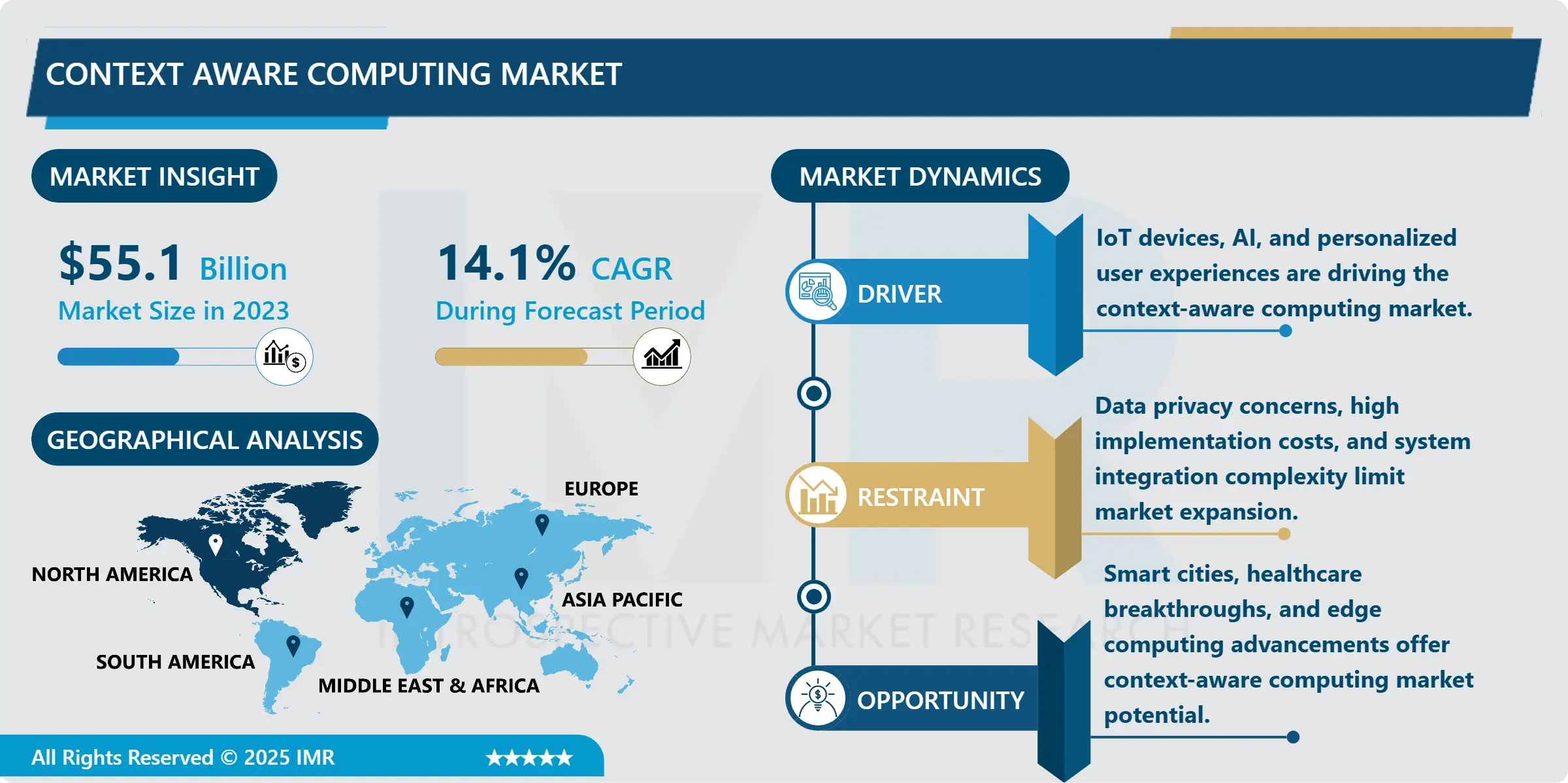
Context Aware Computing Market Size Was Valued at USD 55.10 Billion in 2023, and is Projected to Reach USD 196.10 Billion by 2032, Growing at a CAGR of 14.10% from 2024-2032.

IMR Group
Description
Context Aware Computing Market Synopsis:
Context Aware Computing Market Size Was Valued at USD 55.10 Billion in 2023, and is Projected to Reach USD 196.10 Billion by 2032, Growing at a CAGR of 14.10% from 2024-2032.
The Context-Aware Computing Market has become one of the biggest factors in modern technological advancements due to the increased use of connected devices, IoT applications, and artificial intelligence. Based on context-aware computing, system can successfully gather and analyze data from multiple sources including users’ preferences, context conditions, and device’s states in order to provide context-aware services. Another is that it is used more and more frequently across many industries, such as healthcare, retail, automobile, and smart home applications. In particular, it has been identified that with businesses seeking for ways to improve engagement from users and optimise operation, requirements for context-aware solutions are set to experience exponential growth.
The importance of the market is further propelled by growth in edge computing, the 5G network, and machine learning algorithms. These developments have reduced the effectiveness of strategies that power context-aware systems for real-time vital decisions in challenging surroundings. For example, in retail, these systems drive targeted marketing and promotional strategies based on the insight derived from the customer behavior and, in the health care industry, these systems provide patient surveillance and risk assessments. Further, there is a burgeoning market for wearables and intelligent personal assistants like Alexa and Google Home triggering a sphere of consumers interested in context-awareness solutions.
Nonetheless, despite its projected potential, the market has inherent issues, which are as follows: personal data protection issues, high costs of implementation, and the issues associated with the incorporation of CAS into existing architectures. But emerging investments in R&D and favourable regulatory policies focusing on these challenges as the key to new opportunities are to be expected. North America and Europe areas are leading the market because of the well-developed technological environment, while Asia-Pacific area is displaying rather high growth rates due to the growth in the sales of smartphones and the implementation of smart city concepts. With these dynamics, the Context-Aware Computing Market is well positioned to form the future of intelligent computing.
Context Aware Computing Market Trend Analysis:
Integration with IoT and Smart Environments
The most profound of these trends is the emergence of IoT and smart environments in the Context-Aware Computing Market. As internet-connected devices continue to become the standard across industries, the capacity of context-aware systems to manage data from sensors and devices has not been particularly relevant. They improve energy management, security and provide customized interactivity applied on smart homes basing on data like occupancy and environmental details. In the same way real time information drives high velocity business decisions, context aware computing is enabling predictive maintenance in IIoT. This integration between IoT and context-aware computing is believed to bring in new innovative facets and increase market size.
Advancements in AI-Powered Contextual Intelligence
Context-aware computing has gained new heights through the integration of the new prominent technology of artificial intelligence (AI), which makes possibility of systems performance by accurate and adaptive responses occurs. Natural language processing and machine learning are the technologies incorporated to improve the system’s functionality for understanding contextual cues like facial expressions and body language. In customer service, for example, AI assisted context-aware solutions help the chatbots being empathetic with the customer. Likewise in healthcare, these systems facilitate clinical decisions by providing analysis of the outcome of a patient condition in real time. Which makes it only natural to assume that further development of AI algorithms and frameworks will push context-aware computing even deeper into as many industries as possible.
Context Aware Computing Market Segment Analysis:
Context Aware Computing Market is Segmented on the basis of By Product, Context, Industry Verticals, and Region.
By Product, Active Maps segment is expected to dominate the market during the forecast period
The Context-Aware Computing Market is categorized by product type into Active Maps, Adaptive phones, Augmented Reality, Guide systems, Conference aids, Cyber guides, Fieldwork tools, Shopping aids, and Other that offer solution for a particular application for various sectors. Augmented reality tools, including active maps, are constantly becoming more popular in navigation and games, giving context-sensitive experiences in real time. Smart phones use embedded context technologies that allow it to feature continuous adjustments according to the behavior of the user. While shopping assistants and guide systems become the new generation of retail and tourist industry that could give recommendations and improve the convenience of use. Cyber guides and conference assistants have proven useful in professional spaces as a means of efficient operational automation as well as contextual awareness in real time. This diverse product segmentation also underlines the versatility of context-aware computing in Consumer and in Enterprise markets.
By Context, Oncology segment expected to held the largest share
The Context-Aware Computing Market is based on the usage of four types of contexts, namely computing context, user context, physical context, as well as time context, to create smart system that can provide adaptive services. The term computing context relates to configurations and available resources of computers, networks and applications so as to promote physical integration and efficient resource management. Personal context uses individual user preferences, actions and interaction, for instance, enabling users to receive customized content such as recommendations. A physical context is an area, place, weather and distance, essential in navigation, shopping, and supply chains. Lastly, time context looks at the various aspects of time, either time of the day or even working shifts in order to get the best out of aspects like power conservation or scheduling of events. Such contextual dimensions when integrated make context-aware computing solutions provide better user experience and business operations to drive growth in areas such as healthcare, retail and smart city as well as in automobile industries.
Context Aware Computing Market Regional Insights:
North America is Expected to Dominate the Market Over the Forecast period
North America will dominate the Context-Aware Computing Market through the forecast period due to developed technology solutions developed in the region and the presence of leading industry players. This region witnessed significant adaption of CA solutions across industries like healthcare, retail and automotive sectors due to which there is a higher investment in IoT, Artificial Intelligence and 5G. Many customers now apply wearables, smart assistants together with connected systems as main application areas that have a crucial influence on consumer interest. Legal backing proposed in the support of data safety and advancement enhances North America given that the USA and Canada are key regions of development attributed to profound interest in digital change and smart city arrangements.
Active Key Players in the Context Aware Computing Market
Amazon.com, Inc. (USA)
Amazon.com, Inc. (USA)
Apple Inc. (USA)
Baidu (China)
Cisco Systems, Inc. (USA)
Google Inc. (USA)
Google LLC (USA)
IBM Corporation (USA)
Infosys Limited (India)
Intel Corporation (USA)
Microsoft (USA)
Microsoft Corporation (USA)
Nokia Corporation (Finland)
Onapsis Inc. (USA)
Oracle Corporation (USA)
Samsung Electronics Co. Ltd (South Korea)
Samsung, Inc. (South Korea)
Teliasonera (Sweden)
Verizon Communications Inc. (USA)
Other Active Players.
Chapter 1: Introduction
1.1 Scope and Coverage
Chapter 2:Executive Summary
Chapter 3: Market Landscape
3.1 Market Dynamics
3.1.1 Drivers
3.1.2 Restraints
3.1.3 Opportunities
3.1.4 Challenges
3.2 Market Trend Analysis
3.3 PESTLE Analysis
3.4 Porter’s Five Forces Analysis
3.5 Industry Value Chain Analysis
3.6 Ecosystem
3.7 Regulatory Landscape
3.8 Price Trend Analysis
3.9 Patent Analysis
3.10 Technology Evolution
3.11 Investment Pockets
3.12 Import-Export Analysis
Chapter 4: Context Aware Computing Market by Product
4.1 Context Aware Computing Market Snapshot and Growth Engine
4.2 Context Aware Computing Market Overview
4.3 Active Maps
4.3.1 Introduction and Market Overview
4.3.2 Historic and Forecasted Market Size in Value USD and Volume Units (2017-2032F)
4.3.3 Key Market Trends, Growth Factors and Opportunities
4.3.4 Active Maps: Geographic Segmentation Analysis
4.4 Adaptive Phones
4.4.1 Introduction and Market Overview
4.4.2 Historic and Forecasted Market Size in Value USD and Volume Units (2017-2032F)
4.4.3 Key Market Trends, Growth Factors and Opportunities
4.4.4 Adaptive Phones: Geographic Segmentation Analysis
4.5 Augmented Reality
4.5.1 Introduction and Market Overview
4.5.2 Historic and Forecasted Market Size in Value USD and Volume Units (2017-2032F)
4.5.3 Key Market Trends, Growth Factors and Opportunities
4.5.4 Augmented Reality: Geographic Segmentation Analysis
4.6 Guide Systems
4.6.1 Introduction and Market Overview
4.6.2 Historic and Forecasted Market Size in Value USD and Volume Units (2017-2032F)
4.6.3 Key Market Trends, Growth Factors and Opportunities
4.6.4 Guide Systems: Geographic Segmentation Analysis
4.7 Conference Assistants
4.7.1 Introduction and Market Overview
4.7.2 Historic and Forecasted Market Size in Value USD and Volume Units (2017-2032F)
4.7.3 Key Market Trends, Growth Factors and Opportunities
4.7.4 Conference Assistants: Geographic Segmentation Analysis
4.8 Cyber guides
4.8.1 Introduction and Market Overview
4.8.2 Historic and Forecasted Market Size in Value USD and Volume Units (2017-2032F)
4.8.3 Key Market Trends, Growth Factors and Opportunities
4.8.4 Cyber guides: Geographic Segmentation Analysis
4.9 Fieldwork
4.9.1 Introduction and Market Overview
4.9.2 Historic and Forecasted Market Size in Value USD and Volume Units (2017-2032F)
4.9.3 Key Market Trends, Growth Factors and Opportunities
4.9.4 Fieldwork: Geographic Segmentation Analysis
4.10 Shopping Assistants and Others
4.10.1 Introduction and Market Overview
4.10.2 Historic and Forecasted Market Size in Value USD and Volume Units (2017-2032F)
4.10.3 Key Market Trends, Growth Factors and Opportunities
4.10.4 Shopping Assistants and Others: Geographic Segmentation Analysis
Chapter 5: Context Aware Computing Market by Context
5.1 Context Aware Computing Market Snapshot and Growth Engine
5.2 Context Aware Computing Market Overview
5.3 Computing Context
5.3.1 Introduction and Market Overview
5.3.2 Historic and Forecasted Market Size in Value USD and Volume Units (2017-2032F)
5.3.3 Key Market Trends, Growth Factors and Opportunities
5.3.4 Computing Context: Geographic Segmentation Analysis
5.4 User Context
5.4.1 Introduction and Market Overview
5.4.2 Historic and Forecasted Market Size in Value USD and Volume Units (2017-2032F)
5.4.3 Key Market Trends, Growth Factors and Opportunities
5.4.4 User Context: Geographic Segmentation Analysis
5.5 Physical Context and Time Context
5.5.1 Introduction and Market Overview
5.5.2 Historic and Forecasted Market Size in Value USD and Volume Units (2017-2032F)
5.5.3 Key Market Trends, Growth Factors and Opportunities
5.5.4 Physical Context and Time Context: Geographic Segmentation Analysis
Chapter 6: Context Aware Computing Market by Industry Verticals
6.1 Context Aware Computing Market Snapshot and Growth Engine
6.2 Context Aware Computing Market Overview
6.3 BFSI
6.3.1 Introduction and Market Overview
6.3.2 Historic and Forecasted Market Size in Value USD and Volume Units (2017-2032F)
6.3.3 Key Market Trends, Growth Factors and Opportunities
6.3.4 BFSI: Geographic Segmentation Analysis
6.4 Healthcare and Life Sciences
6.4.1 Introduction and Market Overview
6.4.2 Historic and Forecasted Market Size in Value USD and Volume Units (2017-2032F)
6.4.3 Key Market Trends, Growth Factors and Opportunities
6.4.4 Healthcare and Life Sciences: Geographic Segmentation Analysis
6.5 Telecommunications and IT
6.5.1 Introduction and Market Overview
6.5.2 Historic and Forecasted Market Size in Value USD and Volume Units (2017-2032F)
6.5.3 Key Market Trends, Growth Factors and Opportunities
6.5.4 Telecommunications and IT: Geographic Segmentation Analysis
6.6 Government and Public Sector
6.6.1 Introduction and Market Overview
6.6.2 Historic and Forecasted Market Size in Value USD and Volume Units (2017-2032F)
6.6.3 Key Market Trends, Growth Factors and Opportunities
6.6.4 Government and Public Sector: Geographic Segmentation Analysis
6.7 Manufacturing
6.7.1 Introduction and Market Overview
6.7.2 Historic and Forecasted Market Size in Value USD and Volume Units (2017-2032F)
6.7.3 Key Market Trends, Growth Factors and Opportunities
6.7.4 Manufacturing: Geographic Segmentation Analysis
6.8 Consumer Goods and Retail
6.8.1 Introduction and Market Overview
6.8.2 Historic and Forecasted Market Size in Value USD and Volume Units (2017-2032F)
6.8.3 Key Market Trends, Growth Factors and Opportunities
6.8.4 Consumer Goods and Retail: Geographic Segmentation Analysis
6.9 Media and Entertainment and Others
6.9.1 Introduction and Market Overview
6.9.2 Historic and Forecasted Market Size in Value USD and Volume Units (2017-2032F)
6.9.3 Key Market Trends, Growth Factors and Opportunities
6.9.4 Media and Entertainment and Others: Geographic Segmentation Analysis
Chapter 7: Company Profiles and Competitive Analysis
7.1 Competitive Landscape
7.1.1 Competitive Benchmarking
7.1.2 Context Aware Computing Market Share by Manufacturer (2023)
7.1.3 Industry BCG Matrix
7.1.4 Heat Map Analysis
7.1.5 Mergers and Acquisitions
7.2 AMAZON.COM INC. (USA)
7.2.1 Company Overview
7.2.2 Key Executives
7.2.3 Company Snapshot
7.2.4 Role of the Company in the Market
7.2.5 Sustainability and Social Responsibility
7.2.6 Operating Business Segments
7.2.7 Product Portfolio
7.2.8 Business Performance
7.2.9 Key Strategic Moves and Recent Developments
7.2.10 SWOT Analysis
7.3 SAMSUNG INC. (SOUTH KOREA)
7.4 APPLE INC. (USA)
7.5 INTEL CORPORATION (USA)
7.6 GOOGLE INC. (USA)
7.7 MICROSOFT (USA)
7.8 BAIDU (CHINA)
7.9 OTHER ACTIVE PLAYERS
Chapter 8: Global Context Aware Computing Market By Region
8.1 Overview
8.2. North America Context Aware Computing Market
8.2.1 Key Market Trends, Growth Factors and Opportunities
8.2.2 Top Key Companies
8.2.3 Historic and Forecasted Market Size by Segments
8.2.4 Historic and Forecasted Market Size By Product
8.2.4.1 Active Maps
8.2.4.2 Adaptive Phones
8.2.4.3 Augmented Reality
8.2.4.4 Guide Systems
8.2.4.5 Conference Assistants
8.2.4.6 Cyber guides
8.2.4.7 Fieldwork
8.2.4.8 Shopping Assistants and Others
8.2.5 Historic and Forecasted Market Size By Context
8.2.5.1 Computing Context
8.2.5.2 User Context
8.2.5.3 Physical Context and Time Context
8.2.6 Historic and Forecasted Market Size By Industry Verticals
8.2.6.1 BFSI
8.2.6.2 Healthcare and Life Sciences
8.2.6.3 Telecommunications and IT
8.2.6.4 Government and Public Sector
8.2.6.5 Manufacturing
8.2.6.6 Consumer Goods and Retail
8.2.6.7 Media and Entertainment and Others
8.2.7 Historic and Forecast Market Size by Country
8.2.7.1 US
8.2.7.2 Canada
8.2.7.3 Mexico
8.3. Eastern Europe Context Aware Computing Market
8.3.1 Key Market Trends, Growth Factors and Opportunities
8.3.2 Top Key Companies
8.3.3 Historic and Forecasted Market Size by Segments
8.3.4 Historic and Forecasted Market Size By Product
8.3.4.1 Active Maps
8.3.4.2 Adaptive Phones
8.3.4.3 Augmented Reality
8.3.4.4 Guide Systems
8.3.4.5 Conference Assistants
8.3.4.6 Cyber guides
8.3.4.7 Fieldwork
8.3.4.8 Shopping Assistants and Others
8.3.5 Historic and Forecasted Market Size By Context
8.3.5.1 Computing Context
8.3.5.2 User Context
8.3.5.3 Physical Context and Time Context
8.3.6 Historic and Forecasted Market Size By Industry Verticals
8.3.6.1 BFSI
8.3.6.2 Healthcare and Life Sciences
8.3.6.3 Telecommunications and IT
8.3.6.4 Government and Public Sector
8.3.6.5 Manufacturing
8.3.6.6 Consumer Goods and Retail
8.3.6.7 Media and Entertainment and Others
8.3.7 Historic and Forecast Market Size by Country
8.3.7.1 Russia
8.3.7.2 Bulgaria
8.3.7.3 The Czech Republic
8.3.7.4 Hungary
8.3.7.5 Poland
8.3.7.6 Romania
8.3.7.7 Rest of Eastern Europe
8.4. Western Europe Context Aware Computing Market
8.4.1 Key Market Trends, Growth Factors and Opportunities
8.4.2 Top Key Companies
8.4.3 Historic and Forecasted Market Size by Segments
8.4.4 Historic and Forecasted Market Size By Product
8.4.4.1 Active Maps
8.4.4.2 Adaptive Phones
8.4.4.3 Augmented Reality
8.4.4.4 Guide Systems
8.4.4.5 Conference Assistants
8.4.4.6 Cyber guides
8.4.4.7 Fieldwork
8.4.4.8 Shopping Assistants and Others
8.4.5 Historic and Forecasted Market Size By Context
8.4.5.1 Computing Context
8.4.5.2 User Context
8.4.5.3 Physical Context and Time Context
8.4.6 Historic and Forecasted Market Size By Industry Verticals
8.4.6.1 BFSI
8.4.6.2 Healthcare and Life Sciences
8.4.6.3 Telecommunications and IT
8.4.6.4 Government and Public Sector
8.4.6.5 Manufacturing
8.4.6.6 Consumer Goods and Retail
8.4.6.7 Media and Entertainment and Others
8.4.7 Historic and Forecast Market Size by Country
8.4.7.1 Germany
8.4.7.2 UK
8.4.7.3 France
8.4.7.4 The Netherlands
8.4.7.5 Italy
8.4.7.6 Spain
8.4.7.7 Rest of Western Europe
8.5. Asia Pacific Context Aware Computing Market
8.5.1 Key Market Trends, Growth Factors and Opportunities
8.5.2 Top Key Companies
8.5.3 Historic and Forecasted Market Size by Segments
8.5.4 Historic and Forecasted Market Size By Product
8.5.4.1 Active Maps
8.5.4.2 Adaptive Phones
8.5.4.3 Augmented Reality
8.5.4.4 Guide Systems
8.5.4.5 Conference Assistants
8.5.4.6 Cyber guides
8.5.4.7 Fieldwork
8.5.4.8 Shopping Assistants and Others
8.5.5 Historic and Forecasted Market Size By Context
8.5.5.1 Computing Context
8.5.5.2 User Context
8.5.5.3 Physical Context and Time Context
8.5.6 Historic and Forecasted Market Size By Industry Verticals
8.5.6.1 BFSI
8.5.6.2 Healthcare and Life Sciences
8.5.6.3 Telecommunications and IT
8.5.6.4 Government and Public Sector
8.5.6.5 Manufacturing
8.5.6.6 Consumer Goods and Retail
8.5.6.7 Media and Entertainment and Others
8.5.7 Historic and Forecast Market Size by Country
8.5.7.1 China
8.5.7.2 India
8.5.7.3 Japan
8.5.7.4 South Korea
8.5.7.5 Malaysia
8.5.7.6 Thailand
8.5.7.7 Vietnam
8.5.7.8 The Philippines
8.5.7.9 Australia
8.5.7.10 New Zealand
8.5.7.11 Rest of APAC
8.6. Middle East & Africa Context Aware Computing Market
8.6.1 Key Market Trends, Growth Factors and Opportunities
8.6.2 Top Key Companies
8.6.3 Historic and Forecasted Market Size by Segments
8.6.4 Historic and Forecasted Market Size By Product
8.6.4.1 Active Maps
8.6.4.2 Adaptive Phones
8.6.4.3 Augmented Reality
8.6.4.4 Guide Systems
8.6.4.5 Conference Assistants
8.6.4.6 Cyber guides
8.6.4.7 Fieldwork
8.6.4.8 Shopping Assistants and Others
8.6.5 Historic and Forecasted Market Size By Context
8.6.5.1 Computing Context
8.6.5.2 User Context
8.6.5.3 Physical Context and Time Context
8.6.6 Historic and Forecasted Market Size By Industry Verticals
8.6.6.1 BFSI
8.6.6.2 Healthcare and Life Sciences
8.6.6.3 Telecommunications and IT
8.6.6.4 Government and Public Sector
8.6.6.5 Manufacturing
8.6.6.6 Consumer Goods and Retail
8.6.6.7 Media and Entertainment and Others
8.6.7 Historic and Forecast Market Size by Country
8.6.7.1 Turkiye
8.6.7.2 Bahrain
8.6.7.3 Kuwait
8.6.7.4 Saudi Arabia
8.6.7.5 Qatar
8.6.7.6 UAE
8.6.7.7 Israel
8.6.7.8 South Africa
8.7. South America Context Aware Computing Market
8.7.1 Key Market Trends, Growth Factors and Opportunities
8.7.2 Top Key Companies
8.7.3 Historic and Forecasted Market Size by Segments
8.7.4 Historic and Forecasted Market Size By Product
8.7.4.1 Active Maps
8.7.4.2 Adaptive Phones
8.7.4.3 Augmented Reality
8.7.4.4 Guide Systems
8.7.4.5 Conference Assistants
8.7.4.6 Cyber guides
8.7.4.7 Fieldwork
8.7.4.8 Shopping Assistants and Others
8.7.5 Historic and Forecasted Market Size By Context
8.7.5.1 Computing Context
8.7.5.2 User Context
8.7.5.3 Physical Context and Time Context
8.7.6 Historic and Forecasted Market Size By Industry Verticals
8.7.6.1 BFSI
8.7.6.2 Healthcare and Life Sciences
8.7.6.3 Telecommunications and IT
8.7.6.4 Government and Public Sector
8.7.6.5 Manufacturing
8.7.6.6 Consumer Goods and Retail
8.7.6.7 Media and Entertainment and Others
8.7.7 Historic and Forecast Market Size by Country
8.7.7.1 Brazil
8.7.7.2 Argentina
8.7.7.3 Rest of SA
Chapter 9 Analyst Viewpoint and Conclusion
9.1 Recommendations and Concluding Analysis
9.2 Potential Market Strategies
Chapter 10 Research Methodology
10.1 Research Process
10.2 Primary Research
10.3 Secondary Research
Q1: What would be the forecast period in the Context Aware Computing Market research report?
A1: The forecast period in the Context Aware Computing Market research report is 2024-2032.
Q2: Who are the key players in the Context Aware Computing Market?
A2: Amazon.com, Inc. (USA), Apple Inc. (USA), Baidu (China), Cisco Systems, Inc. (USA), Google Inc. (USA), Google LLC (USA), IBM Corporation (USA), Infosys Limited (India), Intel Corporation (USA), Microsoft (USA), Microsoft Corporation (USA), Nokia Corporation (Finland), Onapsis Inc. (USA), Oracle Corporation (USA), Samsung Electronics Co. Ltd (South Korea), Samsung, Inc. (South Korea), Teliasonera (Sweden), Verizon Communications Inc. (USA), Other Active Players.
Q3: What are the segments of the Context Aware Computing Market?
A3: The Context Aware Computing Market is segmented into By Product, Context, Industry Verticals and region. By Product (Active Maps, Adaptive Phones, Augmented Reality, Guide Systems, Conference Assistants, Cyber guides, Fieldwork, Shopping Assistants and Others), Context (Computing Context, User Context, Physical Context and Time Context), Industry Verticals (BFSI, Healthcare and Life Sciences, Telecommunications and IT, Government and Public Sector, Manufacturing, Consumer Goods and Retail, Media and Entertainment and Others). By region, it is analyzed across North America (U.S., Canada, Mexico), Eastern Europe (Russia, Bulgaria, The Czech Republic, Hungary, Poland, Romania, Rest of Eastern Europe), Western Europe (Germany, UK, France, The Netherlands, Italy, Russia, Spain, Rest of Western Europe), Asia Pacific (China, India, Japan, South Korea, Malaysia, Thailand, Vietnam, The Philippines, Australia, New-Zealand, Rest of APAC), Middle East & Africa (Turkiye, Bahrain, Kuwait, Saudi Arabia, Qatar, UAE, Israel, South Africa), South America (Brazil, Argentina, Rest of SA).
Q4: What is the Context Aware Computing Market?
A4: Context-Aware Computing refers to a technological paradigm where systems or devices can sense, interpret, and respond to the context or environment they are operating in. This context can include factors such as user location, time, environmental conditions, and personal preferences. By leveraging data from sensors, IoT devices, and real-time information, context-aware systems adapt their behavior and provide personalized, relevant services without requiring explicit user input. This technology is widely used in applications like smart homes, wearable devices, mobile apps, and healthcare systems, enhancing user experience by making interactions more intuitive and responsive to the changing context.
Q5: How big is the Context Aware Computing Market?
A5: Context Aware Computing Market Size Was Valued at USD 55.10 Billion in 2023, and is Projected to Reach USD 196.10 Billion by 2032, Growing at a CAGR of 14.10% from 2024-2032.
How to Buy a Report from eminsights.jp
On the product page, choose the license you want: Single-User License, Multi-User License or Enterprise License.
If you required report in your native language, then you can click on Translated Report button and fill out the form with report name and language you want, then our team will contact you as soon as possible.
Click the Buy Now button.
You will be redirected to the checkout page. Enter your company details and payment information.
Click Place Order to complete the purchase.
Confirmation: You’ll receive an order confirmation and our team will contact you shortly with your ordered report.
If you have any questions, fill out the contact form below or email us at [email protected].
Thank you for choosing eminsights.jp!