Stay Ahead in Fast-Growing Economies.
Browse Reports Now
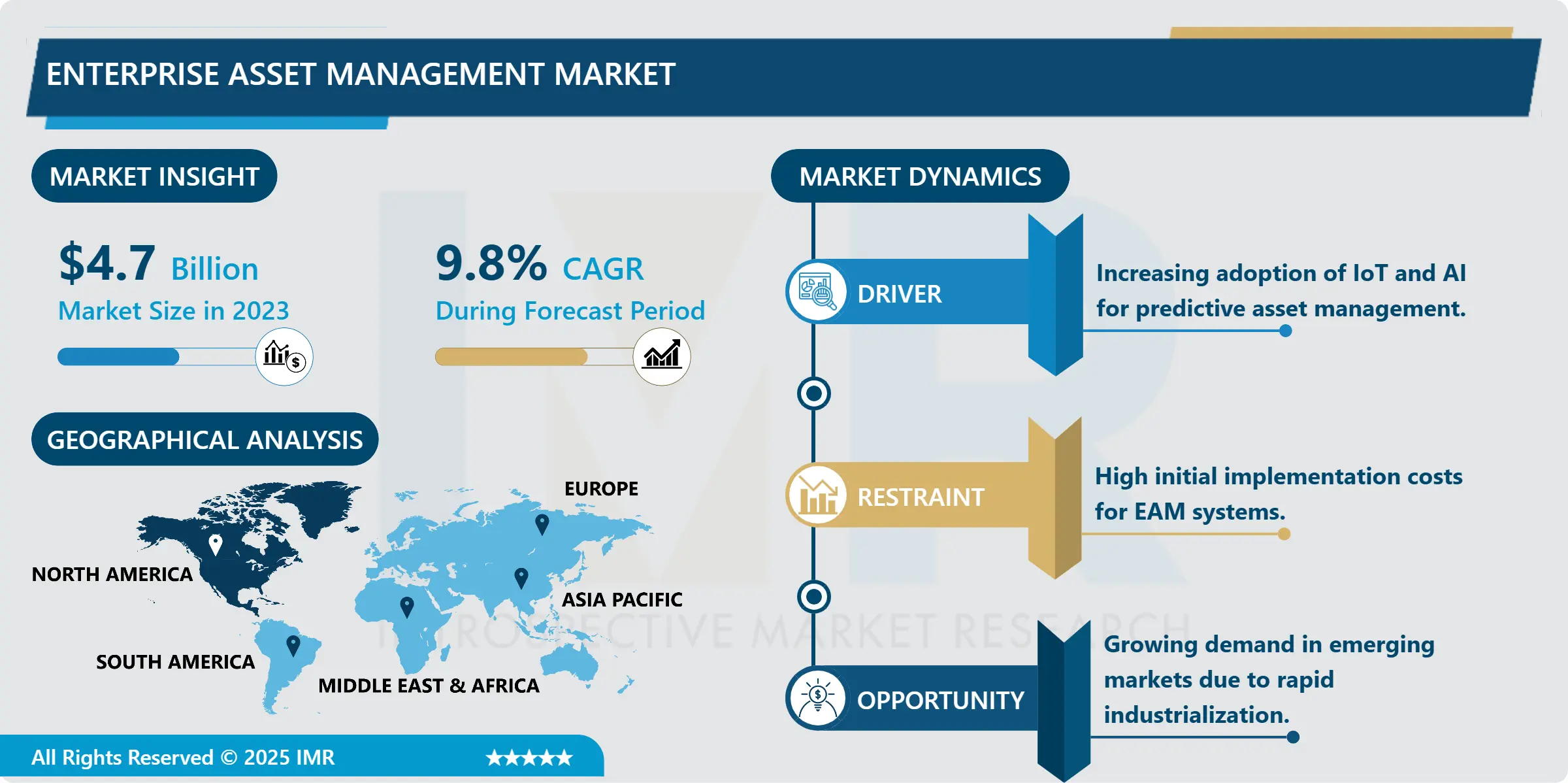
Enterprise Asset Management Market Industry Overview, Key Insights & Forecast to 2032
Enterprise Asset Management Market Size Was Valued at USD 4.7 Billion in 2023, and is Projected to Reach USD 10.90 Billion by 2032, Growing at a CAGR of 9.80% From 2024-2032.

IMR Group
Description
Enterprise Asset Management Market Synopsis
Enterprise Asset Management Market Size Was Valued at USD 4.7 Billion in 2023, and is Projected to Reach USD 10.90 Billion by 2032, Growing at a CAGR of 9.80% From 2024-2032.
Enterprise Asset Management (EAM) is defined as the business practice used by many organizations in order to manage the use of physical assets during their lifecycle. EAM systems connect various processes, tools, and methods encompassing data analyses and IoT, Artificial Intelligence, and cloud computing to improve the efficiency of asset operation, minimize time to failure, and adhere to the necessary standards and requirements.
Enterprise Asset Management (EAM) market has matured tremendously because of the need for better asset management systems and reduced unscheduled downtime. Companies are incorporating EAM solutions in an organization’s operational systems to achieve a competitive edge through effective operation and optimization of asset usage. Use of IoT sensors in equipment, substantial cloud computing and big data analytics allows real time monitoring of equipment, condition-based maintenance and decision making. They have divided the conventional asset management activities into complicated and computerized methodologies for increased dependability and functionality.
There is also increasing pressure from regulatory and sustainable requirements as an important factor. Many governments and organizations are concentrating on green projects; therefore, firms are implementing EAM solutions to save energy and keep minimal environmental impact. Besides, ageing of infrastructure and equipment in various industries has raised the need for efficient asset management in an effort to make extensive repairs and replacements expensive. The EAM market remains buoyant since organizations remain ever concerned with getting the optimal balance between the life cycle of their assets and the cost of improving that life cycle.
Enterprise Asset Management Market Trend Analysis
Digital Transformation Driving Predictive Asset Management
EAM are evolving, influenced by the convergence of digital technologies; one of them is predictive asset management. IoT, AI, and machine learning support predictive maintenance as a way to forecast when an organization’s equipment may fail and reduce the quantity of time lost to these issues. From this point of view, using IoT sensors, companies can gather information concerning the state of assets at any time and focus on temperature, pressure, and vibration.
The data from these sources are then pre-processed by use of AI analytics to identify patterns of anomaly or likely maintenance. Thus, this trend is highly useful in industries such as manufacturing, oil & gas and utilities that may suffer great losses in case of sudden downtime. Going forward, as more industries embark on the digital journey, predictive asset management will continue to find traction offering new opportunities for growth in EAM market.
Expansion in Emerging Markets
The opportunity that emerging markets offer can be regarded as a significant driver for the EAM market, mainly due to industrialization and infrastructure development. Smart cities investments are common amongst Asian-Pacific, Latin America, and the middle eastern countries in technology enhanced transportation and energy systems. These regions have started to implement EAM solutions to address the growing complexity of their asset base and achieve sustainability. In addition, governments in these regions are insisting in digitization and policies that support the adoption of sophisticated asset management technologies.
For example, the India government’s Digital India program or China’s Made in China 2025 are enabling EAM friendly conditions. The growth potential in these markets is great for those firms that design their products to reflect the needs of these markets for specific languages, affordable and scalable products, and language localization.
Enterprise Asset Management Market Segment Analysis:
Enterprise Asset Management Market Segmented on the basis Of Component, Application And Industry Vertical, and Region
By Component, software segment is expected to dominate the market during the forecast period
The software segment in the Enterprise Asset Management (EAM) market comprises a variety of applications that are developed to facilitate effective management of assets. They can include modules such as, assets tracking, inventory tracking, predictive maintenance modules and work order modules. With the help of IoT, AI, big data analytics and other advanced technologies EAM software has become efficient real time monitoring and decision tools. Solutions based on cloud are becoming more popular because of the ability to scale, integrate, and facilitate remote working, which are most benefited by manufacturers, utilities, and transport industries among others.
The services segment ensures that the EAM solutions are implemented, tailored and managed effectively throughout any organisation. Consulting, system integration, and training make up professional services that help organizations manage the effective implementation of EAM systems well. Outsourced services on the other hand, are arrangements whereby EAM functions are outsourced and a third party is hired to perform those tasks on behalf of the business to help them to achieve their central business objectives without having to worry about their assets. The growth in demand for specialized knowledge and increased levels of difficulty while implementing efficient asset management systems has rapidly increased the consumption of services most specifically by SMEs who are looking for low cost effective solutions.
By Application, Asset Lifecycle Management segment expected to held the largest share
Asset Lifecycle Management and Predictive Maintenance are two of the most important applications in the Enterprise Asset Management (EAM) market. Asset management life cycle concentrates on the enhancement of the usage of the asset from acquisition to disposal. Here one monitors performance of the asset, legal requirements, and upgrades in a bid to realize the return on investment. Based on efficiency of IoT and AI, the method predicts failures in the equipment, using real-time data on its condition. This application facilitates early detection of the problem, preventing further losses and stretching the life of the asset, which is crucial in manufacturing, energy and transport sectors.
Computer supported facility management applications help organization manage and optimally use spaces/areas, energy and resources in their establishment s. Inventory enables tracking of spare parts and materials, and their availability when needed for important functions in a company or hospital. Work order management improves the process of assigning and tracking them, completing and finalizing work orders, making work processes efficient. Labour management application assist in the scheduling of workers, monitoring of workers’ efficiency, and allocation of workers within the operational setup, all of which is very useful given the complex nature of large operations. Taken together, these application do help businesses to run smooth operation, compliance and cost control.
Enterprise Asset Management Market Regional Insights:
North America is Expected to Dominate the Market Over the Forecast period
The Enterprise Asset Management market was most concentrated in the North American region. The leadership in the region can be attributed to the technologically leading countries that have IoT and Cloud prove acceptance, EAM market major vendors. The United States has been the most leading nation, advocated by the robust capital on digital transformation projects across sectors like utilities, healthcare and transport.
Higher regulatory standards of working in North America have led to pressure on organizations to implement more advanced EAM solutions to meet these standard. Such strategies as sustainability and optimal use of energy in the region increase the need for modern practices in asset management. The rise in Focus on Predictive Maintenance and Real-Time Monitoring will ensure North America retains the status as the largest market for EAMs.
Active Key Players in the Enterprise Asset Management Market
ABB (Switzerland)
AssetWorks (USA)
CGI Inc. (Canada)
IBM Corporation (USA)
Infor (USA)
IFS (Sweden)
Oracle Corporation (USA)
Ramco Systems (India)
SAP SE (Germany)
Schneider Electric (France)
Siemens AG (Germany)
Trimble Inc. (USA)
Ultimo Software Solutions (Netherlands)
UpKeep (USA)
Wipro Limited (India)
Other key Players
Chapter 1: Introduction
1.1 Scope and Coverage
Chapter 2:Executive Summary
Chapter 3: Market Landscape
3.1 Market Dynamics
3.1.1 Drivers
3.1.2 Restraints
3.1.3 Opportunities
3.1.4 Challenges
3.2 Market Trend Analysis
3.3 PESTLE Analysis
3.4 Porter’s Five Forces Analysis
3.5 Industry Value Chain Analysis
3.6 Ecosystem
3.7 Regulatory Landscape
3.8 Price Trend Analysis
3.9 Patent Analysis
3.10 Technology Evolution
3.11 Investment Pockets
3.12 Import-Export Analysis
Chapter 4: Enterprise Asset Management Market by Component
4.1 Enterprise Asset Management Market Snapshot and Growth Engine
4.2 Enterprise Asset Management Market Overview
4.3 Software
4.3.1 Introduction and Market Overview
4.3.2 Historic and Forecasted Market Size in Value USD and Volume Units (2017-2032F)
4.3.3 Key Market Trends, Growth Factors and Opportunities
4.3.4 Software: Geographic Segmentation Analysis
4.4 Services (Professional and Managed Services)
4.4.1 Introduction and Market Overview
4.4.2 Historic and Forecasted Market Size in Value USD and Volume Units (2017-2032F)
4.4.3 Key Market Trends, Growth Factors and Opportunities
4.4.4 Services (Professional and Managed Services): Geographic Segmentation Analysis
Chapter 5: Enterprise Asset Management Market by Application
5.1 Enterprise Asset Management Market Snapshot and Growth Engine
5.2 Enterprise Asset Management Market Overview
5.3 Asset Lifecycle Management
5.3.1 Introduction and Market Overview
5.3.2 Historic and Forecasted Market Size in Value USD and Volume Units (2017-2032F)
5.3.3 Key Market Trends, Growth Factors and Opportunities
5.3.4 Asset Lifecycle Management: Geographic Segmentation Analysis
5.4 Inventory Management
5.4.1 Introduction and Market Overview
5.4.2 Historic and Forecasted Market Size in Value USD and Volume Units (2017-2032F)
5.4.3 Key Market Trends, Growth Factors and Opportunities
5.4.4 Inventory Management: Geographic Segmentation Analysis
5.5 Work Order Management
5.5.1 Introduction and Market Overview
5.5.2 Historic and Forecasted Market Size in Value USD and Volume Units (2017-2032F)
5.5.3 Key Market Trends, Growth Factors and Opportunities
5.5.4 Work Order Management: Geographic Segmentation Analysis
5.6 Labour Management
5.6.1 Introduction and Market Overview
5.6.2 Historic and Forecasted Market Size in Value USD and Volume Units (2017-2032F)
5.6.3 Key Market Trends, Growth Factors and Opportunities
5.6.4 Labour Management: Geographic Segmentation Analysis
5.7 Predictive Maintenance
5.7.1 Introduction and Market Overview
5.7.2 Historic and Forecasted Market Size in Value USD and Volume Units (2017-2032F)
5.7.3 Key Market Trends, Growth Factors and Opportunities
5.7.4 Predictive Maintenance: Geographic Segmentation Analysis
5.8 Facility Management
5.8.1 Introduction and Market Overview
5.8.2 Historic and Forecasted Market Size in Value USD and Volume Units (2017-2032F)
5.8.3 Key Market Trends, Growth Factors and Opportunities
5.8.4 Facility Management: Geographic Segmentation Analysis
Chapter 6: Enterprise Asset Management Market by Industry Vertical
6.1 Enterprise Asset Management Market Snapshot and Growth Engine
6.2 Enterprise Asset Management Market Overview
6.3 Manufacturing
6.3.1 Introduction and Market Overview
6.3.2 Historic and Forecasted Market Size in Value USD and Volume Units (2017-2032F)
6.3.3 Key Market Trends, Growth Factors and Opportunities
6.3.4 Manufacturing: Geographic Segmentation Analysis
6.4 Energy & Utilities
6.4.1 Introduction and Market Overview
6.4.2 Historic and Forecasted Market Size in Value USD and Volume Units (2017-2032F)
6.4.3 Key Market Trends, Growth Factors and Opportunities
6.4.4 Energy & Utilities: Geographic Segmentation Analysis
6.5 Healthcare
6.5.1 Introduction and Market Overview
6.5.2 Historic and Forecasted Market Size in Value USD and Volume Units (2017-2032F)
6.5.3 Key Market Trends, Growth Factors and Opportunities
6.5.4 Healthcare: Geographic Segmentation Analysis
6.6 Transportation & Logistics
6.6.1 Introduction and Market Overview
6.6.2 Historic and Forecasted Market Size in Value USD and Volume Units (2017-2032F)
6.6.3 Key Market Trends, Growth Factors and Opportunities
6.6.4 Transportation & Logistics: Geographic Segmentation Analysis
6.7 IT & Telecom
6.7.1 Introduction and Market Overview
6.7.2 Historic and Forecasted Market Size in Value USD and Volume Units (2017-2032F)
6.7.3 Key Market Trends, Growth Factors and Opportunities
6.7.4 IT & Telecom: Geographic Segmentation Analysis
6.8 Government & Public Sector
6.8.1 Introduction and Market Overview
6.8.2 Historic and Forecasted Market Size in Value USD and Volume Units (2017-2032F)
6.8.3 Key Market Trends, Growth Factors and Opportunities
6.8.4 Government & Public Sector: Geographic Segmentation Analysis
6.9 Education
6.9.1 Introduction and Market Overview
6.9.2 Historic and Forecasted Market Size in Value USD and Volume Units (2017-2032F)
6.9.3 Key Market Trends, Growth Factors and Opportunities
6.9.4 Education: Geographic Segmentation Analysis
6.10 Other Industries
6.10.1 Introduction and Market Overview
6.10.2 Historic and Forecasted Market Size in Value USD and Volume Units (2017-2032F)
6.10.3 Key Market Trends, Growth Factors and Opportunities
6.10.4 Other Industries: Geographic Segmentation Analysis
Chapter 7: Company Profiles and Competitive Analysis
7.1 Competitive Landscape
7.1.1 Competitive Benchmarking
7.1.2 Enterprise Asset Management Market Share by Manufacturer (2023)
7.1.3 Industry BCG Matrix
7.1.4 Heat Map Analysis
7.1.5 Mergers and Acquisitions
7.2 ABB (SWITZERLAND)
7.2.1 Company Overview
7.2.2 Key Executives
7.2.3 Company Snapshot
7.2.4 Role of the Company in the Market
7.2.5 Sustainability and Social Responsibility
7.2.6 Operating Business Segments
7.2.7 Product Portfolio
7.2.8 Business Performance
7.2.9 Key Strategic Moves and Recent Developments
7.2.10 SWOT Analysis
7.3 ASSETWORKS (USA)
7.4 CGI INC. (CANADA)
7.5 IBM CORPORATION (USA)
7.6 INFOR (USA)
7.7 IFS (SWEDEN)
7.8 ORACLE CORPORATION (USA)
7.9 RAMCO SYSTEMS (INDIA)
7.10 SAP SE (GERMANY)
7.11 SCHNEIDER ELECTRIC (FRANCE)
7.12 SIEMENS AG (GERMANY)
7.13 TRIMBLE INC. (USA)
7.14 ULTIMO SOFTWARE SOLUTIONS (NETHERLANDS)
7.15 UPKEEP (USA)
7.16 WIPRO LIMITED (INDIA)
7.17 OTHER ACTIVE PLAYERS
Chapter 8: Global Enterprise Asset Management Market By Region
8.1 Overview
8.2. North America Enterprise Asset Management Market
8.2.1 Key Market Trends, Growth Factors and Opportunities
8.2.2 Top Key Companies
8.2.3 Historic and Forecasted Market Size by Segments
8.2.4 Historic and Forecasted Market Size By Component
8.2.4.1 Software
8.2.4.2 Services (Professional and Managed Services)
8.2.5 Historic and Forecasted Market Size By Application
8.2.5.1 Asset Lifecycle Management
8.2.5.2 Inventory Management
8.2.5.3 Work Order Management
8.2.5.4 Labour Management
8.2.5.5 Predictive Maintenance
8.2.5.6 Facility Management
8.2.6 Historic and Forecasted Market Size By Industry Vertical
8.2.6.1 Manufacturing
8.2.6.2 Energy & Utilities
8.2.6.3 Healthcare
8.2.6.4 Transportation & Logistics
8.2.6.5 IT & Telecom
8.2.6.6 Government & Public Sector
8.2.6.7 Education
8.2.6.8 Other Industries
8.2.7 Historic and Forecast Market Size by Country
8.2.7.1 US
8.2.7.2 Canada
8.2.7.3 Mexico
8.3. Eastern Europe Enterprise Asset Management Market
8.3.1 Key Market Trends, Growth Factors and Opportunities
8.3.2 Top Key Companies
8.3.3 Historic and Forecasted Market Size by Segments
8.3.4 Historic and Forecasted Market Size By Component
8.3.4.1 Software
8.3.4.2 Services (Professional and Managed Services)
8.3.5 Historic and Forecasted Market Size By Application
8.3.5.1 Asset Lifecycle Management
8.3.5.2 Inventory Management
8.3.5.3 Work Order Management
8.3.5.4 Labour Management
8.3.5.5 Predictive Maintenance
8.3.5.6 Facility Management
8.3.6 Historic and Forecasted Market Size By Industry Vertical
8.3.6.1 Manufacturing
8.3.6.2 Energy & Utilities
8.3.6.3 Healthcare
8.3.6.4 Transportation & Logistics
8.3.6.5 IT & Telecom
8.3.6.6 Government & Public Sector
8.3.6.7 Education
8.3.6.8 Other Industries
8.3.7 Historic and Forecast Market Size by Country
8.3.7.1 Russia
8.3.7.2 Bulgaria
8.3.7.3 The Czech Republic
8.3.7.4 Hungary
8.3.7.5 Poland
8.3.7.6 Romania
8.3.7.7 Rest of Eastern Europe
8.4. Western Europe Enterprise Asset Management Market
8.4.1 Key Market Trends, Growth Factors and Opportunities
8.4.2 Top Key Companies
8.4.3 Historic and Forecasted Market Size by Segments
8.4.4 Historic and Forecasted Market Size By Component
8.4.4.1 Software
8.4.4.2 Services (Professional and Managed Services)
8.4.5 Historic and Forecasted Market Size By Application
8.4.5.1 Asset Lifecycle Management
8.4.5.2 Inventory Management
8.4.5.3 Work Order Management
8.4.5.4 Labour Management
8.4.5.5 Predictive Maintenance
8.4.5.6 Facility Management
8.4.6 Historic and Forecasted Market Size By Industry Vertical
8.4.6.1 Manufacturing
8.4.6.2 Energy & Utilities
8.4.6.3 Healthcare
8.4.6.4 Transportation & Logistics
8.4.6.5 IT & Telecom
8.4.6.6 Government & Public Sector
8.4.6.7 Education
8.4.6.8 Other Industries
8.4.7 Historic and Forecast Market Size by Country
8.4.7.1 Germany
8.4.7.2 UK
8.4.7.3 France
8.4.7.4 The Netherlands
8.4.7.5 Italy
8.4.7.6 Spain
8.4.7.7 Rest of Western Europe
8.5. Asia Pacific Enterprise Asset Management Market
8.5.1 Key Market Trends, Growth Factors and Opportunities
8.5.2 Top Key Companies
8.5.3 Historic and Forecasted Market Size by Segments
8.5.4 Historic and Forecasted Market Size By Component
8.5.4.1 Software
8.5.4.2 Services (Professional and Managed Services)
8.5.5 Historic and Forecasted Market Size By Application
8.5.5.1 Asset Lifecycle Management
8.5.5.2 Inventory Management
8.5.5.3 Work Order Management
8.5.5.4 Labour Management
8.5.5.5 Predictive Maintenance
8.5.5.6 Facility Management
8.5.6 Historic and Forecasted Market Size By Industry Vertical
8.5.6.1 Manufacturing
8.5.6.2 Energy & Utilities
8.5.6.3 Healthcare
8.5.6.4 Transportation & Logistics
8.5.6.5 IT & Telecom
8.5.6.6 Government & Public Sector
8.5.6.7 Education
8.5.6.8 Other Industries
8.5.7 Historic and Forecast Market Size by Country
8.5.7.1 China
8.5.7.2 India
8.5.7.3 Japan
8.5.7.4 South Korea
8.5.7.5 Malaysia
8.5.7.6 Thailand
8.5.7.7 Vietnam
8.5.7.8 The Philippines
8.5.7.9 Australia
8.5.7.10 New Zealand
8.5.7.11 Rest of APAC
8.6. Middle East & Africa Enterprise Asset Management Market
8.6.1 Key Market Trends, Growth Factors and Opportunities
8.6.2 Top Key Companies
8.6.3 Historic and Forecasted Market Size by Segments
8.6.4 Historic and Forecasted Market Size By Component
8.6.4.1 Software
8.6.4.2 Services (Professional and Managed Services)
8.6.5 Historic and Forecasted Market Size By Application
8.6.5.1 Asset Lifecycle Management
8.6.5.2 Inventory Management
8.6.5.3 Work Order Management
8.6.5.4 Labour Management
8.6.5.5 Predictive Maintenance
8.6.5.6 Facility Management
8.6.6 Historic and Forecasted Market Size By Industry Vertical
8.6.6.1 Manufacturing
8.6.6.2 Energy & Utilities
8.6.6.3 Healthcare
8.6.6.4 Transportation & Logistics
8.6.6.5 IT & Telecom
8.6.6.6 Government & Public Sector
8.6.6.7 Education
8.6.6.8 Other Industries
8.6.7 Historic and Forecast Market Size by Country
8.6.7.1 Turkiye
8.6.7.2 Bahrain
8.6.7.3 Kuwait
8.6.7.4 Saudi Arabia
8.6.7.5 Qatar
8.6.7.6 UAE
8.6.7.7 Israel
8.6.7.8 South Africa
8.7. South America Enterprise Asset Management Market
8.7.1 Key Market Trends, Growth Factors and Opportunities
8.7.2 Top Key Companies
8.7.3 Historic and Forecasted Market Size by Segments
8.7.4 Historic and Forecasted Market Size By Component
8.7.4.1 Software
8.7.4.2 Services (Professional and Managed Services)
8.7.5 Historic and Forecasted Market Size By Application
8.7.5.1 Asset Lifecycle Management
8.7.5.2 Inventory Management
8.7.5.3 Work Order Management
8.7.5.4 Labour Management
8.7.5.5 Predictive Maintenance
8.7.5.6 Facility Management
8.7.6 Historic and Forecasted Market Size By Industry Vertical
8.7.6.1 Manufacturing
8.7.6.2 Energy & Utilities
8.7.6.3 Healthcare
8.7.6.4 Transportation & Logistics
8.7.6.5 IT & Telecom
8.7.6.6 Government & Public Sector
8.7.6.7 Education
8.7.6.8 Other Industries
8.7.7 Historic and Forecast Market Size by Country
8.7.7.1 Brazil
8.7.7.2 Argentina
8.7.7.3 Rest of SA
Chapter 9 Analyst Viewpoint and Conclusion
9.1 Recommendations and Concluding Analysis
9.2 Potential Market Strategies
Chapter 10 Research Methodology
10.1 Research Process
10.2 Primary Research
10.3 Secondary Research
Q1: What would be the forecast period in the Enterprise Asset Management Market research report?
A1: The forecast period in the Enterprise Asset Management Market research report is 2024-2032.
Q2: Who are the key players in the Enterprise Asset Management Market?
A2: ABB (Switzerland), AssetWorks (USA), CGI Inc. (Canada), IBM Corporation (USA), Infor (USA), IFS (Sweden), Oracle Corporation (USA), Ramco Systems (India), SAP SE (Germany), Schneider Electric (France), Siemens AG (Germany), Trimble Inc. (USA), Ultimo Software Solutions (Netherlands), UpKeep (USA), Wipro Limited (India) and Other Active Players.
Q3: What are the segments of the Enterprise Asset Management Market?
A3: The Enterprise Asset Management Market is segmented into component, Application, by industry vertical and region. by Component market is categorized into (Software, Services (Professional and Managed Services)), Application market is categorized into (Asset Lifecycle Management, Inventory Management, Work Order Management, Labour Management, Predictive Maintenance, Facility Management), By Industry Vertical, market is categorized into (Manufacturing, Energy & Utilities, Healthcare, Transportation & Logistics, IT & Telecom, Government & Public Sector, Education, Other Industries). By Region, it is analyzed across North America (U.S., Canada, Mexico), Eastern Europe (Russia, Bulgaria, The Czech Republic, Hungary, Poland, Romania, Rest of Eastern Europe), Western Europe (Germany, UK, France, Netherlands, Italy, Spain, Rest of Western Europe), Asia Pacific (China, India, Japan, South Korea, Malaysia, Thailand, Vietnam, The Philippines, Australia, New-Zealand, Rest of APAC), Middle East & Africa (Turkiye, Bahrain, Kuwait, Saudi Arabia, Qatar, UAE, Israel, South Africa), South America (Brazil, Argentina, Rest of SA)
Q4: What is the Enterprise Asset Management Market?
A4: Enterprise Asset Management (EAM) is defined as the business practice used by many organizations in order to manage the use of physical assets during their lifecycle. EAM systems connect various processes, tools, and methods encompassing data analyses and IoT, Artificial Intelligence, and cloud computing to improve the efficiency of asset operation, minimize time to failure, and adhere to the necessary standards and requirements.
Q5: How big is the Enterprise Asset Management Market?
A5: Enterprise Asset Management Market Size Was Valued at USD 4.7 Billion in 2023, and is Projected to Reach USD 10.90 Billion by 2032, Growing at a CAGR of 9.80% From 2024-2032.
How to Buy a Report from eminsights.jp
On the product page, choose the license you want: Single-User License, Multi-User License or Enterprise License.
If you required report in your native language, then you can click on Translated Report button and fill out the form with report name and language you want, then our team will contact you as soon as possible.
Click the Buy Now button.
You will be redirected to the checkout page. Enter your company details and payment information.
Click Place Order to complete the purchase.
Confirmation: You’ll receive an order confirmation and our team will contact you shortly with your ordered report.
If you have any questions, fill out the contact form below or email us at [email protected].
Thank you for choosing eminsights.jp!