Stay Ahead in Fast-Growing Economies.
Browse Reports Now




Smart Food Logistics Market Opportunities, Challenges & Strategic Forecast (2024-2032)
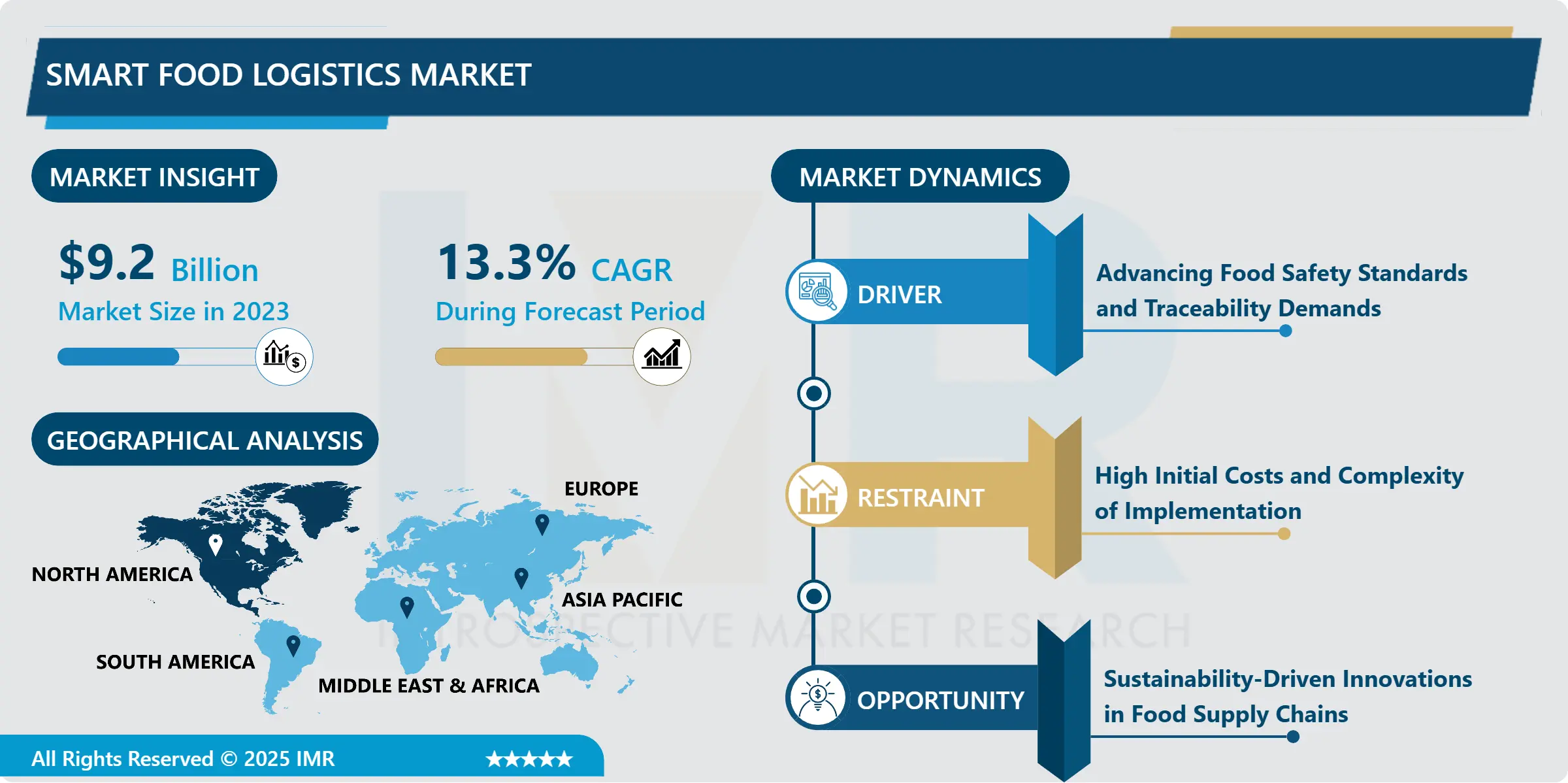
Smart Food Logistics Market Size Was Valued at USD 9.20 Billion in 2023, and is Projected to Reach USD 28.30 Billion by 2032, Growing at a CAGR of 13.30% From 2024-2032.

IMR Group
Description
Smart Food Logistics Market Synopsis:
Smart Food Logistics Market Size Was Valued at USD 9.20 Billion in 2023, and is Projected to Reach USD 28.30 Billion by 2032, Growing at a CAGR of 13.30% From 2024-2032.
The Smart Food Logistics Market could be defined as the processes and solutions used for IoT, AI, blockchain, and big data on the food supply chain that help to optimize food logistics processes and ensure transparent and punctual delivery of food products. This market is centered on issues such as making logistics processes efficient and reducing foods spoilage and tracking items as they undergo the distribution channel.
Enhancing Food Safety and Traceability: Improvised awareness over the food quality has created the need for the monitoring solutions in the food logistics sector. National and international authorities are imposing severe safety requirements, promoting the use of smart technologies that guarantee compliance and openness. The increasing incidences of food borne diseases have even put more revelance to the extraodinary logistics systems that can trace products from production to the shelves.
The advancement of online grocery buying and home delivery solutions has sharply boosted the need for effective logistics solutions. Various e-commerce platforms based on technologies that will help to deliver customers’ fresh and quality food expectations. Also, the increased cross-border transportation of fresh produce such as fruits and vegetables, dairy products and meats among others have required that logistics solutions for temperature regulated and controlled transport and warehousing.
Smart Food Logistics Market Trend Analysis:
AI and IoT in Logistics Optimization
Integration of Blockchain for Transparency: Application of blockchain technology is on the rise to improve the traceability of food products and to eradicate fraud within the supply chain. It also allows stakeholders to confirm the genuineness and transit of the food products throughout the supply chain, and hence a guarantee of accuracy. In consumer products, blockchain is being adopted to foster consumer trust as well as implement sustainable practices by giving right information on sourcing of products.
The integration of AI and IoT technologies is revolutionizing food logistics providing the capacity to forecast demand, optimize delivery routes and many others. Intelligent sensors and connected things help in monitoring the climate as a result minimize the wastage and use of products optimally. These technologies are at the center of enabling innovation and greater efficiency through the logistics chain.
Sustainability Initiatives in Food Supply Chains
The Asia-Pacific and the Latin America regions are the most attractive regions for the smart food logistics market. Growth in urban populations, increasing per capita income, and increasing use of online businesses are key factors increasing the need for effective supply chain services. These governments are also putting their money into infrastructure that would foster more sophisticated supply chains.
Rising awareness of global sustainability, smart food logistics solutions are being essential in making an impact in cutting down on food wastage and decrease the carbon footprint of supply chains. Firms that have started implementing sustainable supply chain practices are benefiting from incentives and clinching the PR environment consumers’ base for growth.
Smart Food Logistics Market Segment Analysis:
Smart Food Logistics Market is Segmented on the basis of Components, Technology, Application, End User, and Region.
By Component, Services segment is expected to dominate the market during the forecast period
The smart food logistics market has been categorized by hardware, software, and service. It includes the physical equipment such as the sensors, tracking devices and RFID equipment needed when tracking and managing food products. While logistic software solutions are based on analytics, supply chain management, and fleet tracking for an efficient operation. Consulting, integration, and maintenance are all considered services because they cover everything needed to deploy smart logistics systems.
By Application, Food Monitoring and Tracking segment expected to held the largest share
The areas of smart food logistics are food monitoring and tracking, inventory management, fleet management among others. Food monitoring guarantees product status awareness and conformity to appropriate safety standards at any specific point in the supply chain. It regulates the level of stock in the store, and minimizes loss through adjustments of orders, lead time, and reorder point. Fleet management includes route planning and automatic-pro tracking for on-time delivery while some other applications cover tailored SCM needs.
Smart Food Logistics Market Regional Insights:
North America is Expected to Dominate the Market Over the Forecast period
North America has a great market share in smart food logistics due to the early implementation of technologies and having a strong supply chain. The involvement of strong players of IoT and integration, and high investments in AI have boosted the region. The specific country profiles by market demand are presented for the United States due to impressive e-commerce indicators and strict food safety requirements.
The prime motivation for developing smart logistics in the region is compliance with waste reduction in food and global standards. Technologies like traceability and accountability through blockchain technology, and inventory optimization through artificial intelligence have been adopted across the supply chain by retailers and manufacturers making North America as the market leader.
Active Key Players in the Smart Food Logistics Market
Honeywell International Inc. (USA)
IBM Corporation (USA)
Oracle Corporation (USA)
Panasonic Corporation (Japan)
SAP SE (Germany)
Sensitech, Inc. (USA)
Siemens AG (Germany)
Tech Mahindra (India)
Trimble Inc. (USA)
Zebra Technologies (USA)
Other Active Players.
Chapter 1: Introduction
1.1 Scope and Coverage
Chapter 2:Executive Summary
Chapter 3: Market Landscape
3.1 Market Dynamics
3.1.1 Drivers
3.1.2 Restraints
3.1.3 Opportunities
3.1.4 Challenges
3.2 Market Trend Analysis
3.3 PESTLE Analysis
3.4 Porter’s Five Forces Analysis
3.5 Industry Value Chain Analysis
3.6 Ecosystem
3.7 Regulatory Landscape
3.8 Price Trend Analysis
3.9 Patent Analysis
3.10 Technology Evolution
3.11 Investment Pockets
3.12 Import-Export Analysis
Chapter 4: Smart Food Logistics Market by Component
4.1 Smart Food Logistics Market Snapshot and Growth Engine
4.2 Smart Food Logistics Market Overview
4.3 Hardware
4.3.1 Introduction and Market Overview
4.3.2 Historic and Forecasted Market Size in Value USD and Volume Units (2017-2032F)
4.3.3 Key Market Trends, Growth Factors and Opportunities
4.3.4 Hardware: Geographic Segmentation Analysis
4.4 Software
4.4.1 Introduction and Market Overview
4.4.2 Historic and Forecasted Market Size in Value USD and Volume Units (2017-2032F)
4.4.3 Key Market Trends, Growth Factors and Opportunities
4.4.4 Software: Geographic Segmentation Analysis
4.5 Services
4.5.1 Introduction and Market Overview
4.5.2 Historic and Forecasted Market Size in Value USD and Volume Units (2017-2032F)
4.5.3 Key Market Trends, Growth Factors and Opportunities
4.5.4 Services: Geographic Segmentation Analysis
Chapter 5: Smart Food Logistics Market by Technology
5.1 Smart Food Logistics Market Snapshot and Growth Engine
5.2 Smart Food Logistics Market Overview
5.3 Wireless
5.3.1 Introduction and Market Overview
5.3.2 Historic and Forecasted Market Size in Value USD and Volume Units (2017-2032F)
5.3.3 Key Market Trends, Growth Factors and Opportunities
5.3.4 Wireless: Geographic Segmentation Analysis
5.4 Wired
5.4.1 Introduction and Market Overview
5.4.2 Historic and Forecasted Market Size in Value USD and Volume Units (2017-2032F)
5.4.3 Key Market Trends, Growth Factors and Opportunities
5.4.4 Wired: Geographic Segmentation Analysis
Chapter 6: Smart Food Logistics Market by End User
6.1 Smart Food Logistics Market Snapshot and Growth Engine
6.2 Smart Food Logistics Market Overview
6.3 Residential
6.3.1 Introduction and Market Overview
6.3.2 Historic and Forecasted Market Size in Value USD and Volume Units (2017-2032F)
6.3.3 Key Market Trends, Growth Factors and Opportunities
6.3.4 Residential: Geographic Segmentation Analysis
6.4 Commercial
6.4.1 Introduction and Market Overview
6.4.2 Historic and Forecasted Market Size in Value USD and Volume Units (2017-2032F)
6.4.3 Key Market Trends, Growth Factors and Opportunities
6.4.4 Commercial: Geographic Segmentation Analysis
6.5 Industrial
6.5.1 Introduction and Market Overview
6.5.2 Historic and Forecasted Market Size in Value USD and Volume Units (2017-2032F)
6.5.3 Key Market Trends, Growth Factors and Opportunities
6.5.4 Industrial: Geographic Segmentation Analysis
Chapter 7: Company Profiles and Competitive Analysis
7.1 Competitive Landscape
7.1.1 Competitive Benchmarking
7.1.2 Smart Food Logistics Market Share by Manufacturer (2023)
7.1.3 Industry BCG Matrix
7.1.4 Heat Map Analysis
7.1.5 Mergers and Acquisitions
7.2 IBM CORPORATION (USA)
7.2.1 Company Overview
7.2.2 Key Executives
7.2.3 Company Snapshot
7.2.4 Role of the Company in the Market
7.2.5 Sustainability and Social Responsibility
7.2.6 Operating Business Segments
7.2.7 Product Portfolio
7.2.8 Business Performance
7.2.9 Key Strategic Moves and Recent Developments
7.2.10 SWOT Analysis
7.3 ORACLE CORPORATION (USA)
7.4 SAP SE (GERMANY)
7.5 SIEMENS AG (GERMANY)
7.6 ZEBRA TECHNOLOGIES (USA)
7.7 TRIMBLE INC. (USA)
7.8 HONEYWELL INTERNATIONAL INC. (USA)
7.9 SENSITECH INC. (USA)
7.10 PANASONIC CORPORATION (JAPAN)
7.11 TECH MAHINDRA (INDIA)
7.12 OTHER ACTIVE PLAYERS
Chapter 8: Global Smart Food Logistics Market By Region
8.1 Overview
8.2. North America Smart Food Logistics Market
8.2.1 Key Market Trends, Growth Factors and Opportunities
8.2.2 Top Key Companies
8.2.3 Historic and Forecasted Market Size by Segments
8.2.4 Historic and Forecasted Market Size By Component
8.2.4.1 Hardware
8.2.4.2 Software
8.2.4.3 Services
8.2.5 Historic and Forecasted Market Size By Technology
8.2.5.1 Wireless
8.2.5.2 Wired
8.2.6 Historic and Forecasted Market Size By End User
8.2.6.1 Residential
8.2.6.2 Commercial
8.2.6.3 Industrial
8.2.7 Historic and Forecast Market Size by Country
8.2.7.1 US
8.2.7.2 Canada
8.2.7.3 Mexico
8.3. Eastern Europe Smart Food Logistics Market
8.3.1 Key Market Trends, Growth Factors and Opportunities
8.3.2 Top Key Companies
8.3.3 Historic and Forecasted Market Size by Segments
8.3.4 Historic and Forecasted Market Size By Component
8.3.4.1 Hardware
8.3.4.2 Software
8.3.4.3 Services
8.3.5 Historic and Forecasted Market Size By Technology
8.3.5.1 Wireless
8.3.5.2 Wired
8.3.6 Historic and Forecasted Market Size By End User
8.3.6.1 Residential
8.3.6.2 Commercial
8.3.6.3 Industrial
8.3.7 Historic and Forecast Market Size by Country
8.3.7.1 Russia
8.3.7.2 Bulgaria
8.3.7.3 The Czech Republic
8.3.7.4 Hungary
8.3.7.5 Poland
8.3.7.6 Romania
8.3.7.7 Rest of Eastern Europe
8.4. Western Europe Smart Food Logistics Market
8.4.1 Key Market Trends, Growth Factors and Opportunities
8.4.2 Top Key Companies
8.4.3 Historic and Forecasted Market Size by Segments
8.4.4 Historic and Forecasted Market Size By Component
8.4.4.1 Hardware
8.4.4.2 Software
8.4.4.3 Services
8.4.5 Historic and Forecasted Market Size By Technology
8.4.5.1 Wireless
8.4.5.2 Wired
8.4.6 Historic and Forecasted Market Size By End User
8.4.6.1 Residential
8.4.6.2 Commercial
8.4.6.3 Industrial
8.4.7 Historic and Forecast Market Size by Country
8.4.7.1 Germany
8.4.7.2 UK
8.4.7.3 France
8.4.7.4 The Netherlands
8.4.7.5 Italy
8.4.7.6 Spain
8.4.7.7 Rest of Western Europe
8.5. Asia Pacific Smart Food Logistics Market
8.5.1 Key Market Trends, Growth Factors and Opportunities
8.5.2 Top Key Companies
8.5.3 Historic and Forecasted Market Size by Segments
8.5.4 Historic and Forecasted Market Size By Component
8.5.4.1 Hardware
8.5.4.2 Software
8.5.4.3 Services
8.5.5 Historic and Forecasted Market Size By Technology
8.5.5.1 Wireless
8.5.5.2 Wired
8.5.6 Historic and Forecasted Market Size By End User
8.5.6.1 Residential
8.5.6.2 Commercial
8.5.6.3 Industrial
8.5.7 Historic and Forecast Market Size by Country
8.5.7.1 China
8.5.7.2 India
8.5.7.3 Japan
8.5.7.4 South Korea
8.5.7.5 Malaysia
8.5.7.6 Thailand
8.5.7.7 Vietnam
8.5.7.8 The Philippines
8.5.7.9 Australia
8.5.7.10 New Zealand
8.5.7.11 Rest of APAC
8.6. Middle East & Africa Smart Food Logistics Market
8.6.1 Key Market Trends, Growth Factors and Opportunities
8.6.2 Top Key Companies
8.6.3 Historic and Forecasted Market Size by Segments
8.6.4 Historic and Forecasted Market Size By Component
8.6.4.1 Hardware
8.6.4.2 Software
8.6.4.3 Services
8.6.5 Historic and Forecasted Market Size By Technology
8.6.5.1 Wireless
8.6.5.2 Wired
8.6.6 Historic and Forecasted Market Size By End User
8.6.6.1 Residential
8.6.6.2 Commercial
8.6.6.3 Industrial
8.6.7 Historic and Forecast Market Size by Country
8.6.7.1 Turkiye
8.6.7.2 Bahrain
8.6.7.3 Kuwait
8.6.7.4 Saudi Arabia
8.6.7.5 Qatar
8.6.7.6 UAE
8.6.7.7 Israel
8.6.7.8 South Africa
8.7. South America Smart Food Logistics Market
8.7.1 Key Market Trends, Growth Factors and Opportunities
8.7.2 Top Key Companies
8.7.3 Historic and Forecasted Market Size by Segments
8.7.4 Historic and Forecasted Market Size By Component
8.7.4.1 Hardware
8.7.4.2 Software
8.7.4.3 Services
8.7.5 Historic and Forecasted Market Size By Technology
8.7.5.1 Wireless
8.7.5.2 Wired
8.7.6 Historic and Forecasted Market Size By End User
8.7.6.1 Residential
8.7.6.2 Commercial
8.7.6.3 Industrial
8.7.7 Historic and Forecast Market Size by Country
8.7.7.1 Brazil
8.7.7.2 Argentina
8.7.7.3 Rest of SA
Chapter 9 Analyst Viewpoint and Conclusion
9.1 Recommendations and Concluding Analysis
9.2 Potential Market Strategies
Chapter 10 Research Methodology
10.1 Research Process
10.2 Primary Research
10.3 Secondary Research
Q1: What would be the forecast period in the Smart Food Logistics Market research report?
A1: The forecast period in the Smart Food Logistics Market research report is 2024-2032.
Q2: Who are the key players in the Smart Food Logistics Market?
A2: •IBM Corporation (USA), Oracle Corporation (USA), SAP SE (Germany), Siemens AG (Germany), Zebra Technologies (USA), Trimble Inc. (USA), Honeywell International Inc. (USA), Sensitech, Inc. (USA), Panasonic Corporation (Japan), Tech Mahindra (India). and Other Active Players.
Q3: What are the segments of the Smart Food Logistics Market?
A3: The Smart Food Logistics Market is segmented into by Component (Hardware, Software, Services), By Technology (IoT, Artificial Intelligence (AI), Blockchain, Big Data Analytics), Application (Food Monitoring and Tracking, Inventory Management, Fleet Management, Others), End User (Food Manufacturers, Retailers, Restaurants and Food Service Providers, Logistics Providers). By region, it is analyzed across North America (U.S., Canada, Mexico), Eastern Europe (Russia, Bulgaria, The Czech Republic, Hungary, Poland, Romania, Rest of Eastern Europe), Western Europe (Germany, UK, France, The Netherlands, Italy, Russia, Spain, Rest of Western Europe), Asia Pacific (China, India, Japan, South Korea, Malaysia, Thailand, Vietnam, The Philippines, Australia, New-Zealand, Rest of APAC), Middle East & Africa (Turkiye, Bahrain, Kuwait, Saudi Arabia, Qatar, UAE, Israel, South Africa), South America (Brazil, Argentina, Rest of SA).
Q4: What is the Smart Food Logistics Market?
A4: The Smart Food Logistics Market could be defined as the processes and solutions used for IoT, AI, blockchain, and big data on the food supply chain that help to optimize food logistics processes and ensure transparent and punctual delivery of food products. This market is centered on issues such as making logistics processes efficient and reducing foods spoilage and tracking items as they undergo the distribution channel.
Q5: How big is the Smart Food Logistics Market?
A5: Smart Food Logistics Market Size Was Valued at USD 9.20 Billion in 2023, and is Projected to Reach USD 28.30 Billion by 2032, Growing at a CAGR of 13.30% From 2024-2032.
How to Buy a Report from eminsights.jp
On the product page, choose the license you want: Single-User License, Multi-User License or Enterprise License.
If you required report in your native language, then you can click on Translated Report button and fill out the form with report name and language you want, then our team will contact you as soon as possible.
Click the Buy Now button.
You will be redirected to the checkout page. Enter your company details and payment information.
Click Place Order to complete the purchase.
Confirmation: You’ll receive an order confirmation and our team will contact you shortly with your ordered report.
If you have any questions, fill out the contact form below or email us at [email protected].
Thank you for choosing eminsights.jp!