Stay Ahead in Fast-Growing Economies.
Browse Reports Now
Coffee Beauty Products Market Size, Share, Growth & Forecast (2024-2032)
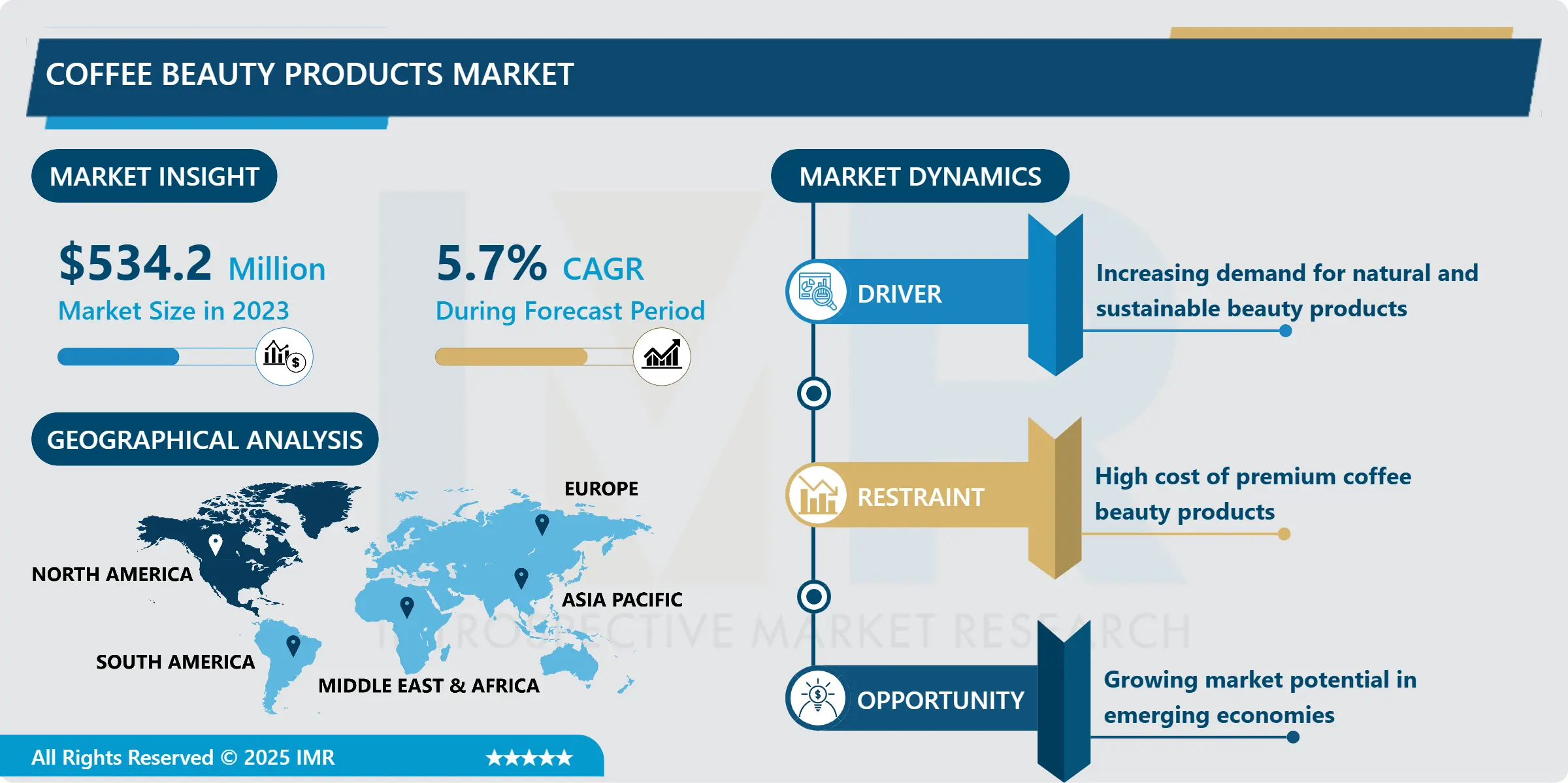
Coffee Beauty Products Market Size Was Valued at USD 534.2 Million in 2023, and is Projected to Reach USD 879.79 Million by 2032, Growing at a CAGR of 5.7% From 2024-2032.

IMR Group
Description
Coffee Beauty Products Market Synopsis:
Coffee Beauty Products Market Size Was Valued at USD 534.2 Million in 2023, and is Projected to Reach USD 879.79 Million by 2032, Growing at a CAGR of 5.7% From 2024-2032.
This report covers the beauty and personal care products market specifically created and based on coffee or having coffee content in it. These products exploit the favorable characteristics of coffee, including; antioxidant, anti-inflammatory, and an excellent exfoliating, which has made it favored in the skincare, hair and body products. Coffee is incorporated in everything from lotions, peels, facial masks, shampoos, and conditioners that join the overgrowing call for organic and eco-friendly products. The market is spurred by growth of consumer awareness on the importance of natural products, the improving standards of living, and the rapid development of the beauty and personal care segment across the world.
Recent years see the Coffee Beauty Products Market achieving high growth as the consumer preference for naturally and organically produced personal care products grows rapidly. Coffee as an ingredient is remembered to have crucial benefits for skins, such as promoting the circulation of blood in skin tissue, minimizing cellulite formation and combating radical forms of oxygen. This has made it to be used widely in product categories that address various needs of the consumers including anti-aging creams and scrubs. Here, an increased concern of customers toward environmentally-friendly products has pressed manufacturers to bring beauty products that embrace the green concept and nationhood and are made from organic materials in making coffee beauty products to meet the rising demand.
Market is also skewed by relatively large number of small, artisanal brands, which poses common coffee-based formulations. These are niche players and they are profiting from the clean beauty concept and have well anchored themselves in the market hence rivaling well established global brands. In addition, the increasing number of e-commerce sites available has also helped consumers to access several types of coffee product use in beauty enhancement thus increasing the market. As for new markets, Asia-Pacific and Latin America are highly promising not only because of a constantly expanding middle class but also increased beauty sensitivity.
Coffee Beauty Products Market Trend Analysis:
Rising Popularity of Sustainable and Clean Beauty Products
Another important trend currently driving the Coffee Beauty Products Market is the consumer interest for the green beauty or clean beauty products. Customers more and more expect to see environmentally sensitive packaging, sustainably sourced coffee ingredients, and no paraben and sulfate present in the brand. A similar trend has significantly risen and influenced brands to infuse organic or fair-trade coffee products along with biodegradable or recyclable packing. Also, the tendency to utilize coffee waste from cafes and coffee roasters to make beauty products has been developed, which is useful for both the environmental-friendly buyers and the companies which do not want to waste money on collecting coffee waste.
Expansion into Emerging Markets
New markets have tremendous potential in the Asia-Pacific, the Middle East, and Latin American region for the growth of Coffee Beauty Products Market. These regions are experiencing increased demand for better personal care products in view of factors such as improve disposable income, increased urbanization, the growing population of the youthful and beauty conscious and the growing population. Also, people in these regions are becoming more conscious of effects of using natural products which makes coffee products one of the best. A social marketing strategy, partners and influencers within these key markets, as well as engaging and effective e-commerce tools can be useful in reaching out to these potentially attractive markets and expanding brand’s revenue streams.
Coffee Beauty Products Market Segment Analysis:
Coffee Beauty Products Market is Segmented on the basis of Product, Distribution Channel, and Region.
By Product, Skincare, Haircare segment is expected to dominate the market during the forecast period
Hence, it could be stated that during the forecast period, the skincare segment is expected to lead the Coffee Beauty Products Market based on the utilization of coffee for skin improvement and restoration endeavours. Drinks containing caffeine are expensive, popular, and helpful for the fight against swelling, skin imperfections, and premature aging. Such convenience coupled with the increasing consumer preference towards natural and environment friendly cosmetic products has fuelled the growth of this segment still further.
Coffee also extends to haircare where hair care products that contain coffee are dominating market mainly due to growing awareness of natural solutions for scalp and hair problems. This property of coffee has ensured it is used in shampoos and conditioners to stimulate hair follicles and increase the blood flow. This segment is anticipated to grow at a stable rate and to equally contribute towards the market growth due to improving consumer awareness of the benefits of coffee in hair care.
By Distribution Channel, Supermarkets/Hypermarkets segment expected to held the largest share
The supermarkets/hypermarkets segment is expected to continue to dominate the Coffee Beauty Products Market. This dominance can be blamed on the accessibility that is associated with these types of retail channels that enables consumers to sample and purchase beauty products from coffee. Product promotions also come through flier distributions and other advertisement techniques as well as seasonal sales, making supermarkets and hypermarkets the most preferred centers by buyers who wish to buy groceries at a cheaper price.
Besides, the increased popularity of the organized retail in the emergent markets also helpedOpened in the segment expansion. In terms of sales, there is great possibility that the supermarkets/hypermarkets retail channel will continue to dominate, especially as more global and regional players invest in this market. The physical establishment of these stores enables customers to get a feel of the products hence gain confidence and also make them place an order.
Coffee Beauty Products Market Regional Insights:
North America is Expected to Dominate the Market Over the Forecast period
North America region seized the highest percentage share in the global coffee beauty products market in 2023 at about 35 percent. The leadership position of the region is due to better consumer knowledge of the advantages of having beauty products that have ingredients sourced from coffee; better buying power; and better spending propensity on some quality beauty products. The US market has taken a significant position by the popularity of key brands, the developing clean beauty concept, and a developed retail distribution network. In addition, the increase in the consumer base of sustainable and organic coffee beauty products in the region has caused North America to be in the forefront in the markets.
Active Key Players in the Coffee Beauty Products Market
Amorepacific Corporation (South Korea)
Avon Products Inc. (United Kingdom)
Bare Escentuals, Inc. (United States)
Beiersdorf AG (Germany)
Colgate-Palmolive Company (United States)
Estée Lauder Companies Inc. (United States)
Frank Body (Australia)
Johnson & Johnson (United States)
Kiehl’s (United States)
L’Oréal S.A. (France)
Natura & Co (Brazil)
Procter & Gamble (United States)
Shiseido Company, Limited (Japan)
The Body Shop (United Kingdom)
Unilever (United Kingdom)
Other Active Players.
Chapter 1: Introduction
1.1 Scope and Coverage
Chapter 2:Executive Summary
Chapter 3: Market Landscape
3.1 Market Dynamics
3.1.1 Drivers
3.1.2 Restraints
3.1.3 Opportunities
3.1.4 Challenges
3.2 Market Trend Analysis
3.3 PESTLE Analysis
3.4 Porter’s Five Forces Analysis
3.5 Industry Value Chain Analysis
3.6 Ecosystem
3.7 Regulatory Landscape
3.8 Price Trend Analysis
3.9 Patent Analysis
3.10 Technology Evolution
3.11 Investment Pockets
3.12 Import-Export Analysis
Chapter 4: Coffee Beauty Products Market by Product
4.1 Coffee Beauty Products Market Snapshot and Growth Engine
4.2 Coffee Beauty Products Market Overview
4.3 Skincare
4.3.1 Introduction and Market Overview
4.3.2 Historic and Forecasted Market Size in Value USD and Volume Units (2017-2032F)
4.3.3 Key Market Trends, Growth Factors and Opportunities
4.3.4 Skincare: Geographic Segmentation Analysis
4.4 Haircare
4.4.1 Introduction and Market Overview
4.4.2 Historic and Forecasted Market Size in Value USD and Volume Units (2017-2032F)
4.4.3 Key Market Trends, Growth Factors and Opportunities
4.4.4 Haircare: Geographic Segmentation Analysis
4.5 Perfumes & Fragrances
4.5.1 Introduction and Market Overview
4.5.2 Historic and Forecasted Market Size in Value USD and Volume Units (2017-2032F)
4.5.3 Key Market Trends, Growth Factors and Opportunities
4.5.4 Perfumes & Fragrances: Geographic Segmentation Analysis
4.6 Color Cosmetics
4.6.1 Introduction and Market Overview
4.6.2 Historic and Forecasted Market Size in Value USD and Volume Units (2017-2032F)
4.6.3 Key Market Trends, Growth Factors and Opportunities
4.6.4 Color Cosmetics: Geographic Segmentation Analysis
Chapter 5: Coffee Beauty Products Market by Distribution Channel
5.1 Coffee Beauty Products Market Snapshot and Growth Engine
5.2 Coffee Beauty Products Market Overview
5.3 Supers/Hypers
5.3.1 Introduction and Market Overview
5.3.2 Historic and Forecasted Market Size in Value USD and Volume Units (2017-2032F)
5.3.3 Key Market Trends, Growth Factors and Opportunities
5.3.4 Supers/Hypers: Geographic Segmentation Analysis
5.4 Specialty Stores
5.4.1 Introduction and Market Overview
5.4.2 Historic and Forecasted Market Size in Value USD and Volume Units (2017-2032F)
5.4.3 Key Market Trends, Growth Factors and Opportunities
5.4.4 Specialty Stores: Geographic Segmentation Analysis
5.5 Convenience Stores
5.5.1 Introduction and Market Overview
5.5.2 Historic and Forecasted Market Size in Value USD and Volume Units (2017-2032F)
5.5.3 Key Market Trends, Growth Factors and Opportunities
5.5.4 Convenience Stores: Geographic Segmentation Analysis
5.6 Online
5.6.1 Introduction and Market Overview
5.6.2 Historic and Forecasted Market Size in Value USD and Volume Units (2017-2032F)
5.6.3 Key Market Trends, Growth Factors and Opportunities
5.6.4 Online: Geographic Segmentation Analysis
Chapter 6: Company Profiles and Competitive Analysis
6.1 Competitive Landscape
6.1.1 Competitive Benchmarking
6.1.2 Coffee Beauty Products Market Share by Manufacturer (2023)
6.1.3 Industry BCG Matrix
6.1.4 Heat Map Analysis
6.1.5 Mergers and Acquisitions
6.2 AMOREPACIFIC CORPORATION (SOUTH KOREA)
6.2.1 Company Overview
6.2.2 Key Executives
6.2.3 Company Snapshot
6.2.4 Role of the Company in the Market
6.2.5 Sustainability and Social Responsibility
6.2.6 Operating Business Segments
6.2.7 Product Portfolio
6.2.8 Business Performance
6.2.9 Key Strategic Moves and Recent Developments
6.2.10 SWOT Analysis
6.3 AVON PRODUCTS INC. (UNITED KINGDOM)
6.4 BARE ESCENTUALS INC. (UNITED STATES)
6.5 BEIERSDORF AG (GERMANY)
6.6 COLGATE-PALMOLIVE COMPANY (UNITED STATES)
6.7 ESTÉE LAUDER COMPANIES INC. (UNITED STATES)
6.8 FRANK BODY (AUSTRALIA)
6.9 JOHNSON & JOHNSON (UNITED STATES)
6.10 KIEHL’S (UNITED STATES)
6.11 L’ORÉAL S.A. (FRANCE)
6.12 NATURA & CO (BRAZIL)
6.13 PROCTER & GAMBLE (UNITED STATES)
6.14 SHISEIDO COMPANY
6.15 LIMITED (JAPAN)
6.16 THE BODY SHOP (UNITED KINGDOM)
6.17 UNILEVER (UNITED KINGDOM)
6.18 OTHER ACTIVE PLAYERS
Chapter 7: Global Coffee Beauty Products Market By Region
7.1 Overview
7.2. North America Coffee Beauty Products Market
7.2.1 Key Market Trends, Growth Factors and Opportunities
7.2.2 Top Key Companies
7.2.3 Historic and Forecasted Market Size by Segments
7.2.4 Historic and Forecasted Market Size By Product
7.2.4.1 Skincare
7.2.4.2 Haircare
7.2.4.3 Perfumes & Fragrances
7.2.4.4 Color Cosmetics
7.2.5 Historic and Forecasted Market Size By Distribution Channel
7.2.5.1 Supers/Hypers
7.2.5.2 Specialty Stores
7.2.5.3 Convenience Stores
7.2.5.4 Online
7.2.6 Historic and Forecast Market Size by Country
7.2.6.1 US
7.2.6.2 Canada
7.2.6.3 Mexico
7.3. Eastern Europe Coffee Beauty Products Market
7.3.1 Key Market Trends, Growth Factors and Opportunities
7.3.2 Top Key Companies
7.3.3 Historic and Forecasted Market Size by Segments
7.3.4 Historic and Forecasted Market Size By Product
7.3.4.1 Skincare
7.3.4.2 Haircare
7.3.4.3 Perfumes & Fragrances
7.3.4.4 Color Cosmetics
7.3.5 Historic and Forecasted Market Size By Distribution Channel
7.3.5.1 Supers/Hypers
7.3.5.2 Specialty Stores
7.3.5.3 Convenience Stores
7.3.5.4 Online
7.3.6 Historic and Forecast Market Size by Country
7.3.6.1 Russia
7.3.6.2 Bulgaria
7.3.6.3 The Czech Republic
7.3.6.4 Hungary
7.3.6.5 Poland
7.3.6.6 Romania
7.3.6.7 Rest of Eastern Europe
7.4. Western Europe Coffee Beauty Products Market
7.4.1 Key Market Trends, Growth Factors and Opportunities
7.4.2 Top Key Companies
7.4.3 Historic and Forecasted Market Size by Segments
7.4.4 Historic and Forecasted Market Size By Product
7.4.4.1 Skincare
7.4.4.2 Haircare
7.4.4.3 Perfumes & Fragrances
7.4.4.4 Color Cosmetics
7.4.5 Historic and Forecasted Market Size By Distribution Channel
7.4.5.1 Supers/Hypers
7.4.5.2 Specialty Stores
7.4.5.3 Convenience Stores
7.4.5.4 Online
7.4.6 Historic and Forecast Market Size by Country
7.4.6.1 Germany
7.4.6.2 UK
7.4.6.3 France
7.4.6.4 The Netherlands
7.4.6.5 Italy
7.4.6.6 Spain
7.4.6.7 Rest of Western Europe
7.5. Asia Pacific Coffee Beauty Products Market
7.5.1 Key Market Trends, Growth Factors and Opportunities
7.5.2 Top Key Companies
7.5.3 Historic and Forecasted Market Size by Segments
7.5.4 Historic and Forecasted Market Size By Product
7.5.4.1 Skincare
7.5.4.2 Haircare
7.5.4.3 Perfumes & Fragrances
7.5.4.4 Color Cosmetics
7.5.5 Historic and Forecasted Market Size By Distribution Channel
7.5.5.1 Supers/Hypers
7.5.5.2 Specialty Stores
7.5.5.3 Convenience Stores
7.5.5.4 Online
7.5.6 Historic and Forecast Market Size by Country
7.5.6.1 China
7.5.6.2 India
7.5.6.3 Japan
7.5.6.4 South Korea
7.5.6.5 Malaysia
7.5.6.6 Thailand
7.5.6.7 Vietnam
7.5.6.8 The Philippines
7.5.6.9 Australia
7.5.6.10 New Zealand
7.5.6.11 Rest of APAC
7.6. Middle East & Africa Coffee Beauty Products Market
7.6.1 Key Market Trends, Growth Factors and Opportunities
7.6.2 Top Key Companies
7.6.3 Historic and Forecasted Market Size by Segments
7.6.4 Historic and Forecasted Market Size By Product
7.6.4.1 Skincare
7.6.4.2 Haircare
7.6.4.3 Perfumes & Fragrances
7.6.4.4 Color Cosmetics
7.6.5 Historic and Forecasted Market Size By Distribution Channel
7.6.5.1 Supers/Hypers
7.6.5.2 Specialty Stores
7.6.5.3 Convenience Stores
7.6.5.4 Online
7.6.6 Historic and Forecast Market Size by Country
7.6.6.1 Turkiye
7.6.6.2 Bahrain
7.6.6.3 Kuwait
7.6.6.4 Saudi Arabia
7.6.6.5 Qatar
7.6.6.6 UAE
7.6.6.7 Israel
7.6.6.8 South Africa
7.7. South America Coffee Beauty Products Market
7.7.1 Key Market Trends, Growth Factors and Opportunities
7.7.2 Top Key Companies
7.7.3 Historic and Forecasted Market Size by Segments
7.7.4 Historic and Forecasted Market Size By Product
7.7.4.1 Skincare
7.7.4.2 Haircare
7.7.4.3 Perfumes & Fragrances
7.7.4.4 Color Cosmetics
7.7.5 Historic and Forecasted Market Size By Distribution Channel
7.7.5.1 Supers/Hypers
7.7.5.2 Specialty Stores
7.7.5.3 Convenience Stores
7.7.5.4 Online
7.7.6 Historic and Forecast Market Size by Country
7.7.6.1 Brazil
7.7.6.2 Argentina
7.7.6.3 Rest of SA
Chapter 8 Analyst Viewpoint and Conclusion
8.1 Recommendations and Concluding Analysis
8.2 Potential Market Strategies
Chapter 9 Research Methodology
9.1 Research Process
9.2 Primary Research
9.3 Secondary Research
Q1: What would be the forecast period in the Coffee Beauty Products Market research report?
A1: The forecast period in the Coffee Beauty Products Market research report is 2024-2032.
Q2: Who are the key players in the Coffee Beauty Products Market?
A2: Amorepacific Corporation (South Korea), Avon Products Inc. (United Kingdom), Bare Escentuals, Inc. (United States), Beiersdorf AG (Germany), Colgate-Palmolive Company (United States) and Other Active Players.
Q3: What are the segments of the Coffee Beauty Products Market?
A3: The Coffee Beauty Products Market is segmented into Product, Distribution Channel, End User and region. By Product, the market is categorized into Skincare, Haircare, Perfumes & Fragrances, Color Cosmetics. By Distribution Channel, the market is categorized into Supermarkets/Hypermarkets, Specialty Stores, Convenience Stores, Online. By region, it is analyzed across North America (U.S., Canada, Mexico), Eastern Europe (Russia, Bulgaria, The Czech Republic, Hungary, Poland, Romania, Rest of Eastern Europe), Western Europe (Germany, UK, France, The Netherlands, Italy, Russia, Spain, Rest of Western Europe), Asia Pacific (China, India, Japan, South Korea, Malaysia, Thailand, Vietnam, The Philippines, Australia, New-Zealand, Rest of APAC), Middle East & Africa (Turkiye, Bahrain, Kuwait, Saudi Arabia, Qatar, UAE, Israel, South Africa), South America (Brazil, Argentina, Rest of SA).
Q4: What is the Coffee Beauty Products Market?
A4: This report covers the beauty and personal care products market specifically created and based on coffee or having coffee content in it. These products exploit the favorable characteristics of coffee, including; antioxidant, anti-inflammatory, and an excellent exfoliating, which has made it favored in the skincare, hair and body products. Coffee is incorporated in everything from lotions, peels, facial masks, shampoos, and conditioners that join the overgoing call for organic and eco-friendly products. The market is spurred by growth of consumer awareness on the importance of natural products, the improving standards of living, and the rapid development of the beauty and personal care segment across the world.
Q5: How big is the Coffee Beauty Products Market?
A5: Coffee Beauty Products Market Size Was Valued at USD 534.2 Million in 2023, and is Projected to Reach USD 879.79 Million by 2032, Growing at a CAGR of 5.7% From 2024-2032.
How to Buy a Report from eminsights.jp
On the product page, choose the license you want: Single-User License, Multi-User License or Enterprise License.
If you required report in your native language, then you can click on Translated Report button and fill out the form with report name and language you want, then our team will contact you as soon as possible.
Click the Buy Now button.
You will be redirected to the checkout page. Enter your company details and payment information.
Click Place Order to complete the purchase.
Confirmation: You’ll receive an order confirmation and our team will contact you shortly with your ordered report.
If you have any questions, fill out the contact form below or email us at [email protected].
Thank you for choosing eminsights.jp!