Stay Ahead in Fast-Growing Economies.
Browse Reports Now




Cognitive Automation Market Size, Share, Growth & Forecast (2024-2032)
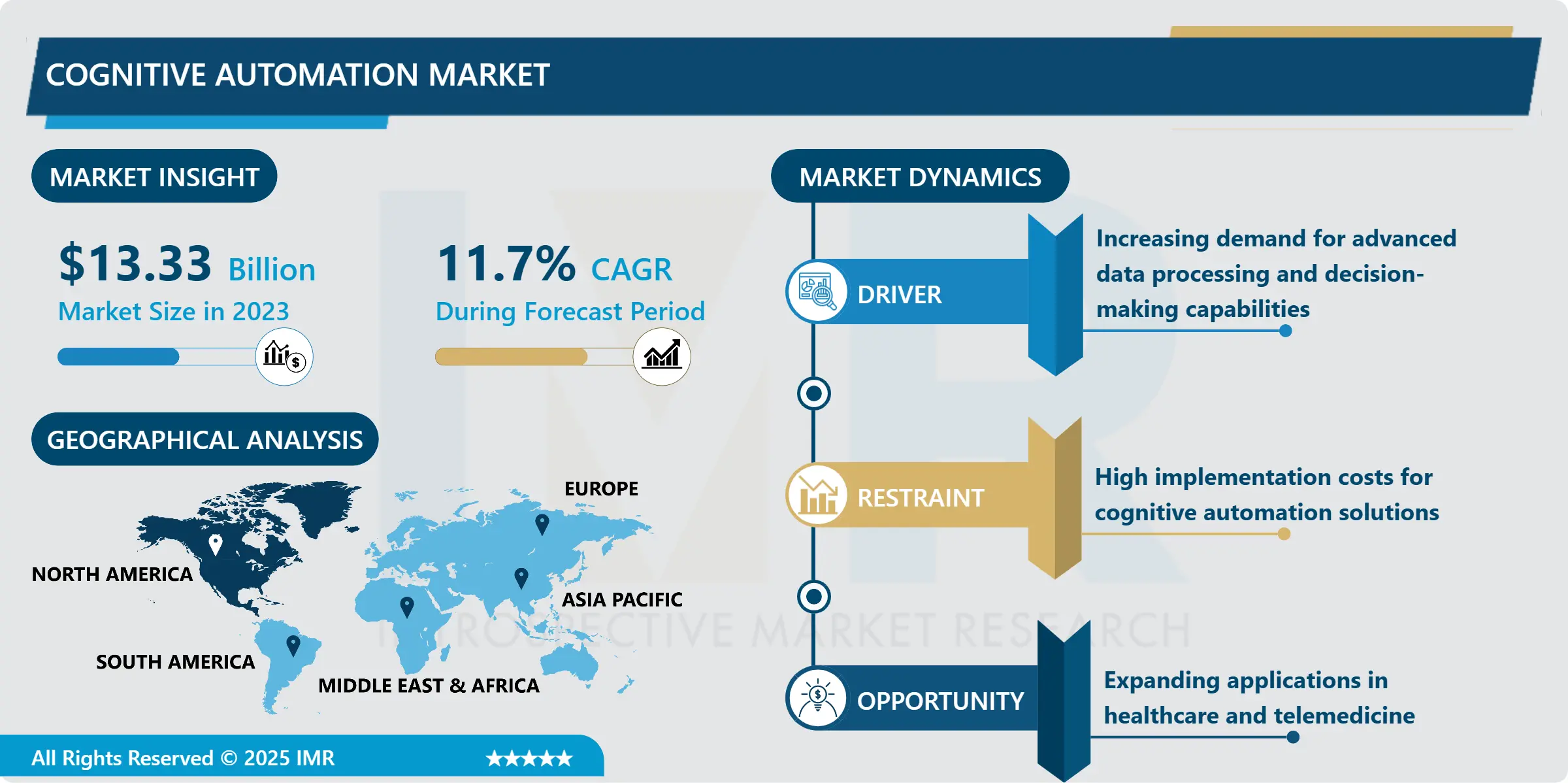
Cognitive Automation Market Size Was Valued at USD 13.33 Billion in 2023, and is Projected to Reach USD 36.09 Billion by 2032, Growing at a CAGR of 11.7% From 2024-2032.

IMR Group
Description
Cognitive Automation Market Synopsis:
Cognitive Automation Market Size Was Valued at USD 13.33 Billion in 2023, and is Projected to Reach USD 36.09 Billion by 2032, Growing at a CAGR of 11.7% From 2024-2032.
The Cognitive Automation Market can be defined as a market that specializes in the use of application of artificial intelligence, machine learning, natural language processing and computer vision to support decision making. Unlike industrial automation, cognitive automation is a method where AI and automation features work hand in hand to let organisation scan unstructured data, learn from previous information and enhance their operations continually. This market covers the sectors including finance, healthcare, retail, manufacturing, and IT to deliver solutions with minimal need for human input, increased efficiency and improved profitability by replicating the human brain’s functions like decision making and learning.
The cognitive automation market has received considerable traction as the industries integrate digital transformation strategies Looking at the list of key industries highlighted above, they have heavily invested in the cognitive automation market. The number of small and large data sets that are not structured, need processing, the aim for operational effectiveness and building customer satisfaction, are some of the factors that are fuelling the adoption of the cognitive automation solution across industries. The various solutions, backed by artificial intelligence and machine learning, enable the organisation to cut operational cost, optimise complicated business processes, and enable informed decision making. Moreover, the growing convergence of cognitive automation with other technologies such as RPA and cloud solutions modifies business processes and generates entirely new opportunities in the market.
In addition, penetration in the market by the products is complimented by the increases in the capability of AI technologies and availability of computational power. Cognitive automation is implemented intensely in industries like banking, financial services and insurance, healthcare and retail to enhance the value customers gain and the firm’s operational flexibility. The increasing demand and centennial shifts towards automation-based growth models are projected to boost the market notably in the coming years to develop suitably product-oriented solutions in different industries.
Cognitive Automation Market Trend Analysis
Integration of AI with RPA
RPA integration is perhaps the most important trend in the cognitive automation market due to the effectiveness of its merging with AI systems. It amplifies the advantages of classic RPA by incorporating cognitive characteristics, which allows for the analyzing of unstructured data and include such formats as emails, images and writing handwritten notes. This trend is revolutionary as it redesigns industries by automating multistep processes that earlier relied on some level of automation. Businesses are now extending the possibility of using smart bots that can make decisions for themselves and learn from experience making the work processes more effective, precise, and satisfying for the customers. With the further development of this integration comes progress to this market as a whole as well as fully unleashing the potential for the cognitive automation market.
Rising Adoption in Healthcare
The healthcare sector is a high growth potential market to augment the cognitive automation market. As healthcare providers are pushed to improve patient outcomes, cut expenses, and handle a great deal of patient information, cognitive automation holds great promise. Examples of the functional uses of applications include; The systems used in diagnosing, managing patients’ and claims processing which enhances efficiency and increases the quality of the services delivered in health care organizations. Furthermore, the availability of cognitive automation in electronic health records and telemedicine is predicted to become highly useful in such scenarios like workforce deficit and increasing patient need. Due to adoption of complex automation technologies in the healthcare industry through investment by the healthcare service providers, this segment will be a key contributor for the market.
Cognitive Automation Market Segment Analysis:
Cognitive Automation Market is Segmented on the basis of Type, End User, and Region.
By Type, Robotic Process Automation segment is expected to dominate the market during the forecast period
The cognitive automation market is expected to witness a maximum growth in its RPA segment throughout the forecast period owing to the flexibility and economical nature of this technology. RPA is centered on automating often monotonous and time-consuming processes, freeing up time and cash to be spent elsewhere. When cognitive capability is added to RPA it gets transformed into intelligent automation to deal with fuller automation that includes unstructured data handling and decision making. Modest Reqnick functionality in handling strict compliance rules with industries such as BFSI, retail and IT, are putting high demand on industries appreciating quick ROI and enhanced efficiency.
Moreover, because of the above characteristics, rapid growth of RPA solutions is noted, to which SMEs are attracted to automate business processes without complex infrastructure investments. The self-learning bots and AI analytics integrated into RPA are some of the continual developments in robotic process automation are expected to strengthen its market position in the cognitive automation market further in the future.
By End User, BFSI segment expected to held the largest share
The Banking, Financial Services and Insurance or the BFSI segment is expected to remain largest consumers of cognitive automation. This is because the sector relies on several data-intensive processes and there is pressure for accomplishing processes without errors. Through cognitive automation tools, BFSI organizations are reducing time and efforts to perform different operations including fraud detection, customers-onboarding, loan processing, and managing compliance. Not only they help in cutting back expenses, but they also add value to clients by providing them with better, faster or more targeted services.
Furthermore, in the BFSI industry, the automation is used to deal with the challenging changes in regulation and to counteract threats such as cybercrime. Cognitive automation with incorporated superior analytics and predictive modeling makes the major paradigm of practices for financial institutions as to ensure the best performances to cope with the competition. Making up a rather large portion of the economic sector, its focus on digital transformation means that BPO’s share in the cognitive automation market is expected to rise even further.
Cognitive Automation Market Regional Insights:
North America is Expected to Dominate the Market Over the Forecast period
North America is becoming the leader in the market of Cognitive Automation as the region takes over than 35% of the market. These leadership factors are attributed to early adoption of technology, robust information technology environment together with the key players in the market. Cognitive automation, for instance, has been adopted in BFSI, healthcare, retail in North America to cover issues of workforce deficiency, operational complexities, and escalating customer demands. In this context, the use of AI as a service appears to be particularly important for the U.S. That is due not only to its leading position in conducting studies on AI technologies but also to the support of the government for changing business through digital transformation. The North American market share is expected to continue to dominate in the next few years due to envisaged increased investment by organizations in the continuity of automation technologies.
Active Key Players in the Cognitive Automation Market
Automation Anywhere (USA)
Blue Prism (UK)
Celonis (Germany)
Cognizant (USA)
Datamatics (India)
EdgeVerve (India)
HCL Technologies (India)
IBM Corporation (USA)
Kofax (USA)
Microsoft Corporation (USA)
NICE Ltd. (Israel)
Pegasystems (USA)
UiPath (USA)
WorkFusion (USA)
Xerox Corporation (USA)
Other Active Players.
Chapter 1: Introduction
1.1 Scope and Coverage
Chapter 2:Executive Summary
Chapter 3: Market Landscape
3.1 Market Dynamics
3.1.1 Drivers
3.1.2 Restraints
3.1.3 Opportunities
3.1.4 Challenges
3.2 Market Trend Analysis
3.3 PESTLE Analysis
3.4 Porter’s Five Forces Analysis
3.5 Industry Value Chain Analysis
3.6 Ecosystem
3.7 Regulatory Landscape
3.8 Price Trend Analysis
3.9 Patent Analysis
3.10 Technology Evolution
3.11 Investment Pockets
3.12 Import-Export Analysis
Chapter 4: Cognitive Automation Market by Type
4.1 Cognitive Automation Market Snapshot and Growth Engine
4.2 Cognitive Automation Market Overview
4.3 Robotic Process Automation
4.3.1 Introduction and Market Overview
4.3.2 Historic and Forecasted Market Size in Value USD and Volume Units (2017-2032F)
4.3.3 Key Market Trends, Growth Factors and Opportunities
4.3.4 Robotic Process Automation: Geographic Segmentation Analysis
4.4 Intelligent Automation
4.4.1 Introduction and Market Overview
4.4.2 Historic and Forecasted Market Size in Value USD and Volume Units (2017-2032F)
4.4.3 Key Market Trends, Growth Factors and Opportunities
4.4.4 Intelligent Automation: Geographic Segmentation Analysis
Chapter 5: Cognitive Automation Market by End User
5.1 Cognitive Automation Market Snapshot and Growth Engine
5.2 Cognitive Automation Market Overview
5.3 BFSI
5.3.1 Introduction and Market Overview
5.3.2 Historic and Forecasted Market Size in Value USD and Volume Units (2017-2032F)
5.3.3 Key Market Trends, Growth Factors and Opportunities
5.3.4 BFSI: Geographic Segmentation Analysis
5.4 Pharma & Healthcare
5.4.1 Introduction and Market Overview
5.4.2 Historic and Forecasted Market Size in Value USD and Volume Units (2017-2032F)
5.4.3 Key Market Trends, Growth Factors and Opportunities
5.4.4 Pharma & Healthcare: Geographic Segmentation Analysis
5.5 Retail & Consumer Goods
5.5.1 Introduction and Market Overview
5.5.2 Historic and Forecasted Market Size in Value USD and Volume Units (2017-2032F)
5.5.3 Key Market Trends, Growth Factors and Opportunities
5.5.4 Retail & Consumer Goods: Geographic Segmentation Analysis
5.6 Information Technology & Telecom
5.6.1 Introduction and Market Overview
5.6.2 Historic and Forecasted Market Size in Value USD and Volume Units (2017-2032F)
5.6.3 Key Market Trends, Growth Factors and Opportunities
5.6.4 Information Technology & Telecom: Geographic Segmentation Analysis
5.7 Communication and Media & Education
5.7.1 Introduction and Market Overview
5.7.2 Historic and Forecasted Market Size in Value USD and Volume Units (2017-2032F)
5.7.3 Key Market Trends, Growth Factors and Opportunities
5.7.4 Communication and Media & Education: Geographic Segmentation Analysis
5.8 Manufacturing
5.8.1 Introduction and Market Overview
5.8.2 Historic and Forecasted Market Size in Value USD and Volume Units (2017-2032F)
5.8.3 Key Market Trends, Growth Factors and Opportunities
5.8.4 Manufacturing: Geographic Segmentation Analysis
5.9 Logistics and Energy & Utilities
5.9.1 Introduction and Market Overview
5.9.2 Historic and Forecasted Market Size in Value USD and Volume Units (2017-2032F)
5.9.3 Key Market Trends, Growth Factors and Opportunities
5.9.4 Logistics and Energy & Utilities: Geographic Segmentation Analysis
5.10 Others
5.10.1 Introduction and Market Overview
5.10.2 Historic and Forecasted Market Size in Value USD and Volume Units (2017-2032F)
5.10.3 Key Market Trends, Growth Factors and Opportunities
5.10.4 Others: Geographic Segmentation Analysis
Chapter 6: Company Profiles and Competitive Analysis
6.1 Competitive Landscape
6.1.1 Competitive Benchmarking
6.1.2 Cognitive Automation Market Share by Manufacturer (2023)
6.1.3 Industry BCG Matrix
6.1.4 Heat Map Analysis
6.1.5 Mergers and Acquisitions
6.2 AUTOMATION ANYWHERE (USA)
6.2.1 Company Overview
6.2.2 Key Executives
6.2.3 Company Snapshot
6.2.4 Role of the Company in the Market
6.2.5 Sustainability and Social Responsibility
6.2.6 Operating Business Segments
6.2.7 Product Portfolio
6.2.8 Business Performance
6.2.9 Key Strategic Moves and Recent Developments
6.2.10 SWOT Analysis
6.3 BLUE PRISM (UK)
6.4 CELONIS (GERMANY)
6.5 COGNIZANT (USA)
6.6 DATAMATICS (INDIA)
6.7 EDGEVERVE (INDIA)
6.8 HCL TECHNOLOGIES (INDIA)
6.9 IBM CORPORATION (USA)
6.10 KOFAX (USA)
6.11 MICROSOFT CORPORATION (USA)
6.12 NICE LTD. (ISRAEL)
6.13 PEGASYSTEMS (USA)
6.14 UIPATH (USA)
6.15 WORKFUSION (USA)
6.16 XEROX CORPORATION (USA)
6.17 OTHER ACTIVE PLAYERS
Chapter 7: Global Cognitive Automation Market By Region
7.1 Overview
7.2. North America Cognitive Automation Market
7.2.1 Key Market Trends, Growth Factors and Opportunities
7.2.2 Top Key Companies
7.2.3 Historic and Forecasted Market Size by Segments
7.2.4 Historic and Forecasted Market Size By Type
7.2.4.1 Robotic Process Automation
7.2.4.2 Intelligent Automation
7.2.5 Historic and Forecasted Market Size By End User
7.2.5.1 BFSI
7.2.5.2 Pharma & Healthcare
7.2.5.3 Retail & Consumer Goods
7.2.5.4 Information Technology & Telecom
7.2.5.5 Communication and Media & Education
7.2.5.6 Manufacturing
7.2.5.7 Logistics and Energy & Utilities
7.2.5.8 Others
7.2.6 Historic and Forecast Market Size by Country
7.2.6.1 US
7.2.6.2 Canada
7.2.6.3 Mexico
7.3. Eastern Europe Cognitive Automation Market
7.3.1 Key Market Trends, Growth Factors and Opportunities
7.3.2 Top Key Companies
7.3.3 Historic and Forecasted Market Size by Segments
7.3.4 Historic and Forecasted Market Size By Type
7.3.4.1 Robotic Process Automation
7.3.4.2 Intelligent Automation
7.3.5 Historic and Forecasted Market Size By End User
7.3.5.1 BFSI
7.3.5.2 Pharma & Healthcare
7.3.5.3 Retail & Consumer Goods
7.3.5.4 Information Technology & Telecom
7.3.5.5 Communication and Media & Education
7.3.5.6 Manufacturing
7.3.5.7 Logistics and Energy & Utilities
7.3.5.8 Others
7.3.6 Historic and Forecast Market Size by Country
7.3.6.1 Russia
7.3.6.2 Bulgaria
7.3.6.3 The Czech Republic
7.3.6.4 Hungary
7.3.6.5 Poland
7.3.6.6 Romania
7.3.6.7 Rest of Eastern Europe
7.4. Western Europe Cognitive Automation Market
7.4.1 Key Market Trends, Growth Factors and Opportunities
7.4.2 Top Key Companies
7.4.3 Historic and Forecasted Market Size by Segments
7.4.4 Historic and Forecasted Market Size By Type
7.4.4.1 Robotic Process Automation
7.4.4.2 Intelligent Automation
7.4.5 Historic and Forecasted Market Size By End User
7.4.5.1 BFSI
7.4.5.2 Pharma & Healthcare
7.4.5.3 Retail & Consumer Goods
7.4.5.4 Information Technology & Telecom
7.4.5.5 Communication and Media & Education
7.4.5.6 Manufacturing
7.4.5.7 Logistics and Energy & Utilities
7.4.5.8 Others
7.4.6 Historic and Forecast Market Size by Country
7.4.6.1 Germany
7.4.6.2 UK
7.4.6.3 France
7.4.6.4 The Netherlands
7.4.6.5 Italy
7.4.6.6 Spain
7.4.6.7 Rest of Western Europe
7.5. Asia Pacific Cognitive Automation Market
7.5.1 Key Market Trends, Growth Factors and Opportunities
7.5.2 Top Key Companies
7.5.3 Historic and Forecasted Market Size by Segments
7.5.4 Historic and Forecasted Market Size By Type
7.5.4.1 Robotic Process Automation
7.5.4.2 Intelligent Automation
7.5.5 Historic and Forecasted Market Size By End User
7.5.5.1 BFSI
7.5.5.2 Pharma & Healthcare
7.5.5.3 Retail & Consumer Goods
7.5.5.4 Information Technology & Telecom
7.5.5.5 Communication and Media & Education
7.5.5.6 Manufacturing
7.5.5.7 Logistics and Energy & Utilities
7.5.5.8 Others
7.5.6 Historic and Forecast Market Size by Country
7.5.6.1 China
7.5.6.2 India
7.5.6.3 Japan
7.5.6.4 South Korea
7.5.6.5 Malaysia
7.5.6.6 Thailand
7.5.6.7 Vietnam
7.5.6.8 The Philippines
7.5.6.9 Australia
7.5.6.10 New Zealand
7.5.6.11 Rest of APAC
7.6. Middle East & Africa Cognitive Automation Market
7.6.1 Key Market Trends, Growth Factors and Opportunities
7.6.2 Top Key Companies
7.6.3 Historic and Forecasted Market Size by Segments
7.6.4 Historic and Forecasted Market Size By Type
7.6.4.1 Robotic Process Automation
7.6.4.2 Intelligent Automation
7.6.5 Historic and Forecasted Market Size By End User
7.6.5.1 BFSI
7.6.5.2 Pharma & Healthcare
7.6.5.3 Retail & Consumer Goods
7.6.5.4 Information Technology & Telecom
7.6.5.5 Communication and Media & Education
7.6.5.6 Manufacturing
7.6.5.7 Logistics and Energy & Utilities
7.6.5.8 Others
7.6.6 Historic and Forecast Market Size by Country
7.6.6.1 Turkiye
7.6.6.2 Bahrain
7.6.6.3 Kuwait
7.6.6.4 Saudi Arabia
7.6.6.5 Qatar
7.6.6.6 UAE
7.6.6.7 Israel
7.6.6.8 South Africa
7.7. South America Cognitive Automation Market
7.7.1 Key Market Trends, Growth Factors and Opportunities
7.7.2 Top Key Companies
7.7.3 Historic and Forecasted Market Size by Segments
7.7.4 Historic and Forecasted Market Size By Type
7.7.4.1 Robotic Process Automation
7.7.4.2 Intelligent Automation
7.7.5 Historic and Forecasted Market Size By End User
7.7.5.1 BFSI
7.7.5.2 Pharma & Healthcare
7.7.5.3 Retail & Consumer Goods
7.7.5.4 Information Technology & Telecom
7.7.5.5 Communication and Media & Education
7.7.5.6 Manufacturing
7.7.5.7 Logistics and Energy & Utilities
7.7.5.8 Others
7.7.6 Historic and Forecast Market Size by Country
7.7.6.1 Brazil
7.7.6.2 Argentina
7.7.6.3 Rest of SA
Chapter 8 Analyst Viewpoint and Conclusion
8.1 Recommendations and Concluding Analysis
8.2 Potential Market Strategies
Chapter 9 Research Methodology
9.1 Research Process
9.2 Primary Research
9.3 Secondary Research
Q1: What would be the forecast period in the Cognitive Automation Market research report?
A1: The forecast period in the Cognitive Automation Market research report is 2024-2032.
Q2: Who are the key players in the Cognitive Automation Market?
A2: Automation Anywhere (USA), Blue Prism (UK), Celonis (Germany), Cognizant (USA), Datamatics (India), EdgeVerve (India), HCL Technologies (India), IBM Corporation (USA) and Other Active Players.
Q3: What are the segments of the Cognitive Automation Market?
A3: The Cognitive Automation Market is segmented into Type, End User and region. By Type, the market is categorized into Robotic Process Automation, Intelligent Automation. By End User, the market is categorized into BFSI, Pharma & Healthcare, Retail & Consumer Goods, Information Technology (IT) & Telecom, Communication and Media & Education, Manufacturing, Logistics and Energy & Utilities, Others By region, it is analyzed across North America (U.S., Canada, Mexico), Eastern Europe (Russia, Bulgaria, The Czech Republic, Hungary, Poland, Romania, Rest of Eastern Europe), Western Europe (Germany, UK, France, The Netherlands, Italy, Russia, Spain, Rest of Western Europe), Asia Pacific (China, India, Japan, South Korea, Malaysia, Thailand, Vietnam, The Philippines, Australia, New-Zealand, Rest of APAC), Middle East & Africa (Turkiye, Bahrain, Kuwait, Saudi Arabia, Qatar, UAE, Israel, South Africa), South America (Brazil, Argentina, Rest of SA).
Q4: What is the Cognitive Automation Market?
A4: The Cognitive Automation Market can be defined as a market that specializes in the use of application of artificial intelligence, machine learning, natural language processing and computer vision to support decision making. Unlike industrial automation, cognitive automation is a method where AI and automation features work hand in hand to let organisation scan unstructured data, learn from previous information and enhance their operations continually. This market covers the sectors including finance, healthcare, retail, manufacturing, and IT to deliver solutions with minimal need for human input, increased efficiency and improved profitability by replicating the human brain’s functions like decision making and learning.
Q5: How big is the Cognitive Automation Market?
A5: Cognitive Automation Market Size Was Valued at USD 13.33 Billion in 2023, and is Projected to Reach USD 36.09 Billion by 2032, Growing at a CAGR of 11.7% From 2024-2032.
How to Buy a Report from eminsights.jp
On the product page, choose the license you want: Single-User License, Multi-User License or Enterprise License.
If you required report in your native language, then you can click on Translated Report button and fill out the form with report name and language you want, then our team will contact you as soon as possible.
Click the Buy Now button.
You will be redirected to the checkout page. Enter your company details and payment information.
Click Place Order to complete the purchase.
Confirmation: You’ll receive an order confirmation and our team will contact you shortly with your ordered report.
If you have any questions, fill out the contact form below or email us at [email protected].
Thank you for choosing eminsights.jp!