Stay Ahead in Fast-Growing Economies.
Browse Reports Now
Coaxial Cable Market Growth Analysis & Forecast (2024-2032)
The coaxial cable market involves metallic signals embedded in an insulating sheath that is coated with one metallic as well as an external protective sheath.

IMR Group
Description
Coaxial Cable Market Synopsis:
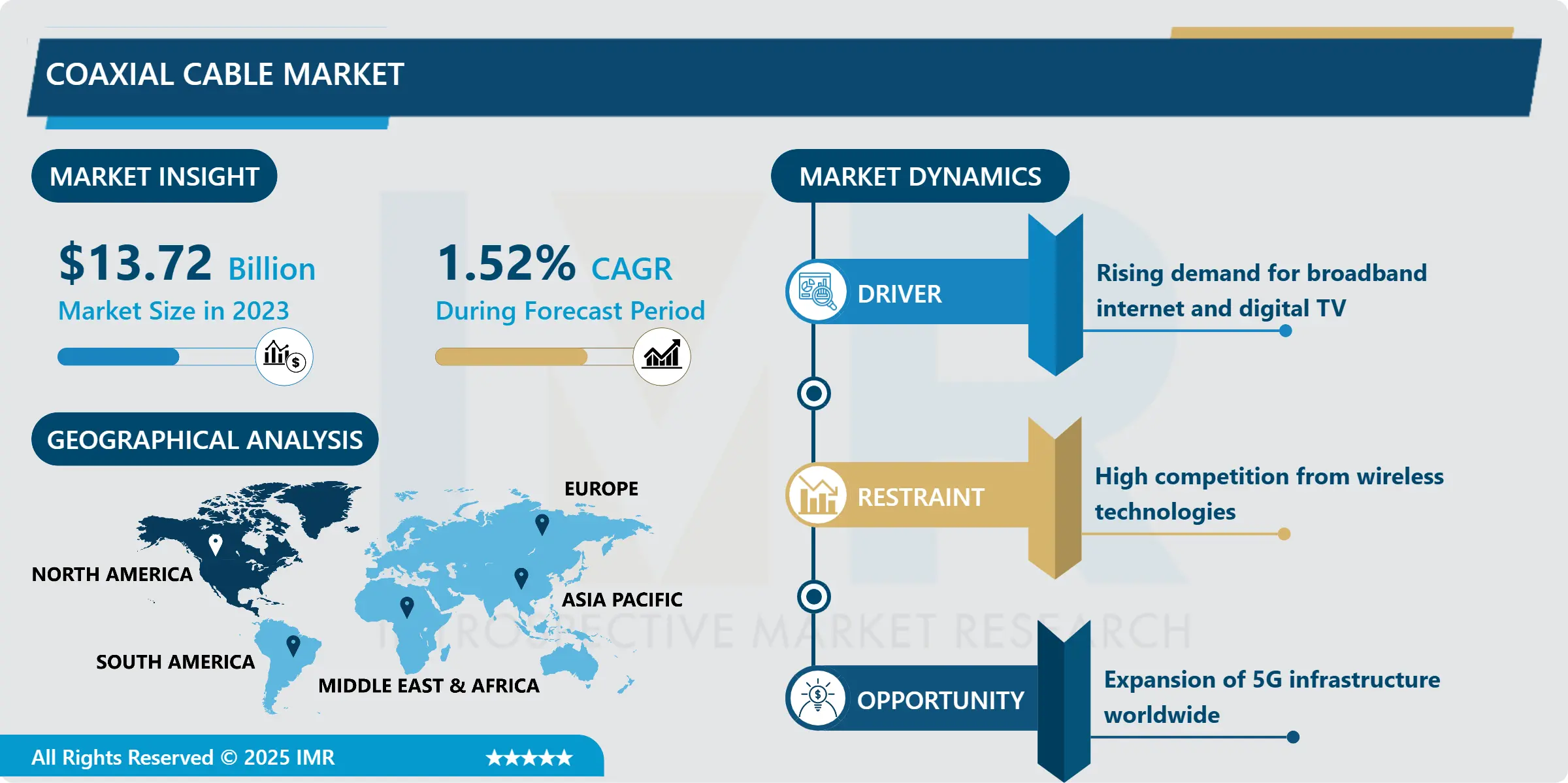
Coaxial Cable Market Size Was Valued at USD 13.72 Billion in 2023, and is Projected to Reach USD 15.72 Billion by 2032, Growing at a CAGR of 1.52% From 2024-2032.
The coaxial cable market involves metallic signals embedded in an insulating sheath that is coated with one metallic as well as an external protective sheath. These cables are well suited to the transmission of high-frequency signals in telecommunications, broadcasting, internet services, and in military fields. The design of the coaxial cables enables them to send signals with a high level of security while at the same time providing high bandwidth utilization consequently making them attractive for video, voice, and data transmission. With the growth in the use of broadband connections, digital television, internet of things, devices the need for coaxial cables is increasing at a very high rate world over.
The Coaxial cable market is growing at an increased rate mainly because of the increased demand of it for data communications and transmission in the telecommunication as well as the media sectors. The increase in broadband internet usage, the increasing use of digital TV and satellite communications has therefore increased demand for cabling solutions. Due to these characteristics, coaxial cables which include highly resistant cables and low signal attenuation and highly bandwidth, continue to attract service providers wishing to meet ever growing customer demands. Market is further driven by the emergence of 5G networks because the kind of network which is needed to support low latency communications, coaxial cables are a part of this supporting infrastructures.
Besides, the growing demands chiefly from aerospace & defense and automotive industry for communication solutions are boosting market growth. The growth within the coherent cable application for medical imaging and industrial automation has also widened the market demand. Contrary to this, emerging economies are also pulling through, many more investments are being made in communication infrastructure and there is fast embracing of digitization, which in totality boosts the global market picture.
Coaxial Cable Market Trend Analysis:
Integration of Advanced Technologies in Coaxial Cables
One the most outstanding factors that are characteristic of a coaxial cable market today is integration of high-grade materials and manufacturing techniques that enhance cable performance. Current manufacturer’s attention is on designing ultra-low loss coaxial cables with superior shielding features, specifically for application in the faster data transmission. The power over coaxial-based cables, which can deliver both power and data over coaxial cable, are gradually making their way in smart city implementations and IoT integration. This trend follows the global trend of adopting energy efficient solutions and miniature size requirements to minimize not just installation costs, but also operations costs.
Expansion of Broadband Infrastructure in Emerging Economies
The advancements in broadband as well as Telecommunication industries of the emerging economies are proving as a major growth factor for coaxial cable market. The Asia-Pacific, the Middle Eastern and African nations are experiencing significant urban and digital transformations, which require stable connection services. Market impulses are boosted by government policies to narrow the digital gap, including cheap broadband services and improvement on rural connectivity solutions. Also, growth of smart homes and connected appliances in these regions also offer high market demand for coaxial cables that has high data transfer rate and connectivity.
Coaxial Cable Market Segment Analysis:
Coaxial Cable Market is Segmented on the basis of Type, Material, Application, and Region.
By Type, Radio Frequency Coaxial Cables segment is expected to dominate the market during the forecast period
Coaxial cables in the radio frequency segment are slated to maintain the lion’s share in the market in the forecast period due to their use in telecommunication and broadcasting. These cables are optimized to carry high frequency signal without losing much signal power, making this type of cables ideal for use for CATV, satellite communications, and wireless broadband service. The availability of faster 4G&5G networks have taken the demand for RF coaxial cables notch higher since they afford longer distance signals while offering better performances.
In addition to these uses, RF coaxial cables are emerging in complex modern technologies such as in radar application and medical imaging among other applications in aerospace communication. High data rates and low susceptibility to electromagnetic interference make them ideal for use in certain applications, thus the outlook on coaxial cable as the growth driver of the world market.
By Material, Copper segment expected to held the largest share
The copper segment is expected to dominate the coaxial cable market due to it having a high conductor and efficient signal transmission properties. Copper coaxial cables are used in the high bandwidth requirement and low attenuation application like Broadband Internet and Digital Television. They also last long and are flexible making them ideal for different residential, commercial and industrial uses.
This has been widely corroborated by the compatibility that these copper-based coaxial cables have with modern-day technologies including 5G and IoT. Copper coaxial cables have a good demand in the industry considering the increase in investments on telecommunication and establishment of smart cities. In addition, better shielding & insulating copper cable materials that have come into the market have made copper cables more popular in hi – performance areas.
Coaxial Cable Market Regional Insights:
North America is Expected to Dominate the Market Over the Forecast period
North American region controls in the overall coaxial cable market in the year 2023. The latitudes are dominant due to high penetration of current communication technologies and existence of major market players. The increased usage of the broadband internet services alongside the brisk extension of the 5G networks has triggered tremendous amounts of demand for the coaxial cables in United States and Canada markets. Also, the region enjoys a healthy media and entertainment industry the market for digital television and satellite broadcasting remains high further contributing to the market’s growth. The application of coaxial cables in defence and aeronautical areas and constantly progressing advancement is one of the primary reasons why North America holds the largest share in the global market.
Active Key Players in the Coaxial Cable Market
Amphenol Corporation (USA)
Belden Inc. (USA)
Commscope Holding Company, Inc. (USA)
Fujikura Ltd. (Japan)
General Cable Technologies Corporation (USA)
Gore & Associates, Inc. (USA)
Habia Cable AB (Sweden)
Hitachi Metals, Ltd. (Japan)
Huber+Suhner AG (Switzerland)
Nexans S.A. (France)
Prysmian Group (Italy)
Radiall S.A. (France)
Southwire Company, LLC (USA)
Sumitomo Electric Industries, Ltd. (Japan)
TE Connectivity Ltd. (Switzerland)
Other Active Players.
Chapter 1: Introduction
1.1 Scope and Coverage
Chapter 2:Executive Summary
Chapter 3: Market Landscape
3.1 Market Dynamics
3.1.1 Drivers
3.1.2 Restraints
3.1.3 Opportunities
3.1.4 Challenges
3.2 Market Trend Analysis
3.3 PESTLE Analysis
3.4 Porter’s Five Forces Analysis
3.5 Industry Value Chain Analysis
3.6 Ecosystem
3.7 Regulatory Landscape
3.8 Price Trend Analysis
3.9 Patent Analysis
3.10 Technology Evolution
3.11 Investment Pockets
3.12 Import-Export Analysis
Chapter 4: Coaxial Cable Market by Type
4.1 Coaxial Cable Market Snapshot and Growth Engine
4.2 Coaxial Cable Market Overview
4.3 Radio Frequency Coaxial Cables
4.3.1 Introduction and Market Overview
4.3.2 Historic and Forecasted Market Size in Value USD and Volume Units (2017-2032F)
4.3.3 Key Market Trends, Growth Factors and Opportunities
4.3.4 Radio Frequency Coaxial Cables: Geographic Segmentation Analysis
4.4 Triaxial Coaxial Cables
4.4.1 Introduction and Market Overview
4.4.2 Historic and Forecasted Market Size in Value USD and Volume Units (2017-2032F)
4.4.3 Key Market Trends, Growth Factors and Opportunities
4.4.4 Triaxial Coaxial Cables: Geographic Segmentation Analysis
4.5 Others
4.5.1 Introduction and Market Overview
4.5.2 Historic and Forecasted Market Size in Value USD and Volume Units (2017-2032F)
4.5.3 Key Market Trends, Growth Factors and Opportunities
4.5.4 Others: Geographic Segmentation Analysis
Chapter 5: Coaxial Cable Market by Material
5.1 Coaxial Cable Market Snapshot and Growth Engine
5.2 Coaxial Cable Market Overview
5.3 Copper
5.3.1 Introduction and Market Overview
5.3.2 Historic and Forecasted Market Size in Value USD and Volume Units (2017-2032F)
5.3.3 Key Market Trends, Growth Factors and Opportunities
5.3.4 Copper: Geographic Segmentation Analysis
5.4 Aluminum
5.4.1 Introduction and Market Overview
5.4.2 Historic and Forecasted Market Size in Value USD and Volume Units (2017-2032F)
5.4.3 Key Market Trends, Growth Factors and Opportunities
5.4.4 Aluminum: Geographic Segmentation Analysis
5.5 Others
5.5.1 Introduction and Market Overview
5.5.2 Historic and Forecasted Market Size in Value USD and Volume Units (2017-2032F)
5.5.3 Key Market Trends, Growth Factors and Opportunities
5.5.4 Others: Geographic Segmentation Analysis
Chapter 6: Coaxial Cable Market by Application
6.1 Coaxial Cable Market Snapshot and Growth Engine
6.2 Coaxial Cable Market Overview
6.3 Telecommunications
6.3.1 Introduction and Market Overview
6.3.2 Historic and Forecasted Market Size in Value USD and Volume Units (2017-2032F)
6.3.3 Key Market Trends, Growth Factors and Opportunities
6.3.4 Telecommunications: Geographic Segmentation Analysis
6.4 Broadcasting
6.4.1 Introduction and Market Overview
6.4.2 Historic and Forecasted Market Size in Value USD and Volume Units (2017-2032F)
6.4.3 Key Market Trends, Growth Factors and Opportunities
6.4.4 Broadcasting: Geographic Segmentation Analysis
6.5 Data Networking
6.5.1 Introduction and Market Overview
6.5.2 Historic and Forecasted Market Size in Value USD and Volume Units (2017-2032F)
6.5.3 Key Market Trends, Growth Factors and Opportunities
6.5.4 Data Networking: Geographic Segmentation Analysis
6.6 Security and Surveillance
6.6.1 Introduction and Market Overview
6.6.2 Historic and Forecasted Market Size in Value USD and Volume Units (2017-2032F)
6.6.3 Key Market Trends, Growth Factors and Opportunities
6.6.4 Security and Surveillance: Geographic Segmentation Analysis
6.7 Others
6.7.1 Introduction and Market Overview
6.7.2 Historic and Forecasted Market Size in Value USD and Volume Units (2017-2032F)
6.7.3 Key Market Trends, Growth Factors and Opportunities
6.7.4 Others: Geographic Segmentation Analysis
Chapter 7: Company Profiles and Competitive Analysis
7.1 Competitive Landscape
7.1.1 Competitive Benchmarking
7.1.2 Coaxial Cable Market Share by Manufacturer (2023)
7.1.3 Industry BCG Matrix
7.1.4 Heat Map Analysis
7.1.5 Mergers and Acquisitions
7.2 AMPHENOL CORPORATION (USA)
7.2.1 Company Overview
7.2.2 Key Executives
7.2.3 Company Snapshot
7.2.4 Role of the Company in the Market
7.2.5 Sustainability and Social Responsibility
7.2.6 Operating Business Segments
7.2.7 Product Portfolio
7.2.8 Business Performance
7.2.9 Key Strategic Moves and Recent Developments
7.2.10 SWOT Analysis
7.3 BELDEN INC. (USA)
7.4 COMMSCOPE HOLDING COMPANY INC. (USA)
7.5 FUJIKURA LTD. (JAPAN)
7.6 GENERAL CABLE TECHNOLOGIES CORPORATION (USA)
7.7 GORE & ASSOCIATES INC. (USA)
7.8 HABIA CABLE AB (SWEDEN)
7.9 HITACHI METALS
7.10 LTD. (JAPAN)
7.11 HUBER+SUHNER AG (SWITZERLAND)
7.12 NEXANS S.A. (FRANCE)
7.13 PRYSMIAN GROUP (ITALY)
7.14 RADIALL S.A. (FRANCE)
7.15 SOUTHWIRE COMPANY LLC (USA)
7.16 SUMITOMO ELECTRIC INDUSTRIES
7.17 LTD. (JAPAN)
7.18 TE CONNECTIVITY LTD. (SWITZERLAND)
7.19 OTHER ACTIVE PLAYERS
Chapter 8: Global Coaxial Cable Market By Region
8.1 Overview
8.2. North America Coaxial Cable Market
8.2.1 Key Market Trends, Growth Factors and Opportunities
8.2.2 Top Key Companies
8.2.3 Historic and Forecasted Market Size by Segments
8.2.4 Historic and Forecasted Market Size By Type
8.2.4.1 Radio Frequency Coaxial Cables
8.2.4.2 Triaxial Coaxial Cables
8.2.4.3 Others
8.2.5 Historic and Forecasted Market Size By Material
8.2.5.1 Copper
8.2.5.2 Aluminum
8.2.5.3 Others
8.2.6 Historic and Forecasted Market Size By Application
8.2.6.1 Telecommunications
8.2.6.2 Broadcasting
8.2.6.3 Data Networking
8.2.6.4 Security and Surveillance
8.2.6.5 Others
8.2.7 Historic and Forecast Market Size by Country
8.2.7.1 US
8.2.7.2 Canada
8.2.7.3 Mexico
8.3. Eastern Europe Coaxial Cable Market
8.3.1 Key Market Trends, Growth Factors and Opportunities
8.3.2 Top Key Companies
8.3.3 Historic and Forecasted Market Size by Segments
8.3.4 Historic and Forecasted Market Size By Type
8.3.4.1 Radio Frequency Coaxial Cables
8.3.4.2 Triaxial Coaxial Cables
8.3.4.3 Others
8.3.5 Historic and Forecasted Market Size By Material
8.3.5.1 Copper
8.3.5.2 Aluminum
8.3.5.3 Others
8.3.6 Historic and Forecasted Market Size By Application
8.3.6.1 Telecommunications
8.3.6.2 Broadcasting
8.3.6.3 Data Networking
8.3.6.4 Security and Surveillance
8.3.6.5 Others
8.3.7 Historic and Forecast Market Size by Country
8.3.7.1 Russia
8.3.7.2 Bulgaria
8.3.7.3 The Czech Republic
8.3.7.4 Hungary
8.3.7.5 Poland
8.3.7.6 Romania
8.3.7.7 Rest of Eastern Europe
8.4. Western Europe Coaxial Cable Market
8.4.1 Key Market Trends, Growth Factors and Opportunities
8.4.2 Top Key Companies
8.4.3 Historic and Forecasted Market Size by Segments
8.4.4 Historic and Forecasted Market Size By Type
8.4.4.1 Radio Frequency Coaxial Cables
8.4.4.2 Triaxial Coaxial Cables
8.4.4.3 Others
8.4.5 Historic and Forecasted Market Size By Material
8.4.5.1 Copper
8.4.5.2 Aluminum
8.4.5.3 Others
8.4.6 Historic and Forecasted Market Size By Application
8.4.6.1 Telecommunications
8.4.6.2 Broadcasting
8.4.6.3 Data Networking
8.4.6.4 Security and Surveillance
8.4.6.5 Others
8.4.7 Historic and Forecast Market Size by Country
8.4.7.1 Germany
8.4.7.2 UK
8.4.7.3 France
8.4.7.4 The Netherlands
8.4.7.5 Italy
8.4.7.6 Spain
8.4.7.7 Rest of Western Europe
8.5. Asia Pacific Coaxial Cable Market
8.5.1 Key Market Trends, Growth Factors and Opportunities
8.5.2 Top Key Companies
8.5.3 Historic and Forecasted Market Size by Segments
8.5.4 Historic and Forecasted Market Size By Type
8.5.4.1 Radio Frequency Coaxial Cables
8.5.4.2 Triaxial Coaxial Cables
8.5.4.3 Others
8.5.5 Historic and Forecasted Market Size By Material
8.5.5.1 Copper
8.5.5.2 Aluminum
8.5.5.3 Others
8.5.6 Historic and Forecasted Market Size By Application
8.5.6.1 Telecommunications
8.5.6.2 Broadcasting
8.5.6.3 Data Networking
8.5.6.4 Security and Surveillance
8.5.6.5 Others
8.5.7 Historic and Forecast Market Size by Country
8.5.7.1 China
8.5.7.2 India
8.5.7.3 Japan
8.5.7.4 South Korea
8.5.7.5 Malaysia
8.5.7.6 Thailand
8.5.7.7 Vietnam
8.5.7.8 The Philippines
8.5.7.9 Australia
8.5.7.10 New Zealand
8.5.7.11 Rest of APAC
8.6. Middle East & Africa Coaxial Cable Market
8.6.1 Key Market Trends, Growth Factors and Opportunities
8.6.2 Top Key Companies
8.6.3 Historic and Forecasted Market Size by Segments
8.6.4 Historic and Forecasted Market Size By Type
8.6.4.1 Radio Frequency Coaxial Cables
8.6.4.2 Triaxial Coaxial Cables
8.6.4.3 Others
8.6.5 Historic and Forecasted Market Size By Material
8.6.5.1 Copper
8.6.5.2 Aluminum
8.6.5.3 Others
8.6.6 Historic and Forecasted Market Size By Application
8.6.6.1 Telecommunications
8.6.6.2 Broadcasting
8.6.6.3 Data Networking
8.6.6.4 Security and Surveillance
8.6.6.5 Others
8.6.7 Historic and Forecast Market Size by Country
8.6.7.1 Turkiye
8.6.7.2 Bahrain
8.6.7.3 Kuwait
8.6.7.4 Saudi Arabia
8.6.7.5 Qatar
8.6.7.6 UAE
8.6.7.7 Israel
8.6.7.8 South Africa
8.7. South America Coaxial Cable Market
8.7.1 Key Market Trends, Growth Factors and Opportunities
8.7.2 Top Key Companies
8.7.3 Historic and Forecasted Market Size by Segments
8.7.4 Historic and Forecasted Market Size By Type
8.7.4.1 Radio Frequency Coaxial Cables
8.7.4.2 Triaxial Coaxial Cables
8.7.4.3 Others
8.7.5 Historic and Forecasted Market Size By Material
8.7.5.1 Copper
8.7.5.2 Aluminum
8.7.5.3 Others
8.7.6 Historic and Forecasted Market Size By Application
8.7.6.1 Telecommunications
8.7.6.2 Broadcasting
8.7.6.3 Data Networking
8.7.6.4 Security and Surveillance
8.7.6.5 Others
8.7.7 Historic and Forecast Market Size by Country
8.7.7.1 Brazil
8.7.7.2 Argentina
8.7.7.3 Rest of SA
Chapter 9 Analyst Viewpoint and Conclusion
9.1 Recommendations and Concluding Analysis
9.2 Potential Market Strategies
Chapter 10 Research Methodology
10.1 Research Process
10.2 Primary Research
10.3 Secondary Research
Q1: What would be the forecast period in the Coaxial Cable Market research report?
A1: The forecast period in the Coaxial Cable Market research report is 2024-2032.
Q2: Who are the key players in the Coaxial Cable Market?
A2: Amphenol Corporation (USA), Belden Inc. (USA), Commscope Holding Company, Inc. (USA), Fujikura Ltd. (Japan), General Cable Technologies Corporation (USA) and Other Active Players.
Q3: What are the segments of the Coaxial Cable Market?
A3: The Coaxial Cable Market is segmented into Type, Material, Application and region. By Type, the market is categorized into Radio Frequency Coaxial Cables, Triaxial Coaxial Cables, Others. By Material, the market is categorized into Copper, Aluminum, Others. By Application, the market is categorized into Telecommunications, Broadcasting, Data Networking, Security and Surveillance, Others. By region, it is analyzed across North America (U.S., Canada, Mexico), Eastern Europe (Russia, Bulgaria, The Czech Republic, Hungary, Poland, Romania, Rest of Eastern Europe), Western Europe (Germany, UK, France, The Netherlands, Italy, Russia, Spain, Rest of Western Europe), Asia Pacific (China, India, Japan, South Korea, Malaysia, Thailand, Vietnam, The Philippines, Australia, New-Zealand, Rest of APAC), Middle East & Africa (Turkiye, Bahrain, Kuwait, Saudi Arabia, Qatar, UAE, Israel, South Africa), South America (Brazil, Argentina, Rest of SA).
Q4: What is the Coaxial Cable Market?
A4: The coaxial cable market involves metallic signals embedded in an insulating sheath that is coated with one metallic as well as an external protective sheath. These cables are well suited to the transmission of high-frequency signals in telecommunications, broadcasting, internet services, and in military fields. The design of the coaxial cables enables them to send signals with a high level of security while at the same time providing high bandwidth utilization consequently making them attractive for video, voice, and data transmission. With the growth in the use of broadband connections, digital television, internet of things, devices the need for coaxial cables is increasing at a very high rate world over.
Q5: How big is the Coaxial Cable Market?
A5: Coaxial Cable Market Size Was Valued at USD 13.72 Billion in 2023, and is Projected to Reach USD 15.72 Billion by 2032, Growing at a CAGR of 1.52% From 2024-2032.
How to Buy a Report from eminsights.jp
On the product page, choose the license you want: Single-User License, Multi-User License or Enterprise License.
If you required report in your native language, then you can click on Translated Report button and fill out the form with report name and language you want, then our team will contact you as soon as possible.
Click the Buy Now button.
You will be redirected to the checkout page. Enter your company details and payment information.
Click Place Order to complete the purchase.
Confirmation: You’ll receive an order confirmation and our team will contact you shortly with your ordered report.
If you have any questions, fill out the contact form below or email us at [email protected].
Thank you for choosing eminsights.jp!