Stay Ahead in Fast-Growing Economies.
Browse Reports Now
Reach Stacker Market Size, Share, Growth & Forecast (2024-2032)
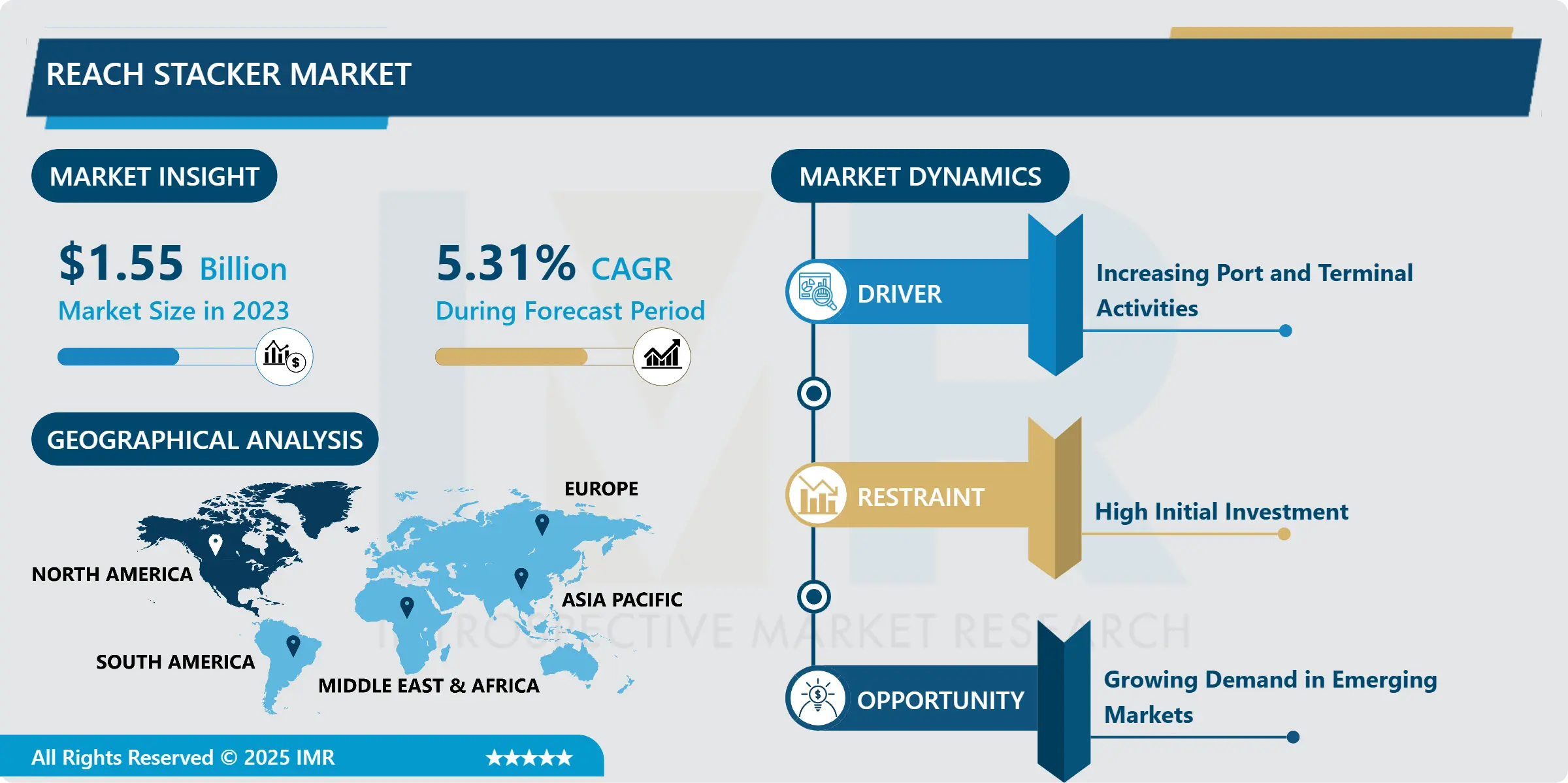
Reach Stacker Market Size Was Valued at USD 1.55 Billion in 2023, and is Projected to Reach USD 2.47 Billion by 2032, Growing at a CAGR of 5.31% From 2024-2032.

IMR Group
Description
Reach Stacker Market Synopsis:
Reach Stacker Market Size Was Valued at USD 1.55 Billion in 2023, and is Projected to Reach USD 2.47 Billion by 2032, Growing at a CAGR of 5.31% From 2024-2032.
A reach stacker is a type of heavy terminal equipment, extensively used in ports and container terminal yards for the purpose of loading, unloading, and / or placing and/or removing the intermodal containers on or from the ships, railcars and trucks. These machines are fitted with a telescopic boom and the other lifting systems for hydraulic lifting the containers which are at different levels and depths on a stack. They intended to enhance the flow of the container in supply chain, to enhance safety measure for container and drivers and to enable short turnaround time in busy ports. Reach stackers are used in the staking of containers particularly in a container terminal making them a staple tool in logistic and shipping industry.
The Reach Stacker Market has not shown significant fluctuation in its growth and is expected to maintain the trend in the near future, as the equipment is important for operation of the container, terminals and ports, and intermodal yards. Stacker reaching machines are used in the handling of containers to enhance the efficiency of operations and loading or unloading of containers to minimize traffic holdup at the terminals. The market is positively influenced by the ongoing globalisation and escalating demand for efficient supply chain solutions to address the growing volumes of containers. Technological factors such as growth in automation and integrated telematics’ application will increase the uptake of reach stackers and its efficiency. Also, the need to expand the capacity of the equipment that deals with the oversized and heavy containers is driving the market. The Asia-Pacific region will thus likely to dominate the market because of the many ports and active industrial operations in the region. But on the other side there are factors which are acting as barriers and these include high initial investment costs and emissions are causing problem to the environment thereby slowing down the growth of the market to some extent. As the environmental standards get rise and customers focus on requiring more environmentally friendly logistic solutions, there are greater demands created for electric and hybrid reach stackers, and it is believed that there will be new growth opportunities for this kind of product.
The market for reach stackers is saturated, and major companies are looking for ways to differentiate themselves in order to lure more clients. Organizations are spending more time and resources to upgrade the operational capability, durability and safety of the reach stacker versions that they intend to put in the market. Automated and Hybrid solutions solutions type is also on the rise due to enhanced operational efficiency and lesser operational expenses. Moreover, rental and leasing services are now used more often in order to handle the costs of equipment more efficiently. The integration of IoT with telematics in the reach stacker is enabling real time data on machine health status, hence enabling the operators to perform knowledgeable decisions and consequently enhance the functionality of the reach stackers. As the container traffic increases and gets into the newer economies more rapidly, more demand for reach stackers and hence solid opportunities for expanding the product line and getting into new markets emerge. Logistics operators would tend to patronize companies that can provide them not just with the equipment but also train them on how to use it, maintain it and support it as the logistics operators’ needs evolve over time around the world.
Reach Stacker Market Trend Analysis;
Driving Forces and Trends in Reach Stacker Market
Developing a sense of the growing importance of the industry, there is an emerging need for equipment that would manipulate immense containers effectively. Reach stackers can be a very useful because they provide fast pick and place operations for the containers. These machines are useful in most terminals where the handling of containers has to be very fast and efficient to support the other relevant processes. There is advancement in features namely telematics and automation to increase the operational productivity and safety of reach stackers. These innovations make it possible for operators to keep track of equipment efficiency; enhance the handling of loads; and minimize unnecessary breaks in operations that slow down activities in ports and other intermodal terminals.
There are other restraints too involved in the growth of the market as manufacturers are concerned with reducing emissions to perform eco-friendly reach stackers using different fuels or hybrid technologies are also inspiring through environmental regulations. All of these machines not only meet the highest emissions requirements, but also make a direct positive contribution to sustainability objectives by guaranteeing a sustainable reduction in the environmental load of heavy-duty container handling. The call for increased carbon-free solutions is expected to act as a stimulus to technological and market development of the reach stacker industry especially in areas where environmental consciousness and legislation are becoming pivotal tools for industrial growth.
Opportunity
Technological Advancements Driving Opportunities in the Reach Stacker Market
As more and more players engage in the growing global trade and port operations, there is ever growing need to enhance the cargo handling equipment such as the reach stacker. This is mainly due to the heightened containerization at seaports and intermodal terminals where there is need for resilient and versatile solutions for managing a large bulk of items in the shortest time possible. One is that the reach stackers are useful in cargo handling offering flexibility in the handling of containers as well as offering the option to lift, stack and maneuver the containers, regardless of their size, this is particularly important when handling the containers to ensure proper space utilization as well as efficient movement at the ports. These machines are very useful in the current situation in supply chains where response time and flexibility are paramount.
Progressive features namely hydraulics, telematics, and other automations features are greatly boosting the functional effectiveness and safety of reach stackers. These innovations make the operation of machines easier, and enables tracking of how the machines are performing, and also enhances synchronization of the equipment and the logistics equipment. This ideology is helping to enhance the efficiency of lifting machinery and also contributing a value to the supply chain logistics and port operators in search of competitive advantage. This trend is expected to help on the growth of the market since various firms would be willing to invest on some high-quality equipment in order to meet the increasing demands of the international market regime.
Reach Stacker Market Segment Analysis:
Reach Stacker Market Segmented on the basis of By Propulsion, Operation, Maximum Capacity, Application, and Region.
By Propulsion, ICE segment is expected to dominate the market during the forecast period
ICE machinery continues to be popular in the brute force class since it is highly endurable and capable of meeting high power requirements. These machines employ conventional diesel or gasoline engines that make them suitable to be used in demanding operating conditions like seaports, terminals, yards and; landsides. Despite the fact that they are large and slow, they are highly prized for ability to move heavy loads of work and carry them for long distances, therefore are very useful where strong pulling power and energy is required. Compared to electrically driven equipment, the purchase costs of ICE-powered equipment and components are relatively low making it cheaper to acquire for various establishments regardless of the overall performance. Nonetheless, the major weakness of implementing ICE machinery is indicated by the excessive emission of pollutants to the environment. This has nurtured research and development with the intent of enhancing fuel economy and exhaust standard. Solutions such as scrubbers and filters SCR and particulate filters are used to annihilate these emissions, thus making ICE machinery relatively friendly to the environment with time.
More developments on ICE have targeted to increase efficiency and reduce fuel consumption for the purposes of cutting operating expenses and impact on the community through emissions from these machines. For example, latest ICE models incorporate either hybrid or electric part to recover energy loss when braking and lower fuel usage. Such innovations aid to tackle the main challenge of emissions where the solutions are needed most such as cities and ports. consequently, use of the ICE-powered machinery has remained important in the heavy industrial application and at the same time, there has being a need for manufacturers to seek ways of improving the efficiency to match with sustainability. The shift to green technologies is still gradual; thus the expectation of improvements in the upcoming years.
By Maximum Capacity, above 45 tons segment expected to held the largest share
Machines ranging from 45 tons and above are designed with specific industrial class applications in mind. As much larger equipment these machines are designed for the most intensive work and thus are indispensable in seaports, terminals and regions where maximum performance is required. They include equipment that can lift more than one container at a time like the following: Mistral carriers, mobile cranes which can extend to great heights as well as long distances and the large container handlers needed for high capacity stacking equipment. These machines are produced to work well in situations where access is restricted and there are many risks involved, for instance in ports, other industrial zones. The construction as well as the hydraulic systems offer the reinforcement required to cope with non-stop working, especially on heavy loads.
Such characteristics are significant in guaranteeing continuous performance of container handling and logistics throughout busy freight ports and production centers. They are owned with mechanized controls, GPS navigation systems, and superior endowment load control systems to increase reliability and safety. These features not only improve the level of accuracy in the operations but also contribute to overcoming downtimes and optimising the efficiency level. Furthermore, these are orthodox construction equipment that is robust to enable them handle multiple functionalities such as picking and moving containers and space them correctly. With the increase in the focus and need on logistics systems, these high capacity machines will be very important in improved seaports and industrial deployment.
Reach Stacker Market Regional Insights:
North America is Expected to Dominate the Market Over the Forecast period
In North America the reach stacker market is further bolstered by a highly robust logistic and transportation network that facilitates movement of large volumes of freight. Various ports within this area, most especially the American region, are immensely involved in the global shipping business; which makes them vital centers for container operation. The developed countries including the United States possesses numerous ports; the ports located in large cities such as Los Angeles, New York and Houston have a highly contributed to the growth of the market. These facilities need sophisticated equipment such as reach stackers to handle voluminous cargo proficiently so as to avoid interruptions. The market’s key industry players are recently trying to incorporate novel advancements in the reach stacker technology like automation, telematics, and hybrid power systems, to achieve optimum utilization and a lesser carbon footprint.
The market for reach stackers in North America is therefore stimulated by the standardisation and enhancement of supply chain requirements coupled with the growing size of container ports. Since the United States is an active participant in the global economy, particular importance is attached to the modernization of ports to accommodate growing traffic. As a result there has been increased usage of reach stackers with specific interventions for improved efficiency and safety. To meet this need, manufacturers are releasing new models of reach stackers with greater carrying capacity, and improved mobility and lower emissions in line with the operational requirements along with green principles. Continuing changes in the structure of the logistics industry outside of North America has lead to both ports and terminals investing in new and technologically advanced equipment to remain as competitive as possible in their industry.
Active Key Players in the Reach Stacker Market:
Hyster Yale
Kalmar
Kion
Konecranes
Liebherr
Manitex International
Sany
Taylor Machine Works
Terex
Toyota
Other Active Players
Key Industry Developments in the Market:
In June 2024, Morris Export Services, a logistics company in Houston, acquired the first LiuGong 2450H Reach Stacker in North America. This marks LiuGong’s entry into the North American heavy machinery market and suggests potential for further expansion. The partnership between Morris Export Services, LiuGong, and Cummins aims to drive significant growth for Morris Export Services. The LiuGong Reach Stacker, powered by the Cummins X12 engine, is expected to boost productivity and support future growth.
In December 2023, Kalmar, part of Cargotec, started producing its electric reach stacker and Essential forklift truck at its Shanghai facility. The Kalmar electric reachstacker, with a lifting capacity of up to 45 tonnes, improves the eco-efficiency of cargo handling while maintaining high productivity and safety. It offers various modular battery options and charging solutions, making it suitable for container handling, intermodal operations, and industrial heavy lifting.
Chapter 1: Introduction
1.1 Scope and Coverage
Chapter 2:Executive Summary
Chapter 3: Market Landscape
3.1 Market Dynamics
3.1.1 Drivers
3.1.2 Restraints
3.1.3 Opportunities
3.1.4 Challenges
3.2 Market Trend Analysis
3.3 PESTLE Analysis
3.4 Porter’s Five Forces Analysis
3.5 Industry Value Chain Analysis
3.6 Ecosystem
3.7 Regulatory Landscape
3.8 Price Trend Analysis
3.9 Patent Analysis
3.10 Technology Evolution
3.11 Investment Pockets
3.12 Import-Export Analysis
Chapter 4: Reach Stacker Market by Product Type
4.1 Reach Stacker Market Snapshot and Growth Engine
4.2 Reach Stacker Market Overview
4.3 Dairy Products
4.3.1 Introduction and Market Overview
4.3.2 Historic and Forecasted Market Size in Value USD and Volume Units (2017-2032F)
4.3.3 Key Market Trends, Growth Factors and Opportunities
4.3.4 Dairy Products: Geographic Segmentation Analysis
4.4 Instant Breakfast/Cereals
4.4.1 Introduction and Market Overview
4.4.2 Historic and Forecasted Market Size in Value USD and Volume Units (2017-2032F)
4.4.3 Key Market Trends, Growth Factors and Opportunities
4.4.4 Instant Breakfast/Cereals: Geographic Segmentation Analysis
4.5 Bakery and Confectionary
4.5.1 Introduction and Market Overview
4.5.2 Historic and Forecasted Market Size in Value USD and Volume Units (2017-2032F)
4.5.3 Key Market Trends, Growth Factors and Opportunities
4.5.4 Bakery and Confectionary: Geographic Segmentation Analysis
4.6 Meat and Poultry
4.6.1 Introduction and Market Overview
4.6.2 Historic and Forecasted Market Size in Value USD and Volume Units (2017-2032F)
4.6.3 Key Market Trends, Growth Factors and Opportunities
4.6.4 Meat and Poultry: Geographic Segmentation Analysis
4.7 Frozen Pizza
4.7.1 Introduction and Market Overview
4.7.2 Historic and Forecasted Market Size in Value USD and Volume Units (2017-2032F)
4.7.3 Key Market Trends, Growth Factors and Opportunities
4.7.4 Frozen Pizza: Geographic Segmentation Analysis
4.8 Pasta and Noodles
4.8.1 Introduction and Market Overview
4.8.2 Historic and Forecasted Market Size in Value USD and Volume Units (2017-2032F)
4.8.3 Key Market Trends, Growth Factors and Opportunities
4.8.4 Pasta and Noodles: Geographic Segmentation Analysis
4.9 Savory Snacks and Prepared Salads
4.9.1 Introduction and Market Overview
4.9.2 Historic and Forecasted Market Size in Value USD and Volume Units (2017-2032F)
4.9.3 Key Market Trends, Growth Factors and Opportunities
4.9.4 Savory Snacks and Prepared Salads: Geographic Segmentation Analysis
Chapter 5: Reach Stacker Market by Sales Channel
5.1 Reach Stacker Market Snapshot and Growth Engine
5.2 Reach Stacker Market Overview
5.3 Food Service
5.3.1 Introduction and Market Overview
5.3.2 Historic and Forecasted Market Size in Value USD and Volume Units (2017-2032F)
5.3.3 Key Market Trends, Growth Factors and Opportunities
5.3.4 Food Service: Geographic Segmentation Analysis
5.4 Airport Retail
5.4.1 Introduction and Market Overview
5.4.2 Historic and Forecasted Market Size in Value USD and Volume Units (2017-2032F)
5.4.3 Key Market Trends, Growth Factors and Opportunities
5.4.4 Airport Retail: Geographic Segmentation Analysis
5.5 Travel Retail
5.5.1 Introduction and Market Overview
5.5.2 Historic and Forecasted Market Size in Value USD and Volume Units (2017-2032F)
5.5.3 Key Market Trends, Growth Factors and Opportunities
5.5.4 Travel Retail: Geographic Segmentation Analysis
5.6 Retail and Online
5.6.1 Introduction and Market Overview
5.6.2 Historic and Forecasted Market Size in Value USD and Volume Units (2017-2032F)
5.6.3 Key Market Trends, Growth Factors and Opportunities
5.6.4 Retail and Online: Geographic Segmentation Analysis
Chapter 6: Company Profiles and Competitive Analysis
6.1 Competitive Landscape
6.1.1 Competitive Benchmarking
6.1.2 Reach Stacker Market Share by Manufacturer (2023)
6.1.3 Industry BCG Matrix
6.1.4 Heat Map Analysis
6.1.5 Mergers and Acquisitions
6.2 HYSTER YALE
6.2.1 Company Overview
6.2.2 Key Executives
6.2.3 Company Snapshot
6.2.4 Role of the Company in the Market
6.2.5 Sustainability and Social Responsibility
6.2.6 Operating Business Segments
6.2.7 Product Portfolio
6.2.8 Business Performance
6.2.9 Key Strategic Moves and Recent Developments
6.2.10 SWOT Analysis
6.3 KALMAR
6.4 KION
6.5 KONECRANES
6.6 LIEBHERR
6.7 MANITEX INTERNATIONAL
6.8 SANY
6.9 TAYLOR MACHINE WORKS
6.10 TEREX
6.11 TOYOTA
6.12 OTHER ACTIVE PLAYERS
Chapter 7: Global Reach Stacker Market By Region
7.1 Overview
7.2. North America Reach Stacker Market
7.2.1 Key Market Trends, Growth Factors and Opportunities
7.2.2 Top Key Companies
7.2.3 Historic and Forecasted Market Size by Segments
7.2.4 Historic and Forecasted Market Size By Product Type
7.2.4.1 Dairy Products
7.2.4.2 Instant Breakfast/Cereals
7.2.4.3 Bakery and Confectionary
7.2.4.4 Meat and Poultry
7.2.4.5 Frozen Pizza
7.2.4.6 Pasta and Noodles
7.2.4.7 Savory Snacks and Prepared Salads
7.2.5 Historic and Forecasted Market Size By Sales Channel
7.2.5.1 Food Service
7.2.5.2 Airport Retail
7.2.5.3 Travel Retail
7.2.5.4 Retail and Online
7.2.6 Historic and Forecast Market Size by Country
7.2.6.1 US
7.2.6.2 Canada
7.2.6.3 Mexico
7.3. Eastern Europe Reach Stacker Market
7.3.1 Key Market Trends, Growth Factors and Opportunities
7.3.2 Top Key Companies
7.3.3 Historic and Forecasted Market Size by Segments
7.3.4 Historic and Forecasted Market Size By Product Type
7.3.4.1 Dairy Products
7.3.4.2 Instant Breakfast/Cereals
7.3.4.3 Bakery and Confectionary
7.3.4.4 Meat and Poultry
7.3.4.5 Frozen Pizza
7.3.4.6 Pasta and Noodles
7.3.4.7 Savory Snacks and Prepared Salads
7.3.5 Historic and Forecasted Market Size By Sales Channel
7.3.5.1 Food Service
7.3.5.2 Airport Retail
7.3.5.3 Travel Retail
7.3.5.4 Retail and Online
7.3.6 Historic and Forecast Market Size by Country
7.3.6.1 Russia
7.3.6.2 Bulgaria
7.3.6.3 The Czech Republic
7.3.6.4 Hungary
7.3.6.5 Poland
7.3.6.6 Romania
7.3.6.7 Rest of Eastern Europe
7.4. Western Europe Reach Stacker Market
7.4.1 Key Market Trends, Growth Factors and Opportunities
7.4.2 Top Key Companies
7.4.3 Historic and Forecasted Market Size by Segments
7.4.4 Historic and Forecasted Market Size By Product Type
7.4.4.1 Dairy Products
7.4.4.2 Instant Breakfast/Cereals
7.4.4.3 Bakery and Confectionary
7.4.4.4 Meat and Poultry
7.4.4.5 Frozen Pizza
7.4.4.6 Pasta and Noodles
7.4.4.7 Savory Snacks and Prepared Salads
7.4.5 Historic and Forecasted Market Size By Sales Channel
7.4.5.1 Food Service
7.4.5.2 Airport Retail
7.4.5.3 Travel Retail
7.4.5.4 Retail and Online
7.4.6 Historic and Forecast Market Size by Country
7.4.6.1 Germany
7.4.6.2 UK
7.4.6.3 France
7.4.6.4 The Netherlands
7.4.6.5 Italy
7.4.6.6 Spain
7.4.6.7 Rest of Western Europe
7.5. Asia Pacific Reach Stacker Market
7.5.1 Key Market Trends, Growth Factors and Opportunities
7.5.2 Top Key Companies
7.5.3 Historic and Forecasted Market Size by Segments
7.5.4 Historic and Forecasted Market Size By Product Type
7.5.4.1 Dairy Products
7.5.4.2 Instant Breakfast/Cereals
7.5.4.3 Bakery and Confectionary
7.5.4.4 Meat and Poultry
7.5.4.5 Frozen Pizza
7.5.4.6 Pasta and Noodles
7.5.4.7 Savory Snacks and Prepared Salads
7.5.5 Historic and Forecasted Market Size By Sales Channel
7.5.5.1 Food Service
7.5.5.2 Airport Retail
7.5.5.3 Travel Retail
7.5.5.4 Retail and Online
7.5.6 Historic and Forecast Market Size by Country
7.5.6.1 China
7.5.6.2 India
7.5.6.3 Japan
7.5.6.4 South Korea
7.5.6.5 Malaysia
7.5.6.6 Thailand
7.5.6.7 Vietnam
7.5.6.8 The Philippines
7.5.6.9 Australia
7.5.6.10 New Zealand
7.5.6.11 Rest of APAC
7.6. Middle East & Africa Reach Stacker Market
7.6.1 Key Market Trends, Growth Factors and Opportunities
7.6.2 Top Key Companies
7.6.3 Historic and Forecasted Market Size by Segments
7.6.4 Historic and Forecasted Market Size By Product Type
7.6.4.1 Dairy Products
7.6.4.2 Instant Breakfast/Cereals
7.6.4.3 Bakery and Confectionary
7.6.4.4 Meat and Poultry
7.6.4.5 Frozen Pizza
7.6.4.6 Pasta and Noodles
7.6.4.7 Savory Snacks and Prepared Salads
7.6.5 Historic and Forecasted Market Size By Sales Channel
7.6.5.1 Food Service
7.6.5.2 Airport Retail
7.6.5.3 Travel Retail
7.6.5.4 Retail and Online
7.6.6 Historic and Forecast Market Size by Country
7.6.6.1 Turkiye
7.6.6.2 Bahrain
7.6.6.3 Kuwait
7.6.6.4 Saudi Arabia
7.6.6.5 Qatar
7.6.6.6 UAE
7.6.6.7 Israel
7.6.6.8 South Africa
7.7. South America Reach Stacker Market
7.7.1 Key Market Trends, Growth Factors and Opportunities
7.7.2 Top Key Companies
7.7.3 Historic and Forecasted Market Size by Segments
7.7.4 Historic and Forecasted Market Size By Product Type
7.7.4.1 Dairy Products
7.7.4.2 Instant Breakfast/Cereals
7.7.4.3 Bakery and Confectionary
7.7.4.4 Meat and Poultry
7.7.4.5 Frozen Pizza
7.7.4.6 Pasta and Noodles
7.7.4.7 Savory Snacks and Prepared Salads
7.7.5 Historic and Forecasted Market Size By Sales Channel
7.7.5.1 Food Service
7.7.5.2 Airport Retail
7.7.5.3 Travel Retail
7.7.5.4 Retail and Online
7.7.6 Historic and Forecast Market Size by Country
7.7.6.1 Brazil
7.7.6.2 Argentina
7.7.6.3 Rest of SA
Chapter 8 Analyst Viewpoint and Conclusion
8.1 Recommendations and Concluding Analysis
8.2 Potential Market Strategies
Chapter 9 Research Methodology
9.1 Research Process
9.2 Primary Research
9.3 Secondary Research
Q1: What would be the forecast period in the Reach Stacker Market research report?
A1: The forecast period in the Market research report is 2024-2032.
Q2: Who are the key players in the Reach Stacker Market?
A2: Hyster Yale, Kalmar, Kion, Konecranes, Liebherr, Manitex International, Sany, Taylor Machine Works, Terex, Toyota, and Other Active Players.
Q3: What are the segments of the Reach Stacker Market?
A3: The Reach Stacker Market is segmented into By Propulsion, By Operation, By Maximum Capacity, By Application and region. By Propulsion, the market is categorized into ICE, Electric and Hybrid. By Operation, the market is categorized into Manual, Semi-automated and Automated. By Maximum Capacity, the market is categorized into Below 30 tons, 30 to 45 tons and Above 45 tons. By Application, the market is categorized into Seaports & terminals, Yards & landsides and Industrial. By region, it is analyzed across North America (U.S., Canada, Mexico), Eastern Europe (Russia, Bulgaria, The Czech Republic, Hungary, Poland, Romania, Rest of Eastern Europe), Western Europe (Germany, UK, France, Netherlands, Italy, Spain, Rest of Western Europe), Asia Pacific (China, India, Japan, South Korea, Malaysia, Thailand, Vietnam, The Philippines, Australia, New Zealand, Rest of APAC), Middle East & Africa (Turkiye, Bahrain, Kuwait, Saudi Arabia, Qatar, UAE, Israel, South Africa), South America (Brazil, Argentina, Rest of SA).
Q4: What is the Reach Stacker Market?
A4: A reach stacker is a specialized heavy-duty vehicle used in container terminals and ports for handling and stacking intermodal containers, primarily on or off ships, railcars, and trucks. These machines are equipped with a telescopic boom and advanced hydraulic lifting capabilities, allowing them to reach containers positioned at multiple levels and depths within a stack. They are designed to increase efficiency in container logistics, improve safety, and facilitate quick turnaround times in high-demand port operations. Reach stackers play a critical role in streamlining the transportation and storage of containers in container terminals, making them an essential piece of equipment in modern logistics and shipping operations.
Q5: How Big is the Reach Stacker Market?
A5: Reach Stacker Market Size Was Valued at USD 1.55 Billion in 2023, and is Projected to Reach USD 2.47 Billion by 2032, Growing at a CAGR of 5.31% From 2024-2032.
How to Buy a Report from eminsights.jp
On the product page, choose the license you want: Single-User License, Multi-User License or Enterprise License.
If you required report in your native language, then you can click on Translated Report button and fill out the form with report name and language you want, then our team will contact you as soon as possible.
Click the Buy Now button.
You will be redirected to the checkout page. Enter your company details and payment information.
Click Place Order to complete the purchase.
Confirmation: You’ll receive an order confirmation and our team will contact you shortly with your ordered report.
If you have any questions, fill out the contact form below or email us at [email protected].
Thank you for choosing eminsights.jp!