Stay Ahead in Fast-Growing Economies.
Browse Reports Now
Ready to Eat Food Market Growth Insights & Forecast Report to 2032
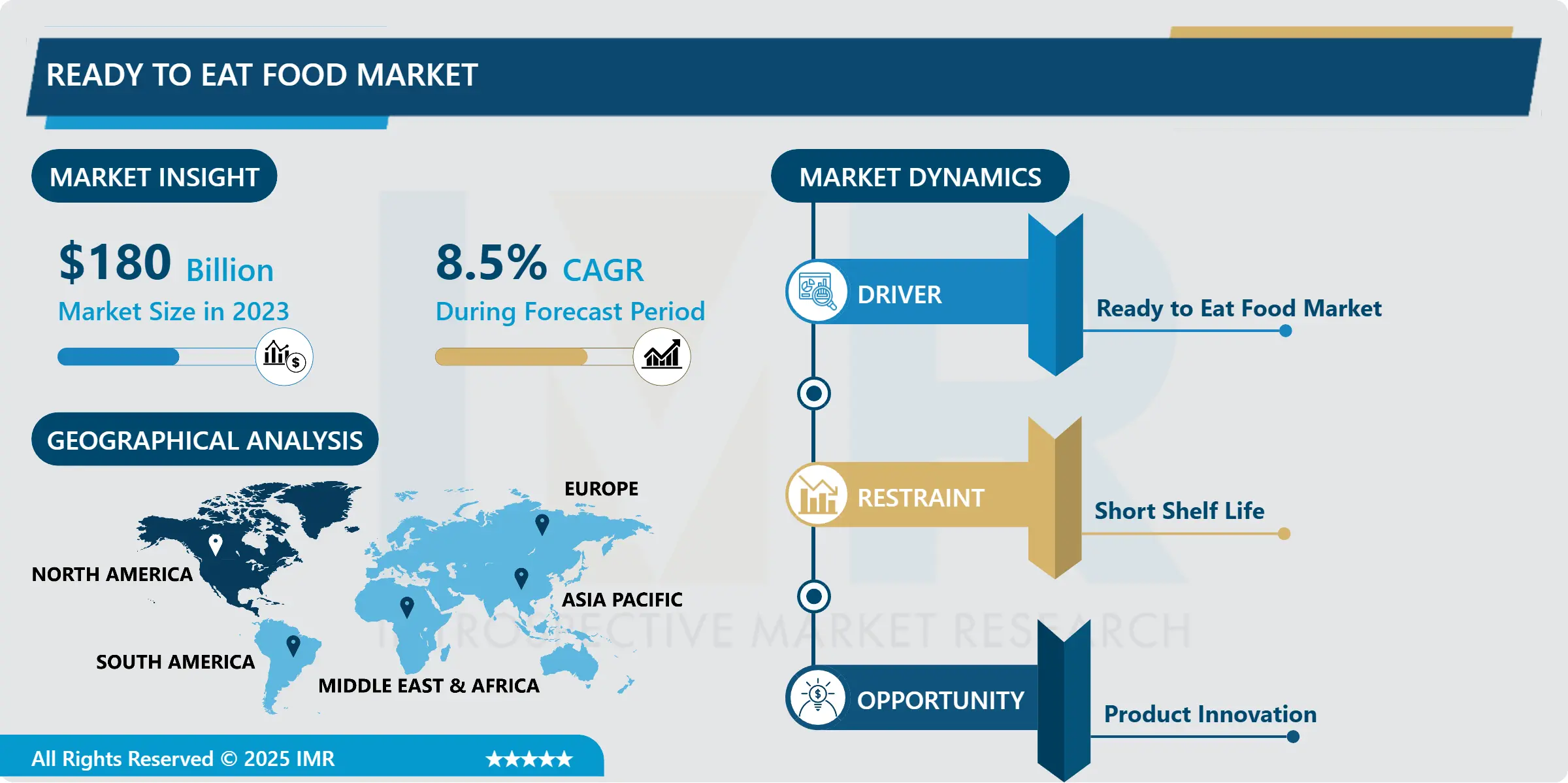
Ready to Eat Food Market Size Was Valued at USD 180 Billion in 2023, and is Projected to Reach USD 375.09 Billion by 2032, Growing at a CAGR of 8.5% From 2024-2032.

IMR Group
Description
Ready to Eat Food Market Synopsis:
Ready to Eat Food Market Size Was Valued at USD 180 Billion in 2023, and is Projected to Reach USD 375.09 Billion by 2032, Growing at a CAGR of 8.5% From 2024-2032.
The Ready-to-Eat (RTE) food market then relates to the food sub-sector that presents the consumer with fully or partly processed food that requires minimal processing before it is eaten. These products act as relief to consumers because they offer products that would need a little processing when consumed. PepsiCo product offerings; These products are in packaged snacks, frozen foods, canned foods and refrigerated foods. Main consumer needs that are addressed by this chain include convenience, good health, nutrition and the global palate.
The consumer trend in the Ready-to-Eat (RTE) food market continues to grow as the population becomes more health-conscious, and time-poor. There is a published trend, which shows that people are increasingly embracing meals through the use of processed foods, a factor that has been most prominent with increased urbanization as well as the need to eat convenience foods. Consumers are now in search of healthful and balanced meals that need least processing time hence the consumption of RTE foods. This market refers to a vast number of products which are in the categories including frozen foods, canned foods, snack foods, and meal delivery services, among others that are depending on ones dietary requirement, lifestyle, and preferences among others. Increased disposable income, increased work schedules, and urbanization have pushed people in various ages, young adults, middle-aged, senior citizens to consume RTE foods. Besides, advances in packaging and preservation of such products have made their shelf life so longer and hence increasing customers appeal.
Another industry that is benefitting from this sector is the ready to eat food market this is because consumers are paying more attention to taking balanced meals that is healthy. This has necessitated the production of RTE foods that use the organic, low calorie and low fat products. Also, the food technology has enhanced the quality of these products by adopting impressive and efficient preservation technologies such as freeze-drying and vacuum-sealing. This has caused new entrants to emerge into the market to offer diverse identified segments and new product development of plant base and vegetables foods due to shift in customer’s preferred diet. Geographical factors also matter here since consumers’ demand differs from city to city, state to state, and country to country depending on consumers’ necessities, preferences, and income powers. Continued diversification of the distribution channels which include online and offline retail continues to push market growth through increased access to RTE foods by more consumers.
Ready to Eat Food Market Trend Analysis:
Growth in the Ready-to-Eat Food Market
The Ready-to-Eat (RTE) food market is growing at a decent pace, majorly due to the rising consumption trend for convenience. Today people are occupied with their businesses, studies or careers meaning that they need easy food preparation methods. This shift is well manifested in the groups of shoppers that are on-the-go families in dual earner and single parent households which remain active in shopping but short on time. The RTE market serves this needs through a vast array of products like, ‘Heart[Z’N]Soul Simple Foods for Healthier Eating’, examples of Packages meals, Snack, Ready to Cook among others which include various flavor and flexibility for people with special diets regarding nutritional needs. Proper packaging techniques like microwave and environment friendly packing is also adding value and convenience to the RTE food products and appealing for conscious customer base.
The demand for natural and organic products is gaining ground, so manufacturers offer healthier RTE products with a simple list of ingredients. This trend is in harmony with the latest tendencies appearing in intensified health-conscious society willing to get more balanced and nutritious meal at the same time it should be fast. The COVID-19 pandemic has also put more pressure for RTE foods, because the population relies more on online sales and delivery services to satisfy their meal needs. Thus, the market is increasing with more types of products and better ways to deliver them in the point of consumer’s need, so RTE foods are easier to be sold to the public.
Advancements in the Ready-to-Eat Food Market
This trend is set to continue due to the current affluence and growth of populations’ busy lifestyles, therefore there is a steady rise in the need for Foods that can be prepared easily yet are tasty plus healthy. This trend holds especially is true for the urban working population, and generation Y working population especially the middle working class who do not have the time to spend so much time preparing meals and cooking. They look for results that can cater for their busy lifestyle while not greatly affecting the outcomes. This is a golden opportunity for Ready to Eat (RTE) foods market to fulfill the need by serving food that is easy also healthy. This is also well embraced by improved diet hlth Anthony also underscores heathly eating habits which people become more selective with the kind of food they want to have indicating whether they are vegan, gluten-free, or low sodium.
Advancement in e-commerce food delivery services haseen increased accessibility of RTE products to customers. They make it easier for consumers to order foods, be delivered to their homes hence giving convenience another shot which is important in meeting con consumers’ needs and expectations. The growth in the consumption of healthier and diverse food products presents a clear opportunity for the RTE market to expand by presenting products that meet consumers new requirements, thus, expanding the market share and sales.
Ready to Eat Food Market Segment Analysis:
Ready to Eat Food Market is Segmented on the basis of By Product Type, Sales Channel, and Region.
By Product Type, Dairy Products segment is expected to dominate the market during the forecast period
Segment involves number of products including milk, cheese, yogurt, butter and numerous dairy dessert. The key market pull factor of dairy products is their nutritional value as vitamins and minerals are paramount in our diets and the use of many dairy products across all classes of trade and preparation in the retail end user and food service sectors. Retail stores reign supreme as this is the major selling method, as consumers easily access various types of dairy products. But for sure, the food service sector such as restaurants, cafes, fast foods also contributes a lot especially for dairy products inclusive for cheeses, ice cream and yogurt that are part of the menu. Moreover there is a trend on the organic and locally sourced food products where consumers today prefer getting their dairy from healthier sources. These are indeed decisions that are made to embrace natural and sustainable foods in consumers’ basket thus impacting on markets given the fact that some firms are adjusting to these changes.
Considering the enhancement in the health consciousness about the consumers, there is a significant trend towards improved and healthier option in dairy products. Without additives and preservatives, organic, free from lactose, local dairy products have been preferred by consumers. It’s not only for nutritious value, but people’s health and guaranteeing preservation of the environment, and protection of animals, all of which are deciding factors for consumer choice. This has led to new changes within the retailers and food service providers that include; products for vegan diets including plant-based dairy and low-fat products for the conscience consumer. Such a trend is expected to persist, which means that future advancements in the production of dairy products will also be observed, and therefore new opportunities in the sales market will emerge mainly due to the differentiated selection by consumers.
By Sales Channel, Food Service segment expected to held the largest share
Sales distribution through restaurants, cafes, and all food selling outlets. It is a major distribution channel by which products are bought and consumed in a dining context. The segment is advantageously located in areas with pedestrian traffic and is conveniently situated in a favorable geographic location within the store to attract many times traffic and gain brand recognition. The ready to eat and on the go foods are those that fuel the growth of this sector because people become extremely busy that they do not have time to prepare meals on their own. Indeed, current trends in consumers’ demand lean towards healthier and specialty products and therefore presents a good opportunity for brand to enter the market with their superior products. Therefore, the food service segment is gradually becoming healthier, expanding the choice of products in accordance with the requirements of the contemporary population. They suggest this trend through social collaborations and partnerships to create extension lines and a wider market outlet for the brands.
The Food Service channel is dictated nearly completely by the consumer habits and tendencies which might be extremely high in the different dining places. A growing number of health and environmentally conscious customers is forcing restaurants and cafes to offer products that are produced organically, locally, and in eco-friendly packages. Consequently, the food service segment is a promising one for brands since it gives them a chance to create products that would be interesting for the environmentally friendly consumer. It also becomes possible to promote new products and advertising campaigns, as this way the consumer’s opinion on some brand’s proposal can be received and considered. Food service brands rely on their outlets, which means the outlets help spread news about their brands, making sure that people get loyal to the brands and recognize them. Such circumstances make the brand to be constantly initiating and implementing change in order to address fluctuating consumer preferences.
Ready to Eat Food Market Regional Insights:
North America is Expected to Dominate the Market Over the Forecast period
Within North America, the category of ‘Ready to Eat’ (RTE) foods is showing remarkable growth, owing primarily to an ever increasing and growing need for convenience food among the working population and families with children. The United States and Canada are dominant contributors to this growth due to the growing consumers looking for convenience food products. This has been especially the case with the fast and ever extending urban population that only gets to prepare such meals during their minimal spare time. Therefore, RTE foods that can be consumed quickly, are healthy, and easy to prepare are becoming popular. Actually, the key market participants within the North of America are also following the same strategy to extend their product offerings to different types of the products like, organic, gluten-free and plant-based products to fit the consumer needs and preferences.
The increase in demand of RTE food market in North America is also facilitated by the continuous enhancement in packaging and distribution technology that support the preservation of these products. Due to an increased awareness of health among the populace the demand for food that relates to the nutritional requirements is on the rise. This means that, there has been an expansion of the RTE foods that are tailored to meet particular nutrient profile including lowsodium, lowfat, highprotein among others. There is also continued research and development to come up with new and tasty RTE meals that in addition to saving time, have rich nutrition value to meet the continuously changing consumer tastes in the region.
Active Key Players in the Ready to Eat Food Market:
Nestlé
Dr. Oetker
Campbell Soup Company
Nomad Foods
Danone
Vietnam Hanfimex Corporation
General Mills Inc.
California Pizza Kitchen
McCain Foods Ltd.
MTR Foods Private Limited
Conagra Brands, Inc.
Atkins Nutritionals, Inc., and Other Active Players
Chapter 1: Introduction
1.1 Scope and Coverage
Chapter 2:Executive Summary
Chapter 3: Market Landscape
3.1 Market Dynamics
3.1.1 Drivers
3.1.2 Restraints
3.1.3 Opportunities
3.1.4 Challenges
3.2 Market Trend Analysis
3.3 PESTLE Analysis
3.4 Porter’s Five Forces Analysis
3.5 Industry Value Chain Analysis
3.6 Ecosystem
3.7 Regulatory Landscape
3.8 Price Trend Analysis
3.9 Patent Analysis
3.10 Technology Evolution
3.11 Investment Pockets
3.12 Import-Export Analysis
Chapter 4: Ready to Eat Food Market by Component
4.1 Ready to Eat Food Market Snapshot and Growth Engine
4.2 Ready to Eat Food Market Overview
4.3 Solution and Services
4.3.1 Introduction and Market Overview
4.3.2 Historic and Forecasted Market Size in Value USD and Volume Units (2017-2032F)
4.3.3 Key Market Trends, Growth Factors and Opportunities
4.3.4 Solution and Services: Geographic Segmentation Analysis
Chapter 5: Ready to Eat Food Market by Deployment
5.1 Ready to Eat Food Market Snapshot and Growth Engine
5.2 Ready to Eat Food Market Overview
5.3 On-Premise and Cloud
5.3.1 Introduction and Market Overview
5.3.2 Historic and Forecasted Market Size in Value USD and Volume Units (2017-2032F)
5.3.3 Key Market Trends, Growth Factors and Opportunities
5.3.4 On-Premise and Cloud: Geographic Segmentation Analysis
Chapter 6: Ready to Eat Food Market by Application
6.1 Ready to Eat Food Market Snapshot and Growth Engine
6.2 Ready to Eat Food Market Overview
6.3 Residential
6.3.1 Introduction and Market Overview
6.3.2 Historic and Forecasted Market Size in Value USD and Volume Units (2017-2032F)
6.3.3 Key Market Trends, Growth Factors and Opportunities
6.3.4 Residential: Geographic Segmentation Analysis
6.4 Commercial
6.4.1 Introduction and Market Overview
6.4.2 Historic and Forecasted Market Size in Value USD and Volume Units (2017-2032F)
6.4.3 Key Market Trends, Growth Factors and Opportunities
6.4.4 Commercial: Geographic Segmentation Analysis
6.5 Retail
6.5.1 Introduction and Market Overview
6.5.2 Historic and Forecasted Market Size in Value USD and Volume Units (2017-2032F)
6.5.3 Key Market Trends, Growth Factors and Opportunities
6.5.4 Retail: Geographic Segmentation Analysis
6.6 Government
6.6.1 Introduction and Market Overview
6.6.2 Historic and Forecasted Market Size in Value USD and Volume Units (2017-2032F)
6.6.3 Key Market Trends, Growth Factors and Opportunities
6.6.4 Government: Geographic Segmentation Analysis
6.7 Construction and Real Estate
6.7.1 Introduction and Market Overview
6.7.2 Historic and Forecasted Market Size in Value USD and Volume Units (2017-2032F)
6.7.3 Key Market Trends, Growth Factors and Opportunities
6.7.4 Construction and Real Estate: Geographic Segmentation Analysis
6.8 Others (Education
6.8.1 Introduction and Market Overview
6.8.2 Historic and Forecasted Market Size in Value USD and Volume Units (2017-2032F)
6.8.3 Key Market Trends, Growth Factors and Opportunities
6.8.4 Others (Education: Geographic Segmentation Analysis
6.9 Industrial
6.9.1 Introduction and Market Overview
6.9.2 Historic and Forecasted Market Size in Value USD and Volume Units (2017-2032F)
6.9.3 Key Market Trends, Growth Factors and Opportunities
6.9.4 Industrial: Geographic Segmentation Analysis
6.10 and Hotel)
6.10.1 Introduction and Market Overview
6.10.2 Historic and Forecasted Market Size in Value USD and Volume Units (2017-2032F)
6.10.3 Key Market Trends, Growth Factors and Opportunities
6.10.4 and Hotel): Geographic Segmentation Analysis
Chapter 7: Ready to Eat Food Market by End User
7.1 Ready to Eat Food Market Snapshot and Growth Engine
7.2 Ready to Eat Food Market Overview
7.3 Property Manager/Agent Housing Association Real Estate Agents Others
7.3.1 Introduction and Market Overview
7.3.2 Historic and Forecasted Market Size in Value USD and Volume Units (2017-2032F)
7.3.3 Key Market Trends, Growth Factors and Opportunities
7.3.4 Property Manager/Agent Housing Association Real Estate Agents Others: Geographic Segmentation Analysis
Chapter 8: Company Profiles and Competitive Analysis
8.1 Competitive Landscape
8.1.1 Competitive Benchmarking
8.1.2 Ready to Eat Food Market Share by Manufacturer (2023)
8.1.3 Industry BCG Matrix
8.1.4 Heat Map Analysis
8.1.5 Mergers and Acquisitions
8.2 NESTLÉ
8.2.1 Company Overview
8.2.2 Key Executives
8.2.3 Company Snapshot
8.2.4 Role of the Company in the Market
8.2.5 Sustainability and Social Responsibility
8.2.6 Operating Business Segments
8.2.7 Product Portfolio
8.2.8 Business Performance
8.2.9 Key Strategic Moves and Recent Developments
8.2.10 SWOT Analysis
8.3 DR. OETKER
8.4 CAMPBELL SOUP COMPANY
8.5 NOMAD FOODS
8.6 DANONE
8.7 VIETNAM HANFIMEX CORPORATION
8.8 GENERAL MILLS INC.
8.9 CALIFORNIA PIZZA KITCHEN
8.10 MCCAIN FOODS LTD.
8.11 MTR FOODS PRIVATE LIMITED
8.12 CONAGRA BRANDS INC.
8.13 ATKINS NUTRITIONALS INC
8.14 OTHER ACTIVE PLAYERS
Chapter 9: Global Ready to Eat Food Market By Region
9.1 Overview
9.2. North America Ready to Eat Food Market
9.2.1 Key Market Trends, Growth Factors and Opportunities
9.2.2 Top Key Companies
9.2.3 Historic and Forecasted Market Size by Segments
9.2.4 Historic and Forecasted Market Size By Component
9.2.4.1 Solution and Services
9.2.5 Historic and Forecasted Market Size By Deployment
9.2.5.1 On-Premise and Cloud
9.2.6 Historic and Forecasted Market Size By Application
9.2.6.1 Residential
9.2.6.2 Commercial
9.2.6.3 Retail
9.2.6.4 Government
9.2.6.5 Construction and Real Estate
9.2.6.6 Others (Education
9.2.6.7 Industrial
9.2.6.8 and Hotel)
9.2.7 Historic and Forecasted Market Size By End User
9.2.7.1 Property Manager/Agent Housing Association Real Estate Agents Others
9.2.8 Historic and Forecast Market Size by Country
9.2.8.1 US
9.2.8.2 Canada
9.2.8.3 Mexico
9.3. Eastern Europe Ready to Eat Food Market
9.3.1 Key Market Trends, Growth Factors and Opportunities
9.3.2 Top Key Companies
9.3.3 Historic and Forecasted Market Size by Segments
9.3.4 Historic and Forecasted Market Size By Component
9.3.4.1 Solution and Services
9.3.5 Historic and Forecasted Market Size By Deployment
9.3.5.1 On-Premise and Cloud
9.3.6 Historic and Forecasted Market Size By Application
9.3.6.1 Residential
9.3.6.2 Commercial
9.3.6.3 Retail
9.3.6.4 Government
9.3.6.5 Construction and Real Estate
9.3.6.6 Others (Education
9.3.6.7 Industrial
9.3.6.8 and Hotel)
9.3.7 Historic and Forecasted Market Size By End User
9.3.7.1 Property Manager/Agent Housing Association Real Estate Agents Others
9.3.8 Historic and Forecast Market Size by Country
9.3.8.1 Russia
9.3.8.2 Bulgaria
9.3.8.3 The Czech Republic
9.3.8.4 Hungary
9.3.8.5 Poland
9.3.8.6 Romania
9.3.8.7 Rest of Eastern Europe
9.4. Western Europe Ready to Eat Food Market
9.4.1 Key Market Trends, Growth Factors and Opportunities
9.4.2 Top Key Companies
9.4.3 Historic and Forecasted Market Size by Segments
9.4.4 Historic and Forecasted Market Size By Component
9.4.4.1 Solution and Services
9.4.5 Historic and Forecasted Market Size By Deployment
9.4.5.1 On-Premise and Cloud
9.4.6 Historic and Forecasted Market Size By Application
9.4.6.1 Residential
9.4.6.2 Commercial
9.4.6.3 Retail
9.4.6.4 Government
9.4.6.5 Construction and Real Estate
9.4.6.6 Others (Education
9.4.6.7 Industrial
9.4.6.8 and Hotel)
9.4.7 Historic and Forecasted Market Size By End User
9.4.7.1 Property Manager/Agent Housing Association Real Estate Agents Others
9.4.8 Historic and Forecast Market Size by Country
9.4.8.1 Germany
9.4.8.2 UK
9.4.8.3 France
9.4.8.4 The Netherlands
9.4.8.5 Italy
9.4.8.6 Spain
9.4.8.7 Rest of Western Europe
9.5. Asia Pacific Ready to Eat Food Market
9.5.1 Key Market Trends, Growth Factors and Opportunities
9.5.2 Top Key Companies
9.5.3 Historic and Forecasted Market Size by Segments
9.5.4 Historic and Forecasted Market Size By Component
9.5.4.1 Solution and Services
9.5.5 Historic and Forecasted Market Size By Deployment
9.5.5.1 On-Premise and Cloud
9.5.6 Historic and Forecasted Market Size By Application
9.5.6.1 Residential
9.5.6.2 Commercial
9.5.6.3 Retail
9.5.6.4 Government
9.5.6.5 Construction and Real Estate
9.5.6.6 Others (Education
9.5.6.7 Industrial
9.5.6.8 and Hotel)
9.5.7 Historic and Forecasted Market Size By End User
9.5.7.1 Property Manager/Agent Housing Association Real Estate Agents Others
9.5.8 Historic and Forecast Market Size by Country
9.5.8.1 China
9.5.8.2 India
9.5.8.3 Japan
9.5.8.4 South Korea
9.5.8.5 Malaysia
9.5.8.6 Thailand
9.5.8.7 Vietnam
9.5.8.8 The Philippines
9.5.8.9 Australia
9.5.8.10 New Zealand
9.5.8.11 Rest of APAC
9.6. Middle East & Africa Ready to Eat Food Market
9.6.1 Key Market Trends, Growth Factors and Opportunities
9.6.2 Top Key Companies
9.6.3 Historic and Forecasted Market Size by Segments
9.6.4 Historic and Forecasted Market Size By Component
9.6.4.1 Solution and Services
9.6.5 Historic and Forecasted Market Size By Deployment
9.6.5.1 On-Premise and Cloud
9.6.6 Historic and Forecasted Market Size By Application
9.6.6.1 Residential
9.6.6.2 Commercial
9.6.6.3 Retail
9.6.6.4 Government
9.6.6.5 Construction and Real Estate
9.6.6.6 Others (Education
9.6.6.7 Industrial
9.6.6.8 and Hotel)
9.6.7 Historic and Forecasted Market Size By End User
9.6.7.1 Property Manager/Agent Housing Association Real Estate Agents Others
9.6.8 Historic and Forecast Market Size by Country
9.6.8.1 Turkiye
9.6.8.2 Bahrain
9.6.8.3 Kuwait
9.6.8.4 Saudi Arabia
9.6.8.5 Qatar
9.6.8.6 UAE
9.6.8.7 Israel
9.6.8.8 South Africa
9.7. South America Ready to Eat Food Market
9.7.1 Key Market Trends, Growth Factors and Opportunities
9.7.2 Top Key Companies
9.7.3 Historic and Forecasted Market Size by Segments
9.7.4 Historic and Forecasted Market Size By Component
9.7.4.1 Solution and Services
9.7.5 Historic and Forecasted Market Size By Deployment
9.7.5.1 On-Premise and Cloud
9.7.6 Historic and Forecasted Market Size By Application
9.7.6.1 Residential
9.7.6.2 Commercial
9.7.6.3 Retail
9.7.6.4 Government
9.7.6.5 Construction and Real Estate
9.7.6.6 Others (Education
9.7.6.7 Industrial
9.7.6.8 and Hotel)
9.7.7 Historic and Forecasted Market Size By End User
9.7.7.1 Property Manager/Agent Housing Association Real Estate Agents Others
9.7.8 Historic and Forecast Market Size by Country
9.7.8.1 Brazil
9.7.8.2 Argentina
9.7.8.3 Rest of SA
Chapter 10 Analyst Viewpoint and Conclusion
10.1 Recommendations and Concluding Analysis
10.2 Potential Market Strategies
Chapter 11 Research Methodology
11.1 Research Process
11.2 Primary Research
11.3 Secondary Research
Q1: What would be the forecast period in the Ready to Eat Food Market research report?
A1: The forecast period in the Market research report is 2024-2032.
Q2: Who are the key players in the Ready to Eat Food Market?
A2: Nestlé, Dr. Oetker, Campbell Soup Company, Nomad Foods, Danone, Vietnam Hanfimex Corporation, General Mills Inc., California Pizza Kitchen, McCain Foods Ltd., MTR Foods Private Limited, Conagra Brands, Inc., Atkins Nutritionals, Inc., and Other Active Players.
Q3: What are the segments of the Ready to Eat Food Market?
A3: The Ready to Eat Food Market is segmented into By Product Type, By Sales Channel and region. By Product Type, the market is categorized into Dairy Products, Instant Breakfast/Cereals, Bakery and Confectionary, Meat and Poultry, Frozen Pizza, Pasta and Noodles, Savory Snacks and Prepared Salads. By Sales Channel, the market is categorized into Food Service, Airport Retail, Travel Retail, Retail and Online. By region, it is analyzed across North America (U.S., Canada, Mexico), Eastern Europe (Russia, Bulgaria, The Czech Republic, Hungary, Poland, Romania, Rest of Eastern Europe), Western Europe (Germany, UK, France, Netherlands, Italy, Spain, Rest of Western Europe), Asia Pacific (China, India, Japan, South Korea, Malaysia, Thailand, Vietnam, The Philippines, Australia, New Zealand, Rest of APAC), Middle East & Africa (Turkiye, Bahrain, Kuwait, Saudi Arabia, Qatar, UAE, Israel, South Africa), South America (Brazil, Argentina, Rest of SA).
Q4: What is the Ready to Eat Food Market?
A4: The Ready-to-Eat (RTE) food market refers to the segment of the food industry that offers convenience foods that are fully or partially prepared and can be consumed without further cooking. These products are designed to save time and effort for consumers by providing quick meal solutions that require minimal preparation. The market includes a wide range of items such as packaged snacks, frozen meals, canned foods, and refrigerated foods. It caters to various consumer needs, including busy lifestyles, health-conscious eating, and preferences for international cuisines.
Q5: How Big is the Ready to Eat Food Market?
A5: Ready to Eat Food Market Size Was Valued at USD 180 Billion in 2023, and is Projected to Reach USD 375.09 Billion by 2032, Growing at a CAGR of 8.5% From 2024-2032.
How to Buy a Report from eminsights.jp
On the product page, choose the license you want: Single-User License, Multi-User License or Enterprise License.
If you required report in your native language, then you can click on Translated Report button and fill out the form with report name and language you want, then our team will contact you as soon as possible.
Click the Buy Now button.
You will be redirected to the checkout page. Enter your company details and payment information.
Click Place Order to complete the purchase.
Confirmation: You’ll receive an order confirmation and our team will contact you shortly with your ordered report.
If you have any questions, fill out the contact form below or email us at [email protected].
Thank you for choosing eminsights.jp!