Stay Ahead in Fast-Growing Economies.
Browse Reports Now
Multiple Sclerosis Therapeutics Market Demand Outlook, Regional Trends & Forecast (2024–2032)
Extending from the discovery, production and distribution of products which are exclusively used to treat MS, the Multiple Sclerosis (MS) Therapeutics Market selected herein refers to the commercialisation of products that seek to address the management of multiple sclerosis, a chronic autoimmune disease of the central nervous system.

IMR Group
Description
Multiple Sclerosis Therapeutics Market Synopsis:
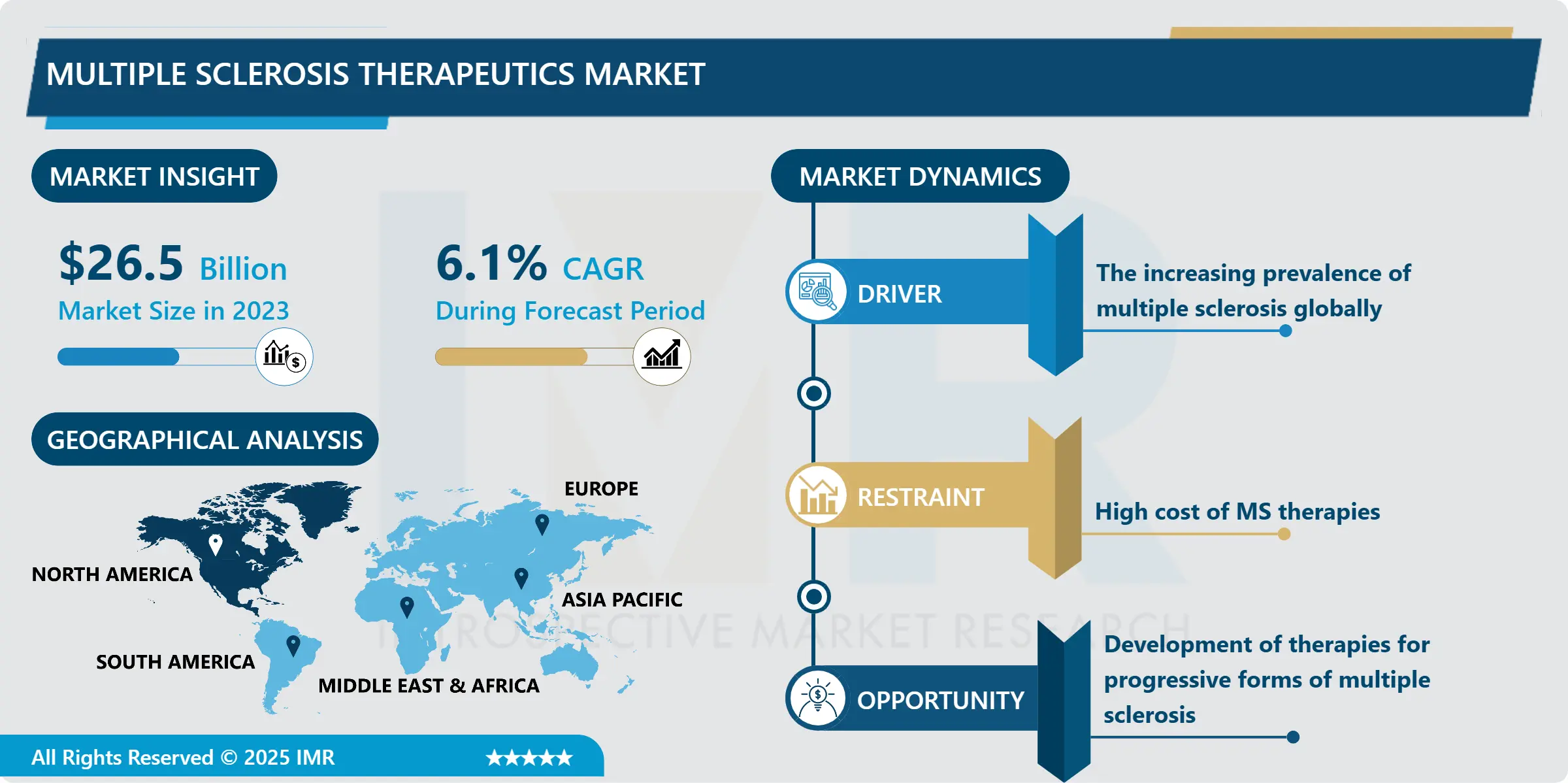
Multiple Sclerosis Therapeutics Market Size Was Valued at USD 26.3 Billion in 2023, and is Projected to Reach USD 44.8 Billion by 2032, Growing at a CAGR of 6.1% From 2024-2032.
Extending from the discovery, production and distribution of products which are exclusively used to treat MS, the Multiple Sclerosis (MS) Therapeutics Market selected herein refers to the commercialisation of products that seek to address the management of multiple sclerosis, a chronic autoimmune disease of the central nervous system. It comprises various therapeutic interventions like DMTs, symptomatic treatments and anti-inflammatory therapies, besides newly developed biologics intended for decelerating disease progression, fewer relapses and enhanced patients’ quality of life. Some major stakeholders in this market are pharma and biotech industries who engage in R&D to develop new procedures and plans in treatment, meanwhile, new formulation in drugs, technique in drug delivery and in the aspect of personalized medicine, are factors of growth to this market and also benefits to the patient.
Technological changes and gains achieved in ways to treat multiple sclerosis are likely to boost growth prospects before the forthcoming period, as such developments significantly improved the patients’ quality of living.. Some of these technologies are assistive robotic arms, applications in smartphone, voice command systems, neurotherapy such as tDCS. New population increasingly suffers from multiple sclerosis and the need for new, better drugs is one more reason for the market’s growth.• It has been associated with increased focus on research and development activities by the leading market participants oriented on introducing more effective drugs.ements have notably elevated the quality of life for patients. Examples of these technologies include assistive robotic arms, smartphone applications, voice command systems, and neurotherapy treatments like transcranial direct current stimulation (tDCS). The increase in the population affected by multiple sclerosis, along with a growing demand for innovative and effective medications, is a significant factor propelling market expansion.
The expansion can be linked to the heightened emphasis on research and development aimed at creating innovative pharmaceuticals by leading market participants. Market expansion during the forecast period is expected to be driven by the promising introduction of new products and the increasing initiatives from governments to improve the treatment and care availability. According to the MS International Federation global prevalence of MS has been rising from 2.3 million people in 2013 to 2.8 million people in 2020, we are projected to reach 2.9 million people in 2023. According to the data, the occurrence of multiple sclerosis is rising globally, contributing a major rationale for the growth of the multiple sclerosis therapeutic market over the forecast period.
Multiple Sclerosis Therapeutics Market Trend Analysis:
Growing shift toward personalized and precision medicine
One the trends of the Multiple Sclerosis (MS) Therapeutics Market is the indication that there is a move towards more personalized and precision medicine as more data on biomarkers and genetic profiles are developed.. Such gives the flexibility of treatment with more specific approaches that address the disease type of the patient therefore enhancing the benefits and minimum side effects recorded on the patients. Moreover, there appears to be an expansion in more efficient new agents such as monoclonal antibodies; being orally administered drugs rather than injectable drugs. Another trend recognized in the industry is the increase in remyelination /neuroprotection therapies which is all about repair nerve impairment and disease progression. Moreover, more capital is devoted to research as to the progressive MS which are still lacking in the market.
Development of therapies for progressive forms of MS
One of the developing trends in the Multiple Sclerosis (MS) Therapeutics Market is the drugs targeting progressive types of MS that are currently much less addressed than relapsing-remitting type. As the market continues to expand and advance, firms conducting research into novel approaches to treating MS and MS-related symptoms, such as remyelinating drugs and neuroprotective agents, will find a promising niche in the market for progressive forms of the disease. thirdly, with biotechnology in place, gene therapies and stem cell cures for the afflictions are not merely conceivable but probably within the foreseeable future, and hence, capable of providing long term solutions to the disease rather than just its manifestations. It also opens the door for introduction of affordable MS therapies to developing markets where incidence of MS and unmet need are on the rise.
Multiple Sclerosis Therapeutics Market Segment Analysis:
Multiple Sclerosis Therapeutics Market Segmented on the basis of Type, Route of Administration, and Region
By Type, Immunosuppressants segment is expected to dominate the market during the forecast period
The immunosuppressants segment is expected to maintain the market dominance in Multiple Sclerosis (MS) Therapeutics Market during the forecast period and occupied 60.8% of the market share in 2023. This dominance is seen having stemmed from the ability of immunosuppressants in the management of MS by directing their action on the immune system to avoid its attack on the CNS. These treatments – many of which, like methotrexate and azathioprine, might be familiar to you – can decrease the rate of relapses and halt the advancement of the disease. Also, the constant switch to less conventional immunosuppressive therapies, coupled with continual research to develop variations of the drug forms, boosts this segment. In addition, the growing number of people diagnosed with MS worldwide, and the shift toward more effective and robust treatments for both relapsing and progressive types of the disease help explain the growing market share of these medications.
By Route of Administration, Oral segment expected to held the largest share
The Multiple Sclerosis (MS) Therapeutics Market include Oral as one of the route of administration and is expected to dominate this market during the forecast period. Such trend is attributed by the flexibility and favorability of oral therapies as compared to injected therapies because of better patient compliance. Other drugs in tablet form or for oral administration like fingolimod and dimethyl fumarate have proved more effective or relatively in terms of result more efficient and in the meantime are less complicated concerning administration problems. Cohort patients reported higher satisfaction with oral medication regimes over time, improving the chances of following set prescriptions and disease-related outcomes. Furthermore, there is high investment from the global pharmaceutical companies on the next generation of oral/mucosal formulations which would still diversify the segment and strengthen its market leadership position.
Multiple Sclerosis Therapeutics Market Regional Insights:
North America is Expected to Dominate the Market Over the Forecast period
The Multiple Sclerosis (MS) Therapeutics Market in North America also has a higher growth rate of 7.7%, and owing to the high sales rate and customer acceptance, the market is expected to retain its leadership position in the years to come, till 2023, where it registered nearly 38.3% of the global market share. There are a number of reasons behind this lead among them being; high incidence of MS in the area, developed health system and increased market share of foremost pharmaceutical companies developing new therapies for MS. Ensuring that the region gets first access to new therapeutic products, further continued development of clinical trials, and qualitative and quantitative increased investment in research on new and better therapeutic agents, including biologics and orally available agents is a factor. Further, the favourable reimbursement policies and higher disease awareness also has a positive impact on the market in North America region. Owing to such strengthened commitment and new breakthroughs in precision Medicine and progress to finding MS drugs for Progressive form of the disease North America will likely remain on the top.
Active Key Players in the Multiple Sclerosis Therapeutics Market:
AbbVie Inc. (United States)
Bayer AG (Germany)
Biogen (United States)
Bristol Myers Squibb (United States)
Celgene Corporation (United States)
Eli Lilly and Company (United States)
Johnson & Johnson (United States)
Mallinckrodt Pharmaceuticals (United Kingdom)
Merck KGaA (Germany)
Novartis AG (Switzerland)
Pfizer Inc. (United States)
Roche Holding AG (Switzerland)
Sanofi (France)
Takeda Pharmaceutical Company (Japan)
Teva Pharmaceutical Industries Ltd. (Israel)
Other Active Players
Key Industry Developments in the Multiple Sclerosis Therapeutics Market:
In February 2024, Roche Pharma India has officially introduced Ocrevus as a treatment option for multiple sclerosis (MS). The initiative aims to address the needs of patients dealing with MS in India. Ocrevus stands out as a prominent product, with availability in over 100 countries. In India, it has received approval for both primary progressive and relapsing forms of multiple sclerosis.
In February 2024, Neuraxpharm Group has announced the introduction of BRIUMVI in Europe, aimed at addressing the needs of adult patients experiencing relapsing MS
Chapter 1: Introduction
1.1 Scope and Coverage
Chapter 2:Executive Summary
Chapter 3: Market Landscape
3.1 Market Dynamics
3.1.1 Drivers
3.1.2 Restraints
3.1.3 Opportunities
3.1.4 Challenges
3.2 Market Trend Analysis
3.3 PESTLE Analysis
3.4 Porter’s Five Forces Analysis
3.5 Industry Value Chain Analysis
3.6 Ecosystem
3.7 Regulatory Landscape
3.8 Price Trend Analysis
3.9 Patent Analysis
3.10 Technology Evolution
3.11 Investment Pockets
3.12 Import-Export Analysis
Chapter 4: Multiple Sclerosis Therapeutics Market by Type
4.1 Multiple Sclerosis Therapeutics Market Snapshot and Growth Engine
4.2 Multiple Sclerosis Therapeutics Market Overview
4.3 Immunosuppressants
4.3.1 Introduction and Market Overview
4.3.2 Historic and Forecasted Market Size in Value USD and Volume Units (2017-2032F)
4.3.3 Key Market Trends, Growth Factors and Opportunities
4.3.4 Immunosuppressants: Geographic Segmentation Analysis
4.4 Immunomodulators
4.4.1 Introduction and Market Overview
4.4.2 Historic and Forecasted Market Size in Value USD and Volume Units (2017-2032F)
4.4.3 Key Market Trends, Growth Factors and Opportunities
4.4.4 Immunomodulators: Geographic Segmentation Analysis
Chapter 5: Multiple Sclerosis Therapeutics Market by Route of Administration
5.1 Multiple Sclerosis Therapeutics Market Snapshot and Growth Engine
5.2 Multiple Sclerosis Therapeutics Market Overview
5.3 Oral
5.3.1 Introduction and Market Overview
5.3.2 Historic and Forecasted Market Size in Value USD and Volume Units (2017-2032F)
5.3.3 Key Market Trends, Growth Factors and Opportunities
5.3.4 Oral: Geographic Segmentation Analysis
5.4 Injectable
5.4.1 Introduction and Market Overview
5.4.2 Historic and Forecasted Market Size in Value USD and Volume Units (2017-2032F)
5.4.3 Key Market Trends, Growth Factors and Opportunities
5.4.4 Injectable: Geographic Segmentation Analysis
5.5 Intravenous
5.5.1 Introduction and Market Overview
5.5.2 Historic and Forecasted Market Size in Value USD and Volume Units (2017-2032F)
5.5.3 Key Market Trends, Growth Factors and Opportunities
5.5.4 Intravenous: Geographic Segmentation Analysis
Chapter 6: Company Profiles and Competitive Analysis
6.1 Competitive Landscape
6.1.1 Competitive Benchmarking
6.1.2 Multiple Sclerosis Therapeutics Market Share by Manufacturer (2023)
6.1.3 Industry BCG Matrix
6.1.4 Heat Map Analysis
6.1.5 Mergers and Acquisitions
6.2 ABBVIE INC. (UNITED STATES)
6.2.1 Company Overview
6.2.2 Key Executives
6.2.3 Company Snapshot
6.2.4 Role of the Company in the Market
6.2.5 Sustainability and Social Responsibility
6.2.6 Operating Business Segments
6.2.7 Product Portfolio
6.2.8 Business Performance
6.2.9 Key Strategic Moves and Recent Developments
6.2.10 SWOT Analysis
6.3 BAYER AG (GERMANY)
6.4 BIOGEN (UNITED STATES)
6.5 BRISTOL MYERS SQUIBB (UNITED STATES)
6.6 CELGENE CORPORATION (UNITED STATES)
6.7 ELI LILLY AND COMPANY (UNITED STATES)
6.8 JOHNSON & JOHNSON (UNITED STATES)
6.9 MALLINCKRODT PHARMACEUTICALS (UNITED KINGDOM)
6.10 MERCK KGAA (GERMANY)
6.11 NOVARTIS AG (SWITZERLAND)
6.12 PFIZER INC. (UNITED STATES)
6.13 ROCHE HOLDING AG (SWITZERLAND)
6.14 SANOFI (FRANCE)
6.15 TAKEDA PHARMACEUTICAL COMPANY (JAPAN)
6.16 TEVA PHARMACEUTICAL INDUSTRIES LTD. (ISRAEL)
6.17 OTHER ACTIVE PLAYERS
Chapter 7: Global Multiple Sclerosis Therapeutics Market By Region
7.1 Overview
7.2. North America Multiple Sclerosis Therapeutics Market
7.2.1 Key Market Trends, Growth Factors and Opportunities
7.2.2 Top Key Companies
7.2.3 Historic and Forecasted Market Size by Segments
7.2.4 Historic and Forecasted Market Size By Type
7.2.4.1 Immunosuppressants
7.2.4.2 Immunomodulators
7.2.5 Historic and Forecasted Market Size By Route of Administration
7.2.5.1 Oral
7.2.5.2 Injectable
7.2.5.3 Intravenous
7.2.6 Historic and Forecast Market Size by Country
7.2.6.1 US
7.2.6.2 Canada
7.2.6.3 Mexico
7.3. Eastern Europe Multiple Sclerosis Therapeutics Market
7.3.1 Key Market Trends, Growth Factors and Opportunities
7.3.2 Top Key Companies
7.3.3 Historic and Forecasted Market Size by Segments
7.3.4 Historic and Forecasted Market Size By Type
7.3.4.1 Immunosuppressants
7.3.4.2 Immunomodulators
7.3.5 Historic and Forecasted Market Size By Route of Administration
7.3.5.1 Oral
7.3.5.2 Injectable
7.3.5.3 Intravenous
7.3.6 Historic and Forecast Market Size by Country
7.3.6.1 Russia
7.3.6.2 Bulgaria
7.3.6.3 The Czech Republic
7.3.6.4 Hungary
7.3.6.5 Poland
7.3.6.6 Romania
7.3.6.7 Rest of Eastern Europe
7.4. Western Europe Multiple Sclerosis Therapeutics Market
7.4.1 Key Market Trends, Growth Factors and Opportunities
7.4.2 Top Key Companies
7.4.3 Historic and Forecasted Market Size by Segments
7.4.4 Historic and Forecasted Market Size By Type
7.4.4.1 Immunosuppressants
7.4.4.2 Immunomodulators
7.4.5 Historic and Forecasted Market Size By Route of Administration
7.4.5.1 Oral
7.4.5.2 Injectable
7.4.5.3 Intravenous
7.4.6 Historic and Forecast Market Size by Country
7.4.6.1 Germany
7.4.6.2 UK
7.4.6.3 France
7.4.6.4 The Netherlands
7.4.6.5 Italy
7.4.6.6 Spain
7.4.6.7 Rest of Western Europe
7.5. Asia Pacific Multiple Sclerosis Therapeutics Market
7.5.1 Key Market Trends, Growth Factors and Opportunities
7.5.2 Top Key Companies
7.5.3 Historic and Forecasted Market Size by Segments
7.5.4 Historic and Forecasted Market Size By Type
7.5.4.1 Immunosuppressants
7.5.4.2 Immunomodulators
7.5.5 Historic and Forecasted Market Size By Route of Administration
7.5.5.1 Oral
7.5.5.2 Injectable
7.5.5.3 Intravenous
7.5.6 Historic and Forecast Market Size by Country
7.5.6.1 China
7.5.6.2 India
7.5.6.3 Japan
7.5.6.4 South Korea
7.5.6.5 Malaysia
7.5.6.6 Thailand
7.5.6.7 Vietnam
7.5.6.8 The Philippines
7.5.6.9 Australia
7.5.6.10 New Zealand
7.5.6.11 Rest of APAC
7.6. Middle East & Africa Multiple Sclerosis Therapeutics Market
7.6.1 Key Market Trends, Growth Factors and Opportunities
7.6.2 Top Key Companies
7.6.3 Historic and Forecasted Market Size by Segments
7.6.4 Historic and Forecasted Market Size By Type
7.6.4.1 Immunosuppressants
7.6.4.2 Immunomodulators
7.6.5 Historic and Forecasted Market Size By Route of Administration
7.6.5.1 Oral
7.6.5.2 Injectable
7.6.5.3 Intravenous
7.6.6 Historic and Forecast Market Size by Country
7.6.6.1 Turkiye
7.6.6.2 Bahrain
7.6.6.3 Kuwait
7.6.6.4 Saudi Arabia
7.6.6.5 Qatar
7.6.6.6 UAE
7.6.6.7 Israel
7.6.6.8 South Africa
7.7. South America Multiple Sclerosis Therapeutics Market
7.7.1 Key Market Trends, Growth Factors and Opportunities
7.7.2 Top Key Companies
7.7.3 Historic and Forecasted Market Size by Segments
7.7.4 Historic and Forecasted Market Size By Type
7.7.4.1 Immunosuppressants
7.7.4.2 Immunomodulators
7.7.5 Historic and Forecasted Market Size By Route of Administration
7.7.5.1 Oral
7.7.5.2 Injectable
7.7.5.3 Intravenous
7.7.6 Historic and Forecast Market Size by Country
7.7.6.1 Brazil
7.7.6.2 Argentina
7.7.6.3 Rest of SA
Chapter 8 Analyst Viewpoint and Conclusion
8.1 Recommendations and Concluding Analysis
8.2 Potential Market Strategies
Chapter 9 Research Methodology
9.1 Research Process
9.2 Primary Research
9.3 Secondary Research
Q1: What would be the forecast period in the Multiple Sclerosis Therapeutics Market research report?
A1: The forecast period in the Multiple Sclerosis Therapeutics Market research report is 2024-2032.
Q2: Who are the key players in the Multiple Sclerosis Therapeutics Market?
A2: AbbVie Inc. (United States), Bayer AG (Germany), Biogen (United States), Bristol Myers Squibb (United States), Celgene Corporation (United States), Eli Lilly and Company (United States), Johnson & Johnson (United States), Mallinckrodt Pharmaceuticals (United Kingdom), Merck KGaA (Germany), Novartis AG (Switzerland), Pfizer Inc. (United States), Roche Holding AG (Switzerland), Sanofi (France), Takeda Pharmaceutical Company (Japan), Teva Pharmaceutical Industries Ltd. (Israel), and Other Active Players.
Q3: What are the segments of the Multiple Sclerosis Therapeutics Market?
A3: The Multiple Sclerosis Therapeutics Market is segmented into Type, Route of Administration, and region. By Type, the market is categorized into Immunosuppressants, Immunomodulators. By Route of Administration, the market is categorized into Oral, Injectable, Intravenous. By region, it is analyzed across North America (U.S., Canada, Mexico), Eastern Europe (Russia, Bulgaria, The Czech Republic, Hungary, Poland, Romania, Rest of Eastern Europe), Western Europe (Germany, UK, France, The Netherlands, Italy, Russia, Spain, Rest of Western Europe), Asia Pacific (China, India, Japan, South Korea, Malaysia, Thailand, Vietnam, The Philippines, Australia, New-Zealand, Rest of APAC), Middle East & Africa (Turkiye, Bahrain, Kuwait, Saudi Arabia, Qatar, UAE, Israel, South Africa), South America (Brazil, Argentina, Rest of SA).
Q4: What is the Multiple Sclerosis Therapeutics Market?
A4: Extending from the discovery, production and distribution of products which are exclusively used to treat MS, the Multiple Sclerosis (MS) Therapeutics Market selected herein refers to the commercialisation of products that seek to address the management of multiple sclerosis, a chronic autoimmune disease of the central nervous system. It comprises various therapeutic interventions like DMTs, symptomatic treatments and anti-inflammatory therapies, besides newly developed biologics intended for decelerating disease progression, fewer relapses and enhanced patients’ quality of life. Some major stakeholders in this market are pharma and biotech industries who engage in R&D to develop new procedures and plans in treatment, meanwhile, new formulation in drugs, technique in drug delivery and in the aspect of personalized medicine, are factors of growth to this market and also benefits to the patient.
Q5: How big is the Multiple Sclerosis Therapeutics Market?
A5: Multiple Sclerosis Therapeutics Market Size Was Valued at USD 26.3 Billion in 2023, and is Projected to Reach USD 44.8 Billion by 2032, Growing at a CAGR of 6.1% From 2024-2032.
How to Buy a Report from eminsights.jp
On the product page, choose the license you want: Single-User License, Multi-User License or Enterprise License.
If you required report in your native language, then you can click on Translated Report button and fill out the form with report name and language you want, then our team will contact you as soon as possible.
Click the Buy Now button.
You will be redirected to the checkout page. Enter your company details and payment information.
Click Place Order to complete the purchase.
Confirmation: You’ll receive an order confirmation and our team will contact you shortly with your ordered report.
If you have any questions, fill out the contact form below or email us at [email protected].
Thank you for choosing eminsights.jp!