Stay Ahead in Fast-Growing Economies.
Browse Reports Now
Car Rental Market Opportunities, Challenges & Strategic Forecast (2024-2032)
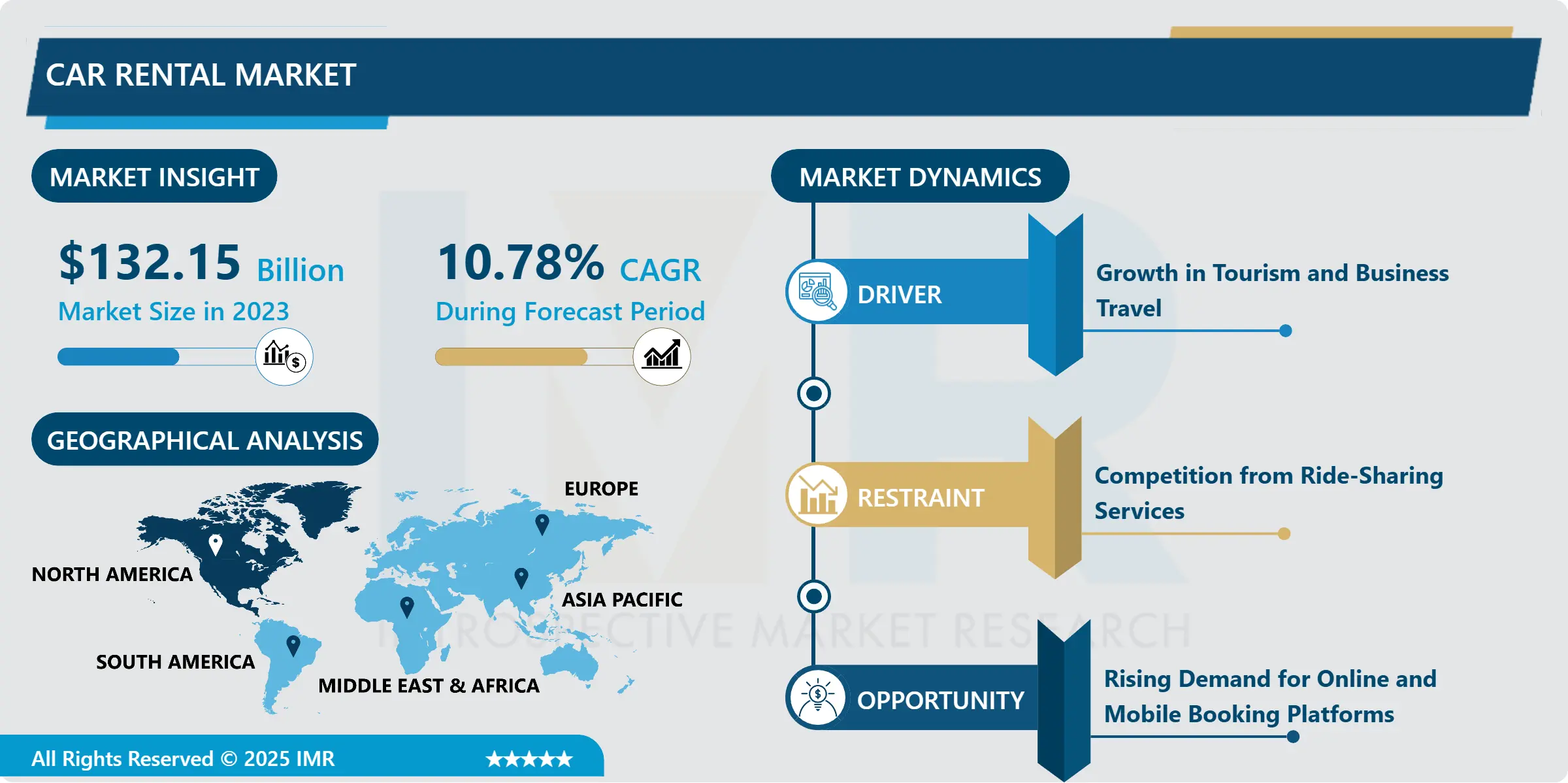
Car Rental Market Size Was Valued at USD 132.15 Billion in 2023, and is Projected to Reach USD 332.06 Billion by 2032, Growing at a CAGR of 10.78% From 2024-2032.

IMR Group
Description
Car Rental Market Synopsis:
Car Rental Market Size Was Valued at USD 132.15 Billion in 2023, and is Projected to Reach USD 332.06 Billion by 2032, Growing at a CAGR of 10.78% From 2024-2032.
The product market concerns the short term hiring of cars to the public or business entities to meet their mobility needs without requiring to own a car. This market can be divided by various customer requirements such as, business, recreational, and rental needs for a short period of time, which is more and more often being conducted through Internet portals and applications on a mobile device.
The car rental market has become one of the most popular and active segments in the current booming market for mobility and flexible, cheap transport. This is particularly the case for car-renting services whose demand is highly likely to grow as urbanization continues, and travel is gradually revived. The market has expanded in response to advances in technology by adopting such factors as online booking, application controls, and telemanagement. Not only do all these innovations provide a better end-user experience but also a means to managing service providers’ vehicles fleets much better.
The market available for car is customized to suit all sort of individuals including self-drive that is more convenient while others that come with chauffeur services for those who want to be eased of any hurrying around since the car is automatically driven by a programmer. Some of the central segments that are defining the market include tourism, business travels, and personal mobility. Also, environmental issues and policies have created demand for electric and hybrid vehicles in the rental service, which expanded the product market. There are however threats which the industry is set to encounter and they include increased regulation, volatility in fuel prices, and assault from ride sharing services.
Car Rental Market Trend Analysis:
Increasing Adoption of Electric Vehicles in Rental Fleets
Global businesses are now adopting sustainability hence car rental companies are incorporatingEVs into their fleets. This trend is due to the increase in environmental smart orientation to the electric vehicles, government incentives towards the EV utilization, and customer preference for environmentally friendly travel. This has led rental providers to seize the opportunity and associate their services with environmentally friendly schemes.
With the increased investment on stations for charging of EVs and development of batteries, electric cars are suitable for rental services. Current car rental companies such as Hertz and Enterprise are increasing their EV fleet adoption rates and partnering with car manufacturers to have numerous choices. Thus, environmental goals are sustainable, and rental companies benefit from increasing the appeal to the younger, technology-savvy and, thus, environmentally minded clientele.
Rising Demand for Online and Mobile Booking Platforms
The current advancement in mobile phones and internet use has greatly extended a chance for the car rental business to adopt online and mobile applications. They are some of the platforms that have made it easy for users to compare prices of car rentals, choose the rate and book for cars in a very short time. This is convenience which is the need of today’s consumers who prefer consuming services that offer them information that is easily understandable.
Additional features like virtual customers support, tailored offers, and contactless payment deepen the perception of the users. To many firms, these platforms offer rich sources of information on enhancing consumer services delivery and customer loyalty. This increasing utilization of technologies in addressing business requirements is forecast to augment the growth of the market particularly among youthful populations and embracing professionals.
Car Rental Market Segment Analysis:
Car Rental Market is Segmented on the basis of Service Type, Vehicle Type, Booking Mode, Rental Duration, End User, and Region.
By Service Type, Self-Driving segment is expected to dominate the market during the forecast period
The car rental market has two categories of services; The self driving car rental; and The Chauffer driven car rental. Self-driving rentals are becoming more prevalent and convenient because of their usage and operational costs. As we can see these types of services suit people who crave self-sufficiency and personal discretion while on the move. Additional improvement that has been observed can be mentioned as GPS integration, as well as ordering through the application.
While there is ride-hailing, which offers a cheaper means for getting around, then the car services are meant for the businessmen and the wealthy. This segment stresses own and others’ comfort and practicability and may involve luxury cars and Special Service drivers. While there might be a slightly higher cost in using chauffeur driven rentals their services are crucial in corporate occasions and for the celebrities among clients. One segment benefits the other to enhance the entire user market as they both cater for a different need in the market.
By End User, Leisure segment expected to held the largest share
Leisure segment stands out as the clear market leader, which can be explained by a growth in domestic and inbound tourism. Many travelers gas a need to move around different places in the destination intending to use car rentals to ease this transportation especially if the place is not well serviced by public means of transport.
Out of the entire demand, the business segment is a major part, driven by business travel and meetings and events. Business people are always in need of transport, and this is why many companies hire rental services to extend this to their employees especially for business trips. Other involves other small users including those that involve substitution for temporary periods and those in special occasions such as functions among others thus making the market even more diverse.
North America is Expected to Dominate the Market Over the Forecast period
The market is dominated by North America due to factors such as sound tourism, a high level of urbanization, and well-developed car hire services infrastructure. The U.S. is at the center of the industry, as evidenced by key industry players such as Hertz as well as Avis. Numerous innovations in digital scheduling through apps and pinpoint real-time tracking through GPS has benefited both the customers and the company.
North America has a very prosperous economy, and a large share of business people that travel frequently. There has also been increased adoption of sustainability that has seen EVs adopted in fleets in the region thus helping to cement its position as the global car rental market.
Active Key Players in the Car Rental Market:
Hertz Global Holdings, Inc. (USA)
Avis Budget Group, Inc. (USA)
Enterprise Holdings, Inc. (USA)
Europcar Mobility Group (France)
Sixt SE (Germany)
ALD Automotive (France)
Localiza Rent a Car S.A. (Brazil)
Budget Rent a Car System, Inc. (USA)
Dollar Thrifty Automotive Group (USA)
National Car Rental (USA)
Zoomcar (India)
Carzonrent (India), and Other Active Players
Key Industry Developments in the Car Rental Market:
In November 2023, MakeMyTrip, an Online travel agency, announced its entry into the car rental market with the acquisition of Indian intercity car rental company Savaari. The acquisition is a small ticket investment within the USD 10 million range.
In August 2023, Avis Budget Group announced a strategic partnership with Albatha Automotive Group to add the Budget Rent a Car and Payless Car Rental brands to the latter’s mobility services portfolio. The newly founded division of Albatha Group will include the Budget and Payless car rental brands. It will also provide a range of self-drive and chauffeur-driven services, including rental cars and leasing for passenger and commercial vehicles.
In March 2023, IndusGo, the leading self-drive car rental company, raised funding of USD 23.5 million from its parent company, Indus Motors. IndusGo is a prominent player operating in South India. It plans to start its car rental operations across Bengaluru and HyderabaD.
Chapter 1: Introduction
1.1 Scope and Coverage
Chapter 2:Executive Summary
Chapter 3: Market Landscape
3.1 Market Dynamics
3.1.1 Drivers
3.1.2 Restraints
3.1.3 Opportunities
3.1.4 Challenges
3.2 Market Trend Analysis
3.3 PESTLE Analysis
3.4 Porter’s Five Forces Analysis
3.5 Industry Value Chain Analysis
3.6 Ecosystem
3.7 Regulatory Landscape
3.8 Price Trend Analysis
3.9 Patent Analysis
3.10 Technology Evolution
3.11 Investment Pockets
3.12 Import-Export Analysis
Chapter 4: Car Rental Market by Service Type
4.1 Car Rental Market Snapshot and Growth Engine
4.2 Car Rental Market Overview
4.3 Self-Driving
4.3.1 Introduction and Market Overview
4.3.2 Historic and Forecasted Market Size in Value USD and Volume Units (2017-2032F)
4.3.3 Key Market Trends, Growth Factors and Opportunities
4.3.4 Self-Driving: Geographic Segmentation Analysis
4.4 Chauffeur-Driven
4.4.1 Introduction and Market Overview
4.4.2 Historic and Forecasted Market Size in Value USD and Volume Units (2017-2032F)
4.4.3 Key Market Trends, Growth Factors and Opportunities
4.4.4 Chauffeur-Driven: Geographic Segmentation Analysis
Chapter 5: Car Rental Market by Vehicle Type
5.1 Car Rental Market Snapshot and Growth Engine
5.2 Car Rental Market Overview
5.3 Economy Cars
5.3.1 Introduction and Market Overview
5.3.2 Historic and Forecasted Market Size in Value USD and Volume Units (2017-2032F)
5.3.3 Key Market Trends, Growth Factors and Opportunities
5.3.4 Economy Cars: Geographic Segmentation Analysis
5.4 Luxury Cars
5.4.1 Introduction and Market Overview
5.4.2 Historic and Forecasted Market Size in Value USD and Volume Units (2017-2032F)
5.4.3 Key Market Trends, Growth Factors and Opportunities
5.4.4 Luxury Cars: Geographic Segmentation Analysis
5.5 SUVs
5.5.1 Introduction and Market Overview
5.5.2 Historic and Forecasted Market Size in Value USD and Volume Units (2017-2032F)
5.5.3 Key Market Trends, Growth Factors and Opportunities
5.5.4 SUVs: Geographic Segmentation Analysis
5.6 Vans
5.6.1 Introduction and Market Overview
5.6.2 Historic and Forecasted Market Size in Value USD and Volume Units (2017-2032F)
5.6.3 Key Market Trends, Growth Factors and Opportunities
5.6.4 Vans: Geographic Segmentation Analysis
Chapter 6: Car Rental Market by Booking Mode
6.1 Car Rental Market Snapshot and Growth Engine
6.2 Car Rental Market Overview
6.3 Online Booking
6.3.1 Introduction and Market Overview
6.3.2 Historic and Forecasted Market Size in Value USD and Volume Units (2017-2032F)
6.3.3 Key Market Trends, Growth Factors and Opportunities
6.3.4 Online Booking: Geographic Segmentation Analysis
6.4 Offline Booking
6.4.1 Introduction and Market Overview
6.4.2 Historic and Forecasted Market Size in Value USD and Volume Units (2017-2032F)
6.4.3 Key Market Trends, Growth Factors and Opportunities
6.4.4 Offline Booking: Geographic Segmentation Analysis
Chapter 7: Car Rental Market by Rental Duration
7.1 Car Rental Market Snapshot and Growth Engine
7.2 Car Rental Market Overview
7.3 Short-Term
7.3.1 Introduction and Market Overview
7.3.2 Historic and Forecasted Market Size in Value USD and Volume Units (2017-2032F)
7.3.3 Key Market Trends, Growth Factors and Opportunities
7.3.4 Short-Term: Geographic Segmentation Analysis
7.4 Long-Term
7.4.1 Introduction and Market Overview
7.4.2 Historic and Forecasted Market Size in Value USD and Volume Units (2017-2032F)
7.4.3 Key Market Trends, Growth Factors and Opportunities
7.4.4 Long-Term: Geographic Segmentation Analysis
Chapter 8: Car Rental Market by End User
8.1 Car Rental Market Snapshot and Growth Engine
8.2 Car Rental Market Overview
8.3 Leisure
8.3.1 Introduction and Market Overview
8.3.2 Historic and Forecasted Market Size in Value USD and Volume Units (2017-2032F)
8.3.3 Key Market Trends, Growth Factors and Opportunities
8.3.4 Leisure: Geographic Segmentation Analysis
8.4 Business
8.4.1 Introduction and Market Overview
8.4.2 Historic and Forecasted Market Size in Value USD and Volume Units (2017-2032F)
8.4.3 Key Market Trends, Growth Factors and Opportunities
8.4.4 Business: Geographic Segmentation Analysis
8.5 Others
8.5.1 Introduction and Market Overview
8.5.2 Historic and Forecasted Market Size in Value USD and Volume Units (2017-2032F)
8.5.3 Key Market Trends, Growth Factors and Opportunities
8.5.4 Others: Geographic Segmentation Analysis
Chapter 9: Company Profiles and Competitive Analysis
9.1 Competitive Landscape
9.1.1 Competitive Benchmarking
9.1.2 Car Rental Market Share by Manufacturer (2023)
9.1.3 Industry BCG Matrix
9.1.4 Heat Map Analysis
9.1.5 Mergers and Acquisitions
9.2 HERTZ GLOBAL HOLDINGS INC. (USA)
9.2.1 Company Overview
9.2.2 Key Executives
9.2.3 Company Snapshot
9.2.4 Role of the Company in the Market
9.2.5 Sustainability and Social Responsibility
9.2.6 Operating Business Segments
9.2.7 Product Portfolio
9.2.8 Business Performance
9.2.9 Key Strategic Moves and Recent Developments
9.2.10 SWOT Analysis
9.3 AVIS BUDGET GROUP INC. (USA)
9.4 ENTERPRISE HOLDINGS INC. (USA)
9.5 EUROPCAR MOBILITY GROUP (FRANCE)
SIXT SE (GERMANY)
9.6 ALD AUTOMOTIVE (FRANCE)
9.7 LOCALIZA RENT A CAR S.A. (BRAZIL)
9.8 BUDGET RENT A CAR SYSTEM INC. (USA)
9.9 DOLLAR THRIFTY AUTOMOTIVE GROUP (USA)
9.10 NATIONAL CAR RENTAL (USA)
9.11 ZOOMCAR (INDIA)
9.12 CARZONRENT (INDIA)
9.13 OTHER ACTIVE PLAYERS
Chapter 10: Global Car Rental Market By Region
10.1 Overview
10.2. North America Car Rental Market
10.2.1 Key Market Trends, Growth Factors and Opportunities
10.2.2 Top Key Companies
10.2.3 Historic and Forecasted Market Size by Segments
10.2.4 Historic and Forecasted Market Size By Service Type
10.2.4.1 Self-Driving
10.2.4.2 Chauffeur-Driven
10.2.5 Historic and Forecasted Market Size By Vehicle Type
10.2.5.1 Economy Cars
10.2.5.2 Luxury Cars
10.2.5.3 SUVs
10.2.5.4 Vans
10.2.6 Historic and Forecasted Market Size By Booking Mode
10.2.6.1 Online Booking
10.2.6.2 Offline Booking
10.2.7 Historic and Forecasted Market Size By Rental Duration
10.2.7.1 Short-Term
10.2.7.2 Long-Term
10.2.8 Historic and Forecasted Market Size By End User
10.2.8.1 Leisure
10.2.8.2 Business
10.2.8.3 Others
10.2.9 Historic and Forecast Market Size by Country
10.2.9.1 US
10.2.9.2 Canada
10.2.9.3 Mexico
10.3. Eastern Europe Car Rental Market
10.3.1 Key Market Trends, Growth Factors and Opportunities
10.3.2 Top Key Companies
10.3.3 Historic and Forecasted Market Size by Segments
10.3.4 Historic and Forecasted Market Size By Service Type
10.3.4.1 Self-Driving
10.3.4.2 Chauffeur-Driven
10.3.5 Historic and Forecasted Market Size By Vehicle Type
10.3.5.1 Economy Cars
10.3.5.2 Luxury Cars
10.3.5.3 SUVs
10.3.5.4 Vans
10.3.6 Historic and Forecasted Market Size By Booking Mode
10.3.6.1 Online Booking
10.3.6.2 Offline Booking
10.3.7 Historic and Forecasted Market Size By Rental Duration
10.3.7.1 Short-Term
10.3.7.2 Long-Term
10.3.8 Historic and Forecasted Market Size By End User
10.3.8.1 Leisure
10.3.8.2 Business
10.3.8.3 Others
10.3.9 Historic and Forecast Market Size by Country
10.3.9.1 Russia
10.3.9.2 Bulgaria
10.3.9.3 The Czech Republic
10.3.9.4 Hungary
10.3.9.5 Poland
10.3.9.6 Romania
10.3.9.7 Rest of Eastern Europe
10.4. Western Europe Car Rental Market
10.4.1 Key Market Trends, Growth Factors and Opportunities
10.4.2 Top Key Companies
10.4.3 Historic and Forecasted Market Size by Segments
10.4.4 Historic and Forecasted Market Size By Service Type
10.4.4.1 Self-Driving
10.4.4.2 Chauffeur-Driven
10.4.5 Historic and Forecasted Market Size By Vehicle Type
10.4.5.1 Economy Cars
10.4.5.2 Luxury Cars
10.4.5.3 SUVs
10.4.5.4 Vans
10.4.6 Historic and Forecasted Market Size By Booking Mode
10.4.6.1 Online Booking
10.4.6.2 Offline Booking
10.4.7 Historic and Forecasted Market Size By Rental Duration
10.4.7.1 Short-Term
10.4.7.2 Long-Term
10.4.8 Historic and Forecasted Market Size By End User
10.4.8.1 Leisure
10.4.8.2 Business
10.4.8.3 Others
10.4.9 Historic and Forecast Market Size by Country
10.4.9.1 Germany
10.4.9.2 UK
10.4.9.3 France
10.4.9.4 The Netherlands
10.4.9.5 Italy
10.4.9.6 Spain
10.4.9.7 Rest of Western Europe
10.5. Asia Pacific Car Rental Market
10.5.1 Key Market Trends, Growth Factors and Opportunities
10.5.2 Top Key Companies
10.5.3 Historic and Forecasted Market Size by Segments
10.5.4 Historic and Forecasted Market Size By Service Type
10.5.4.1 Self-Driving
10.5.4.2 Chauffeur-Driven
10.5.5 Historic and Forecasted Market Size By Vehicle Type
10.5.5.1 Economy Cars
10.5.5.2 Luxury Cars
10.5.5.3 SUVs
10.5.5.4 Vans
10.5.6 Historic and Forecasted Market Size By Booking Mode
10.5.6.1 Online Booking
10.5.6.2 Offline Booking
10.5.7 Historic and Forecasted Market Size By Rental Duration
10.5.7.1 Short-Term
10.5.7.2 Long-Term
10.5.8 Historic and Forecasted Market Size By End User
10.5.8.1 Leisure
10.5.8.2 Business
10.5.8.3 Others
10.5.9 Historic and Forecast Market Size by Country
10.5.9.1 China
10.5.9.2 India
10.5.9.3 Japan
10.5.9.4 South Korea
10.5.9.5 Malaysia
10.5.9.6 Thailand
10.5.9.7 Vietnam
10.5.9.8 The Philippines
10.5.9.9 Australia
10.5.9.10 New Zealand
10.5.9.11 Rest of APAC
10.6. Middle East & Africa Car Rental Market
10.6.1 Key Market Trends, Growth Factors and Opportunities
10.6.2 Top Key Companies
10.6.3 Historic and Forecasted Market Size by Segments
10.6.4 Historic and Forecasted Market Size By Service Type
10.6.4.1 Self-Driving
10.6.4.2 Chauffeur-Driven
10.6.5 Historic and Forecasted Market Size By Vehicle Type
10.6.5.1 Economy Cars
10.6.5.2 Luxury Cars
10.6.5.3 SUVs
10.6.5.4 Vans
10.6.6 Historic and Forecasted Market Size By Booking Mode
10.6.6.1 Online Booking
10.6.6.2 Offline Booking
10.6.7 Historic and Forecasted Market Size By Rental Duration
10.6.7.1 Short-Term
10.6.7.2 Long-Term
10.6.8 Historic and Forecasted Market Size By End User
10.6.8.1 Leisure
10.6.8.2 Business
10.6.8.3 Others
10.6.9 Historic and Forecast Market Size by Country
10.6.9.1 Turkiye
10.6.9.2 Bahrain
10.6.9.3 Kuwait
10.6.9.4 Saudi Arabia
10.6.9.5 Qatar
10.6.9.6 UAE
10.6.9.7 Israel
10.6.9.8 South Africa
10.7. South America Car Rental Market
10.7.1 Key Market Trends, Growth Factors and Opportunities
10.7.2 Top Key Companies
10.7.3 Historic and Forecasted Market Size by Segments
10.7.4 Historic and Forecasted Market Size By Service Type
10.7.4.1 Self-Driving
10.7.4.2 Chauffeur-Driven
10.7.5 Historic and Forecasted Market Size By Vehicle Type
10.7.5.1 Economy Cars
10.7.5.2 Luxury Cars
10.7.5.3 SUVs
10.7.5.4 Vans
10.7.6 Historic and Forecasted Market Size By Booking Mode
10.7.6.1 Online Booking
10.7.6.2 Offline Booking
10.7.7 Historic and Forecasted Market Size By Rental Duration
10.7.7.1 Short-Term
10.7.7.2 Long-Term
10.7.8 Historic and Forecasted Market Size By End User
10.7.8.1 Leisure
10.7.8.2 Business
10.7.8.3 Others
10.7.9 Historic and Forecast Market Size by Country
10.7.9.1 Brazil
10.7.9.2 Argentina
10.7.9.3 Rest of SA
Chapter 11 Analyst Viewpoint and Conclusion
11.1 Recommendations and Concluding Analysis
11.2 Potential Market Strategies
Chapter 12 Research Methodology
12.1 Research Process
12.2 Primary Research
12.3 Secondary Research
Q1: What would be the forecast period in the Car Rental Market research report?
A1: The forecast period in the Car Rental Market research report is 2024-2032.
Q2: Who are the key players in the Car Rental Market?
A2: Hertz Global Holdings, Inc. (USA), Avis Budget Group, Inc. (USA), Enterprise Holdings, Inc. (USA), Europcar Mobility Group (France), Sixt SE (Germany), ALD Automotive (France), Localiza Rent a Car S.A. (Brazil), Budget Rent a Car System, Inc. (USA), Dollar Thrifty Automotive Group (USA), National Car Rental (USA), Zoomcar (India), Carzonrent (India), and Other Active Players.
Q3: What are the segments of the Car Rental Market?
A3: The Car Rental Market is segmented into Service Type, Vehicle Type, Booking Mode, Rental Duration, End User, and region. By Service Type, the market is categorized into Self-Driving, Chauffeur-Driven. By Vehicle Type, the market is categorized into Economy Cars, Luxury Cars, SUVs, and Vans. By Booking Mode, the market is categorized into Online Booking, Offline Booking. By Rental Duration, the market is categorized into Short-Term, Long-Term. By End User, the market is categorized into Leisure, Business, and Others. By region, it is analyzed across North America (U.S., Canada, Mexico), Eastern Europe (Russia, Bulgaria, The Czech Republic, Hungary, Poland, Romania, Rest of Eastern Europe), Western Europe (Germany, UK, France, Netherlands, Italy, Spain, Rest of Western Europe), Asia Pacific (China, India, Japan, South Korea, Malaysia, Thailand, Vietnam, The Philippines, Australia, New Zealand, Rest of APAC), Middle East & Africa (Turkiye, Bahrain, Kuwait, Saudi Arabia, Qatar, UAE, Israel, South Africa), South America (Brazil, Argentina, Rest of SA).
Q4: What is the Car Rental Market?
A4: The product market concerns the short term hiring of cars to the public or business entities to meet their mobility needs without requiring to own a car. This market can be divided by various customer requirements such as, business, recreational, and rental needs for a short period of time, which is more and more often being conducted through Internet portals and applications on a mobile device.
Q5: How big is the Car Rental Market?
A5: Car Rental Market Size Was Valued at USD 132.15 Billion in 2023, and is Projected to Reach USD 332.06 Billion by 2032, Growing at a CAGR of 10.78% From 2024-2032
How to Buy a Report from eminsights.jp
On the product page, choose the license you want: Single-User License, Multi-User License or Enterprise License.
If you required report in your native language, then you can click on Translated Report button and fill out the form with report name and language you want, then our team will contact you as soon as possible.
Click the Buy Now button.
You will be redirected to the checkout page. Enter your company details and payment information.
Click Place Order to complete the purchase.
Confirmation: You’ll receive an order confirmation and our team will contact you shortly with your ordered report.
If you have any questions, fill out the contact form below or email us at [email protected].
Thank you for choosing eminsights.jp!