Stay Ahead in Fast-Growing Economies.
Browse Reports Now
Vehicle to Grid Technology Market Trends, Analysis & Future Outlook (2024-2032)
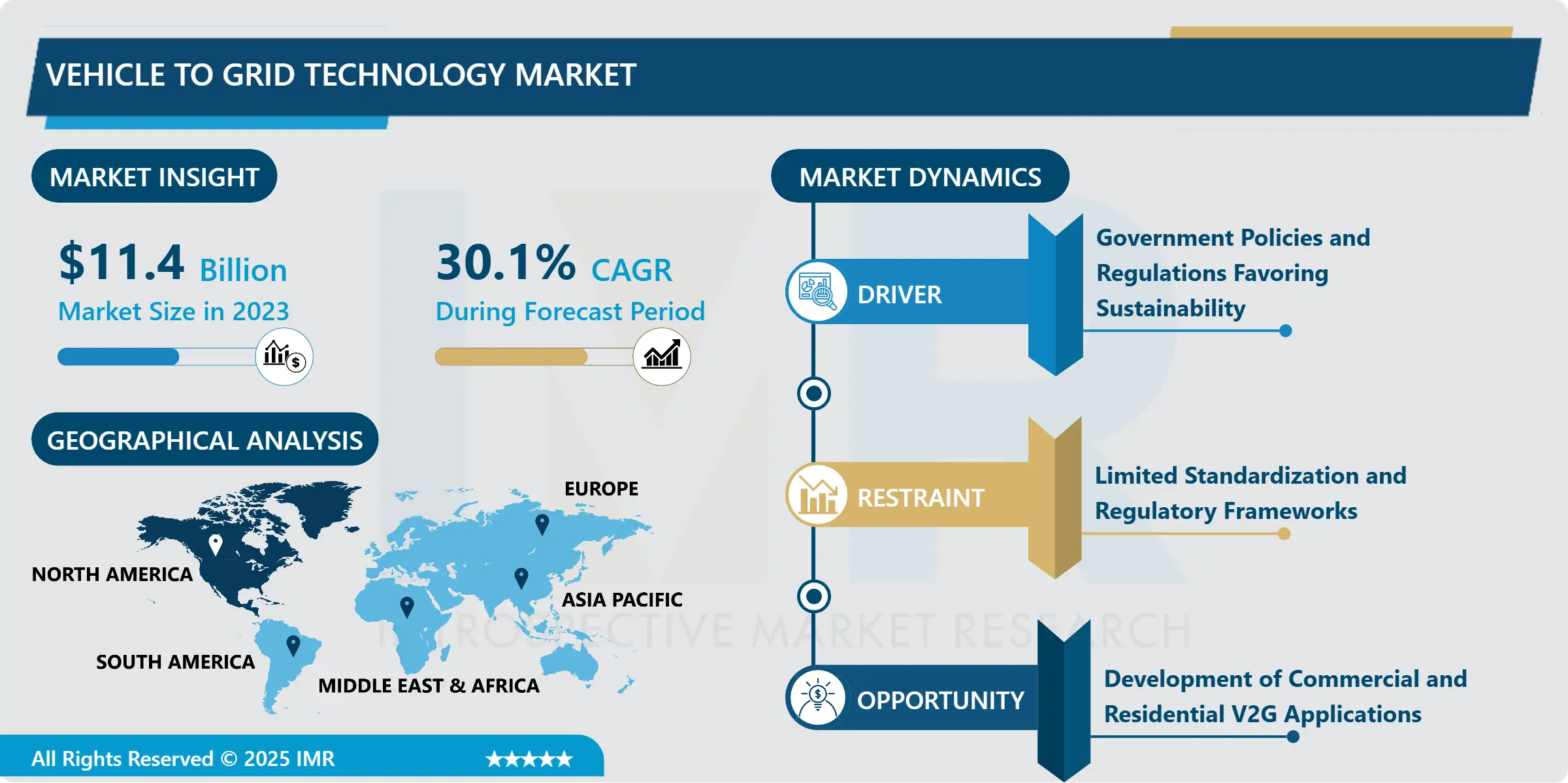
Vehicle-to-Grid Technology Market Size Was Valued at USD 11.40 Billion in 2023, and is Projected to Reach USD 121.73 Billion by 2032, Growing at a CAGR of 30.10 % From 2024-2032.

IMR Group
Description
Vehicle-to-Grid Technology Market Synopsis:
Vehicle-to-Grid Technology Market Size Was Valued at USD 11.40 Billion in 2023, and is Projected to Reach USD 121.73 Billion by 2032, Growing at a CAGR of 30.10 % From 2024-2032.
Vehicle-to-Grid (V2G) technology is the ability of a vehicle to take electricity from a charging point as well as inject electricity back into the grid. This kind of flow allows in the management of the supply and demand, an increase in the stability of the grid and enhances the uptake of renewable energy resources. They allow for flexibility in management of energy storage devices and this makes vehicles act as moving storage systems that can provide load balancing, backup power and basically anything that cans enhance the functionality and stability of the grid.
The primary enabler of V2G technology is the increasing use of electric vehicle (EVs), across the globe. As more EVs continue to be used, automotive players worldwide are now seeking new approaches to improve the reliability of the grid and optimise energy utilisation. With the loading and returning of energy capability given by V2G technology means that the same becomes core in moving toward a sustainable renewable energy grid. Moreover, favourable political measures and policies inclusive of subsidies with special emphasis on Europe and North America continue to encourage investment in this technology all having the effect of enhancing its deployment.
The next important factor is the use of different renewable energy in the form of wind and solar energy. These sources of energies are not steady and this imply that there are always periods when they are scarce. V2G systems solve this problem by offering a contorted storage solution for the battery which is charged from excess energy produced at the time of high renewable generation and discharged back to grid at a time when there is high demand or low renewable generation. This makes V2G an important tool in the drive towards formalization of carbon cut and energy efficiency nationwide.
Vehicle To Grid Technology Market Trend Analysis:
Establishment of joint business models
The impressive growth of V2G market has resulted in establishment of joint business models for developers of automobile industry and utility. Both Nissan and Tesla have been venturing into agreements with utilities with a view of developing an underlying charging framework for V2G technology. Such partnerships whereby EV companies partner with utilities seek to provide as much convenience for electric vehicle owners as improve the grid regulation and energy supply. Also, improvements in the construction of both ways charging infrastructure are making V2G systems more available and viable.
Another important trend has to do with the increased interest in and implementation of V2G technology in the residence and commerce segments. Since the consumers and businesses are looking for some solutions on how to save money more on power bills, how to make their power systems greener and more sustainable, the demand on the EVs and charging stations, compatible with V2G has increased. Major highlighted benefits of EVs and V2G systems include the incentives being offered by governments to embrace these technologies and as such, more people and companies are becoming more willing to adopt to these systems.
The V2G integration of electric vehicle batteries
According to the interviewed professionals there are many benefits in applying V2G technology, in particular in the sphere of energy storage. The V2G integration of electric vehicle batteries means that there is distributed storage that can be employed in stabilizing the electrical supply. Because there are already a large number of EVs on the road, utilities can harness a virtually limitless number of storage units that factor into load peaks and renewable energy sources. This is an opportunity to develop far wiser and more robust grid systems using minimal amounts of investment in traditional large scale energy storage systems.
However, the V2G technology offers a good experience to develop the smart grid system at the same time. Smart grids employed with timely information on energy demand from the vehicles and with real time communication between the vehicle and grid operators, can work most effectively to the benefit of the grid efficiency and reduction of energy wastage. This opportunity is further bolstered by growth in urbanization and the need to adopt sustainable energy storage and management making V2G as a focal point of future grid systems integrating renewable energy and electric vehicles.
Vehicle To Grid Technology Market Segment Analysis:
Vehicle To Grid Technology Market Segmented on the basis of Technology, Application, End-User, and Region.
By Technology, Bi-directional Charging segment is expected to dominate the market during the forecast period
The market of V2G technology is divided into several types according to the function of the system. Bidirectional charging unlike unidirectional charging allow evs to be charged and discharge energy in the grid. Smart charging means electricity charging plans that consider the grid load requirement, making it more efficient. V2H or V2B systems, enable energy to be used directly to power a home or building and V2G systems support ancillary grid services like load leveling.
By Application, Energy Storage segment expected to held the largest share
Thus, V2G technology is used in several strategic sectors. In energy storage, it enables the EV to serve as storage systems which can store power and discharge when necessary. Load leveling on the other hand involves the utility’s use of V2G technology in procuring power during peak hours or low hours to diminish the stress that comes with it on the grid. One of the major applications of V2G is grid stabilization that is an essential role of managing fluctuations in energy supply and demand. Finally, integration of renewables makes certain that renewable resources such as wind and solar power is included in the system alongside V2G that determines the amount of energy to be stored or released in relation to production of renewable energy.
Vehicle To Grid Technology Market Regional Insights:
North America is Expected to Dominate the Market Over the Forecast period
Europe continues to be the largest consumer for V2G technology where the company gets about 40% of its revenues. This leadership is due to political efforts to encourage and promote sustainable energy options, the general uptake of EVs, and large amounts of capital expenditure committed to building smart grid systems.
Germany, the Netherlands, and the UK are some of the leading nations in the deployment of V2G technologies because of central climate goals and renewed significance on decentralised and renewable energy sources. It is also seeing the emergence of numerous V2G pilot projects and partnerships for automakers planning to invest in required supporting elements.
Active Key Players in the Vehicle to Grid Technology Market
ABB Ltd. (Switzerland)
BMW AG (Germany)
Daimler AG (Germany)
Enel SpA (Italy)
General Motors (GM) (USA)
Hitachi Ltd. (Japan)
Honda Motor Co Ltd. (Japan)
Nissan Motor Co Ltd. (Japan)
Renault Groupe (France)
Tesla Inc. (USA)
Other Active Players
Global Vehicle To Grid Technology Market Scope:
Chapter 1: Introduction
1.1 Scope and Coverage
Chapter 2:Executive Summary
Chapter 3: Market Landscape
3.1 Market Dynamics
3.1.1 Drivers
3.1.2 Restraints
3.1.3 Opportunities
3.1.4 Challenges
3.2 Market Trend Analysis
3.3 PESTLE Analysis
3.4 Porter’s Five Forces Analysis
3.5 Industry Value Chain Analysis
3.6 Ecosystem
3.7 Regulatory Landscape
3.8 Price Trend Analysis
3.9 Patent Analysis
3.10 Technology Evolution
3.11 Investment Pockets
3.12 Import-Export Analysis
Chapter 4: Vehicle To Grid Technology Market by Application
4.1 Vehicle To Grid Technology Market Snapshot and Growth Engine
4.2 Vehicle To Grid Technology Market Overview
4.3 Safety
4.3.1 Introduction and Market Overview
4.3.2 Historic and Forecasted Market Size in Value USD and Volume Units (2017-2032F)
4.3.3 Key Market Trends, Growth Factors and Opportunities
4.3.4 Safety: Geographic Segmentation Analysis
4.4 Traffic Management
4.4.1 Introduction and Market Overview
4.4.2 Historic and Forecasted Market Size in Value USD and Volume Units (2017-2032F)
4.4.3 Key Market Trends, Growth Factors and Opportunities
4.4.4 Traffic Management: Geographic Segmentation Analysis
4.5 Infotainment
4.5.1 Introduction and Market Overview
4.5.2 Historic and Forecasted Market Size in Value USD and Volume Units (2017-2032F)
4.5.3 Key Market Trends, Growth Factors and Opportunities
4.5.4 Infotainment: Geographic Segmentation Analysis
4.6 Autonomous Vehicles
4.6.1 Introduction and Market Overview
4.6.2 Historic and Forecasted Market Size in Value USD and Volume Units (2017-2032F)
4.6.3 Key Market Trends, Growth Factors and Opportunities
4.6.4 Autonomous Vehicles: Geographic Segmentation Analysis
4.7 Others
4.7.1 Introduction and Market Overview
4.7.2 Historic and Forecasted Market Size in Value USD and Volume Units (2017-2032F)
4.7.3 Key Market Trends, Growth Factors and Opportunities
4.7.4 Others: Geographic Segmentation Analysis
Chapter 5: Vehicle To Grid Technology Market by End-User
5.1 Vehicle To Grid Technology Market Snapshot and Growth Engine
5.2 Vehicle To Grid Technology Market Overview
5.3 OEMs (Original Equipment Manufacturers)
5.3.1 Introduction and Market Overview
5.3.2 Historic and Forecasted Market Size in Value USD and Volume Units (2017-2032F)
5.3.3 Key Market Trends, Growth Factors and Opportunities
5.3.4 OEMs (Original Equipment Manufacturers): Geographic Segmentation Analysis
Chapter 6: Company Profiles and Competitive Analysis
6.1 Competitive Landscape
6.1.1 Competitive Benchmarking
6.1.2 Vehicle To Grid Technology Market Share by Manufacturer (2023)
6.1.3 Industry BCG Matrix
6.1.4 Heat Map Analysis
6.1.5 Mergers and Acquisitions
6.2 DAIMLER AG (GERMANY)
6.2.1 Company Overview
6.2.2 Key Executives
6.2.3 Company Snapshot
6.2.4 Role of the Company in the Market
6.2.5 Sustainability and Social Responsibility
6.2.6 Operating Business Segments
6.2.7 Product Portfolio
6.2.8 Business Performance
6.2.9 Key Strategic Moves and Recent Developments
6.2.10 SWOT Analysis
6.3 GENERAL MOTORS (GM) (USA)
6.4 BMW AG (GERMANY)
6.5 ENEL SPA (ITALY)
6.6 HONDA MOTOR CO LTD. (JAPAN)
6.7 HITACHI LTD. (JAPAN)
6.8 TESLA INC. (USA)
6.9 NISSAN MOTOR CO LTD. (JAPAN)
6.10 RENAULT GROUPE (FRANCE)
6.11 ABB LTD. (SWITZERLAND)
6.12 OTHER ACTIVE PLAYERS
Chapter 7: Global Vehicle To Grid Technology Market By Region
7.1 Overview
7.2. North America Vehicle To Grid Technology Market
7.2.1 Key Market Trends, Growth Factors and Opportunities
7.2.2 Top Key Companies
7.2.3 Historic and Forecasted Market Size by Segments
7.2.4 Historic and Forecasted Market Size By Application
7.2.4.1 Safety
7.2.4.2 Traffic Management
7.2.4.3 Infotainment
7.2.4.4 Autonomous Vehicles
7.2.4.5 Others
7.2.5 Historic and Forecasted Market Size By End-User
7.2.5.1 OEMs (Original Equipment Manufacturers)
7.2.6 Historic and Forecast Market Size by Country
7.2.6.1 US
7.2.6.2 Canada
7.2.6.3 Mexico
7.3. Eastern Europe Vehicle To Grid Technology Market
7.3.1 Key Market Trends, Growth Factors and Opportunities
7.3.2 Top Key Companies
7.3.3 Historic and Forecasted Market Size by Segments
7.3.4 Historic and Forecasted Market Size By Application
7.3.4.1 Safety
7.3.4.2 Traffic Management
7.3.4.3 Infotainment
7.3.4.4 Autonomous Vehicles
7.3.4.5 Others
7.3.5 Historic and Forecasted Market Size By End-User
7.3.5.1 OEMs (Original Equipment Manufacturers)
7.3.6 Historic and Forecast Market Size by Country
7.3.6.1 Russia
7.3.6.2 Bulgaria
7.3.6.3 The Czech Republic
7.3.6.4 Hungary
7.3.6.5 Poland
7.3.6.6 Romania
7.3.6.7 Rest of Eastern Europe
7.4. Western Europe Vehicle To Grid Technology Market
7.4.1 Key Market Trends, Growth Factors and Opportunities
7.4.2 Top Key Companies
7.4.3 Historic and Forecasted Market Size by Segments
7.4.4 Historic and Forecasted Market Size By Application
7.4.4.1 Safety
7.4.4.2 Traffic Management
7.4.4.3 Infotainment
7.4.4.4 Autonomous Vehicles
7.4.4.5 Others
7.4.5 Historic and Forecasted Market Size By End-User
7.4.5.1 OEMs (Original Equipment Manufacturers)
7.4.6 Historic and Forecast Market Size by Country
7.4.6.1 Germany
7.4.6.2 UK
7.4.6.3 France
7.4.6.4 The Netherlands
7.4.6.5 Italy
7.4.6.6 Spain
7.4.6.7 Rest of Western Europe
7.5. Asia Pacific Vehicle To Grid Technology Market
7.5.1 Key Market Trends, Growth Factors and Opportunities
7.5.2 Top Key Companies
7.5.3 Historic and Forecasted Market Size by Segments
7.5.4 Historic and Forecasted Market Size By Application
7.5.4.1 Safety
7.5.4.2 Traffic Management
7.5.4.3 Infotainment
7.5.4.4 Autonomous Vehicles
7.5.4.5 Others
7.5.5 Historic and Forecasted Market Size By End-User
7.5.5.1 OEMs (Original Equipment Manufacturers)
7.5.6 Historic and Forecast Market Size by Country
7.5.6.1 China
7.5.6.2 India
7.5.6.3 Japan
7.5.6.4 South Korea
7.5.6.5 Malaysia
7.5.6.6 Thailand
7.5.6.7 Vietnam
7.5.6.8 The Philippines
7.5.6.9 Australia
7.5.6.10 New Zealand
7.5.6.11 Rest of APAC
7.6. Middle East & Africa Vehicle To Grid Technology Market
7.6.1 Key Market Trends, Growth Factors and Opportunities
7.6.2 Top Key Companies
7.6.3 Historic and Forecasted Market Size by Segments
7.6.4 Historic and Forecasted Market Size By Application
7.6.4.1 Safety
7.6.4.2 Traffic Management
7.6.4.3 Infotainment
7.6.4.4 Autonomous Vehicles
7.6.4.5 Others
7.6.5 Historic and Forecasted Market Size By End-User
7.6.5.1 OEMs (Original Equipment Manufacturers)
7.6.6 Historic and Forecast Market Size by Country
7.6.6.1 Turkiye
7.6.6.2 Bahrain
7.6.6.3 Kuwait
7.6.6.4 Saudi Arabia
7.6.6.5 Qatar
7.6.6.6 UAE
7.6.6.7 Israel
7.6.6.8 South Africa
7.7. South America Vehicle To Grid Technology Market
7.7.1 Key Market Trends, Growth Factors and Opportunities
7.7.2 Top Key Companies
7.7.3 Historic and Forecasted Market Size by Segments
7.7.4 Historic and Forecasted Market Size By Application
7.7.4.1 Safety
7.7.4.2 Traffic Management
7.7.4.3 Infotainment
7.7.4.4 Autonomous Vehicles
7.7.4.5 Others
7.7.5 Historic and Forecasted Market Size By End-User
7.7.5.1 OEMs (Original Equipment Manufacturers)
7.7.6 Historic and Forecast Market Size by Country
7.7.6.1 Brazil
7.7.6.2 Argentina
7.7.6.3 Rest of SA
Chapter 8 Analyst Viewpoint and Conclusion
8.1 Recommendations and Concluding Analysis
8.2 Potential Market Strategies
Chapter 9 Research Methodology
9.1 Research Process
9.2 Primary Research
9.3 Secondary Research
Q1: What would be the forecast period in the Vehicle To Grid Technology Market research report?
A1: The forecast period in the Vehicle To Grid Technology Market research report is 2024-2032.
Q2: Who are the key players in the Vehicle To Grid Technology Market?
A2: Daimler AG (Germany), General Motors (GM) (USA), BMW AG (Germany), Enel SpA (Italy), Honda Motor Co Ltd. (Japan), Hitachi Ltd. (Japan), Tesla Inc. (USA), Nissan Motor Co Ltd. (Japan), Renault Groupe (France), ABB Ltd. (Switzerland) and Other Active Players.
Q3: What are the segments of the Vehicle-to-Grid Technology Market?
A3: The Vehicle To Grid Technology Market is segmented into By Technology, By Application, By End-User and region. By Technology, the market is categorized into Bi-directional Charging, Smart Charging, Vehicle-to-Home (V2H), Vehicle-to-Building (V2B), Vehicle-to-Grid (V2G). By Application, the market is categorized into Energy Storage, Load Leveling, Grid Stabilization, Renewable Energy Integration. By End-User, the market is categorized into Residential, Commercial, Industrial. By region, it is analyzed across North America (U.S., Canada, Mexico), Eastern Europe (Russia, Bulgaria, The Czech Republic, Hungary, Poland, Romania, Rest of Eastern Europe), Western Europe (Germany, UK, France, The Netherlands, Italy, Spain, Rest of Western Europe), Asia Pacific (China, India, Japan, South Korea, Malaysia, Thailand, Vietnam, The Philippines, Australia, New-Zealand, Rest of APAC), Middle East & Africa (Turkiye, Bahrain, Kuwait, Saudi Arabia, Qatar, UAE, Israel, South Africa), South America (Brazil, Argentina, Rest of SA).
Q4: What is the Vehicle-to-Grid Technology Market?
A4: Vehicle-to-Grid (V2G) technology is the ability of a vehicle to take electricity from a charging point as well as inject electricity back into the grid. This kind of flow allows in the management of the supply and demand, an increase in the stability of the grid and enhances the uptake of renewable energy resources. They allow for flexibility in management of energy storage devices and this makes vehicles act as moving storage systems that can provide load balancing, backup power and basically anything that can enhance the functionality and stability of the grid.
Q5: How big is the Vehicle-to-Grid Technology Market?
A5: Vehicle-to-Grid Technology Market Size Was Valued at USD 11.40 Billion in 2023, and is Projected to Reach USD 121.73 Billion by 2032, Growing at a CAGR of 30.10 % From 2024-2032.
How to Buy a Report from eminsights.jp
On the product page, choose the license you want: Single-User License, Multi-User License or Enterprise License.
If you required report in your native language, then you can click on Translated Report button and fill out the form with report name and language you want, then our team will contact you as soon as possible.
Click the Buy Now button.
You will be redirected to the checkout page. Enter your company details and payment information.
Click Place Order to complete the purchase.
Confirmation: You’ll receive an order confirmation and our team will contact you shortly with your ordered report.
If you have any questions, fill out the contact form below or email us at [email protected].
Thank you for choosing eminsights.jp!