Stay Ahead in Fast-Growing Economies.
Browse Reports Now




Exoskeleton Market Opportunities, Challenges & Strategic Forecast (2024-2032)
The market for the Exoskeleton Business which is a segment of the Business Area that is related to the creation as well as using of wearable robot-based orthosis to supplement for or act as muscles and bones. Mobile aiding devices may either be active or passive; they are used in medical rehabilitation, industry and military to provide mobility, to reduce fatigue or in performance enhancement.

IMR Group
Description
Exoskeleton Market Synopsis:
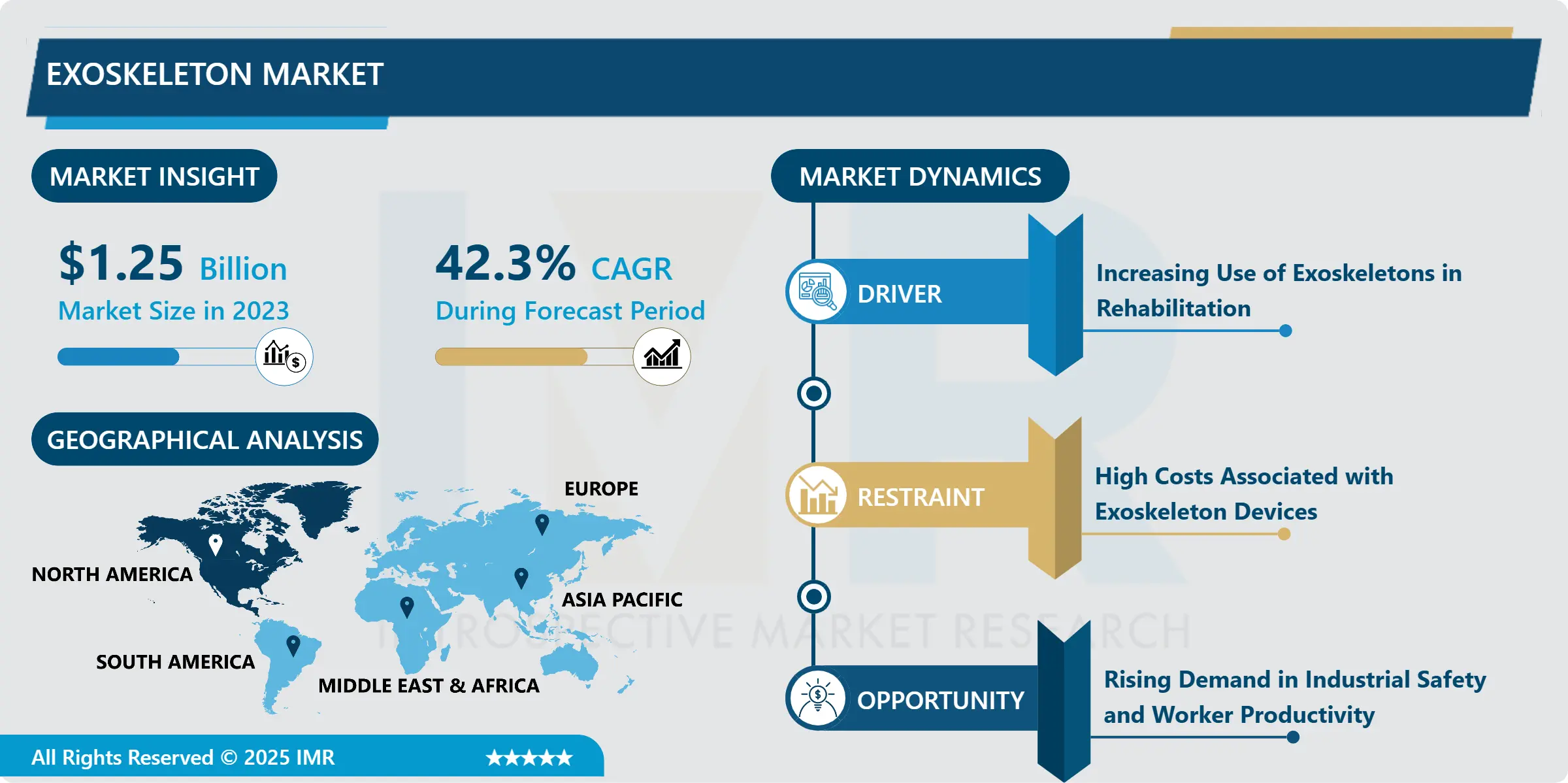
Exoskeleton Market Size Was Valued at USD 1.25 Billion in 2023, and is Projected to Reach USD 29.91 Billion by 2032, Growing at a CAGR of 42.3% From 2024-2032.
The market for the Exoskeleton Business which is a segment of the Business Area that is related to the creation as well as using of wearable robot-based orthosis to supplement for or act as muscles and bones. Mobile aiding devices may either be active or passive; they are used in medical rehabilitation, industry and military to provide mobility, to reduce fatigue or in performance enhancement.
Exoskeleton stakeholders throughout the exoskeleton market are interested in the creation of new and advanced products with the support of formative technologies in robotics, healthier investment in healthcare and increasing rates of physical disability. Readers are authorized that exoskeletons are increasingly used in a hospital and medical rehabilitation centers where patients with stroke or spinal cord or other motion limiting injuries are recovering. That it has enhanced the quality of lives of disabled persons dramatically has drawn the attention of stake holders.
Exoskeletons are is slowly being incorporated in various working areas such as construction, logistics, manufacturing among others to increase efficiency and safety. They have been instrumental in reducing numbers of usual types of injuries arising out of lifting of some objects or performing monotonous tasks, creating demand pull in the industrial application segment. It will also benefit the market as investment in r&d of robotics is making progression in put into place that has improve light weight material, battery and artificial intelligence.
Exoskeleton Market Trend Analysis:
Integration of Artificial Intelligence in Exoskeletons
The integration of Artificial Intelligence (AI) in exoskeletons has enhanced their adaptability, enabling real-time adjustment to user movements. AI algorithms optimize performance, improving the efficiency and precision of exoskeletons in various applications, such as healthcare, industrial operations, and rehabilitation. With AI’s ability to analyze data from sensors, exoskeletons can offer tailored support, reduce user fatigue, and enhance mobility.
The growing demand for exoskeletons across sectors like healthcare and manufacturing is fueled by advancements in technology, making devices more affordable and accessible. AI enables a more seamless user experience, positioning exoskeletons as crucial tools in enhancing productivity, safety, and independence. This evolution is paving the way for widespread adoption across industries, contributing to market expansion.
Expanding Applications in Aging Populations
The global exoskeleton market is expanding as aging populations seek solutions to maintain mobility, independence, and quality of life. With the elderly demographic growing worldwide, healthcare providers, rehabilitation centers, and elder care facilities are integrating wearable robotic systems to support movement and reduce strain during physical therapy. These devices assist in walking, lifting, and postural control, making them valuable in daily support and clinical recovery.
Medical and assistive sectors are seeing rising interest in robotic exoskeletons designed for geriatric use. Market participants are focusing on lightweight, ergonomic designs tailored to older users with reduced muscle strength. As healthcare infrastructure evolves to meet long-term care demands, exoskeleton solutions are being incorporated as part of advanced aging care strategies across developed and developing regions.
Exoskeleton Market Segment Analysis:
Exoskeleton Market is Segmented on the basis of Technology, Application, End User, and Region
By Technology, Powered segment is expected to dominate the market during the forecast period
The powered segment is expected to dominate the global exoskeleton market during the forecast period, with advancements in robotics, AI integration, and growing demand across healthcare, military, and industrial applications. Powered exoskeletons provide enhanced mobility and strength, significantly benefiting rehabilitation processes and reducing physical strain in high-demand environments such as factories and defense sectors. Their ability to improve worker efficiency and assist those with mobility challenges makes them highly sought after across various industries.
The growth of the exoskeleton market is also supported by the increasing need for assistive technologies in aging populations and labor-intensive industries. As powered models become more cost-effective and ergonomically advanced, their adoption is accelerating, particularly in regions like North America, Europe, and Asia-Pacific. This trend positions the powered segment as a leading force in the evolution of human augmentation technologies.
By Application, Assistive segment expected to held the largest share
The assistive segment is anticipated to dominate the global exoskeleton market, driven by rising demand in rehabilitation centers, elderly care, and mobility assistance for individuals with physical disabilities. This growth is supported by increasing investments in medical robotics and advancements in wearable technology that enhance user comfort and functional performance. Healthcare providers are increasingly adopting assistive exoskeletons to improve patient outcomes, reduce caregiver burden, and enable early mobility in recovery processes.
As the global population ages and incidences of mobility impairment rise, the assistive exoskeleton market is witnessing accelerated adoption across developed and emerging economies. Strategic collaborations between medical device manufacturers and healthcare institutions are further propelling innovation and accessibility.
Exoskeleton Market Regional Insights:
North America is Expected to Dominate the Market Over the Forecast period
The region which is also expected to have the largest increase in the market share for exoskeletons is North America due to advanced health care facilities, higher research and development expenditure and early feasibility of new technologies. The area contains many makers of exoskeletons and examination focus, switches progressing improvement and advertising. The country, United States of America, is the largest market for exoskeleton concerning usage particularly in the health sector, security among other areas.
Incentives from the government through funding of the initiatives and through tax exemptions for assistive technologies employed in the market strategies cannot be underemphasized as far as the improvement of growth in North America is concerned. In addition, manufacture, research institution, and healthcare provider are engaged to produce new technologies for exoskeleton. Owing to escalating anxiety for the worker’s safety and the need for rehabilitation apparatus, North America will maintain its market leadership in the years to come.
Active Key Players in the Exoskeleton Market:
ATOUN Inc. (Japan)
Bionik Laboratories (Canada)
Cyberdyne Inc. (Japan)
Ekso Bionics Holdings, Inc. (United States)
Focal Meditech BV (Netherlands)
GOGOA Mobility Robots (Spain)
Hyundai Motor Company (South Korea)
Lockheed Martin Corporation (United States)
Mitsubishi Heavy Industries, Ltd. (Japan)
Ottobock SE & Co. KGaA (Germany)
Parker Hannifin Corporation (United States)
ReWalk Robotics Ltd. (Israel)
Rex Bionics Ltd. (United Kingdom)
Sarcos Technology and Robotics Corporation (United States)
Technaid S.L. (Spain)
Other Active Players
Chapter 1: Introduction
1.1 Scope and Coverage
Chapter 2:Executive Summary
Chapter 3: Market Landscape
3.1 Market Dynamics
3.1.1 Drivers
3.1.2 Restraints
3.1.3 Opportunities
3.1.4 Challenges
3.2 Market Trend Analysis
3.3 PESTLE Analysis
3.4 Porter’s Five Forces Analysis
3.5 Industry Value Chain Analysis
3.6 Ecosystem
3.7 Regulatory Landscape
3.8 Price Trend Analysis
3.9 Patent Analysis
3.10 Technology Evolution
3.11 Investment Pockets
3.12 Import-Export Analysis
Chapter 4: Exoskeleton Market by Technology
4.1 Exoskeleton Market Snapshot and Growth Engine
4.2 Exoskeleton Market Overview
4.3 Powered and Passive
4.3.1 Introduction and Market Overview
4.3.2 Historic and Forecasted Market Size in Value USD and Volume Units (2017-2032F)
4.3.3 Key Market Trends, Growth Factors and Opportunities
4.3.4 Powered and Passive: Geographic Segmentation Analysis
Chapter 5: Exoskeleton Market by Application
5.1 Exoskeleton Market Snapshot and Growth Engine
5.2 Exoskeleton Market Overview
5.3 Rehabilitation
5.3.1 Introduction and Market Overview
5.3.2 Historic and Forecasted Market Size in Value USD and Volume Units (2017-2032F)
5.3.3 Key Market Trends, Growth Factors and Opportunities
5.3.4 Rehabilitation: Geographic Segmentation Analysis
5.4 Assistive
5.4.1 Introduction and Market Overview
5.4.2 Historic and Forecasted Market Size in Value USD and Volume Units (2017-2032F)
5.4.3 Key Market Trends, Growth Factors and Opportunities
5.4.4 Assistive: Geographic Segmentation Analysis
5.5 Body Parts Support
5.5.1 Introduction and Market Overview
5.5.2 Historic and Forecasted Market Size in Value USD and Volume Units (2017-2032F)
5.5.3 Key Market Trends, Growth Factors and Opportunities
5.5.4 Body Parts Support: Geographic Segmentation Analysis
5.6 and Sports
5.6.1 Introduction and Market Overview
5.6.2 Historic and Forecasted Market Size in Value USD and Volume Units (2017-2032F)
5.6.3 Key Market Trends, Growth Factors and Opportunities
5.6.4 and Sports: Geographic Segmentation Analysis
Chapter 6: Exoskeleton Market by End User
6.1 Exoskeleton Market Snapshot and Growth Engine
6.2 Exoskeleton Market Overview
6.3 Healthcare
6.3.1 Introduction and Market Overview
6.3.2 Historic and Forecasted Market Size in Value USD and Volume Units (2017-2032F)
6.3.3 Key Market Trends, Growth Factors and Opportunities
6.3.4 Healthcare: Geographic Segmentation Analysis
6.4 Manufacturing
6.4.1 Introduction and Market Overview
6.4.2 Historic and Forecasted Market Size in Value USD and Volume Units (2017-2032F)
6.4.3 Key Market Trends, Growth Factors and Opportunities
6.4.4 Manufacturing: Geographic Segmentation Analysis
6.5 Defence & Aerospace
6.5.1 Introduction and Market Overview
6.5.2 Historic and Forecasted Market Size in Value USD and Volume Units (2017-2032F)
6.5.3 Key Market Trends, Growth Factors and Opportunities
6.5.4 Defence & Aerospace: Geographic Segmentation Analysis
6.6 and Commercial
6.6.1 Introduction and Market Overview
6.6.2 Historic and Forecasted Market Size in Value USD and Volume Units (2017-2032F)
6.6.3 Key Market Trends, Growth Factors and Opportunities
6.6.4 and Commercial: Geographic Segmentation Analysis
Chapter 7: Company Profiles and Competitive Analysis
7.1 Competitive Landscape
7.1.1 Competitive Benchmarking
7.1.2 Exoskeleton Market Share by Manufacturer (2023)
7.1.3 Industry BCG Matrix
7.1.4 Heat Map Analysis
7.1.5 Mergers and Acquisitions
7.2 ATOUN INC. (JAPAN)
7.2.1 Company Overview
7.2.2 Key Executives
7.2.3 Company Snapshot
7.2.4 Role of the Company in the Market
7.2.5 Sustainability and Social Responsibility
7.2.6 Operating Business Segments
7.2.7 Product Portfolio
7.2.8 Business Performance
7.2.9 Key Strategic Moves and Recent Developments
7.2.10 SWOT Analysis
7.3 BIONIK LABORATORIES (CANADA)
7.4 CYBERDYNE INC. (JAPAN)
7.5 EKSO BIONICS HOLDINGS INC. (UNITED STATES)
7.6 FOCAL MEDITECH BV (NETHERLANDS)
7.7 GOGOA MOBILITY ROBOTS (SPAIN)
7.8 HYUNDAI MOTOR COMPANY (SOUTH KOREA)
7.9 LOCKHEED MARTIN CORPORATION (UNITED STATES)
7.10 MITSUBISHI HEAVY INDUSTRIES
7.11 LTD. (JAPAN)
7.12 OTTOBOCK SE & CO. KGAA (GERMANY)
7.13 PARKER HANNIFIN CORPORATION (UNITED STATES)
7.14 REWALK ROBOTICS LTD. (ISRAEL)
7.15 REX BIONICS LTD. (UNITED KINGDOM)
7.16 SARCOS TECHNOLOGY AND ROBOTICS CORPORATION (UNITED STATES)
7.17 TECHNAID S.L. (SPAIN)
7.18 OTHER ACTIVE PLAYERS
Chapter 8: Global Exoskeleton Market By Region
8.1 Overview
8.2. North America Exoskeleton Market
8.2.1 Key Market Trends, Growth Factors and Opportunities
8.2.2 Top Key Companies
8.2.3 Historic and Forecasted Market Size by Segments
8.2.4 Historic and Forecasted Market Size By Technology
8.2.4.1 Powered and Passive
8.2.5 Historic and Forecasted Market Size By Application
8.2.5.1 Rehabilitation
8.2.5.2 Assistive
8.2.5.3 Body Parts Support
8.2.5.4 and Sports
8.2.6 Historic and Forecasted Market Size By End User
8.2.6.1 Healthcare
8.2.6.2 Manufacturing
8.2.6.3 Defence & Aerospace
8.2.6.4 and Commercial
8.2.7 Historic and Forecast Market Size by Country
8.2.7.1 US
8.2.7.2 Canada
8.2.7.3 Mexico
8.3. Eastern Europe Exoskeleton Market
8.3.1 Key Market Trends, Growth Factors and Opportunities
8.3.2 Top Key Companies
8.3.3 Historic and Forecasted Market Size by Segments
8.3.4 Historic and Forecasted Market Size By Technology
8.3.4.1 Powered and Passive
8.3.5 Historic and Forecasted Market Size By Application
8.3.5.1 Rehabilitation
8.3.5.2 Assistive
8.3.5.3 Body Parts Support
8.3.5.4 and Sports
8.3.6 Historic and Forecasted Market Size By End User
8.3.6.1 Healthcare
8.3.6.2 Manufacturing
8.3.6.3 Defence & Aerospace
8.3.6.4 and Commercial
8.3.7 Historic and Forecast Market Size by Country
8.3.7.1 Russia
8.3.7.2 Bulgaria
8.3.7.3 The Czech Republic
8.3.7.4 Hungary
8.3.7.5 Poland
8.3.7.6 Romania
8.3.7.7 Rest of Eastern Europe
8.4. Western Europe Exoskeleton Market
8.4.1 Key Market Trends, Growth Factors and Opportunities
8.4.2 Top Key Companies
8.4.3 Historic and Forecasted Market Size by Segments
8.4.4 Historic and Forecasted Market Size By Technology
8.4.4.1 Powered and Passive
8.4.5 Historic and Forecasted Market Size By Application
8.4.5.1 Rehabilitation
8.4.5.2 Assistive
8.4.5.3 Body Parts Support
8.4.5.4 and Sports
8.4.6 Historic and Forecasted Market Size By End User
8.4.6.1 Healthcare
8.4.6.2 Manufacturing
8.4.6.3 Defence & Aerospace
8.4.6.4 and Commercial
8.4.7 Historic and Forecast Market Size by Country
8.4.7.1 Germany
8.4.7.2 UK
8.4.7.3 France
8.4.7.4 The Netherlands
8.4.7.5 Italy
8.4.7.6 Spain
8.4.7.7 Rest of Western Europe
8.5. Asia Pacific Exoskeleton Market
8.5.1 Key Market Trends, Growth Factors and Opportunities
8.5.2 Top Key Companies
8.5.3 Historic and Forecasted Market Size by Segments
8.5.4 Historic and Forecasted Market Size By Technology
8.5.4.1 Powered and Passive
8.5.5 Historic and Forecasted Market Size By Application
8.5.5.1 Rehabilitation
8.5.5.2 Assistive
8.5.5.3 Body Parts Support
8.5.5.4 and Sports
8.5.6 Historic and Forecasted Market Size By End User
8.5.6.1 Healthcare
8.5.6.2 Manufacturing
8.5.6.3 Defence & Aerospace
8.5.6.4 and Commercial
8.5.7 Historic and Forecast Market Size by Country
8.5.7.1 China
8.5.7.2 India
8.5.7.3 Japan
8.5.7.4 South Korea
8.5.7.5 Malaysia
8.5.7.6 Thailand
8.5.7.7 Vietnam
8.5.7.8 The Philippines
8.5.7.9 Australia
8.5.7.10 New Zealand
8.5.7.11 Rest of APAC
8.6. Middle East & Africa Exoskeleton Market
8.6.1 Key Market Trends, Growth Factors and Opportunities
8.6.2 Top Key Companies
8.6.3 Historic and Forecasted Market Size by Segments
8.6.4 Historic and Forecasted Market Size By Technology
8.6.4.1 Powered and Passive
8.6.5 Historic and Forecasted Market Size By Application
8.6.5.1 Rehabilitation
8.6.5.2 Assistive
8.6.5.3 Body Parts Support
8.6.5.4 and Sports
8.6.6 Historic and Forecasted Market Size By End User
8.6.6.1 Healthcare
8.6.6.2 Manufacturing
8.6.6.3 Defence & Aerospace
8.6.6.4 and Commercial
8.6.7 Historic and Forecast Market Size by Country
8.6.7.1 Turkiye
8.6.7.2 Bahrain
8.6.7.3 Kuwait
8.6.7.4 Saudi Arabia
8.6.7.5 Qatar
8.6.7.6 UAE
8.6.7.7 Israel
8.6.7.8 South Africa
8.7. South America Exoskeleton Market
8.7.1 Key Market Trends, Growth Factors and Opportunities
8.7.2 Top Key Companies
8.7.3 Historic and Forecasted Market Size by Segments
8.7.4 Historic and Forecasted Market Size By Technology
8.7.4.1 Powered and Passive
8.7.5 Historic and Forecasted Market Size By Application
8.7.5.1 Rehabilitation
8.7.5.2 Assistive
8.7.5.3 Body Parts Support
8.7.5.4 and Sports
8.7.6 Historic and Forecasted Market Size By End User
8.7.6.1 Healthcare
8.7.6.2 Manufacturing
8.7.6.3 Defence & Aerospace
8.7.6.4 and Commercial
8.7.7 Historic and Forecast Market Size by Country
8.7.7.1 Brazil
8.7.7.2 Argentina
8.7.7.3 Rest of SA
Chapter 9 Analyst Viewpoint and Conclusion
9.1 Recommendations and Concluding Analysis
9.2 Potential Market Strategies
Chapter 10 Research Methodology
10.1 Research Process
10.2 Primary Research
10.3 Secondary Research
Q1: What would be the forecast period in the Exoskeleton Market research report?
A1: The forecast period in the Exoskeleton Market research report is 2024-2032.
Q2: Who are the key players in the Exoskeleton Market?
A2: ATOUN Inc. (Japan), Bionik Laboratories (Canada), Cyberdyne Inc. (Japan),Ekso Bionics Holdings, Inc. (United States), Focal Meditech BV (Netherlands), GOGOA Mobility Robots (Spain), Hyundai Motor Company (South Korea), Lockheed Martin Corporation (United States), Mitsubishi Heavy Industries, Ltd. (Japan), Ottobock SE & Co. KGaA (Germany), Parker Hannifin Corporation (United States), ReWalk Robotics Ltd. (Israel), Rex Bionics Ltd. (United Kingdom), Sarcos Technology and Robotics Corporation (United States), Technaid S.L. (Spain), and Other Active Players.
Q3: What are the segments of the Exoskeleton Market?
A3: The Exoskeleton Market is segmented into Technology, Application, End User and region. By Technology, the market is categorized into Powered and Passive. By Application, the market is categorized into Rehabilitation, Assistive, Body Parts Support, and Sports. By End User, the market is categorized into Healthcare, Manufacturing, Defense & Aerospace, and Commercial. By region, it is analyzed across North America (U.S., Canada, Mexico),Eastern Europe (Russia, Bulgaria, The Czech Republic, Hungary, Poland, Romania, Rest of Eastern Europe),Western Europe (Germany, UK, France, Netherlands, Italy, Spain, Rest of Western Europe), Asia Pacific (China, India, Japan, South Korea, Malaysia, Thailand, Vietnam, The Philippines, Australia, New-Zealand, Rest of APAC), Middle East & Africa (Turkiye, Bahrain, Kuwait, Saudi Arabia, Qatar, UAE, Israel, South Africa), South America (Brazil, Argentina, Rest of SA).
Q4: What is the Exoskeleton Market?
A4: The market for the Exoskeleton Business which is a segment of the Business Area that is related to the creation as well as using of wearable robot-based orthosis to supplement for or act as muscles and bones. Mobile aiding devices may either be active or passive; they are used in medical rehabilitation, industry and military to provide mobility, to reduce fatigue or in performance enhancement.
Q5: How big is the Exoskeleton Market?
A5: Exoskeleton Market Size Was Valued at USD 1.25 Billion in 2023, and is Projected to Reach USD 29.91 Billion by 2032, Growing at a CAGR of 42.3% From 2024-2032.
How to Buy a Report from eminsights.jp
On the product page, choose the license you want: Single-User License, Multi-User License or Enterprise License.
If you required report in your native language, then you can click on Translated Report button and fill out the form with report name and language you want, then our team will contact you as soon as possible.
Click the Buy Now button.
You will be redirected to the checkout page. Enter your company details and payment information.
Click Place Order to complete the purchase.
Confirmation: You’ll receive an order confirmation and our team will contact you shortly with your ordered report.
If you have any questions, fill out the contact form below or email us at [email protected].
Thank you for choosing eminsights.jp!