Stay Ahead in Fast-Growing Economies.
Browse Reports Now




Ethernet Card Market Size, Share, Growth & Forecast (2024-2032)
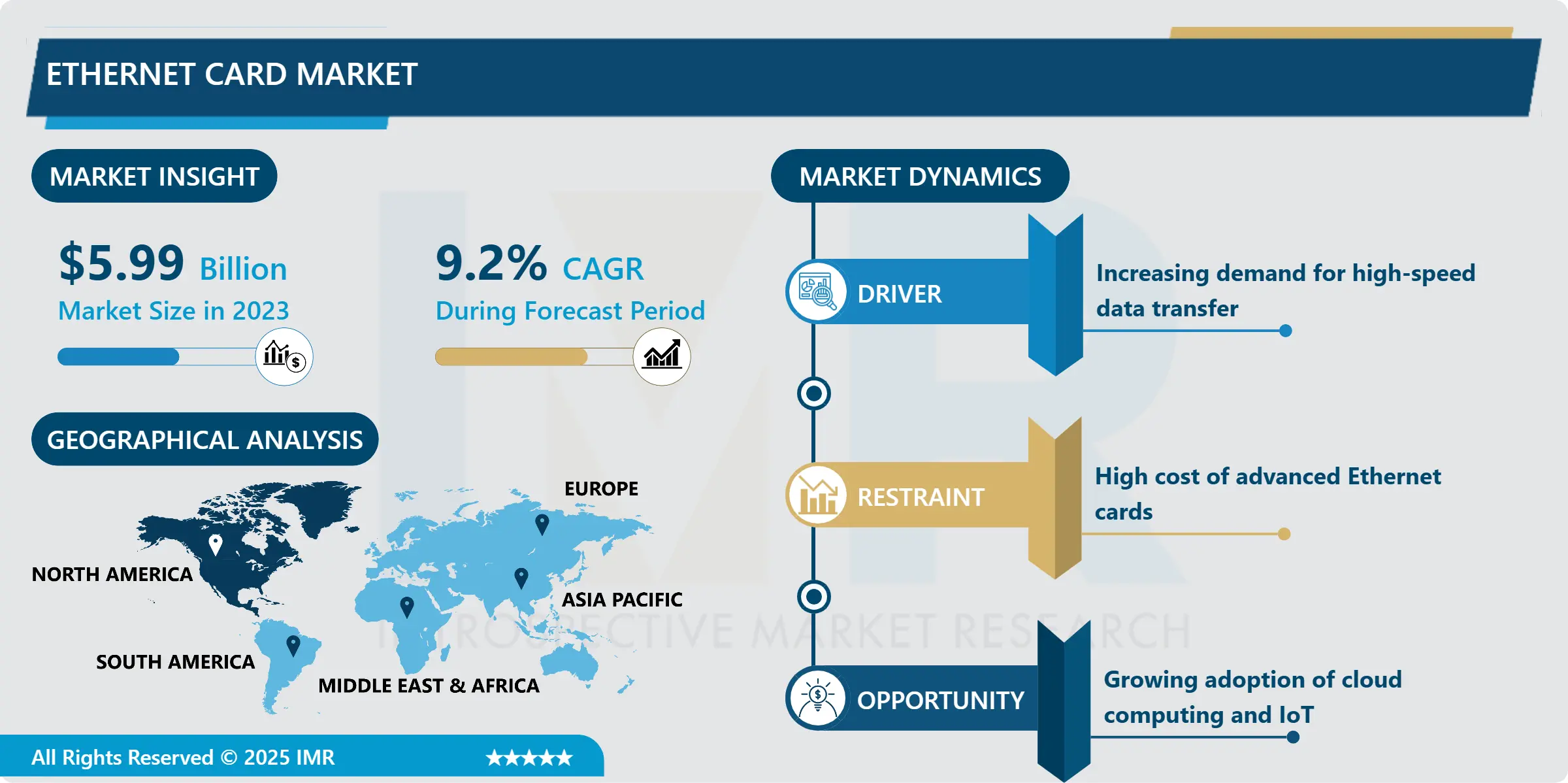
Ethernet Card Market Size Was Valued at USD 5.99 Billion in 2023, and is Projected to Reach USD 13.23 Billion by 2032, Growing at a CAGR of 9.2 % From 2024-2032.

IMR Group
Description
Ethernet Card Market Synopsis:
Ethernet Card Market Size Was Valued at USD 5.99 Billion in 2023, and is Projected to Reach USD 13.23 Billion by 2032, Growing at a CAGR of 9.2 % From 2024-2032.
The Ethernet Card Market includes the formation and use of NIC’s- which facilitate connection of computing devices to Ethernet networks. These cards on PC’s and Laptops and as well as in Industries especially Information, Telecommunication and Manufacturing industries are useful in the speeding up and improving the data Communicational effectiveness up to the personal computing standard.
Ethernet Card Market is currently in the expansion stage due to the desire to improve on the capacity and effectiveness of the network in various sectors. A greater attention to the high-speed Ethernet solution has to be encouraged on the new business and consumer digital environment. These network interface cards are mandatory to connect the servers’ desks and IoT devices to mitigate issues of network delay.
With the expansion of data centers they also saw the need of enhanced Ethernet cards capable of supporting high bandwidth around the globe as well. Among these new trends, there are related to the bandwidth of Gigabit and 10 GbE Ethernet cards to increase big data and HPC connections. New generation of wireless technology integrated with wired technologies and additional inputs of the compatibility along with Hybrid network is further extending the domains of the Ethernet Card Market.
Ethernet Card Market Trend Analysis:
Increasing Adoption of Gigabit Ethernet Solutions
The growing demand for faster internet speeds has accelerated the adoption of Gigabit Ethernet solutions across various sectors. As businesses and organizations increasingly rely on high-bandwidth applications, such as cloud computing and data-intensive services, the need for reliable and efficient network infrastructure has become paramount. Gigabit Ethernet offers superior data transfer rates and reduced latency, making it an ideal choice for enterprises looking to enhance their network performance.
As industries transition to more advanced technological environments, the Ethernet card market has experienced a surge in demand. Organizations are integrating Gigabit Ethernet solutions into their infrastructure to meet the evolving needs of remote work, video conferencing, and large-scale data transfer. This trend is expected to continue, as more businesses adopt high-speed network capabilities to stay competitive in a digitally driven market.
Expansion of IoT and Edge Computing
The ongoing expansion of IoT and edge computing environments is reshaping network infrastructure demands, creating a compelling growth avenue for the Ethernet card market. As enterprises deploy vast networks of connected devices and smart systems, the need for robust, low-latency, and scalable connectivity is intensifying. Ethernet cards, particularly those supporting high-speed data transmission and energy-efficient performance, are becoming critical components in modern IT architectures that support real-time data processing at the network edge.
Manufacturers and solution providers are responding to increased requirements for bandwidth, interoperability, and reliability in both industrial and commercial IoT applications. Edge computing nodes, which rely on decentralized processing, often require enhanced networking hardware to support data-intensive tasks locally. Ethernet cards tailored for edge infrastructure help streamline operations by ensuring stable and fast connections, reducing the load on central systems. As a result, Ethernet interface solutions are gaining preference in next-generation networking deployments.
Ethernet Card Market Segment Analysis:
Ethernet Card Market is Segmented on the basis of Type, Application, End User, and Region
By Type, Gigabit Ethernet segment is expected to dominate the market during the forecast period
The Gigabit Ethernet segment is anticipated to lead the Ethernet card market during the forecast period, supported by growing enterprise demand for high-speed data transmission. Organizations are increasingly upgrading their IT infrastructure to accommodate bandwidth-intensive applications such as cloud computing, virtualization, and large-scale data analytics. This shift is influencing purchasing decisions across sectors including telecommunications, manufacturing, and financial services, where stable and fast network performance is a core operational requirement.
Manufacturers and solution providers are focusing on product offerings that enhance throughput and minimize latency within data centers and corporate networks. Gigabit Ethernet cards offer a balance of speed, compatibility, and cost-efficiency, making them a preferred choice for both new deployments and system upgrades. Their integration into a range of networking hardware is also facilitating streamlined system architecture in enterprise environments, supporting scalability and reducing complexity in network management.
By Application, Switches segment expected to held the largest share
The switches segment is projected to account for the largest share of the Ethernet card market based on its central role in enabling seamless data transfer and network management across enterprise and data center infrastructures. As network demands continue to evolve, organizations are scaling their operations with enhanced switching solutions that optimize bandwidth allocation and reduce latency. Ethernet cards integrated with switch functionality offer reliable connectivity and high-speed data exchange, aligning with the performance standards required in today’s cloud-based and virtualized environments.
Increased investment in data center modernization and the adoption of high-performance computing environments are reinforcing the demand for advanced switching hardware. Enterprises across sectors are upgrading to scalable and efficient Ethernet switch architectures to support growing data traffic and improve system responsiveness. Vendors catering to this segment are focusing on compatibility, port density, and energy efficiency, responding to industry requirements for robust and flexible networking infrastructure.
Ethernet Card Market Regional Insights:
North America is Expected to Dominate the Market Over the Forecast period
North America is projected to maintain a leading position in the Ethernet card market throughout the forecast period, supported by a well-established IT infrastructure and high adoption rates of advanced networking technologies. Enterprises across sectors such as telecommunications, finance, and data centers continue to invest in high-performance networking hardware to support growing data demands and maintain competitive agility. The region’s strong presence of key manufacturers and early adoption of innovative technologies contribute to sustained market momentum.
Large-scale digitization initiatives and increased deployment of cloud computing and virtualization platforms are creating favorable conditions for Ethernet card usage. Organizations are upgrading network capabilities to improve speed, efficiency, and reliability, which aligns with evolving business and consumer expectations. With a consistent focus on enhancing data transfer performance and network scalability, North America remains a core region for ongoing development and commercial growth in the Ethernet card segment.
Active Key Players in the Ethernet Card Market
Allied Telesis (Japan)
Broadcom Inc. (USA)
Cisco Systems (USA)
D-Link Corporation (Taiwan)
Dell Technologies (USA)
Edimax Technology Co., Ltd. (Taiwan)
Hewlett Packard Enterprise (USA)
Intel Corporation (USA)
Juniper Networks (USA)
Mellanox Technologies (USA)
Netgear Inc. (USA)
Realtek Semiconductor Corp. (Taiwan)
TP-Link Technologies Co., Ltd. (China)
TRENDnet (USA)
ZTE Corporation (China)
Other Active Players
Chapter 1: Introduction
1.1 Scope and Coverage
Chapter 2:Executive Summary
Chapter 3: Market Landscape
3.1 Market Dynamics
3.1.1 Drivers
3.1.2 Restraints
3.1.3 Opportunities
3.1.4 Challenges
3.2 Market Trend Analysis
3.3 PESTLE Analysis
3.4 Porter’s Five Forces Analysis
3.5 Industry Value Chain Analysis
3.6 Ecosystem
3.7 Regulatory Landscape
3.8 Price Trend Analysis
3.9 Patent Analysis
3.10 Technology Evolution
3.11 Investment Pockets
3.12 Import-Export Analysis
Chapter 4: Ethernet Card Market by Type
4.1 Ethernet Card Market Snapshot and Growth Engine
4.2 Ethernet Card Market Overview
4.3 Ethernet NICs 5-Base T 10-Base T 100-Base T Gigabit Ethernet Wireless NICs
4.3.1 Introduction and Market Overview
4.3.2 Historic and Forecasted Market Size in Value USD and Volume Units (2017-2032F)
4.3.3 Key Market Trends, Growth Factors and Opportunities
4.3.4 Ethernet NICs 5-Base T 10-Base T 100-Base T Gigabit Ethernet Wireless NICs: Geographic Segmentation Analysis
Chapter 5: Ethernet Card Market by Application
5.1 Ethernet Card Market Snapshot and Growth Engine
5.2 Ethernet Card Market Overview
5.3 Wireless Communication Devices Firewall Bridges Repeaters Wired Communication Devices Hubs Switches Routers Telephones
5.3.1 Introduction and Market Overview
5.3.2 Historic and Forecasted Market Size in Value USD and Volume Units (2017-2032F)
5.3.3 Key Market Trends, Growth Factors and Opportunities
5.3.4 Wireless Communication Devices Firewall Bridges Repeaters Wired Communication Devices Hubs Switches Routers Telephones: Geographic Segmentation Analysis
Chapter 6: Ethernet Card Market by End User
6.1 Ethernet Card Market Snapshot and Growth Engine
6.2 Ethernet Card Market Overview
6.3 Data Centre’s Networking Service Providers Telecom Operators Enterprises/Corporates Others
6.3.1 Introduction and Market Overview
6.3.2 Historic and Forecasted Market Size in Value USD and Volume Units (2017-2032F)
6.3.3 Key Market Trends, Growth Factors and Opportunities
6.3.4 Data Centre’s Networking Service Providers Telecom Operators Enterprises/Corporates Others: Geographic Segmentation Analysis
Chapter 7: Company Profiles and Competitive Analysis
7.1 Competitive Landscape
7.1.1 Competitive Benchmarking
7.1.2 Ethernet Card Market Share by Manufacturer (2023)
7.1.3 Industry BCG Matrix
7.1.4 Heat Map Analysis
7.1.5 Mergers and Acquisitions
7.2 ALLIED TELESIS (JAPAN)
7.2.1 Company Overview
7.2.2 Key Executives
7.2.3 Company Snapshot
7.2.4 Role of the Company in the Market
7.2.5 Sustainability and Social Responsibility
7.2.6 Operating Business Segments
7.2.7 Product Portfolio
7.2.8 Business Performance
7.2.9 Key Strategic Moves and Recent Developments
7.2.10 SWOT Analysis
7.3 BROADCOM INC. (USA)
7.4 CISCO SYSTEMS (USA)
7.5 D-LINK CORPORATION (TAIWAN)
7.6 DELL TECHNOLOGIES (USA)
7.7 EDIMAX TECHNOLOGY CO. LTD. (TAIWAN)
7.8 HEWLETT PACKARD ENTERPRISE (USA)
7.9 INTEL CORPORATION (USA)
7.10 JUNIPER NETWORKS (USA)
7.11 MELLANOX TECHNOLOGIES (USA)
7.12 NETGEAR INC. (USA)
7.13 REALTEK SEMICONDUCTOR CORP. (TAIWAN)
7.14 TP-LINK TECHNOLOGIES CO. LTD. (CHINA)
7.15 TRENDNET (USA)
7.16 ZTE CORPORATION (CHINA)
7.17 OTHER ACTIVE PLAYERS
Chapter 8: Global Ethernet Card Market By Region
8.1 Overview
8.2. North America Ethernet Card Market
8.2.1 Key Market Trends, Growth Factors and Opportunities
8.2.2 Top Key Companies
8.2.3 Historic and Forecasted Market Size by Segments
8.2.4 Historic and Forecasted Market Size By Type
8.2.4.1 Ethernet NICs 5-Base T 10-Base T 100-Base T Gigabit Ethernet Wireless NICs
8.2.5 Historic and Forecasted Market Size By Application
8.2.5.1 Wireless Communication Devices Firewall Bridges Repeaters Wired Communication Devices Hubs Switches Routers Telephones
8.2.6 Historic and Forecasted Market Size By End User
8.2.6.1 Data Centre’s Networking Service Providers Telecom Operators Enterprises/Corporates Others
8.2.7 Historic and Forecast Market Size by Country
8.2.7.1 US
8.2.7.2 Canada
8.2.7.3 Mexico
8.3. Eastern Europe Ethernet Card Market
8.3.1 Key Market Trends, Growth Factors and Opportunities
8.3.2 Top Key Companies
8.3.3 Historic and Forecasted Market Size by Segments
8.3.4 Historic and Forecasted Market Size By Type
8.3.4.1 Ethernet NICs 5-Base T 10-Base T 100-Base T Gigabit Ethernet Wireless NICs
8.3.5 Historic and Forecasted Market Size By Application
8.3.5.1 Wireless Communication Devices Firewall Bridges Repeaters Wired Communication Devices Hubs Switches Routers Telephones
8.3.6 Historic and Forecasted Market Size By End User
8.3.6.1 Data Centre’s Networking Service Providers Telecom Operators Enterprises/Corporates Others
8.3.7 Historic and Forecast Market Size by Country
8.3.7.1 Russia
8.3.7.2 Bulgaria
8.3.7.3 The Czech Republic
8.3.7.4 Hungary
8.3.7.5 Poland
8.3.7.6 Romania
8.3.7.7 Rest of Eastern Europe
8.4. Western Europe Ethernet Card Market
8.4.1 Key Market Trends, Growth Factors and Opportunities
8.4.2 Top Key Companies
8.4.3 Historic and Forecasted Market Size by Segments
8.4.4 Historic and Forecasted Market Size By Type
8.4.4.1 Ethernet NICs 5-Base T 10-Base T 100-Base T Gigabit Ethernet Wireless NICs
8.4.5 Historic and Forecasted Market Size By Application
8.4.5.1 Wireless Communication Devices Firewall Bridges Repeaters Wired Communication Devices Hubs Switches Routers Telephones
8.4.6 Historic and Forecasted Market Size By End User
8.4.6.1 Data Centre’s Networking Service Providers Telecom Operators Enterprises/Corporates Others
8.4.7 Historic and Forecast Market Size by Country
8.4.7.1 Germany
8.4.7.2 UK
8.4.7.3 France
8.4.7.4 The Netherlands
8.4.7.5 Italy
8.4.7.6 Spain
8.4.7.7 Rest of Western Europe
8.5. Asia Pacific Ethernet Card Market
8.5.1 Key Market Trends, Growth Factors and Opportunities
8.5.2 Top Key Companies
8.5.3 Historic and Forecasted Market Size by Segments
8.5.4 Historic and Forecasted Market Size By Type
8.5.4.1 Ethernet NICs 5-Base T 10-Base T 100-Base T Gigabit Ethernet Wireless NICs
8.5.5 Historic and Forecasted Market Size By Application
8.5.5.1 Wireless Communication Devices Firewall Bridges Repeaters Wired Communication Devices Hubs Switches Routers Telephones
8.5.6 Historic and Forecasted Market Size By End User
8.5.6.1 Data Centre’s Networking Service Providers Telecom Operators Enterprises/Corporates Others
8.5.7 Historic and Forecast Market Size by Country
8.5.7.1 China
8.5.7.2 India
8.5.7.3 Japan
8.5.7.4 South Korea
8.5.7.5 Malaysia
8.5.7.6 Thailand
8.5.7.7 Vietnam
8.5.7.8 The Philippines
8.5.7.9 Australia
8.5.7.10 New Zealand
8.5.7.11 Rest of APAC
8.6. Middle East & Africa Ethernet Card Market
8.6.1 Key Market Trends, Growth Factors and Opportunities
8.6.2 Top Key Companies
8.6.3 Historic and Forecasted Market Size by Segments
8.6.4 Historic and Forecasted Market Size By Type
8.6.4.1 Ethernet NICs 5-Base T 10-Base T 100-Base T Gigabit Ethernet Wireless NICs
8.6.5 Historic and Forecasted Market Size By Application
8.6.5.1 Wireless Communication Devices Firewall Bridges Repeaters Wired Communication Devices Hubs Switches Routers Telephones
8.6.6 Historic and Forecasted Market Size By End User
8.6.6.1 Data Centre’s Networking Service Providers Telecom Operators Enterprises/Corporates Others
8.6.7 Historic and Forecast Market Size by Country
8.6.7.1 Turkiye
8.6.7.2 Bahrain
8.6.7.3 Kuwait
8.6.7.4 Saudi Arabia
8.6.7.5 Qatar
8.6.7.6 UAE
8.6.7.7 Israel
8.6.7.8 South Africa
8.7. South America Ethernet Card Market
8.7.1 Key Market Trends, Growth Factors and Opportunities
8.7.2 Top Key Companies
8.7.3 Historic and Forecasted Market Size by Segments
8.7.4 Historic and Forecasted Market Size By Type
8.7.4.1 Ethernet NICs 5-Base T 10-Base T 100-Base T Gigabit Ethernet Wireless NICs
8.7.5 Historic and Forecasted Market Size By Application
8.7.5.1 Wireless Communication Devices Firewall Bridges Repeaters Wired Communication Devices Hubs Switches Routers Telephones
8.7.6 Historic and Forecasted Market Size By End User
8.7.6.1 Data Centre’s Networking Service Providers Telecom Operators Enterprises/Corporates Others
8.7.7 Historic and Forecast Market Size by Country
8.7.7.1 Brazil
8.7.7.2 Argentina
8.7.7.3 Rest of SA
Chapter 9 Analyst Viewpoint and Conclusion
9.1 Recommendations and Concluding Analysis
9.2 Potential Market Strategies
Chapter 10 Research Methodology
10.1 Research Process
10.2 Primary Research
10.3 Secondary Research
Q1: What would be the forecast period in the Ethernet Card Market research report?
A1: The forecast period in the Ethernet Card Market research report is 2024-2032.
Q2: Who are the key players in the Ethernet Card Market?
A2: Allied Telesis (Japan), Broadcom Inc. (USA), Cisco Systems (USA),D-Link Corporation (Taiwan),Dell Technologies (USA),Edimax Technology Co., Ltd. (Taiwan),Hewlett Packard Enterprise (USA),Intel Corporation (USA),Juniper Networks (USA),Mellanox Technologies (USA),Netgear Inc. (USA),Realtek Semiconductor Corp. (Taiwan),TP-Link Technologies Co., Ltd. (China),TRENDnet (USA),ZTE Corporation (China), and Other Active Players.
Q3: What are the segments of the Ethernet Card Market?
A3: The Ethernet Card Market is segmented into Type, Application, End User and Region. By Type, the market is categorized into Ethernet NICs 5-Base T 10-Base T 100-Base T Gigabit Ethernet Wireless NICs. By Application, the market is categorized into Wireless Communication Devices Firewall Bridges Repeaters Wired Communication Devices Hubs Switches Routers Telephones. By End User, the market is categorized into Data Centers Networking Service Providers Telecom Operators Enterprises/Corporates Others. By region, it is analyzed across North America (U.S., Canada, Mexico),Eastern Europe (Russia, Bulgaria, The Czech Republic, Hungary, Poland, Romania, Rest of Eastern Europe),Western Europe (Germany, UK, France, Netherlands, Italy, Spain, Rest of Western Europe),Asia Pacific (China, India, Japan, South Korea, Malaysia, Thailand, Vietnam, The Philippines, Australia, New-Zealand, Rest of APAC),Middle East & Africa (Turkiye, Bahrain, Kuwait, Saudi Arabia, Qatar, UAE, Israel, South Africa),South America (Brazil, Argentina, Rest of SA).
Q4: What is the Ethernet Card Market?
A4: The Ethernet Card Market includes the formation and use of NIC’s- which facilitate connection of computing devices to Ethernet networks. These cards on PC’s and Laptops and as well as in Industries especially Information, Telecommunication and Manufacturing industries are useful in the speeding up and improving the data Communicational effectiveness up to the personal computing standard.
Q5: How big is the Ethernet Card Market?
A5: Ethernet Card Market Size Was Valued at USD 5.99 Billion in 2023, and is Projected to Reach USD 13.23 Billion by 2032, Growing at a CAGR of 9.2 % From 2024-2032.
How to Buy a Report from eminsights.jp
On the product page, choose the license you want: Single-User License, Multi-User License or Enterprise License.
If you required report in your native language, then you can click on Translated Report button and fill out the form with report name and language you want, then our team will contact you as soon as possible.
Click the Buy Now button.
You will be redirected to the checkout page. Enter your company details and payment information.
Click Place Order to complete the purchase.
Confirmation: You’ll receive an order confirmation and our team will contact you shortly with your ordered report.
If you have any questions, fill out the contact form below or email us at [email protected].
Thank you for choosing eminsights.jp!