Stay Ahead in Fast-Growing Economies.
Browse Reports Now
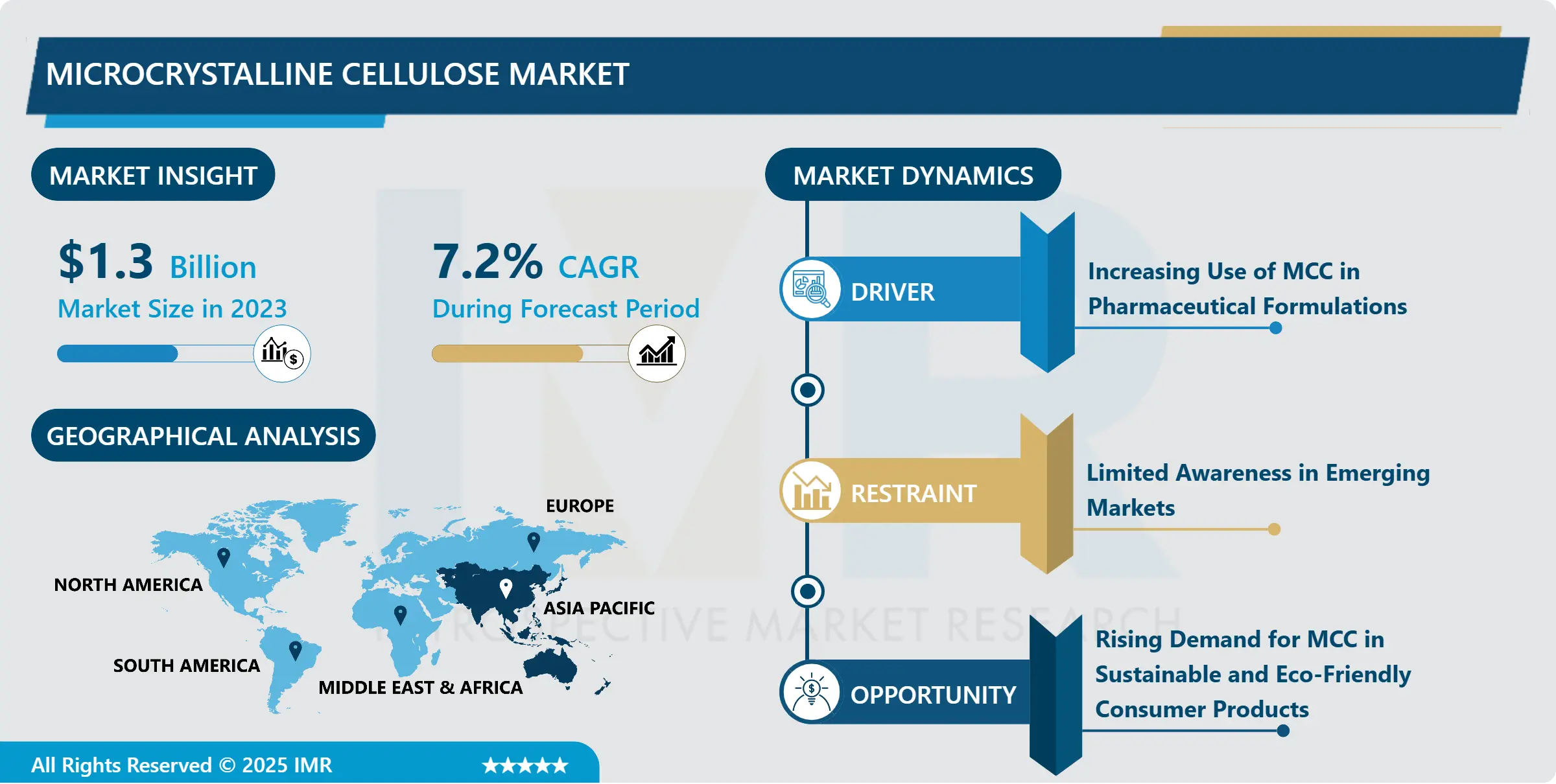
Microcrystalline Cellulose Market Size, Share, Growth & Forecast (2024-2032)
Microcrystalline Cellulose Market Size Was Valued at USD 1.30 Billion in 2023, and is Projected to Reach USD 2.43 Billion by 2032, Growing at a CAGR of 7.20% From 2024-2032.

IMR Group
Description
Microcrystalline Cellulose Market Synopsis:
Microcrystalline Cellulose Market Size Was Valued at USD 1.30 Billion in 2023, and is Projected to Reach USD 2.43 Billion by 2032, Growing at a CAGR of 7.20% From 2024-2032.
Microcrystalline Cellulose (MCC) is a purified, partially depolymerized cellulose derived from animal fibres with a natural plant base usually derived from wood or cotton. It has wide application including as a food ingredient, an adjuvant in drugs, and for stabilizing or bulking purposes. MCC is appreciated for its almost complete absence of impurities and moisture, as well as good binding, disintegration and flow properties.
The main factor to which Microcrystalline Cellulose is subjected is the presence of high demand for Microcrystalline Cellulose within various industries, including pharmaceuticals, food & beverage industry, and cosmetics industry. MCC is still growing in popularity due to its non-toxicity, availability, and high ability to help maintain the stability, texture and consistency of products. It is being seen that in the pharmaceutical industry most particularly in the sector of controlled release formulations and drug stability; there is increased demand of MCC. In addition, the changing pattern of preference toward natural and plant products in use such as in cosmetic and medicines also contribute to the market growth.
This lift in the consumption consciousness towards the better diet and easy-to-identify products has also fueled the MCC prospects in the food sector. It is widely used as a bulk forming agent and stabilizer and is highly sought after by manufacturers of natural products with little processing. In addition, the growing cosmetics market due to the use of natural resources and organic compounds is also one of the key drivers for the market. The demand for sustainable and versatile material profiles adds even more to MCC relevance for various sectors.
Microcrystalline Cellulose Market Trend Analysis:
Growing preference for multifunctional and sustainable ingredients across industries
Another of the most prominent trends identified on the Microcrystalline Cellulose market is the shift to polyfunctional and environmentally friendly additives by manufacturers and suppliers of various industries. Natural products are getting more and more preference from the consumers as well as manufactures, so MCC is finding more and more applications especially for formulations which are safe and processed with minimum process and are eco-friendly. With clean-label trends and the desire for products with no preservatives, MCC is being integrated into multiple consumer products.
A rising trend explored is the growing use of MCC in new pharma applications, especially in drug release systems that are controlled for time. There is also a development of new MCC formulations in the development which in particular, the nutraceutical segment where the consumption of supplemental foods is on the rise. All these trends demonstrate the new direction of MCC in enhancing the quality and effectiveness of products in various sectors.
The increasing need for controlled release medications
An increased demand for pharmaceutical products and Products with Microcrystalline Cellulose: The Microcrystalline Cellulose business has immense opportunities to explore the global market for pharmaceutical products expanding since the current century. The recent emphasis on controlled release medications and excipients for improving drug delivery systems create further opportunities for MCC in new delivery systems formulation. Besides, a continuously increasing request for cheaper generic drugs that mostly utilize MCC for tablets will also drive the market for MCC in the pharmaceutical industry.
In the food and beverage industry, versatile individuals for plant product foods and healthy foods compel food manufacturers to opt for natural and non-GMO products. As a functional micro ingredient derived from plant source Microcrystalline Cellulose is set to benefit from this transition. Also, the ongoing shift toward the consumption of organic and clean label products is something MCC producers could also build on, primarily in the developing world where the change of preferences for healthier foods is rapidly gaining steam.
Microcrystalline Cellulose Market Segment Analysis:
Microcrystalline Cellulose Market is Segmented on the basis of Type, Application, End User, and Region.
By Type, Powdered segment is expected to dominate the market during the forecast period
The powdered segment is anticipated to dominate the microcrystalline cellulose (MCC) market by type during the forecast period. This dominance is primarily attributed to its wide range of applications and favorable properties such as high compressibility, stability, and ease of handling. Powdered microcrystalline cellulose is extensively used in the pharmaceutical industry as a binder and filler in tablet formulations, owing to its excellent flowability and compactability.
It is commonly utilized in food and beverage applications as an anti-caking agent, stabilizer, and fat substitute. The cosmetics and personal care industry also relies on powdered MCC for its absorbent and bulking properties. Its versatility across multiple industries, along with increasing demand for processed foods and pharmaceuticals, further supports its market leadership. With technological advancements and expanding end-use industries, the powdered segment is expected to sustain its prominent market share over the coming years.
By Application, Pharmaceutical segment expected to held the largest share
The pharmaceutical segment is anticipated to hold the largest share of the microcrystalline cellulose (MCC) market due to its extensive usage as an excipient in drug formulation. MCC is widely used in the pharmaceutical industry as a binder, filler, and disintegrant in tablet manufacturing because of its excellent compressibility and compatibility with active pharmaceutical ingredients (APIs).
Its ability to enhance the mechanical strength and stability of tablets without affecting the efficacy of the medicine makes it a preferred choice among pharmaceutical manufacturers. Additionally, the growing global demand for over-the-counter (OTC) medications, coupled with the rising aging population and increased incidence of chronic diseases, further drives the demand for MCC in this sector. Regulatory approvals and the emphasis on producing high-quality, consistent pharmaceutical products also contribute to the dominance of the pharmaceutical segment in the MCC market.
Microcrystalline Cellulose Market Regional Insights:
Asia Pacific is Expected to Dominate the Market Over the Forecast period
The Asia Pacific region leads in the Microcrystalline Cellulose market due to an extraordinary growth of the pharmaceutical, food, and cosmetic industries in countries including China, India, and Japan. The growth of an extensive manufacturing sector and popularization of MCC in medication products are the drivers of the market. Increasing consumption of natural and functional ingredients, particularly in the food and personal care products, also has helped Asia Pacific to continue its supremacy in the global MCC market. Besides, flows in disposable income and increasing urbanization in Asia are increasing consumer good demands that cement the position of this region further.
The growth of the sector of pharmaceuticals in both India and China, as well as the increasing customer preference for cleaner label and natural foods, gives Microcrystalline Cellulose a great demand. The large population in Asia Pacific also consumes the product; with the growing middle-income earners, they prefer better quality products, thus promoting the demand for MCC.
Active Key Players in the Microcrystalline Cellulose Market:
ACCID (Advanced Cellulose Products) (USA)
Ashland Global (USA)
Blanver (Brazil)
CP Kelco (USA)
DuPont (USA)
Huzhou Xinyang Technology (China)
JRS Pharma (Germany)
Mingtai Chemical (China)
Purus (USA)
Siegfried (Switzerland), and Other Active Players
Chapter 1: Introduction
1.1 Scope and Coverage
Chapter 2:Executive Summary
Chapter 3: Market Landscape
3.1 Market Dynamics
3.1.1 Drivers
3.1.2 Restraints
3.1.3 Opportunities
3.1.4 Challenges
3.2 Market Trend Analysis
3.3 PESTLE Analysis
3.4 Porter’s Five Forces Analysis
3.5 Industry Value Chain Analysis
3.6 Ecosystem
3.7 Regulatory Landscape
3.8 Price Trend Analysis
3.9 Patent Analysis
3.10 Technology Evolution
3.11 Investment Pockets
3.12 Import-Export Analysis
Chapter 4: Microcrystalline Cellulose Market by Type
4.1 Microcrystalline Cellulose Market Snapshot and Growth Engine
4.2 Microcrystalline Cellulose Market Overview
4.3 Powdered
4.3.1 Introduction and Market Overview
4.3.2 Historic and Forecasted Market Size in Value USD and Volume Units (2017-2032F)
4.3.3 Key Market Trends, Growth Factors and Opportunities
4.3.4 Powdered: Geographic Segmentation Analysis
4.4 Granular
4.4.1 Introduction and Market Overview
4.4.2 Historic and Forecasted Market Size in Value USD and Volume Units (2017-2032F)
4.4.3 Key Market Trends, Growth Factors and Opportunities
4.4.4 Granular: Geographic Segmentation Analysis
Chapter 5: Microcrystalline Cellulose Market by End User
5.1 Microcrystalline Cellulose Market Snapshot and Growth Engine
5.2 Microcrystalline Cellulose Market Overview
5.3 Pharmaceutical & Healthcare
5.3.1 Introduction and Market Overview
5.3.2 Historic and Forecasted Market Size in Value USD and Volume Units (2017-2032F)
5.3.3 Key Market Trends, Growth Factors and Opportunities
5.3.4 Pharmaceutical & Healthcare: Geographic Segmentation Analysis
5.4 Food & Beverages
5.4.1 Introduction and Market Overview
5.4.2 Historic and Forecasted Market Size in Value USD and Volume Units (2017-2032F)
5.4.3 Key Market Trends, Growth Factors and Opportunities
5.4.4 Food & Beverages: Geographic Segmentation Analysis
5.5 Cosmetics & Personal Care
5.5.1 Introduction and Market Overview
5.5.2 Historic and Forecasted Market Size in Value USD and Volume Units (2017-2032F)
5.5.3 Key Market Trends, Growth Factors and Opportunities
5.5.4 Cosmetics & Personal Care: Geographic Segmentation Analysis
5.6 Paints & Coatings
5.6.1 Introduction and Market Overview
5.6.2 Historic and Forecasted Market Size in Value USD and Volume Units (2017-2032F)
5.6.3 Key Market Trends, Growth Factors and Opportunities
5.6.4 Paints & Coatings: Geographic Segmentation Analysis
5.7 Others
5.7.1 Introduction and Market Overview
5.7.2 Historic and Forecasted Market Size in Value USD and Volume Units (2017-2032F)
5.7.3 Key Market Trends, Growth Factors and Opportunities
5.7.4 Others: Geographic Segmentation Analysis
Chapter 6: Company Profiles and Competitive Analysis
6.1 Competitive Landscape
6.1.1 Competitive Benchmarking
6.1.2 Microcrystalline Cellulose Market Share by Manufacturer (2023)
6.1.3 Industry BCG Matrix
6.1.4 Heat Map Analysis
6.1.5 Mergers and Acquisitions
6.2 ASHLAND GLOBAL (USA)
6.2.1 Company Overview
6.2.2 Key Executives
6.2.3 Company Snapshot
6.2.4 Role of the Company in the Market
6.2.5 Sustainability and Social Responsibility
6.2.6 Operating Business Segments
6.2.7 Product Portfolio
6.2.8 Business Performance
6.2.9 Key Strategic Moves and Recent Developments
6.2.10 SWOT Analysis
6.3 DUPONT (USA)
6.4 MINGTAI CHEMICAL (CHINA)
6.5 JRS PHARMA (GERMANY)
6.6 ACCID (USA)
6.7 HUZHOU XINYANG TECHNOLOGY (CHINA)
6.8 CP KELCO (USA)
6.9 SIEGFRIED (SWITZERLAND)
6.10 PURUS (USA)
6.11 BLANVER (BRAZIL)
6.12 OTHER ACTIVE PLAYERS
Chapter 7: Global Microcrystalline Cellulose Market By Region
7.1 Overview
7.2. North America Microcrystalline Cellulose Market
7.2.1 Key Market Trends, Growth Factors and Opportunities
7.2.2 Top Key Companies
7.2.3 Historic and Forecasted Market Size by Segments
7.2.4 Historic and Forecasted Market Size By Type
7.2.4.1 Powdered
7.2.4.2 Granular
7.2.5 Historic and Forecasted Market Size By End User
7.2.5.1 Pharmaceutical & Healthcare
7.2.5.2 Food & Beverages
7.2.5.3 Cosmetics & Personal Care
7.2.5.4 Paints & Coatings
7.2.5.5 Others
7.2.6 Historic and Forecast Market Size by Country
7.2.6.1 US
7.2.6.2 Canada
7.2.6.3 Mexico
7.3. Eastern Europe Microcrystalline Cellulose Market
7.3.1 Key Market Trends, Growth Factors and Opportunities
7.3.2 Top Key Companies
7.3.3 Historic and Forecasted Market Size by Segments
7.3.4 Historic and Forecasted Market Size By Type
7.3.4.1 Powdered
7.3.4.2 Granular
7.3.5 Historic and Forecasted Market Size By End User
7.3.5.1 Pharmaceutical & Healthcare
7.3.5.2 Food & Beverages
7.3.5.3 Cosmetics & Personal Care
7.3.5.4 Paints & Coatings
7.3.5.5 Others
7.3.6 Historic and Forecast Market Size by Country
7.3.6.1 Russia
7.3.6.2 Bulgaria
7.3.6.3 The Czech Republic
7.3.6.4 Hungary
7.3.6.5 Poland
7.3.6.6 Romania
7.3.6.7 Rest of Eastern Europe
7.4. Western Europe Microcrystalline Cellulose Market
7.4.1 Key Market Trends, Growth Factors and Opportunities
7.4.2 Top Key Companies
7.4.3 Historic and Forecasted Market Size by Segments
7.4.4 Historic and Forecasted Market Size By Type
7.4.4.1 Powdered
7.4.4.2 Granular
7.4.5 Historic and Forecasted Market Size By End User
7.4.5.1 Pharmaceutical & Healthcare
7.4.5.2 Food & Beverages
7.4.5.3 Cosmetics & Personal Care
7.4.5.4 Paints & Coatings
7.4.5.5 Others
7.4.6 Historic and Forecast Market Size by Country
7.4.6.1 Germany
7.4.6.2 UK
7.4.6.3 France
7.4.6.4 The Netherlands
7.4.6.5 Italy
7.4.6.6 Spain
7.4.6.7 Rest of Western Europe
7.5. Asia Pacific Microcrystalline Cellulose Market
7.5.1 Key Market Trends, Growth Factors and Opportunities
7.5.2 Top Key Companies
7.5.3 Historic and Forecasted Market Size by Segments
7.5.4 Historic and Forecasted Market Size By Type
7.5.4.1 Powdered
7.5.4.2 Granular
7.5.5 Historic and Forecasted Market Size By End User
7.5.5.1 Pharmaceutical & Healthcare
7.5.5.2 Food & Beverages
7.5.5.3 Cosmetics & Personal Care
7.5.5.4 Paints & Coatings
7.5.5.5 Others
7.5.6 Historic and Forecast Market Size by Country
7.5.6.1 China
7.5.6.2 India
7.5.6.3 Japan
7.5.6.4 South Korea
7.5.6.5 Malaysia
7.5.6.6 Thailand
7.5.6.7 Vietnam
7.5.6.8 The Philippines
7.5.6.9 Australia
7.5.6.10 New Zealand
7.5.6.11 Rest of APAC
7.6. Middle East & Africa Microcrystalline Cellulose Market
7.6.1 Key Market Trends, Growth Factors and Opportunities
7.6.2 Top Key Companies
7.6.3 Historic and Forecasted Market Size by Segments
7.6.4 Historic and Forecasted Market Size By Type
7.6.4.1 Powdered
7.6.4.2 Granular
7.6.5 Historic and Forecasted Market Size By End User
7.6.5.1 Pharmaceutical & Healthcare
7.6.5.2 Food & Beverages
7.6.5.3 Cosmetics & Personal Care
7.6.5.4 Paints & Coatings
7.6.5.5 Others
7.6.6 Historic and Forecast Market Size by Country
7.6.6.1 Turkiye
7.6.6.2 Bahrain
7.6.6.3 Kuwait
7.6.6.4 Saudi Arabia
7.6.6.5 Qatar
7.6.6.6 UAE
7.6.6.7 Israel
7.6.6.8 South Africa
7.7. South America Microcrystalline Cellulose Market
7.7.1 Key Market Trends, Growth Factors and Opportunities
7.7.2 Top Key Companies
7.7.3 Historic and Forecasted Market Size by Segments
7.7.4 Historic and Forecasted Market Size By Type
7.7.4.1 Powdered
7.7.4.2 Granular
7.7.5 Historic and Forecasted Market Size By End User
7.7.5.1 Pharmaceutical & Healthcare
7.7.5.2 Food & Beverages
7.7.5.3 Cosmetics & Personal Care
7.7.5.4 Paints & Coatings
7.7.5.5 Others
7.7.6 Historic and Forecast Market Size by Country
7.7.6.1 Brazil
7.7.6.2 Argentina
7.7.6.3 Rest of SA
Chapter 8 Analyst Viewpoint and Conclusion
8.1 Recommendations and Concluding Analysis
8.2 Potential Market Strategies
Chapter 9 Research Methodology
9.1 Research Process
9.2 Primary Research
9.3 Secondary Research
Q1: What would be the forecast period in the Microcrystalline Cellulose Market research report?
A1: The forecast period in the Microcrystalline Cellulose Market research report is 2024-2032.
Q2: Who are the key players in the Microcrystalline Cellulose Market?
A2: ACCID (Advanced Cellulose Products) (USA), Ashland Global (USA), Blanver (Brazil), CP Kelco (USA), DuPont (USA), Huzhou Xinyang Technology (China), JRS Pharma (Germany), Mingtai Chemical (China), Purus (USA), Siegfried (Switzerland), and Other Active Players.
Q3: What are the segments of the Microcrystalline Cellulose Market?
A3: Microcrystalline Cellulose Market is Segmented on the basis of Type, Application, End User, and Region. By Type, the market is categorized into Powdered, and Granular. By Application, the market is categorized into Pharmaceutical, Food & Beverage, Cosmetics & Personal Care, Chemicals, Others. By End User, the market is categorized into Pharmaceutical & Healthcare, Food & Beverages, Cosmetics & Personal Care, Paints & Coatings, Others. By region, it is analyzed across North America (U.S., Canada, Mexico), Eastern Europe (Russia, Bulgaria, The Czech Republic, Hungary, Poland, Romania, Rest of Eastern Europe), Western Europe (Germany, UK, France, Netherlands, Italy, Spain, Rest of Western Europe), Asia Pacific (China, India, Japan, South Korea, Malaysia, Thailand, Vietnam, The Philippines, Australia, New Zealand, Rest of APAC), Middle East & Africa (Turkiye, Bahrain, Kuwait, Saudi Arabia, Qatar, UAE, Israel, South Africa), South America (Brazil, Argentina, Rest of SA).
Q4: What is the Microcrystalline Cellulose Market?
A4: Microcrystalline Cellulose (MCC) is a purified, partially depolymerized cellulose derived from animal fibres with a natural plant base usually derived from wood or cotton. It has wide application including as a food ingredient, an adjuvant in drugs, and for stabilizing or bulking purposes. MCC is appreciated for its almost complete absence of impurities and moisture, as well as good binding, disintegration and flow properties.
Q5: How big is the Microcrystalline Cellulose Market?
A5: Microcrystalline Cellulose Market Size Was Valued at USD 1.30 Billion in 2023, and is Projected to Reach USD 2.43 Billion by 2032, Growing at a CAGR of 7.20% From 2024-2032.
How to Buy a Report from eminsights.jp
On the product page, choose the license you want: Single-User License, Multi-User License or Enterprise License.
If you required report in your native language, then you can click on Translated Report button and fill out the form with report name and language you want, then our team will contact you as soon as possible.
Click the Buy Now button.
You will be redirected to the checkout page. Enter your company details and payment information.
Click Place Order to complete the purchase.
Confirmation: You’ll receive an order confirmation and our team will contact you shortly with your ordered report.
If you have any questions, fill out the contact form below or email us at [email protected].
Thank you for choosing eminsights.jp!