Stay Ahead in Fast-Growing Economies.
Browse Reports Now




Molecular Imaging Market Growth Insights & Forecast Report to 2032
Molecular imaging is a technique used in diagnosing the character status as well as monitoring the functions of molecules and cells in living tissues. Combining imaging technology with molecular biology, it can identify certain biomarkers related to the disease, assists in diagnosis, assess treatment efficacy, and elucidate underpinning disease pathophysiologic processes. Molecular imaging is a versatile technique in contrast to imaging that captures structural information and offers imaging of the function and activity of biomolecules of interest in the practice of medicine including oncology, cardiology, neurology, and drug development.

IMR Group
Description
Molecular Imaging Market Synopsis:
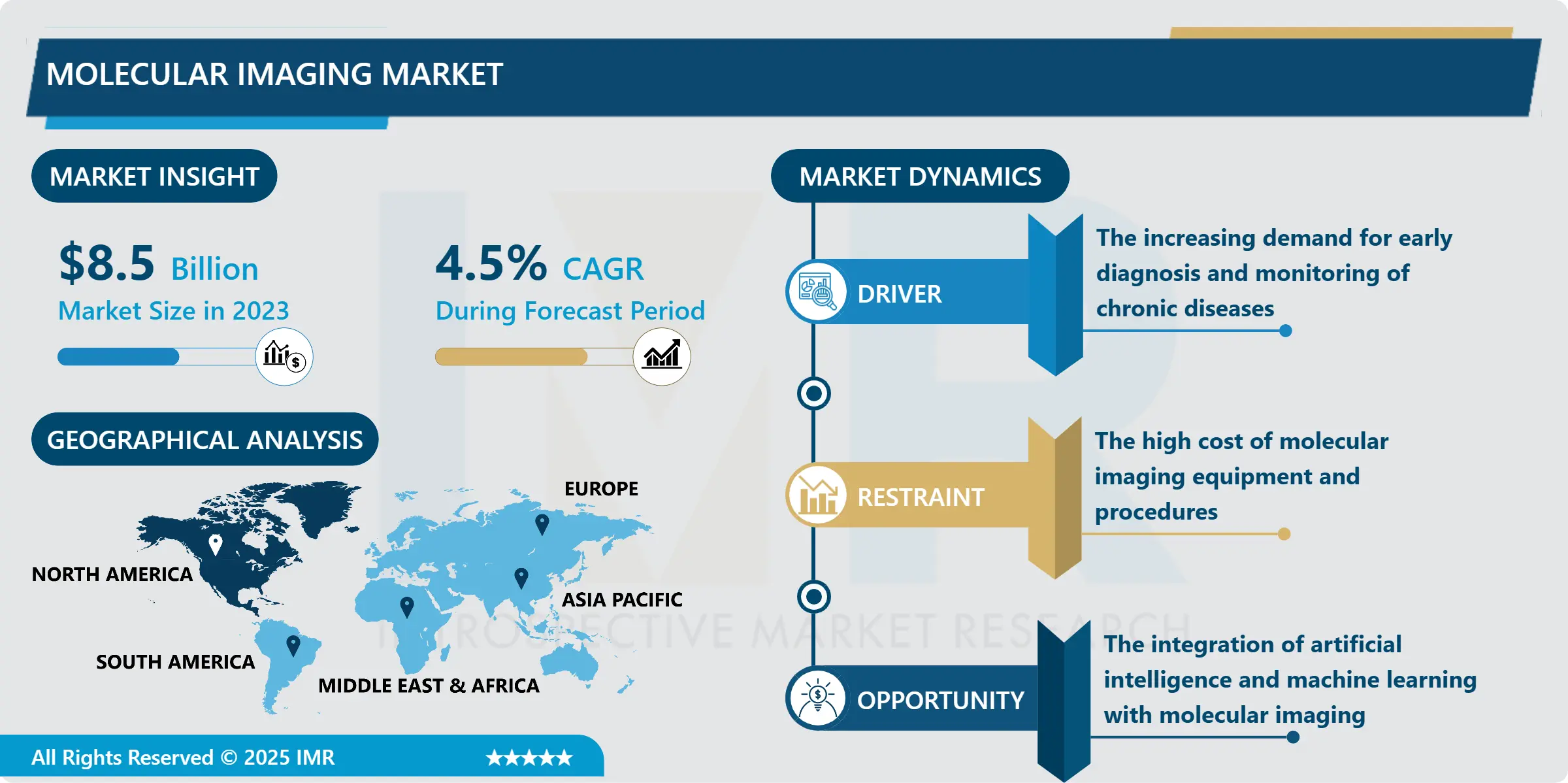
Molecular Imaging Market Size Was Valued at USD 8.5 Billion in 2023, and is Projected to Reach USD 12.6 Billion by 2032, Growing at a CAGR of 4.5% From 2024-2032.
Molecular imaging is a technique used in diagnosing the character status as well as monitoring the functions of molecules and cells in living tissues. Combining imaging technology with molecular biology, it can identify certain biomarkers related to the disease, assists in diagnosis, assess treatment efficacy, and elucidate underpinning disease pathophysiologic processes. Molecular imaging is a versatile technique in contrast to imaging that captures structural information and offers imaging of the function and activity of biomolecules of interest in the practice of medicine including oncology, cardiology, neurology, and drug development.
The global molecular imaging industry has rapidly developed during the past few years because of the huge demand in diseases like cancer, cardiovascular diseases, and neurological disorders that can only be diagnosed properly with the help of molecular imaging. New method of diagnostic tool has enhanced the chance of developing new techniques of imaging that can enhance early detection of diseases. New Technologies, like positron emission tomography (PET), single-photon emission computed tomography (SPECT), and molecular ultrasound have reinforced the positive impact of Molecular Imaging throughout the medical filed and Research. Also, with the current increased emphasis on individualized treatments, molecular imaging has been necessary in decisions regarding the selecting of therapeutic treatment plans.
The market is also driven by the development of image depth definitions that are even higher than the existing ones while offering real-time data to the doctors to enable them to make the right diagnosis. Factors that will drive this market are then enhancements of research and development, set alongside government policies in modernization of the healthcare sector. Moreover, immediate collaborations between molecular imaging companies and healthcare care organizations have contributed to enhanced market access. These are also driving innovations within imaging analysis that incorporate artificial intelligence and machine learning into these models, in order to provide quicker results to the imaging analysis process.
Molecular Imaging Market Trend Analysis:
The Emergence of Molecular Ultrasound Imaging Technology
The most comprehensive rising trend that the global molecular imaging market has been experiencing is the dynamic growth of molecular ultrasound imaging. This noninvasive approach integrates the advantages of ultrasound with molecular imaging and provides higher spatial resolution compared to MRI or PET at a lower cost and with better availability. There is a growing interest in the use of molecular US in cancer diagnosis and treatment due to the ability of immediately observing the tumor microenvironment and the reaction to treatment. Moreover, there are Improvements in microbubbles and targeted contrast vascularization have improved the accuracy and precision in visualization of disease markers at the molecular level. The factor behind this trend is likely to propel the use of molecular ultrasound technology during the time of the forecast period, thereby further boosting the market.
Expansion of Personalized Medicine
One of the biggest opportunities in the molecular imaging market is centered around the expansion of personalized medicine. With the treatments being more personalized with regards to the DNA makeup of the individual, molecular imaging is instrumental in determining specific molecular markers to direct the treatment. Molecular visualization of the biological processes in action enables the clinician monitor the effects of treatment on a patient and make necessary changes to the patient’s current therapy if necessary. As more scholars are shifting their attention to precision medicine, more attention is directed toward molecular imaging for early detection of diseases progression and therapeutic interventions. This opportunity opens a great outlet for organizations in the molecular imaging market to develop new products that will address the other approach in treatment, which is the personalized medicine approach.
Molecular Imaging Market Segment Analysis:
Molecular Imaging Market is Segmented on the basis of Modality, Application, End User, and Region.
By Modality, Molecular Ultrasound Imaging segment is expected to dominate the market during the forecast period
Molecular ultrasound imaging is on course to lead the molecular imaging market during the forecast period. This modality uses microbubbles as contrast agents to increase the resolution of ultrasound at the molecular level and supply important data for diseases’ identification and tracking. This technology is known to improve continuously in costs and has been made portable, it’s not invasive, and so is becoming more popular. The molecular ultrasound imaging is less costly in comparison to those modalities which include PET or MRI; thus the modality can be easily employed not only in hospitals but also in clinicing settings. Moreover, development of endogenous and exogenous ultrasound contrast and identification of distinctive biomolecules in real time make molecular ultrasound suitable in oncology and cardiology.
In particular, the need for affordable, fast, and immediate visualizations of images, particularly in low-resource settings, is also fueling the application of molecular ultrasound imaging. The asset of real-time tracking of the dynamic physiological processes including blood flow and tissue perfusion augments further its possibilities of use in diagnostic patterns of diseases in general and particularly in oncological and cardiovascular pathology. It is expected that molecular ultrasound will advance rapidly in the future, and the improvement of molecular ultrasound’s imaging capabilities while the cost reduces makes it a significant competitor to other molecular imaging tools.
By Application, Cardiovascular segment expected to held the largest share
The cardiovascular segment occupies the largest share of molecular imaging during the forecast period. This is mainly attributed to rising global prevalence of cardiovascular illnesses for example coronary artery illness, heart failure, and stroke. Through molecular imaging, the diseases can be diagnosed and evaluated at their early stages, by detecting changes that occur arising from the efficiencies of therapeutic management. Thanks to the newly developed molecular imaging methods, the clinician can have a direct view of blood flow, plaques, or any other factor that is so important in cardiovascular diagnosis. Moreover, new method tools for molecular and functional diagnostics of the heart and vascular system are given, which enables the implementation of individual treatment programs and stimulates the growth of this segment.
Cardiovascular diseases continue to be among the biggest killers across the world, and with the rapid advancement in technology there is likely to be a continuous rise in the need for better diagnostic procedures such as that provided by molecular imaging. This segment’s growth is further supported through advanced imaging technologies in diagnosing the heart diseases as well as complications that are related with the diseases. The market is expected to benefit from the increasing use of molecular imaging in cardiovascular diseases since it would eventually improve the clinicians’ ability to diagnose diseases and create treatment plans.
Molecular Imaging Market Regional Insights:
North America is Expected to Dominate the Market Over the Forecast period
North America was the largest market for molecular imaging in 2023, with a large market share globally. This is due to the fact that there are important market leaders, a well developed healthcare system, and high healthcare expenditures in the region. The market share for these systems was particularly significant in the United States owing to a strong demand for highly effective diagnostic technology in cancer, cardiovascular, and neurological applications. North America has a well-established regulatory system and the government provides funds for molecular imaging technologies research and development, together with the early adoption of advanced medical technologies this has rendered North America as the molecular imaging technologies market leader. According to the analysis from 2023, North America has approximately the 45% share in the molecular imaging market, which apparently indicates that this region dominates in this field.
Active Key Players in the Molecular Imaging Market:
Bracco Imaging (Italy)
Canon Medical Systems Corporation (Japan)
Carl Zeiss Meditec AG (Germany)
Cigna Corporation (USA)
GE Healthcare (USA)
Hitachi, Ltd. (Japan)
Hologic, Inc. (USA)
IBM Corporation (USA)
Siemens Healthineers (Germany)
Philips Healthcare (Netherlands)
Shimadzu Corporation (Japan)
United Imaging Healthcare (China)
PerkinElmer (USA)
Other Active Player
Chapter 1: Introduction
1.1 Scope and Coverage
Chapter 2:Executive Summary
Chapter 3: Market Landscape
3.1 Market Dynamics
3.1.1 Drivers
3.1.2 Restraints
3.1.3 Opportunities
3.1.4 Challenges
3.2 Market Trend Analysis
3.3 PESTLE Analysis
3.4 Porter’s Five Forces Analysis
3.5 Industry Value Chain Analysis
3.6 Ecosystem
3.7 Regulatory Landscape
3.8 Price Trend Analysis
3.9 Patent Analysis
3.10 Technology Evolution
3.11 Investment Pockets
3.12 Import-Export Analysis
Chapter 4: Molecular Imaging Market by Modality
4.1 Molecular Imaging Market Snapshot and Growth Engine
4.2 Molecular Imaging Market Overview
4.3 Molecular Ultrasound Imaging
4.3.1 Introduction and Market Overview
4.3.2 Historic and Forecasted Market Size in Value USD and Volume Units (2017-2032F)
4.3.3 Key Market Trends, Growth Factors and Opportunities
4.3.4 Molecular Ultrasound Imaging: Geographic Segmentation Analysis
4.4 Positron Emission Tomography (PET)
4.4.1 Introduction and Market Overview
4.4.2 Historic and Forecasted Market Size in Value USD and Volume Units (2017-2032F)
4.4.3 Key Market Trends, Growth Factors and Opportunities
4.4.4 Positron Emission Tomography (PET): Geographic Segmentation Analysis
4.5 Single Photon Emission Computed Tomography (SPECT)
4.5.1 Introduction and Market Overview
4.5.2 Historic and Forecasted Market Size in Value USD and Volume Units (2017-2032F)
4.5.3 Key Market Trends, Growth Factors and Opportunities
4.5.4 Single Photon Emission Computed Tomography (SPECT): Geographic Segmentation Analysis
4.6 Nuclear Magnetic Resonance (NMR) Spectrometer
4.6.1 Introduction and Market Overview
4.6.2 Historic and Forecasted Market Size in Value USD and Volume Units (2017-2032F)
4.6.3 Key Market Trends, Growth Factors and Opportunities
4.6.4 Nuclear Magnetic Resonance (NMR) Spectrometer: Geographic Segmentation Analysis
4.7 Other Modalities
4.7.1 Introduction and Market Overview
4.7.2 Historic and Forecasted Market Size in Value USD and Volume Units (2017-2032F)
4.7.3 Key Market Trends, Growth Factors and Opportunities
4.7.4 Other Modalities: Geographic Segmentation Analysis
Chapter 5: Molecular Imaging Market by Application
5.1 Molecular Imaging Market Snapshot and Growth Engine
5.2 Molecular Imaging Market Overview
5.3 Cardiovascular
5.3.1 Introduction and Market Overview
5.3.2 Historic and Forecasted Market Size in Value USD and Volume Units (2017-2032F)
5.3.3 Key Market Trends, Growth Factors and Opportunities
5.3.4 Cardiovascular: Geographic Segmentation Analysis
5.4 Neurology
5.4.1 Introduction and Market Overview
5.4.2 Historic and Forecasted Market Size in Value USD and Volume Units (2017-2032F)
5.4.3 Key Market Trends, Growth Factors and Opportunities
5.4.4 Neurology: Geographic Segmentation Analysis
5.5 Oncology
5.5.1 Introduction and Market Overview
5.5.2 Historic and Forecasted Market Size in Value USD and Volume Units (2017-2032F)
5.5.3 Key Market Trends, Growth Factors and Opportunities
5.5.4 Oncology: Geographic Segmentation Analysis
5.6 Respiratory
5.6.1 Introduction and Market Overview
5.6.2 Historic and Forecasted Market Size in Value USD and Volume Units (2017-2032F)
5.6.3 Key Market Trends, Growth Factors and Opportunities
5.6.4 Respiratory: Geographic Segmentation Analysis
5.7 Gastrointestinal
5.7.1 Introduction and Market Overview
5.7.2 Historic and Forecasted Market Size in Value USD and Volume Units (2017-2032F)
5.7.3 Key Market Trends, Growth Factors and Opportunities
5.7.4 Gastrointestinal: Geographic Segmentation Analysis
Chapter 6: Molecular Imaging Market by End User
6.1 Molecular Imaging Market Snapshot and Growth Engine
6.2 Molecular Imaging Market Overview
6.3 Hospital
6.3.1 Introduction and Market Overview
6.3.2 Historic and Forecasted Market Size in Value USD and Volume Units (2017-2032F)
6.3.3 Key Market Trends, Growth Factors and Opportunities
6.3.4 Hospital: Geographic Segmentation Analysis
6.4 Diagnostic Imaging Centers
6.4.1 Introduction and Market Overview
6.4.2 Historic and Forecasted Market Size in Value USD and Volume Units (2017-2032F)
6.4.3 Key Market Trends, Growth Factors and Opportunities
6.4.4 Diagnostic Imaging Centers: Geographic Segmentation Analysis
6.5 Research Institutes
6.5.1 Introduction and Market Overview
6.5.2 Historic and Forecasted Market Size in Value USD and Volume Units (2017-2032F)
6.5.3 Key Market Trends, Growth Factors and Opportunities
6.5.4 Research Institutes: Geographic Segmentation Analysis
Chapter 7: Company Profiles and Competitive Analysis
7.1 Competitive Landscape
7.1.1 Competitive Benchmarking
7.1.2 Molecular Imaging Market Share by Manufacturer (2023)
7.1.3 Industry BCG Matrix
7.1.4 Heat Map Analysis
7.1.5 Mergers and Acquisitions
7.2 BRACCO IMAGING (ITALY)
7.2.1 Company Overview
7.2.2 Key Executives
7.2.3 Company Snapshot
7.2.4 Role of the Company in the Market
7.2.5 Sustainability and Social Responsibility
7.2.6 Operating Business Segments
7.2.7 Product Portfolio
7.2.8 Business Performance
7.2.9 Key Strategic Moves and Recent Developments
7.2.10 SWOT Analysis
7.3 CANON MEDICAL SYSTEMS CORPORATION (JAPAN)
7.4 CARL ZEISS MEDITEC AG (GERMANY)
7.5 CIGNA CORPORATION (USA)
7.6 GE HEALTHCARE (USA)
7.7 HITACHI
7.8 LTD. (JAPAN)
7.9 HOLOGIC INC. (USA)
7.10 IBM CORPORATION (USA)
7.11 SIEMENS HEALTHINEERS (GERMANY)
7.12 PHILIPS HEALTHCARE (NETHERLANDS)
7.13 SHIMADZU CORPORATION (JAPAN)
7.14 UNITED IMAGING HEALTHCARE (CHINA)
7.15 PERKINELMER (USA)
7.16
7.17 OTHER ACTIVE PLAYERS
Chapter 8: Global Molecular Imaging Market By Region
8.1 Overview
8.2. North America Molecular Imaging Market
8.2.1 Key Market Trends, Growth Factors and Opportunities
8.2.2 Top Key Companies
8.2.3 Historic and Forecasted Market Size by Segments
8.2.4 Historic and Forecasted Market Size By Modality
8.2.4.1 Molecular Ultrasound Imaging
8.2.4.2 Positron Emission Tomography (PET)
8.2.4.3 Single Photon Emission Computed Tomography (SPECT)
8.2.4.4 Nuclear Magnetic Resonance (NMR) Spectrometer
8.2.4.5 Other Modalities
8.2.5 Historic and Forecasted Market Size By Application
8.2.5.1 Cardiovascular
8.2.5.2 Neurology
8.2.5.3 Oncology
8.2.5.4 Respiratory
8.2.5.5 Gastrointestinal
8.2.6 Historic and Forecasted Market Size By End User
8.2.6.1 Hospital
8.2.6.2 Diagnostic Imaging Centers
8.2.6.3 Research Institutes
8.2.7 Historic and Forecast Market Size by Country
8.2.7.1 US
8.2.7.2 Canada
8.2.7.3 Mexico
8.3. Eastern Europe Molecular Imaging Market
8.3.1 Key Market Trends, Growth Factors and Opportunities
8.3.2 Top Key Companies
8.3.3 Historic and Forecasted Market Size by Segments
8.3.4 Historic and Forecasted Market Size By Modality
8.3.4.1 Molecular Ultrasound Imaging
8.3.4.2 Positron Emission Tomography (PET)
8.3.4.3 Single Photon Emission Computed Tomography (SPECT)
8.3.4.4 Nuclear Magnetic Resonance (NMR) Spectrometer
8.3.4.5 Other Modalities
8.3.5 Historic and Forecasted Market Size By Application
8.3.5.1 Cardiovascular
8.3.5.2 Neurology
8.3.5.3 Oncology
8.3.5.4 Respiratory
8.3.5.5 Gastrointestinal
8.3.6 Historic and Forecasted Market Size By End User
8.3.6.1 Hospital
8.3.6.2 Diagnostic Imaging Centers
8.3.6.3 Research Institutes
8.3.7 Historic and Forecast Market Size by Country
8.3.7.1 Russia
8.3.7.2 Bulgaria
8.3.7.3 The Czech Republic
8.3.7.4 Hungary
8.3.7.5 Poland
8.3.7.6 Romania
8.3.7.7 Rest of Eastern Europe
8.4. Western Europe Molecular Imaging Market
8.4.1 Key Market Trends, Growth Factors and Opportunities
8.4.2 Top Key Companies
8.4.3 Historic and Forecasted Market Size by Segments
8.4.4 Historic and Forecasted Market Size By Modality
8.4.4.1 Molecular Ultrasound Imaging
8.4.4.2 Positron Emission Tomography (PET)
8.4.4.3 Single Photon Emission Computed Tomography (SPECT)
8.4.4.4 Nuclear Magnetic Resonance (NMR) Spectrometer
8.4.4.5 Other Modalities
8.4.5 Historic and Forecasted Market Size By Application
8.4.5.1 Cardiovascular
8.4.5.2 Neurology
8.4.5.3 Oncology
8.4.5.4 Respiratory
8.4.5.5 Gastrointestinal
8.4.6 Historic and Forecasted Market Size By End User
8.4.6.1 Hospital
8.4.6.2 Diagnostic Imaging Centers
8.4.6.3 Research Institutes
8.4.7 Historic and Forecast Market Size by Country
8.4.7.1 Germany
8.4.7.2 UK
8.4.7.3 France
8.4.7.4 The Netherlands
8.4.7.5 Italy
8.4.7.6 Spain
8.4.7.7 Rest of Western Europe
8.5. Asia Pacific Molecular Imaging Market
8.5.1 Key Market Trends, Growth Factors and Opportunities
8.5.2 Top Key Companies
8.5.3 Historic and Forecasted Market Size by Segments
8.5.4 Historic and Forecasted Market Size By Modality
8.5.4.1 Molecular Ultrasound Imaging
8.5.4.2 Positron Emission Tomography (PET)
8.5.4.3 Single Photon Emission Computed Tomography (SPECT)
8.5.4.4 Nuclear Magnetic Resonance (NMR) Spectrometer
8.5.4.5 Other Modalities
8.5.5 Historic and Forecasted Market Size By Application
8.5.5.1 Cardiovascular
8.5.5.2 Neurology
8.5.5.3 Oncology
8.5.5.4 Respiratory
8.5.5.5 Gastrointestinal
8.5.6 Historic and Forecasted Market Size By End User
8.5.6.1 Hospital
8.5.6.2 Diagnostic Imaging Centers
8.5.6.3 Research Institutes
8.5.7 Historic and Forecast Market Size by Country
8.5.7.1 China
8.5.7.2 India
8.5.7.3 Japan
8.5.7.4 South Korea
8.5.7.5 Malaysia
8.5.7.6 Thailand
8.5.7.7 Vietnam
8.5.7.8 The Philippines
8.5.7.9 Australia
8.5.7.10 New Zealand
8.5.7.11 Rest of APAC
8.6. Middle East & Africa Molecular Imaging Market
8.6.1 Key Market Trends, Growth Factors and Opportunities
8.6.2 Top Key Companies
8.6.3 Historic and Forecasted Market Size by Segments
8.6.4 Historic and Forecasted Market Size By Modality
8.6.4.1 Molecular Ultrasound Imaging
8.6.4.2 Positron Emission Tomography (PET)
8.6.4.3 Single Photon Emission Computed Tomography (SPECT)
8.6.4.4 Nuclear Magnetic Resonance (NMR) Spectrometer
8.6.4.5 Other Modalities
8.6.5 Historic and Forecasted Market Size By Application
8.6.5.1 Cardiovascular
8.6.5.2 Neurology
8.6.5.3 Oncology
8.6.5.4 Respiratory
8.6.5.5 Gastrointestinal
8.6.6 Historic and Forecasted Market Size By End User
8.6.6.1 Hospital
8.6.6.2 Diagnostic Imaging Centers
8.6.6.3 Research Institutes
8.6.7 Historic and Forecast Market Size by Country
8.6.7.1 Turkiye
8.6.7.2 Bahrain
8.6.7.3 Kuwait
8.6.7.4 Saudi Arabia
8.6.7.5 Qatar
8.6.7.6 UAE
8.6.7.7 Israel
8.6.7.8 South Africa
8.7. South America Molecular Imaging Market
8.7.1 Key Market Trends, Growth Factors and Opportunities
8.7.2 Top Key Companies
8.7.3 Historic and Forecasted Market Size by Segments
8.7.4 Historic and Forecasted Market Size By Modality
8.7.4.1 Molecular Ultrasound Imaging
8.7.4.2 Positron Emission Tomography (PET)
8.7.4.3 Single Photon Emission Computed Tomography (SPECT)
8.7.4.4 Nuclear Magnetic Resonance (NMR) Spectrometer
8.7.4.5 Other Modalities
8.7.5 Historic and Forecasted Market Size By Application
8.7.5.1 Cardiovascular
8.7.5.2 Neurology
8.7.5.3 Oncology
8.7.5.4 Respiratory
8.7.5.5 Gastrointestinal
8.7.6 Historic and Forecasted Market Size By End User
8.7.6.1 Hospital
8.7.6.2 Diagnostic Imaging Centers
8.7.6.3 Research Institutes
8.7.7 Historic and Forecast Market Size by Country
8.7.7.1 Brazil
8.7.7.2 Argentina
8.7.7.3 Rest of SA
Chapter 9 Analyst Viewpoint and Conclusion
9.1 Recommendations and Concluding Analysis
9.2 Potential Market Strategies
Chapter 10 Research Methodology
10.1 Research Process
10.2 Primary Research
10.3 Secondary Research
Q1: What would be the forecast period in the Molecular Imaging Market research report?
A1: The forecast period in the Molecular Imaging Market research report is 2024-2032.
Q2: Who are the key players in the Molecular Imaging Market?
A2: Bracco Imaging (Italy), Canon Medical Systems Corporation (Japan), Carl Zeiss Meditec AG (Germany), Cigna Corporation (USA), GE Healthcare (USA), Hitachi, Ltd. (Japan), Hologic, Inc. (USA), IBM Corporation (USA), Siemens Healthineers (Germany), Philips Healthcare (Netherlands), Shimadzu Corporation (Japan), United Imaging Healthcare (China), PerkinElmer (USA), and Other Active Players.
Q3: What are the segments of the Molecular Imaging Market?
A3: The Molecular Imaging Market is segmented into Modality, Application, End User and region. By Modality, the market is categorized into Molecular Ultrasound Imaging, Positron Emission Tomography (PET), Single Photon Emission Computed Tomography (SPECT), Nuclear Magnetic Resonance (NMR) Spectrometer, Other Modalities. By Application, the market is categorized into Cardiovascular, Neurology, Oncology, Respiratory, Gastrointestinal. By End User, the market is categorized into Hospital, Diagnostic Imaging Centers, Research Institutes. By region, it is analyzed across North America (U.S., Canada, Mexico), Eastern Europe (Russia, Bulgaria, The Czech Republic, Hungary, Poland, Romania, Rest of Eastern Europe), Western Europe (Germany, UK, France, The Netherlands, Italy, Russia, Spain, Rest of Western Europe), Asia Pacific (China, India, Japan, South Korea, Malaysia, Thailand, Vietnam, The Philippines, Australia, New-Zealand, Rest of APAC), Middle East & Africa (Turkiye, Bahrain, Kuwait, Saudi Arabia, Qatar, UAE, Israel, South Africa), South America (Brazil, Argentina, Rest of SA).
Q4: What is the Molecular Imaging Market?
A4: Molecular imaging is a technique used in diagnosing the character status as well as monitoring the functions of molecules and cells in living tissues. Combining imaging technology with molecular biology, it can identify certain biomarkers related to the disease, assists in diagnosis, assess treatment efficacy, and elucidate underpinning disease pathophysiologic processes. Molecular imaging is a versatile technique in contrast to imaging that captures structural information and offers imaging of the function and activity of biomolecules of interest in the practice of medicine including oncology, cardiology, neurology, and drug development.
Q5: How big is the Molecular Imaging Market?
A5: Molecular Imaging Market Size Was Valued at USD 8.5 Billion in 2023, and is Projected to Reach USD 12.6 Billion by 2032, Growing at a CAGR of 4.5% From 2024-2032.
How to Buy a Report from eminsights.jp
On the product page, choose the license you want: Single-User License, Multi-User License or Enterprise License.
If you required report in your native language, then you can click on Translated Report button and fill out the form with report name and language you want, then our team will contact you as soon as possible.
Click the Buy Now button.
You will be redirected to the checkout page. Enter your company details and payment information.
Click Place Order to complete the purchase.
Confirmation: You’ll receive an order confirmation and our team will contact you shortly with your ordered report.
If you have any questions, fill out the contact form below or email us at [email protected].
Thank you for choosing eminsights.jp!