Stay Ahead in Fast-Growing Economies.
Browse Reports Now




Trade Finance Market – Global Size & Upcoming Industry Trends
Trade finance means the provision of finance or the products that help in rendering the foreign trade and business. It encompasses a number of services that assist in customers to promote payment for products and services imported as well as exported, insuring risks that may hamper business transactions and other escorts of import and export operations.

IMR Group
Description
Trade Finance Market Synopsis
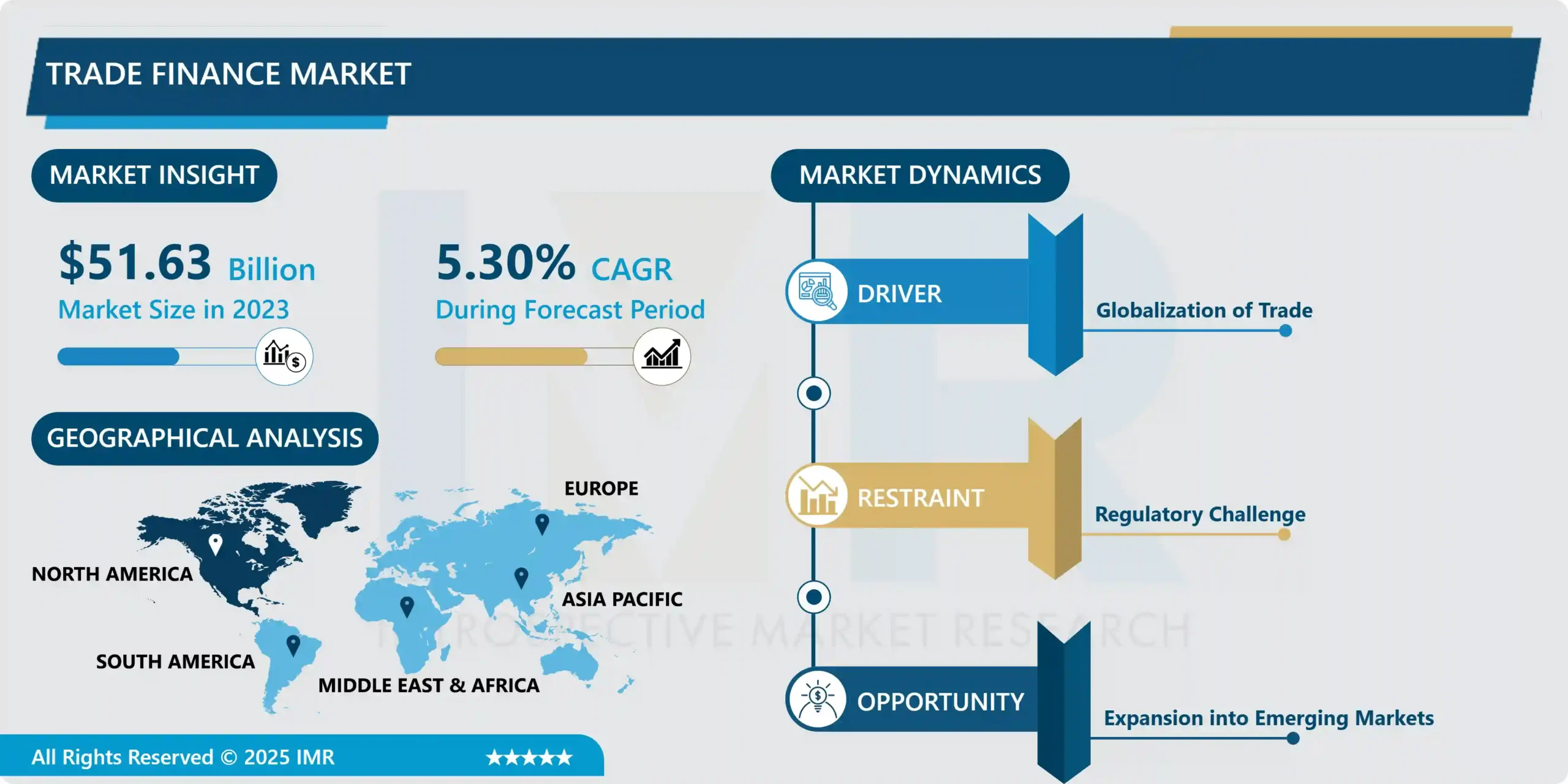
Trade Finance Market Size Was Valued at USD 51.63 Billion in 2023 and is Projected to Reach USD 82.18 Billion by 2032, Growing at a CAGR of 5.30% From 2024-2032.
Trade finance means the provision of finance or the products that help in rendering the foreign trade and business. It encompasses a number of services that assist in customers to promote payment for products and services imported as well as exported, insuring risks that may hamper business transactions and other escorts of import and export operations. These major instruments used in the trade finance include; letters of credit, insurance of trade credits, factoring and supply chain financing.
The Trade Finance Market is a platform that helps to manage the potential risks in international trade and offers financial tools for it. This market covers commodities of value, such as loans with letters of credit, trade credit risk, factoring, and supply chain finance. It is primarily used in addressing threats with regards to payment guarantees, exchange controls and political risk in the international business. Trade finance has also been on the rise as a result of the globalization of trade resulting in increased needs for efficient and secure trade finance solutions. One of the factors that is expected to fuel the Trade Finance Market is the current trend of rising volume of international trade globally which according to the different global trade bodies’ statistics is expected to cross $30 trillion by year 2025. This growth is attributed to such aspects as increased uses of the internet in conducting businesses and increase in the business of the world’s emerging markets and technology developments that enhance trade practices. Finally, there’s the shift to a digital environment, due to the increase in the adoption of blockchain and digital platforms by various financial institutions to improve on the level of transparency and cost of the transaction. In addition, regulatory update and efforts for increasing the availability of trade finance for SMEs are increasing rapidly, especially in developing nations. Thus, changes in the Trade Finance Market trends have just manifested themselves due to the shifts in customers’ expectations and technological advancements in industries.
Some of the market players include Banks, Fintech firms, Insurance companies and Logistics companies. Historically, trade finance has been concentrated with the traditional actors such as banks, however, there is an increasing wave of fintech players providing services in the field and thus revolutionizing this sector by increasing efficiency coupled with reducing the costs of accomplishes trade finance transaction. For instance, one can track the shipments, digital trade documents processing of many trade finance associated activities in real-time, which enhances trade finance experience of the businesses. In addition, cooperation between the banks and the fintech start-ups continues to advance more since they seek to leverage their individual offers and compete effectively when offering trade finance services.
An understandable characteristic of the Trade Finance Market is that in addition to growth and opportunities for companies, they have started to pay attention to sustainability and ethical approaches to financing. Thanks to the global warming awareness and carrying out adequate Corporate Social Responsibility, businessmen are now looking for trade fiances, which can be sustainable enough. Banks and other financial companies are now protecting themselves by creating green trade finance products which accommodate environmental sustainable projects. Not only does this trend help financial institutions establish a better image for themselves in the public eye but also a new crowd that actively focuses on environmentally friendly business models. Over time, more and more market players are going to have to embrace the aspects of sustainable market in conjunction with the other aspects of the market system, which is international trade. Therefore, the global trade finance market is in a TRANSFORMATIONAL phase that has been triggered by issues to do with globalization, technology, and sustainability. More demands are increasing in international trade, and customer needs for secure and faster transaction processing present promising and expanding opportunities for this industry. However, threats like regulatory hurdle, risk, and Digital Transformation has not been fully respond to take maximum advantages of these opportunities. With the constantly shifting global market environment the enhance cooperation between various players will be crucial in providing versatile innovative trade finance solutions that would fit the different needs of companies in global economy.
Trade Finance Market Trend Analysis
Digitization in Trade Finance
The other observable characteristic of the trade finance market which is trending is the increasing adoption of technology solutions in the delivery of financial services. Hitherto in traditional trade finance, there has been a lot of documentation, delayed processing of the financing request/applications and, secrecy. However, due to the integration of technology, there is a perceived move to digital processing of trade finance. Most of the firms in the financial industry are currently adopting innovative solutions that involve technology in various activities, especially in the preparation of documents to support the various transactions. This trend can only increase efficiency and help to better manage risks by gaining more insight into trade flows and documentation.
Besides, the advancement in the use of blockchain is also driving the change in trade finance by allowing safe and secure trade. Implementing of block chain base solution can significantly minimize probability of fraudulent activities and errors compare to traditional paper works. This paper has demonstrated that blockchain improves trust among international trade stakeholders by allowing direct communication between parties and maintaining the accuracy of transaction records. Considering that many market participants involved in trade finance continue to adopt digital solutions in their operations, the market should become more competitive and open in the long run, which should propel its development and innovatio.
Expansion into Emerging Markets
This is a developing market that offers a vast of opportunity for growth mainly in developing countries. For the countries in Asia, Africa and Latin America as they open up their economies for development, it becomes eritable to predict that their participation in the international markets will increase. The growth therefore comes from increased demand from the consumer front, increased ability of manufacturers and improved facilities. This means that there are great opportunities that financial institutions can support the financing of businesses based in these regions for export and import trade finance needs.
In addition, development in the global implementation of trade financial services also lead to trade finance providers opening new opportunities, such as the growing engagement of SMEs in the international marketplace. This is in regards to difficulties faced by SMEs in financing activities as traditional lenders take high risks and require collateral. As witnessed above, this means that establishing specialized products and services tailored to the SMEs requires in emerging markets is a sure bet for growth for banks and financial institutions. Such strategic focus on intestining support to SMEs in their trading endeavours can lead to better and sustainable economic orchestration for trade finance players.
Trade Finance Market Segment Analysis:
Trade Finance Market Segmented based on Instrument Type , Service Provider , Trade Type,Enterprise Size Industry, End User.
By Service Provider, Financial Institutions segment is expected to dominate the market during the forecast period
Property and casualty insurance market plays a crucial role in protecting societies and enterprises from some risks connected with property and liability. According to service provider, this market has major support on banking sectors which provide special insurance to cover almost all types of risks associated with property, car and other valuable things. Insurance is usually a partnership between the financial institution and insurance companies that offer policies and policies customized to specific needs such as disaster and theft and liability claims. It also enhances the confidence level and satisfaction of the customers, mainly because; the banks can provide the kind of service, which can adequately meet the financial needs and wants of customers.
Furthermore, trading houses play a key role of ensuring that insurance covers for commercial risks are available in the property and casualty insurance industry. These entities invest heavy amounts of money on transactions and where there is lack of adequate insurance cover they face serious losses. Risk assessment and affiliation with insurance bearing companies are the possibilities through which trading house can guarantee the necessity coverage with a view to minimizing the possible losses. Consequently, as property and casualty insurance becomes more popular, related service providers such as banks and trading companies will be critical to the provision of better risk management.
By End User, Trade intermediaries segment held the largest share in 2023
In the property and casualty insurance market, end users are categorized into importers, exporters, and trade intermediaries. Importers face unique risks related to the transportation and storage of goods, making them reliant on comprehensive insurance coverage to protect against potential losses due to damage, theft, or liability claims. Property and casualty insurance provides importers with peace of mind, ensuring that they can recover financially from unforeseen events. As global trade expands, the importance of effective insurance solutions for importers becomes even more pronounced, driving the demand for tailored policies that cater to their specific operational needs.
Exporters, on the other hand, encounter different challenges, including compliance with international regulations and risks associated with foreign markets. Insurance products that address political risks, credit risks, and transportation issues are essential for exporters to safeguard their financial interests. Trade intermediaries, such as freight forwarders and customs brokers, also require specialized insurance coverage to protect their operations and liabilities. By understanding the distinct needs of these end users, property and casualty insurance providers can develop targeted solutions that enhance risk management and facilitate smoother international trade operations.
Trade Finance Market Regional Insights:
North America is Expected to Dominate the Market Over the Forecast period
North American countries continue to occupy the largest TM share mainly due to prominent financial performers and strong economic climates. The United States being the largest economy in the world has a larger share in the international business thus have a higher request for trade finance products. Besides, the banking systems in the region are well developed, and the use of technology in carrying out trade finance is well enhanced. When influenced by the globalization, more North American businesses are venturing into regional and international markets and hence, the demand for trade finance products and services will increase further entrenching leadership of the region.
Furthermore, the existing legal requirements across North America promote the trade finance industry by providing specific legal conditions within which trade finance activities operate. North America is one of the most significant players in the global trading system so, the implementation of blockchain and other digital technologies in the framework of trade finance chain makes these procedures more effective and transparent. As firms engage in intricate world trade search for a variety of effective and sound trade finance products in North America shows the area as a key contender in the world trade finance market.
Active Key Players in the Trade Finance Market
HSBC Holdings plc (UK)
JPMorgan Chase & Co. (USA)
Deutsche Bank AG (Germany)
Citigroup Inc. (USA)
Standard Chartered plc (UK)
BNP Paribas S.A. (France)
Wells Fargo & Company (USA)
ING Group N.V. (Netherlands)
Barclays plc (UK)
Rabobank (Netherlands) Others Key Player
Key Industry Developments in the Trade Finance Market
In August 2023, India Exim Bank established a subsidiary in Gujarat International Finance Tec-City (GIFT City) to focus on trade financing. Initially, the subsidiary was slated to offer factoring services to Indian exporters. Factoring involves the sale of accounts receivable (invoices) to a third party, thereby providing immediate access to funds and supporting the short-term liquidity requirements of businesses. This move was aimed at enhancing the trade finance options of Indian exporters, promoting smoother cash flows and facilitating international trade activities.
Chapter 1: Introduction
1.1 Scope and Coverage
Chapter 2:Executive Summary
Chapter 3: Market Landscape
3.1 Market Dynamics
3.1.1 Drivers
3.1.2 Restraints
3.1.3 Opportunities
3.1.4 Challenges
3.2 Market Trend Analysis
3.3 PESTLE Analysis
3.4 Porter’s Five Forces Analysis
3.5 Industry Value Chain Analysis
3.6 Ecosystem
3.7 Regulatory Landscape
3.8 Price Trend Analysis
3.9 Patent Analysis
3.10 Technology Evolution
3.11 Investment Pockets
3.12 Import-Export Analysis
Chapter 4: Trade Finance Market by Instrument Type (2018-2032)
4.1 Trade Finance Market Snapshot and Growth Engine
4.2 Market Overview
4.3 Letter of Credit
4.3.1 Introduction and Market Overview
4.3.2 Historic and Forecasted Market Size in Value USD and Volume Units
4.3.3 Key Market Trends, Growth Factors, and Opportunities
4.3.4 Geographic Segmentation Analysis
4.4 Supply Chain Financing
4.5 Documentary Collections
4.6 Receivables Financing/Invoice Discounting
4.7 Others
Chapter 5: Trade Finance Market by Service Provider (2018-2032)
5.1 Trade Finance Market Snapshot and Growth Engine
5.2 Market Overview
5.3 Banks
5.3.1 Introduction and Market Overview
5.3.2 Historic and Forecasted Market Size in Value USD and Volume Units
5.3.3 Key Market Trends, Growth Factors, and Opportunities
5.3.4 Geographic Segmentation Analysis
5.4 Financial Institutions
5.5 Trading Houses
5.6 Others
Chapter 6: Trade Finance Market by Trade Type (2018-2032)
6.1 Trade Finance Market Snapshot and Growth Engine
6.2 Market Overview
6.3 Domestic
6.3.1 Introduction and Market Overview
6.3.2 Historic and Forecasted Market Size in Value USD and Volume Units
6.3.3 Key Market Trends, Growth Factors, and Opportunities
6.3.4 Geographic Segmentation Analysis
6.4 International
Chapter 7: Trade Finance Market by Enterprise Size (2018-2032)
7.1 Trade Finance Market Snapshot and Growth Engine
7.2 Market Overview
7.3 Large Enterprises
7.3.1 Introduction and Market Overview
7.3.2 Historic and Forecasted Market Size in Value USD and Volume Units
7.3.3 Key Market Trends, Growth Factors, and Opportunities
7.3.4 Geographic Segmentation Analysis
7.4 SMEs
Chapter 8: Trade Finance Market by Industry (2018-2032)
8.1 Trade Finance Market Snapshot and Growth Engine
8.2 Market Overview
8.3 BFSI
8.3.1 Introduction and Market Overview
8.3.2 Historic and Forecasted Market Size in Value USD and Volume Units
8.3.3 Key Market Trends, Growth Factors, and Opportunities
8.3.4 Geographic Segmentation Analysis
8.4 Construction
8.5 Wholesale/Retail
8.6 Manufacturing
8.7 Automobile
8.8 Shipping & Logistics
8.9 Others
Chapter 9: Trade Finance Market by End User (2018-2032)
9.1 Trade Finance Market Snapshot and Growth Engine
9.2 Market Overview
9.3 Importer
9.3.1 Introduction and Market Overview
9.3.2 Historic and Forecasted Market Size in Value USD and Volume Units
9.3.3 Key Market Trends, Growth Factors, and Opportunities
9.3.4 Geographic Segmentation Analysis
9.4 Exporter
9.5 Trade Intermediaries
Chapter 10: Company Profiles and Competitive Analysis
10.1 Competitive Landscape
10.1.1 Competitive Benchmarking
10.1.2 Trade Finance Market Share by Manufacturer (2024)
10.1.3 Industry BCG Matrix
10.1.4 Heat Map Analysis
10.1.5 Mergers and Acquisitions
10.2 HSBC HOLDINGS PLC (UK)
10.2.1 Company Overview
10.2.2 Key Executives
10.2.3 Company Snapshot
10.2.4 Role of the Company in the Market
10.2.5 Sustainability and Social Responsibility
10.2.6 Operating Business Segments
10.2.7 Product Portfolio
10.2.8 Business Performance
10.2.9 Key Strategic Moves and Recent Developments
10.2.10 SWOT Analysis
10.3 JPMORGAN CHASE & CO. (USA)
10.4 DEUTSCHE BANK AG (GERMANY)
10.5 CITIGROUP INC. (USA)
10.6 STANDARD CHARTERED PLC (UK)
10.7 BNP PARIBAS S.A. (FRANCE)
10.8 WELLS FARGO & COMPANY (USA)
10.9 ING GROUP N.V. (NETHERLANDS)
10.10 BARCLAYS PLC (UK)
10.11 RABOBANK (NETHERLANDS)
10.12 OTHERS KEY PLAYER
Chapter 11: Global Trade Finance Market By Region
11.1 Overview
11.2. North America Trade Finance Market
11.2.1 Key Market Trends, Growth Factors and Opportunities
11.2.2 Top Key Companies
11.2.3 Historic and Forecasted Market Size by Segments
11.2.4 Historic and Forecasted Market Size by Instrument Type
11.2.4.1 Letter of Credit
11.2.4.2 Supply Chain Financing
11.2.4.3 Documentary Collections
11.2.4.4 Receivables Financing/Invoice Discounting
11.2.4.5 Others
11.2.5 Historic and Forecasted Market Size by Service Provider
11.2.5.1 Banks
11.2.5.2 Financial Institutions
11.2.5.3 Trading Houses
11.2.5.4 Others
11.2.6 Historic and Forecasted Market Size by Trade Type
11.2.6.1 Domestic
11.2.6.2 International
11.2.7 Historic and Forecasted Market Size by Enterprise Size
11.2.7.1 Large Enterprises
11.2.7.2 SMEs
11.2.8 Historic and Forecasted Market Size by Industry
11.2.8.1 BFSI
11.2.8.2 Construction
11.2.8.3 Wholesale/Retail
11.2.8.4 Manufacturing
11.2.8.5 Automobile
11.2.8.6 Shipping & Logistics
11.2.8.7 Others
11.2.9 Historic and Forecasted Market Size by End User
11.2.9.1 Importer
11.2.9.2 Exporter
11.2.9.3 Trade Intermediaries
11.2.10 Historic and Forecast Market Size by Country
11.2.10.1 US
11.2.10.2 Canada
11.2.10.3 Mexico
11.3. Eastern Europe Trade Finance Market
11.3.1 Key Market Trends, Growth Factors and Opportunities
11.3.2 Top Key Companies
11.3.3 Historic and Forecasted Market Size by Segments
11.3.4 Historic and Forecasted Market Size by Instrument Type
11.3.4.1 Letter of Credit
11.3.4.2 Supply Chain Financing
11.3.4.3 Documentary Collections
11.3.4.4 Receivables Financing/Invoice Discounting
11.3.4.5 Others
11.3.5 Historic and Forecasted Market Size by Service Provider
11.3.5.1 Banks
11.3.5.2 Financial Institutions
11.3.5.3 Trading Houses
11.3.5.4 Others
11.3.6 Historic and Forecasted Market Size by Trade Type
11.3.6.1 Domestic
11.3.6.2 International
11.3.7 Historic and Forecasted Market Size by Enterprise Size
11.3.7.1 Large Enterprises
11.3.7.2 SMEs
11.3.8 Historic and Forecasted Market Size by Industry
11.3.8.1 BFSI
11.3.8.2 Construction
11.3.8.3 Wholesale/Retail
11.3.8.4 Manufacturing
11.3.8.5 Automobile
11.3.8.6 Shipping & Logistics
11.3.8.7 Others
11.3.9 Historic and Forecasted Market Size by End User
11.3.9.1 Importer
11.3.9.2 Exporter
11.3.9.3 Trade Intermediaries
11.3.10 Historic and Forecast Market Size by Country
11.3.10.1 Russia
11.3.10.2 Bulgaria
11.3.10.3 The Czech Republic
11.3.10.4 Hungary
11.3.10.5 Poland
11.3.10.6 Romania
11.3.10.7 Rest of Eastern Europe
11.4. Western Europe Trade Finance Market
11.4.1 Key Market Trends, Growth Factors and Opportunities
11.4.2 Top Key Companies
11.4.3 Historic and Forecasted Market Size by Segments
11.4.4 Historic and Forecasted Market Size by Instrument Type
11.4.4.1 Letter of Credit
11.4.4.2 Supply Chain Financing
11.4.4.3 Documentary Collections
11.4.4.4 Receivables Financing/Invoice Discounting
11.4.4.5 Others
11.4.5 Historic and Forecasted Market Size by Service Provider
11.4.5.1 Banks
11.4.5.2 Financial Institutions
11.4.5.3 Trading Houses
11.4.5.4 Others
11.4.6 Historic and Forecasted Market Size by Trade Type
11.4.6.1 Domestic
11.4.6.2 International
11.4.7 Historic and Forecasted Market Size by Enterprise Size
11.4.7.1 Large Enterprises
11.4.7.2 SMEs
11.4.8 Historic and Forecasted Market Size by Industry
11.4.8.1 BFSI
11.4.8.2 Construction
11.4.8.3 Wholesale/Retail
11.4.8.4 Manufacturing
11.4.8.5 Automobile
11.4.8.6 Shipping & Logistics
11.4.8.7 Others
11.4.9 Historic and Forecasted Market Size by End User
11.4.9.1 Importer
11.4.9.2 Exporter
11.4.9.3 Trade Intermediaries
11.4.10 Historic and Forecast Market Size by Country
11.4.10.1 Germany
11.4.10.2 UK
11.4.10.3 France
11.4.10.4 The Netherlands
11.4.10.5 Italy
11.4.10.6 Spain
11.4.10.7 Rest of Western Europe
11.5. Asia Pacific Trade Finance Market
11.5.1 Key Market Trends, Growth Factors and Opportunities
11.5.2 Top Key Companies
11.5.3 Historic and Forecasted Market Size by Segments
11.5.4 Historic and Forecasted Market Size by Instrument Type
11.5.4.1 Letter of Credit
11.5.4.2 Supply Chain Financing
11.5.4.3 Documentary Collections
11.5.4.4 Receivables Financing/Invoice Discounting
11.5.4.5 Others
11.5.5 Historic and Forecasted Market Size by Service Provider
11.5.5.1 Banks
11.5.5.2 Financial Institutions
11.5.5.3 Trading Houses
11.5.5.4 Others
11.5.6 Historic and Forecasted Market Size by Trade Type
11.5.6.1 Domestic
11.5.6.2 International
11.5.7 Historic and Forecasted Market Size by Enterprise Size
11.5.7.1 Large Enterprises
11.5.7.2 SMEs
11.5.8 Historic and Forecasted Market Size by Industry
11.5.8.1 BFSI
11.5.8.2 Construction
11.5.8.3 Wholesale/Retail
11.5.8.4 Manufacturing
11.5.8.5 Automobile
11.5.8.6 Shipping & Logistics
11.5.8.7 Others
11.5.9 Historic and Forecasted Market Size by End User
11.5.9.1 Importer
11.5.9.2 Exporter
11.5.9.3 Trade Intermediaries
11.5.10 Historic and Forecast Market Size by Country
11.5.10.1 China
11.5.10.2 India
11.5.10.3 Japan
11.5.10.4 South Korea
11.5.10.5 Malaysia
11.5.10.6 Thailand
11.5.10.7 Vietnam
11.5.10.8 The Philippines
11.5.10.9 Australia
11.5.10.10 New Zealand
11.5.10.11 Rest of APAC
11.6. Middle East & Africa Trade Finance Market
11.6.1 Key Market Trends, Growth Factors and Opportunities
11.6.2 Top Key Companies
11.6.3 Historic and Forecasted Market Size by Segments
11.6.4 Historic and Forecasted Market Size by Instrument Type
11.6.4.1 Letter of Credit
11.6.4.2 Supply Chain Financing
11.6.4.3 Documentary Collections
11.6.4.4 Receivables Financing/Invoice Discounting
11.6.4.5 Others
11.6.5 Historic and Forecasted Market Size by Service Provider
11.6.5.1 Banks
11.6.5.2 Financial Institutions
11.6.5.3 Trading Houses
11.6.5.4 Others
11.6.6 Historic and Forecasted Market Size by Trade Type
11.6.6.1 Domestic
11.6.6.2 International
11.6.7 Historic and Forecasted Market Size by Enterprise Size
11.6.7.1 Large Enterprises
11.6.7.2 SMEs
11.6.8 Historic and Forecasted Market Size by Industry
11.6.8.1 BFSI
11.6.8.2 Construction
11.6.8.3 Wholesale/Retail
11.6.8.4 Manufacturing
11.6.8.5 Automobile
11.6.8.6 Shipping & Logistics
11.6.8.7 Others
11.6.9 Historic and Forecasted Market Size by End User
11.6.9.1 Importer
11.6.9.2 Exporter
11.6.9.3 Trade Intermediaries
11.6.10 Historic and Forecast Market Size by Country
11.6.10.1 Turkiye
11.6.10.2 Bahrain
11.6.10.3 Kuwait
11.6.10.4 Saudi Arabia
11.6.10.5 Qatar
11.6.10.6 UAE
11.6.10.7 Israel
11.6.10.8 South Africa
11.7. South America Trade Finance Market
11.7.1 Key Market Trends, Growth Factors and Opportunities
11.7.2 Top Key Companies
11.7.3 Historic and Forecasted Market Size by Segments
11.7.4 Historic and Forecasted Market Size by Instrument Type
11.7.4.1 Letter of Credit
11.7.4.2 Supply Chain Financing
11.7.4.3 Documentary Collections
11.7.4.4 Receivables Financing/Invoice Discounting
11.7.4.5 Others
11.7.5 Historic and Forecasted Market Size by Service Provider
11.7.5.1 Banks
11.7.5.2 Financial Institutions
11.7.5.3 Trading Houses
11.7.5.4 Others
11.7.6 Historic and Forecasted Market Size by Trade Type
11.7.6.1 Domestic
11.7.6.2 International
11.7.7 Historic and Forecasted Market Size by Enterprise Size
11.7.7.1 Large Enterprises
11.7.7.2 SMEs
11.7.8 Historic and Forecasted Market Size by Industry
11.7.8.1 BFSI
11.7.8.2 Construction
11.7.8.3 Wholesale/Retail
11.7.8.4 Manufacturing
11.7.8.5 Automobile
11.7.8.6 Shipping & Logistics
11.7.8.7 Others
11.7.9 Historic and Forecasted Market Size by End User
11.7.9.1 Importer
11.7.9.2 Exporter
11.7.9.3 Trade Intermediaries
11.7.10 Historic and Forecast Market Size by Country
11.7.10.1 Brazil
11.7.10.2 Argentina
11.7.10.3 Rest of SA
Chapter 12 Analyst Viewpoint and Conclusion
12.1 Recommendations and Concluding Analysis
12.2 Potential Market Strategies
Chapter 13 Research Methodology
13.1 Research Process
13.2 Primary Research
13.3 Secondary Research
Q1: What would be the forecast period in the Trade Finance Market research report?
A1: The forecast period in the Trade Finance Market research report is 2024-2032.
Q2: Who are the key players in the Trade Finance Market?
A2: HSBC Holdings plc (UK),JPMorgan Chase & Co. (USA),Deutsche Bank AG (Germany),Citigroup Inc. (USA),Standard Chartered plc (UK),BNP Paribas S.A. (France),Wells Fargo & Company (USA),and Other Major Players.
Q3: What are the segments of the Trade Finance Market?
A3: The Trade Finance Market is segmented into Instrument Type , Service Provider , Trade Type,Enterprise Size ,Industry,End User and Region. By Instrument Type , the market is categorized into Letter of Credit,Supply Chain Financing,Documentary Collections,Receivables Financing/Invoice Discounting,Others. By Service Provider , the market is categorized into Banks,Financial Institutions,Trading Houses,Others. By Trade Type , the market is categorized into Domestic,International. By Enterprise Size , the market is categorized into Large Enterprises,SMEs. By Industry, the market is categorized into BFSI, Construction, Wholesale/Retail, Manufacturing, Automobile,Shipping & Logistics, Others. By End User, the market is categorized into Importer,Exporter,Trade Intermediaries. By region, it is analyzed across North America (U.S.; Canada; Mexico), Europe (Germany; U.K.; France; Italy; Russia; Spain, etc.), Asia-Pacific (China; India; Japan; Southeast Asia, etc.), South America (Brazil; Argentina, etc.), Middle East & Africa (Saudi Arabia; South Africa, etc.).
Q4: What is the Trade Finance Market?
A4: Trade finance means the provision of finance or the products that help in rendering the foreign trade and business. It encompasses a number of services that assist in customers to promote payment for products and services imported as well as exported, insuring risks that may hamper business transactions and other escorts of import and export operations. These major instruments used in the trade finance include; letters of credit, insurance of trade credits, factoring and supply chain financing.
Q5: How big is the Trade Finance Market?
A5: Trade Finance Market Size Was Valued at USD 51.63 Billion in 2023, and is Projected to Reach USD 82.18 Billion by 2032, Growing at a CAGR of 5.30% From 2024-2032.
How to Buy a Report from eminsights.jp
On the product page, choose the license you want: Single-User License, Multi-User License or Enterprise License.
If you required report in your native language, then you can click on Translated Report button and fill out the form with report name and language you want, then our team will contact you as soon as possible.
Click the Buy Now button.
You will be redirected to the checkout page. Enter your company details and payment information.
Click Place Order to complete the purchase.
Confirmation: You’ll receive an order confirmation and our team will contact you shortly with your ordered report.
If you have any questions, fill out the contact form below or email us at [email protected].
Thank you for choosing eminsights.jp!