Stay Ahead in Fast-Growing Economies.
Browse Reports Now




Agave Nectar Market – Comprehensive Study Report And Trends
Agave syrup (AS), also referred to as agave nectar, is a recently developed (post-1990) food product made from agave plant sap, particularly Agave salmiana and Agave tequilana, that is, salmiana and blue agave, respectively. Given its low glycaemic index and vegan status, this product has become popular as a substitute for traditional sweeteners such as table sugar (sucrose) and honey. Fructan hydrolysis produces this natural sweetener. Nectar, which comes as fructans from agave cores (piñas in Spanish), is a principal carbohydrate reserve of agave plants.

IMR Group
Description
Agave Nectar Market Synopsis
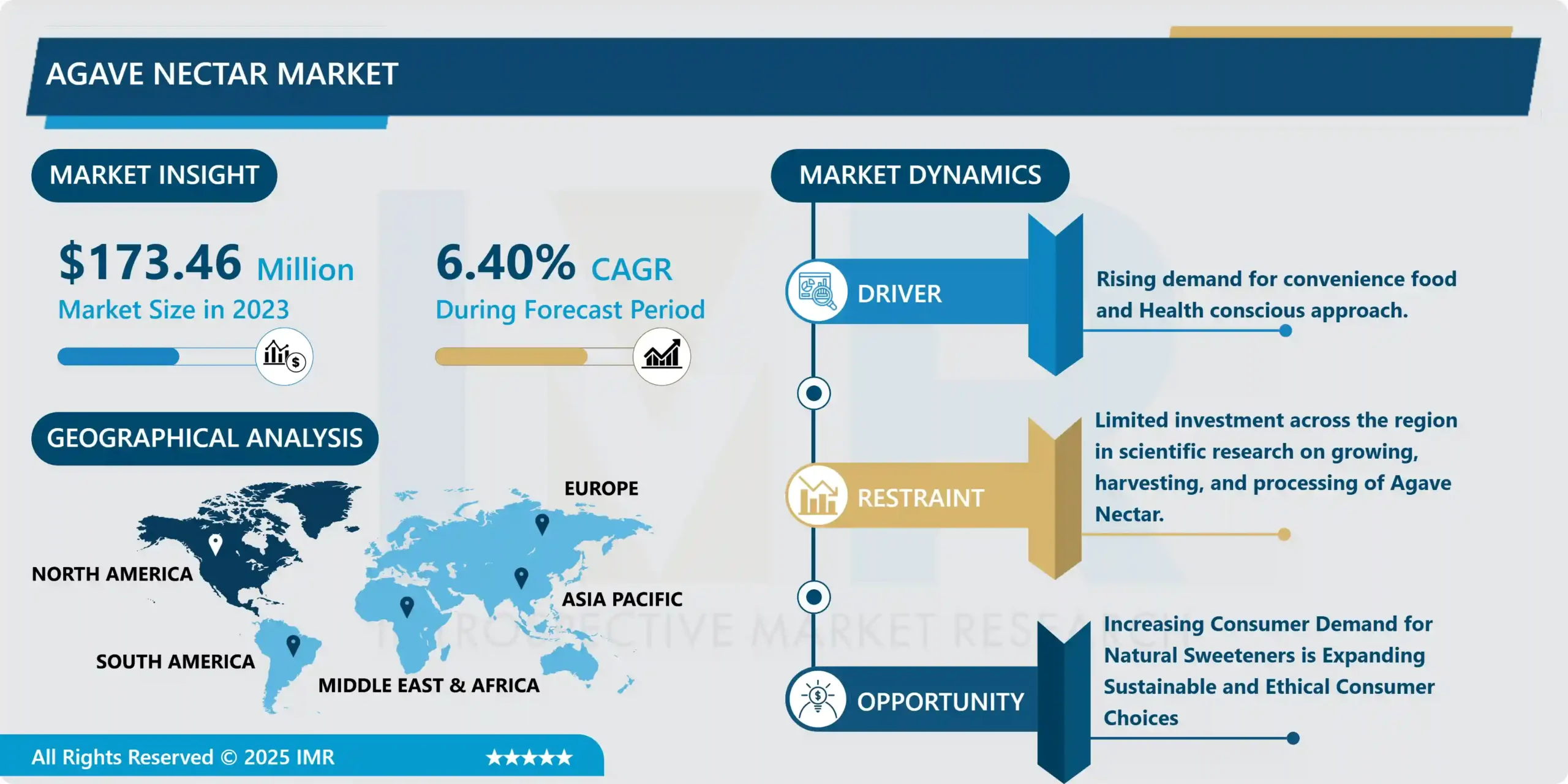
Agave Nectar Market Size Was Valued at USD 173.46 Million in 2023 and is Projected to Reach 303.16 Million by 2032, Growing at a CAGR of 6.4% From 2024-2032.
Agave syrup (AS), also referred to as agave nectar, is a recently developed (post-1990) food product made from agave plant sap, particularly Agave salmiana and Agave tequilana, that is, salmiana and blue agave, respectively. Given its low glycaemic index and vegan status, this product has become popular as a substitute for traditional sweeteners such as table sugar (sucrose) and honey. Fructan hydrolysis produces this natural sweetener. Nectar, which comes as fructans from agave cores (piñas in Spanish), is a principal carbohydrate reserve of agave plants. Grown in arid and semi-arid environments, the Agave genus applies photosynthetic adaptation and a crassulacean acid metabolism to the periodic water supply. Such plants prevail in Central and Northern America, but a large proportion of the species (about 55%) are located in Mexico, believed to be the center of agave’s diversity and origin. Both the consumption and socio-economic impacts of agave originate from pre-Columbian times, given its high sugar content.
Nowadays, consumers are increasingly becoming familiar with natural ingredients, and the growing prominence of naturalness for consumers has had significant repercussions for the food industry. It is feasible that consumers in most countries may reject food products that are not perceived as natural. In recent decades, demand for naturally derived sweeteners has exploded. Based on these premises, this review aims to study the nutritional pro?le and health impacts of AS consumption, its possible applications in the food industry and sustainability issues, as well as its central safety and quality parameters, including the chemical analysis of its main components.
Agave Nectar Market Trend Analysis
High-density sweeteners in the recently emerging trend
Agave syrup (AS) has recently gained popularity in the market for healthy, organic, functional, and diabetic foods. This trend is due to its natural origin and putative nutraceutical properties. However, the use of AS can be questioned regarding its elevated fructose concentration and its adverse effects on human health, rendering it similar to high-fructose corn syrup. This critical review aims to provide a broad overview of recent scientific research related to AS applications in the food industry and its health effects in consumers. According to the reviewed information, the manufacturing process employed to obtain AS affects its physicochemical and functional properties; therefore, the process variables need to be properly controlled.
The global market for non-sugar sweeteners was estimated at USD 9.2 billion in 20101 and is forecasted to reach over USD 14 billion by 20202. High-intensity sweeteners (HIS) are widely used in food and beverages. Initially driven by diet soft drinks, this segment was valued at USD 1.22 billion in 2014 (equivalent to the sweetening power of 16 million MT of sugar). Artificial HIS (acesulfame-K, aspartame, cyclamate, neotame, saccharin, sucralose) dominate the HIS segment (>70%) and are much cheaper than natural options. However, natural HIS are expected to register the fastest growth in the HIS segment. The shift towards stevia, licorice root extract, and monk fruit extract is driven by growing health concerns around artificial sweeteners. Other natural sugar substitutes include corn syrup, Agave Nectar, honey, maple syrup, Agave Nectar, etc.
Opportunity
Increasing Consumer Demand for Natural Sweeteners is Expanding Sustainable and Ethical Consumer Choices
The demand to reduce sugar in food products is a probable consequence of the alarming increase in global health problems, such as dental cavities, overweight, obesity, and comorbidities such as type 2 diabetes, hypertension, and cancer (Deliza et al., 2021). To deal with these pathologies, some governments (e.g. the UK) had previously adopted public health policies, which include more strict food-labeling guidelines and higher taxes on sugar-rich products (Erickson & Carr, 2020). However, as a result of the recent association of these diseases of civilization with the severity of COVID-19, for which the number of deaths worldwide has exceeded several millions of people (World Health Organization, 2022), even more, governments worldwide have now developed public health initiatives and programs aimed to reduce and reformulate the sugar content in foods.
To achieve this, viable alternative sweeteners still need to be discovered and thoroughly investigated. In the last years, agave syrup (AS), also known as agave sap concentrate or agave nectar concentrate (Gonzalez-Montemayor ´ et al., 2019; Santos-Zea, Rosas-P´erez, Leal-Díaz, & Guti´errez-Uribe, 2016), has gained popularity in the market for healthy, organic, and functional foods due to its natural origin, putative nutraceutical properties, and low glycemic index. There is an increasing public awareness about the potential health impacts of added sugars in foods. This has led to a growing interest in “plant-derived, natural low-calorie or zero-calorie sweeteners”.
Low-calorie sweeteners like saccharine, cyclamates, aspartame, and acesulfame K became popular in the 1980s. However, such synthetic sweeteners have been embroiled in controversies and conflicts as well including allegations of serious health dangers like bladder and liver toxicity, fetus malformation, carcinogenicity, etc. Even though investigations have shown that these sweeteners are generally harmless, there has still been a certain amount of consumer mistrust. As a result, some laws forbid the use of specific artificial sweeteners. Moreover, customers believe that naturalness is good for food as a whole. A survey of consumers has consistently shown that they have an increasing awareness of food additives and most often choose natural additives over artificial alternatives. Therefore, it may be inferred that natural sweeteners will be positively accepted by consumers as long as they have a sufficient level of hedonic appeal. The key opportunity is the increasing demand for natural and organic products.
Agave Nectar Market Segment Analysis:
The Agave Nectar Market is Segmented based on Type, Application, nature, function, source, form, distribution channel, and region.
By Form, Liquid Segment Is Expected To Dominate The Market During The Forecast Period
During the study period, the liquid sector had the highest market share. Agave nectar, which is in a liquid form, is convenient and easy to use in many cooking uses. Because of its ability to pour easily, it can be effortlessly and promptly incorporated into foods, beverages, and other items without requiring any extra preparation. The versatility of liquid agave nectar allows for a range of different applications. It can top pancakes and sweets, sweeten smoothies and tea, be an ingredient in sauces, dressings, and baked goods, and be used as a sweetener. Additionally, the fluid consistency of agave nectar allows it to blend smoothly with other components, ensuring an even spread of sweetness in the dish or drink. Liquid agave nectar fulfills the need for a natural, healthier option to refined sugars, leading to a predicted rise in market demand.
Liquid form is a natural sweetener derived from the agave plant. A notable trend in the Agave Nectar Market is the rising popularity of liquid agave nectar due to its easy pourability and suitability for beverages, dressings, and baking. Consumers appreciate its low glycemic index and its use in diverse culinary applications.
By Type, Light Segment Held The Largest Share In 2023
The light agave nectar market is growing rapidly due to the rising health awareness of consumers. As individuals look for healthier options to regular sweeteners such as refined sugar, light agave nectar has become more popular because of its lower glycemic index and less pronounced effect on blood sugar levels when compared to dark agave nectar. This variety of agave nectar is less processed as well, fitting with the increasing consumer desire for natural and minimally processed items.
Light agave nectar’s mild taste and versatility make it ideal for various culinary uses such as drinks, baking, and cooking, without drastically changing the flavor of the food. Manufacturers in the food and beverage industry are increasingly drawn to its flexibility to meet the growing interest in healthier and natural ingredients, which is boosting its popularity.
Known for its delicate sweetness and mild flavor, light agave nectar is a top choice for health-conscious individuals seeking natural alternatives to processed sugars and artificial sweeteners. Its popularity is further increased by its lower glycemic index and perceived health benefits, which align with current dietary preferences and wellness trends. As a result, the demand for light agave nectar is predicted to keep rising due to its alignment with consumers’ preference for healthier, more natural sweetening choices. Overall, the increasing focus on health and the desire for natural, minimally processed items are driving the popularity of light agave nectar, leading to its widespread use in cooking and ensuring continued market growth.
Agave Nectar Market Regional Insights:
North America is Expected to Dominate the Market Over the Forecast Period in 2023
The North American region has captured a sizable portion of the agave nectar market, fueled by an increasing inclination towards natural ingredients instead of conventional processed sugars. This trend is especially potent in the United States, projected to secure more than 80% of the market revenue. The Mexican government and producers of agave syrup (AS) have put in place rules to make sure that only ingredients derived from agave are utilized in the making of commercial AS, boosting its genuineness and attractiveness. The high mineral, vitamin, and polyphenol content of agave nectar makes it a better choice than traditional sweeteners in terms of nutrition. The market’s growth is being increased by the existence of large producers in the area. Efforts by the government to safeguard and enhance the utilization of agave nectar are creating fresh avenues for expansion.
Increased awareness about health and changing eating habits in North America have greatly increased the demand for agave nectar. Consumers value its flexibility, reduced glycemic index, and believed health advantages. Its flexibility in different culinary uses, such as in craft drinks and pastries, fits nicely with the varied food tastes of the area. The market dominance of agave nectar is underscored by its easy access in supermarkets, health food stores, and online platforms. The increasing popularity is also fueled by the clean-label and organic product trends. Agave nectar remains a top choice for North American consumers looking for natural sweeteners due to its flexibility and health advantages in various food and drink uses.
Agave Nectar Market Top Key Players:
ARIZONA: Beverages USA LLC (USA)
Best Ground International (USA)
Ciranda Inc. (USA)
Domino Foods Inc. (USA)
Florida Crystals Corporation (USA)
Global Organics (USA)
GLOBAL GOODS INC. (USA)
Hain Daniels Group (USA)
MADHAVA LTD. (USA)
Madhava Natural Sweeteners (USA)
Malt Products Corporation (USA)
Natura Bio Foods (USA)
Nature’s Agave, Inc. (USA)
NOW Foods (USA)
NOW Health Group, INC. (USA)
Sisana Sweeteners (USA)
SunOpta, Inc. (USA)
SWEEET (USA)
The Agave Sweetener Company (USA)
The Colibree Company Inc. (USA)
The Simple Syrup Co. (USA)
The Tierra Group (USA)
Wholesome Sweeteners Inc. (USA)
Wildly Organic by Wilderness Family Naturals (USA)
Loving Earth Pty Ltd. (Australia)
Maretai Organics Australia (Australia)
NATURAL SUBSTITUTE DE MEXICO, S.A. DE C.V. (Mexico)
Naturalever de México (Mexico)
Chapter 1: Introduction
1.1 Scope and Coverage
Chapter 2:Executive Summary
Chapter 3: Market Landscape
3.1 Market Dynamics
3.1.1 Drivers
3.1.2 Restraints
3.1.3 Opportunities
3.1.4 Challenges
3.2 Market Trend Analysis
3.3 PESTLE Analysis
3.4 Porter’s Five Forces Analysis
3.5 Industry Value Chain Analysis
3.6 Ecosystem
3.7 Regulatory Landscape
3.8 Price Trend Analysis
3.9 Patent Analysis
3.10 Technology Evolution
3.11 Investment Pockets
3.12 Import-Export Analysis
Chapter 4: Agave Nectar Market by Type (2018-2032)
4.1 Agave Nectar Market Snapshot and Growth Engine
4.2 Market Overview
4.3 Light
4.3.1 Introduction and Market Overview
4.3.2 Historic and Forecasted Market Size in Value USD and Volume Units
4.3.3 Key Market Trends, Growth Factors, and Opportunities
4.3.4 Geographic Segmentation Analysis
4.4 Amer
4.5 Dark
4.6 Raw
Chapter 5: Agave Nectar Market by Nature (2018-2032)
5.1 Agave Nectar Market Snapshot and Growth Engine
5.2 Market Overview
5.3 Conventional
5.3.1 Introduction and Market Overview
5.3.2 Historic and Forecasted Market Size in Value USD and Volume Units
5.3.3 Key Market Trends, Growth Factors, and Opportunities
5.3.4 Geographic Segmentation Analysis
5.4 Organic
Chapter 6: Agave Nectar Market by Form (2018-2032)
6.1 Agave Nectar Market Snapshot and Growth Engine
6.2 Market Overview
6.3 Powder
6.3.1 Introduction and Market Overview
6.3.2 Historic and Forecasted Market Size in Value USD and Volume Units
6.3.3 Key Market Trends, Growth Factors, and Opportunities
6.3.4 Geographic Segmentation Analysis
6.4 Liquid
Chapter 7: Agave Nectar Market by Function (2018-2032)
7.1 Agave Nectar Market Snapshot and Growth Engine
7.2 Market Overview
7.3 Emulsifier
7.3.1 Introduction and Market Overview
7.3.2 Historic and Forecasted Market Size in Value USD and Volume Units
7.3.3 Key Market Trends, Growth Factors, and Opportunities
7.3.4 Geographic Segmentation Analysis
7.4 Sweetener
7.5 Flavor Enhancer
Chapter 8: Agave Nectar Market by Application (2018-2032)
8.1 Agave Nectar Market Snapshot and Growth Engine
8.2 Market Overview
8.3 Sweeting Beverages
8.3.1 Introduction and Market Overview
8.3.2 Historic and Forecasted Market Size in Value USD and Volume Units
8.3.3 Key Market Trends, Growth Factors, and Opportunities
8.3.4 Geographic Segmentation Analysis
8.4 Baking
8.5 Desserts
8.6 Sauces & Dressing
Chapter 9: Agave Nectar Market by Source (2018-2032)
9.1 Agave Nectar Market Snapshot and Growth Engine
9.2 Market Overview
9.3 Blue Agave
9.3.1 Introduction and Market Overview
9.3.2 Historic and Forecasted Market Size in Value USD and Volume Units
9.3.3 Key Market Trends, Growth Factors, and Opportunities
9.3.4 Geographic Segmentation Analysis
9.4 Salamiana Agave
Chapter 10: Company Profiles and Competitive Analysis
10.1 Competitive Landscape
10.1.1 Competitive Benchmarking
10.1.2 Agave Nectar Market Share by Manufacturer (2024)
10.1.3 Industry BCG Matrix
10.1.4 Heat Map Analysis
10.1.5 Mergers and Acquisitions
10.2 ARIZONA BEVERAGES USA LLC (USA)
10.2.1 Company Overview
10.2.2 Key Executives
10.2.3 Company Snapshot
10.2.4 Role of the Company in the Market
10.2.5 Sustainability and Social Responsibility
10.2.6 Operating Business Segments
10.2.7 Product Portfolio
10.2.8 Business Performance
10.2.9 Key Strategic Moves and Recent Developments
10.2.10 SWOT Analysis
10.3 BEST GROUND INTERNATIONAL (USA)
10.4 CIRANDA INC. (USA)
10.5 DOMINO FOODS INC. (USA)
10.6 FLORIDA CRYSTALS CORPORATION (USA)
10.7 GLOBAL ORGANICS (USA)
10.8 GLOBAL GOODS INC. (USA)
10.9 HAIN DANIELS GROUP (USA)
10.10 MADHAVA LTD. (USA)
10.11 MADHAVA NATURAL SWEETENERS (USA)
10.12 MALT PRODUCTS CORPORATION (USA)
10.13 NATURA BIO FOODS (USA)
10.14 NATURE’S AGAVE INC. (USA)
10.15 NOW FOODS (USA)
10.16 NOW HEALTH GROUP INC. (USA)
10.17 SISANA SWEETENERS (USA)
10.18 SUNOPTA INC. (USA)
10.19 SWEEET (USA)
10.20 THE AGAVE SWEETENER COMPANY (USA)
10.21 THE COLIBREE COMPANY INC. (USA)
10.22 THE SIMPLE SYRUP CO. (USA)
10.23 THE TIERRA GROUP (USA)
10.24 WHOLESOME SWEETENERS INC. (USA)
10.25 WILDLY ORGANIC BY WILDERNESS FAMILY NATURALS (USA)
10.26 LOVING EARTH PTY LTD. (AUSTRALIA)
10.27 MARETAI ORGANICS AUSTRALIA (AUSTRALIA)
10.28 NATURAL SUBSTITUTE DE MEXICO
10.29 S.A. DE C.V. (MEXICO)
10.30 NATURALEVER DE MÉXICO (MEXICO)
10.31 NEKUTLI AGAVE NECTAR (MEXICO)
10.32 THE IIDEA COMPANY (MEXICO)
10.33 DANDY LIONS LTD. (UK)
10.34 GROOVY FOOD COMPANY LTD. (UK)
10.35 PURA FOODS LTD. (UK)
10.36 THE GROOVY FOOD COMPANY (UK)
10.37 DIPASA USA (CANADA)
10.38 S.F.D (PTY) LTD. (SOUTH AFRICA) OTHERS ARE MAJOR PLAYERS.
Chapter 11: Global Agave Nectar Market By Region
11.1 Overview
11.2. North America Agave Nectar Market
11.2.1 Key Market Trends, Growth Factors and Opportunities
11.2.2 Top Key Companies
11.2.3 Historic and Forecasted Market Size by Segments
11.2.4 Historic and Forecasted Market Size by Type
11.2.4.1 Light
11.2.4.2 Amer
11.2.4.3 Dark
11.2.4.4 Raw
11.2.5 Historic and Forecasted Market Size by Nature
11.2.5.1 Conventional
11.2.5.2 Organic
11.2.6 Historic and Forecasted Market Size by Form
11.2.6.1 Powder
11.2.6.2 Liquid
11.2.7 Historic and Forecasted Market Size by Function
11.2.7.1 Emulsifier
11.2.7.2 Sweetener
11.2.7.3 Flavor Enhancer
11.2.8 Historic and Forecasted Market Size by Application
11.2.8.1 Sweeting Beverages
11.2.8.2 Baking
11.2.8.3 Desserts
11.2.8.4 Sauces & Dressing
11.2.9 Historic and Forecasted Market Size by Source
11.2.9.1 Blue Agave
11.2.9.2 Salamiana Agave
11.2.10 Historic and Forecast Market Size by Country
11.2.10.1 US
11.2.10.2 Canada
11.2.10.3 Mexico
11.3. Eastern Europe Agave Nectar Market
11.3.1 Key Market Trends, Growth Factors and Opportunities
11.3.2 Top Key Companies
11.3.3 Historic and Forecasted Market Size by Segments
11.3.4 Historic and Forecasted Market Size by Type
11.3.4.1 Light
11.3.4.2 Amer
11.3.4.3 Dark
11.3.4.4 Raw
11.3.5 Historic and Forecasted Market Size by Nature
11.3.5.1 Conventional
11.3.5.2 Organic
11.3.6 Historic and Forecasted Market Size by Form
11.3.6.1 Powder
11.3.6.2 Liquid
11.3.7 Historic and Forecasted Market Size by Function
11.3.7.1 Emulsifier
11.3.7.2 Sweetener
11.3.7.3 Flavor Enhancer
11.3.8 Historic and Forecasted Market Size by Application
11.3.8.1 Sweeting Beverages
11.3.8.2 Baking
11.3.8.3 Desserts
11.3.8.4 Sauces & Dressing
11.3.9 Historic and Forecasted Market Size by Source
11.3.9.1 Blue Agave
11.3.9.2 Salamiana Agave
11.3.10 Historic and Forecast Market Size by Country
11.3.10.1 Russia
11.3.10.2 Bulgaria
11.3.10.3 The Czech Republic
11.3.10.4 Hungary
11.3.10.5 Poland
11.3.10.6 Romania
11.3.10.7 Rest of Eastern Europe
11.4. Western Europe Agave Nectar Market
11.4.1 Key Market Trends, Growth Factors and Opportunities
11.4.2 Top Key Companies
11.4.3 Historic and Forecasted Market Size by Segments
11.4.4 Historic and Forecasted Market Size by Type
11.4.4.1 Light
11.4.4.2 Amer
11.4.4.3 Dark
11.4.4.4 Raw
11.4.5 Historic and Forecasted Market Size by Nature
11.4.5.1 Conventional
11.4.5.2 Organic
11.4.6 Historic and Forecasted Market Size by Form
11.4.6.1 Powder
11.4.6.2 Liquid
11.4.7 Historic and Forecasted Market Size by Function
11.4.7.1 Emulsifier
11.4.7.2 Sweetener
11.4.7.3 Flavor Enhancer
11.4.8 Historic and Forecasted Market Size by Application
11.4.8.1 Sweeting Beverages
11.4.8.2 Baking
11.4.8.3 Desserts
11.4.8.4 Sauces & Dressing
11.4.9 Historic and Forecasted Market Size by Source
11.4.9.1 Blue Agave
11.4.9.2 Salamiana Agave
11.4.10 Historic and Forecast Market Size by Country
11.4.10.1 Germany
11.4.10.2 UK
11.4.10.3 France
11.4.10.4 The Netherlands
11.4.10.5 Italy
11.4.10.6 Spain
11.4.10.7 Rest of Western Europe
11.5. Asia Pacific Agave Nectar Market
11.5.1 Key Market Trends, Growth Factors and Opportunities
11.5.2 Top Key Companies
11.5.3 Historic and Forecasted Market Size by Segments
11.5.4 Historic and Forecasted Market Size by Type
11.5.4.1 Light
11.5.4.2 Amer
11.5.4.3 Dark
11.5.4.4 Raw
11.5.5 Historic and Forecasted Market Size by Nature
11.5.5.1 Conventional
11.5.5.2 Organic
11.5.6 Historic and Forecasted Market Size by Form
11.5.6.1 Powder
11.5.6.2 Liquid
11.5.7 Historic and Forecasted Market Size by Function
11.5.7.1 Emulsifier
11.5.7.2 Sweetener
11.5.7.3 Flavor Enhancer
11.5.8 Historic and Forecasted Market Size by Application
11.5.8.1 Sweeting Beverages
11.5.8.2 Baking
11.5.8.3 Desserts
11.5.8.4 Sauces & Dressing
11.5.9 Historic and Forecasted Market Size by Source
11.5.9.1 Blue Agave
11.5.9.2 Salamiana Agave
11.5.10 Historic and Forecast Market Size by Country
11.5.10.1 China
11.5.10.2 India
11.5.10.3 Japan
11.5.10.4 South Korea
11.5.10.5 Malaysia
11.5.10.6 Thailand
11.5.10.7 Vietnam
11.5.10.8 The Philippines
11.5.10.9 Australia
11.5.10.10 New Zealand
11.5.10.11 Rest of APAC
11.6. Middle East & Africa Agave Nectar Market
11.6.1 Key Market Trends, Growth Factors and Opportunities
11.6.2 Top Key Companies
11.6.3 Historic and Forecasted Market Size by Segments
11.6.4 Historic and Forecasted Market Size by Type
11.6.4.1 Light
11.6.4.2 Amer
11.6.4.3 Dark
11.6.4.4 Raw
11.6.5 Historic and Forecasted Market Size by Nature
11.6.5.1 Conventional
11.6.5.2 Organic
11.6.6 Historic and Forecasted Market Size by Form
11.6.6.1 Powder
11.6.6.2 Liquid
11.6.7 Historic and Forecasted Market Size by Function
11.6.7.1 Emulsifier
11.6.7.2 Sweetener
11.6.7.3 Flavor Enhancer
11.6.8 Historic and Forecasted Market Size by Application
11.6.8.1 Sweeting Beverages
11.6.8.2 Baking
11.6.8.3 Desserts
11.6.8.4 Sauces & Dressing
11.6.9 Historic and Forecasted Market Size by Source
11.6.9.1 Blue Agave
11.6.9.2 Salamiana Agave
11.6.10 Historic and Forecast Market Size by Country
11.6.10.1 Turkiye
11.6.10.2 Bahrain
11.6.10.3 Kuwait
11.6.10.4 Saudi Arabia
11.6.10.5 Qatar
11.6.10.6 UAE
11.6.10.7 Israel
11.6.10.8 South Africa
11.7. South America Agave Nectar Market
11.7.1 Key Market Trends, Growth Factors and Opportunities
11.7.2 Top Key Companies
11.7.3 Historic and Forecasted Market Size by Segments
11.7.4 Historic and Forecasted Market Size by Type
11.7.4.1 Light
11.7.4.2 Amer
11.7.4.3 Dark
11.7.4.4 Raw
11.7.5 Historic and Forecasted Market Size by Nature
11.7.5.1 Conventional
11.7.5.2 Organic
11.7.6 Historic and Forecasted Market Size by Form
11.7.6.1 Powder
11.7.6.2 Liquid
11.7.7 Historic and Forecasted Market Size by Function
11.7.7.1 Emulsifier
11.7.7.2 Sweetener
11.7.7.3 Flavor Enhancer
11.7.8 Historic and Forecasted Market Size by Application
11.7.8.1 Sweeting Beverages
11.7.8.2 Baking
11.7.8.3 Desserts
11.7.8.4 Sauces & Dressing
11.7.9 Historic and Forecasted Market Size by Source
11.7.9.1 Blue Agave
11.7.9.2 Salamiana Agave
11.7.10 Historic and Forecast Market Size by Country
11.7.10.1 Brazil
11.7.10.2 Argentina
11.7.10.3 Rest of SA
Chapter 12 Analyst Viewpoint and Conclusion
12.1 Recommendations and Concluding Analysis
12.2 Potential Market Strategies
Chapter 13 Research Methodology
13.1 Research Process
13.2 Primary Research
13.3 Secondary Research
Q1: What would be the forecast period in the Agave Nectar Market research report?
A1: The forecast period in the Agave Nectar Market research report is 2024-2032.
Q2: Who are the key players in the Agave Nectar market?
A2: ARIZONA: Beverages USA LLC (USA), Best Ground International (USA), Ciranda Inc. (USA), Domino Foods Inc. (USA), Florida Crystals Corporation (USA), Global Organics (USA), GLOBAL GOODS INC. (USA), Hain Daniels Group (USA), MADHAVA LTD. (USA), Madhava Natural Sweeteners (USA), Malt Products Corporation (USA), Natura Bio Foods (USA), Nature’s Agave, Inc. (USA), NOW Foods (USA), NOW Health Group, INC. (USA), Sisana Sweeteners (USA), SunOpta, Inc. (USA),SWEEET (USA), The Agave Sweetener Company (USA), The Colibree Company Inc. (USA), The Simple Syrup Co. (USA), The Tierra Group (USA), Wholesome Sweeteners Inc. (USA), Wildly Organic by Wilderness Family Naturals (USA), Loving Earth Pty Ltd. (Australia), Maretai Organics Australia (Australia), NATURAL SUBSTITUTE DE MEXICO, S.A. DE C.V. (Mexico), Naturalever de México (Mexico), Nekutli Agave Nectar (Mexico), The IIDEA Company (Mexico), Dandy Lions Ltd. (UK), Groovy Food Company Ltd. (UK), Pura Foods Ltd. (UK), The Groovy Food Company (UK), Dipasa USA (Canada), S.F.D (PTY) Ltd. (South Africa) and Others are Major Players.
Q3: What are the segments of the Agave Nectar Market?
A3: The Agave Nectar Market is segmented into Form, Nature, Function, Type, Application, Source, Distribution Channel and region. By Type, the market is categorized into Light, Amer, Dark, Raw. By Nature, the market is categorized into Conventional and Organic. By Form, the market is categorized as Powder, Liquid. By Function, the market is categorized as Emulsifier, Sweetener, Flavor Enhancer. By Application, the market is categorized as Sweeting Beverages, Baking, Desserts, Sauces & Dressing. By Source, the market is categorized as Blue Agave, Salamiana Agave. By Distribution Channel, the market is categorized as Offline [Hypermarkets/Supermarkets, Convenience Stores, Discount Stores, Wholesale Stores, Groceries] and Online. By regions, it is analyzed across North America (U.S.; Canada; Mexico), Eastern Europe (Bulgaria; The Czech Republic; Hungary; Poland; Romania; Rest of Eastern Europe), Western Europe (Germany; UK; France; Netherlands; Italy; Russia; Spain; Rest of Western Europe), Asia-Pacific (China; India; Japan; Southeast Asia, etc.), South America (Brazil; Argentina, etc.), Middle East & Africa (Saudi Arabia; South Africa, etc.).
Q4: What is the Agave Nectar Market?
A4: Agave syrup (AS), also referred to as agave nectar, is a recently developed (post-1990) food product made from agave plant sap, particularly Agave salmiana and Agave tequilana, that is, salmiana and blue agave, respectively. Given its low glycaemic index and vegan status, this product has become popular as a substitute for traditional sweeteners such as table sugar (sucrose) and honey.
Q5: How big is the Agave Nectar Market?
A5: Agave Nectar Market Size Was Valued at USD 173.46 Million in 2023 and is Projected to Reach 303.16 Million by 2032, Growing at a CAGR of 6.4% From 2024-2032.
How to Buy a Report from eminsights.jp
On the product page, choose the license you want: Single-User License, Multi-User License or Enterprise License.
If you required report in your native language, then you can click on Translated Report button and fill out the form with report name and language you want, then our team will contact you as soon as possible.
Click the Buy Now button.
You will be redirected to the checkout page. Enter your company details and payment information.
Click Place Order to complete the purchase.
Confirmation: You’ll receive an order confirmation and our team will contact you shortly with your ordered report.
If you have any questions, fill out the contact form below or email us at [email protected].
Thank you for choosing eminsights.jp!