Stay Ahead in Fast-Growing Economies.
Browse Reports Now


Automotive Load Floor Market – Global Size & Upcoming Industry Trends 2024-2032
Increased global vehicle manufacturing has resulted in higher demand for car parts such as load floors. This trend is driven by the increased demand for both traditional and electric vehicles. Advancements in materials and manufacturing technology are enhancing the functionality and efficiency of load floors.

IMR Group
Description
Automotive Load Floor Market Synopsis
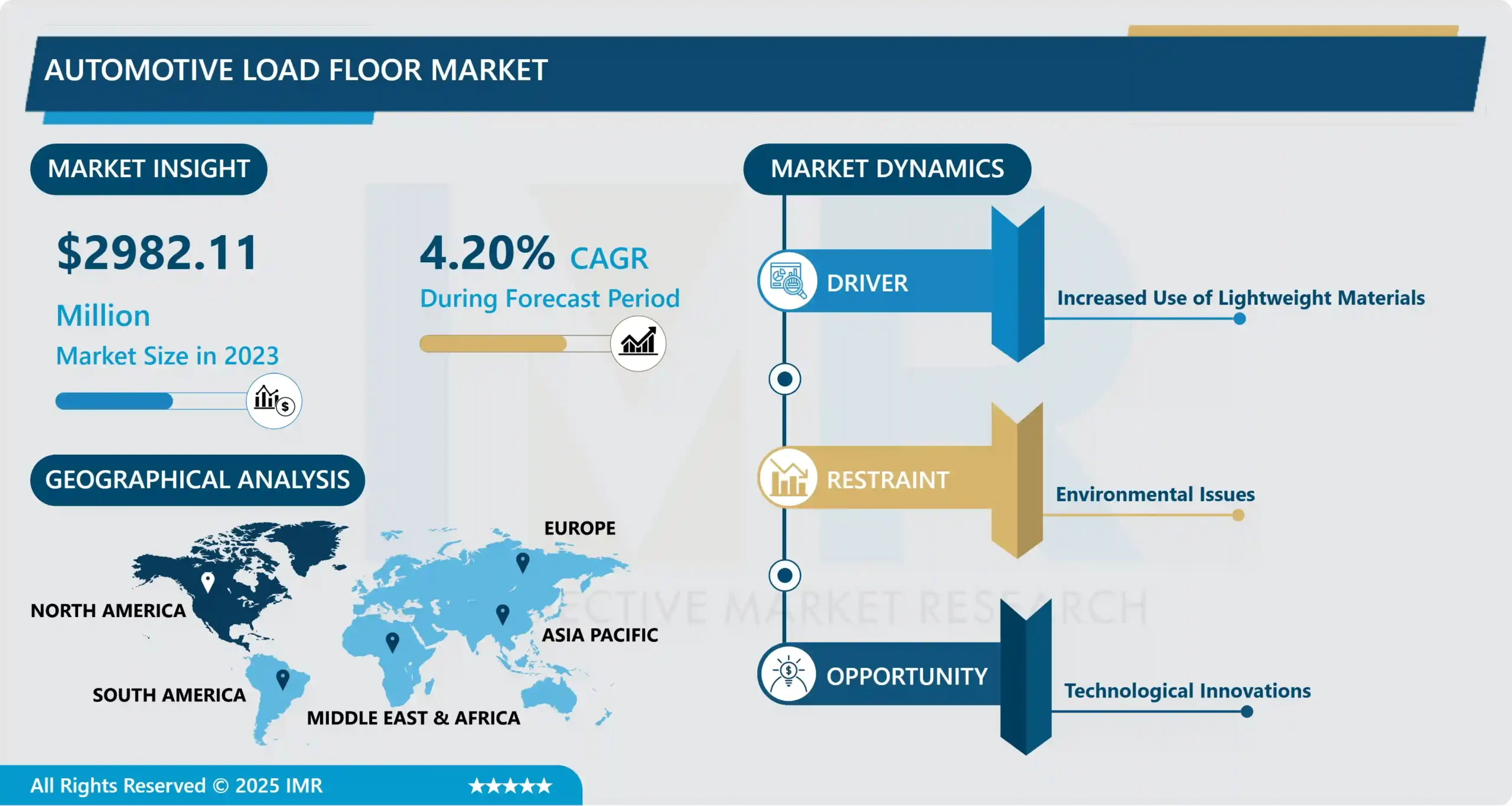
Automotive Load Floor Market Size Was Valued at USD 2982.11 Million in 2023, and is Projected to Reach USD 4318.50 Million by 2032, Growing at a CAGR of 4.2% From 2024-2032.
An automotive load floor is a panel that’s installed in a vehicle to carry cargo and baggage. They are often found in the rear cargo area of a vehicle. Increased global vehicle manufacturing has resulted in higher demand for car parts such as load floors. This trend is driven by the increased demand for both traditional and electric vehicles. Advancements in materials and manufacturing technology are enhancing the functionality and efficiency of load floors. Market growth is being fueled by growing demand for spacious and versatile load floors in SUVs and crossovers. Consumers prioritize comfort, convenience, and cargo space, prompting automakers to design load floors that are more flexible and easier to use. Improvements in load floor design also prioritize safety and durability, aiming to enhance crash protection and structural integrity in vehicle design.
The automotive sector is moving towards sustainability, affecting load floor materials and manufacturing processes. Unique design requirements are being brought to the load floor market by electric vehicles. Environmentally friendly materials and procedures are on the rise, in line with larger movements towards minimizing environmental harm and opening up fresh market prospects.
Automotive Load Floor Market Trend Analysis
Increased Use of Lightweight Materials
The use of lightweight materials in vehicles enhances fuel efficiency and decreases emissions. Automakers utilize them in order to comply with more stringent regulations regarding fuel efficiency and emissions. Vehicles that are lighter demonstrate improved performance, particularly in terms of handling and acceleration. Decreasing weight is crucial in order to increase the range of electric vehicles. Utilizing lightweight materials in components increases battery efficiency in Electric Vehicles (EVs), enabling them to achieve longer travel distances on one charge, attracting potential customers.
Innovations in materials technology, like carbon fibre, aluminium alloys, and high-strength polymers, enable the use of lightweight materials in automotive uses. Although they may have a higher initial price, improvements in manufacturing and larger production quantities are reducing expenses. Consumers are showing a growing desire for vehicles that offer better fuel efficiency and performance, prompting car manufacturers to use lighter materials to appeal to environmentally-conscious and performance-driven customers.
Automakers are putting money into lightweight materials in order to meet stringent government regulations on vehicle emissions and fuel consumption while also improving the durability and lifespan of their vehicles. High-strength composites, an advanced material, can withstand harsh conditions and resist corrosion, thereby prolonging the lifespan of load floors. Lightweight materials also allow for creative design solutions, like intricate shapes and structures, enhancing the functionality and appearance of vehicle load floors.
Opportunity
Technological Innovations
The strength, durability, and functionality of load floors are improved by new materials and technologies, resulting in improved performance and longevity. Carbon fibre and advanced composites enable vehicles to be lighter, enhancing fuel efficiency and performance. Technological progress allows for adaptable and modular load floor systems that can be customized to cater to various consumer requirements, enhancing the flexibility of vehicles by providing more storage space and specific storage options.
Intelligent features such as sensors, automated adjustments, and connectivity options have the ability to improve the functionality of the load floor by adapting to cargo requirements and tracking weight. Vehicles are made safer with enhanced safety features like strengthened structures and surfaces that reduce slipping. Eco-friendly materials such as recycled or bio-based polymers lessen environmental harm, attracting environmentally aware customers and matching worldwide movements towards environmental accountability.
Using technological developments to increase cost effectiveness can lower the price of high-quality load floors. Innovation has the potential to improve user experience by incorporating user-friendly elements such as surfaces that are easy to clean and designs that are ergonomic. Businesses that are at the forefront of technological advancements can have a competitive edge by offering innovative features and top-quality load areas, which can help them attract a wider customer base and set themselves apart from other brands in the market.
Automotive Load Floor Market Segment Analysis:
Automotive Load Floor Market is Segmented based on Material Type, Operation, Sales Channel, Application, Vehicle Type, And Region.
By material Type, the polypropylene Segment Is Expected to Dominate the Market During the Forecast Period
Polypropylene (PP) used in the automotive sector provides lightweight characteristics, which help decrease vehicle weight for better fuel efficiency and handling. It is resilient and sturdy, capable of enduring daily wear and tear and heavyweights in vehicle load floors, demonstrating outstanding impact resistance and strength.
Polypropylene is a budget-friendly option for manufacturers as it helps lower production expenses without compromising quality. Additionally, it offers strong protection against chemicals, oils, and moisture, which helps extend the lifespan and diminish the maintenance requirements of load floors.
The versatility of manufacturing polypropylene allows for a variety of load floor designs, promoting creativity. The fact that it can be recycled fits in with the automotive sector’s emphasis on sustainability, attracting manufacturers who want to improve their eco-friendly image. Furthermore, polypropylene’s ability to reduce noise and vibrations helps create a quieter and more pleasant driving atmosphere, ultimately improving overall comfort.
By Distribution channel, aftermarket Segment Held the Largest Share In 2023
As vehicles get older, the need for replacement and upgraded parts such as load floors increases. The aftermarket sector fulfills this demands by offering customization and improvement choices for car owners seeking to preserve or enhance their vehicles’ performance and look, with distinct designs not always provided by original manufacturers.
Vehicle owners looking to replace load floors may find aftermarket parts to be a more budget-friendly option compared to OEM parts. The aftermarket sector provides a variety of load floor products to meet the varying preferences of customers. The expansion of online shopping has simplified the acquisition of aftermarket components, enabling customers to easily compare and buy items such as load floors, which has in turn driven up the demand for aftermarket products.
Aftermarket load floors have advanced in both quality and innovation, now offering products that are on par with OEM parts. DIY lovers favour aftermarket choices designed for simple installation and customization. Variations in vehicle ownership and repair methods at a regional level impact the growth of the aftermarket industry.
Automotive Load Floor Market Regional Insights:
North is Expected to Dominate the Market Over the Forecast Period
Increased demand for advanced load floor solutions has been driven by the growth in vehicle production in North America, particularly in the US and Mexico. Customers are seeking cars with increased storage capacity and flexible functions such as adjustable load areas and creative storage options, leading to market growth.
In North America, the market is growing due to advancements in technology such as lightweight composites and modular designs on load floors. Robust economic expansion in the area results in higher sales and manufacturing of vehicles, which boosts the need for parts such as load floors and drives investments in cutting-edge automotive technologies.
North American laws for cars encourage safer and more effective vehicle parts. Adhering to regulations results in improved load floor layouts. Businesses allocate resources to research and development in order to advance load floor technology and stimulate market expansion. There is a strong emphasis on sustainability, specifically using eco-friendly materials for load floors to attract environmentally conscious customers.
Automotive Load Floor Market Active Players
Adient plc (Ireland)
Magna International Inc. (Canada)
Lear Corporation (USA)
Faurecia (France)
Johnson Controls International plc (Ireland)
Plastic Omnium (France)
Valeo (France)
Gestamp Automoción (Spain)
Brose Fahrzeugteile GmbH & Co. KG (Germany)
Harman International (a Samsung company) (USA)
Delphi Technologies (UK)
Toyota Boshoku Corporation (Japan)
TS Tech Co., Ltd. (Japan)
SABIC (Saudi Arabia)
Continental AG (Germany)
Rieter Automotive (Switzerland)
Nifco Inc. (Kawasaki, Kanagawa, Japan)
Calsonic Kansei Corporation (Japan)
Yanfeng Automotive Interiors (China)
Hella GmbH & Co. KGaA (Germany)
Hyundai Dymos Inc. (South Korea)
Magna Steyr (Austria)
Daimler AG (Germany)
Ford Motor Company (USA)
General Motors (GM) (USA)
Chapter 1: Introduction
1.1 Scope and Coverage
Chapter 2:Executive Summary
Chapter 3: Market Landscape
3.1 Market Dynamics
3.1.1 Drivers
3.1.2 Restraints
3.1.3 Opportunities
3.1.4 Challenges
3.2 Market Trend Analysis
3.3 PESTLE Analysis
3.4 Porter’s Five Forces Analysis
3.5 Industry Value Chain Analysis
3.6 Ecosystem
3.7 Regulatory Landscape
3.8 Price Trend Analysis
3.9 Patent Analysis
3.10 Technology Evolution
3.11 Investment Pockets
3.12 Import-Export Analysis
Chapter 4: Automotive Load Floor Market by Material Type (2018-2032)
4.1 Automotive Load Floor Market Snapshot and Growth Engine
4.2 Market Overview
4.3 Hardboard
4.3.1 Introduction and Market Overview
4.3.2 Historic and Forecasted Market Size in Value USD and Volume Units
4.3.3 Key Market Trends, Growth Factors, and Opportunities
4.3.4 Geographic Segmentation Analysis
4.4 Fluted Polypropylene
4.5 Honeycomb Polypropylene
4.6 Composites
4.7 Twin Sheet
4.8 Natural Fiber & wooden
Chapter 5: Automotive Load Floor Market by Operation (2018-2032)
5.1 Automotive Load Floor Market Snapshot and Growth Engine
5.2 Market Overview
5.3 Fixed
5.3.1 Introduction and Market Overview
5.3.2 Historic and Forecasted Market Size in Value USD and Volume Units
5.3.3 Key Market Trends, Growth Factors, and Opportunities
5.3.4 Geographic Segmentation Analysis
5.4 Sliding
Chapter 6: Automotive Load Floor Market by Sales Channel (2018-2032)
6.1 Automotive Load Floor Market Snapshot and Growth Engine
6.2 Market Overview
6.3 Original Equipment Manufacturer (OEM)
6.3.1 Introduction and Market Overview
6.3.2 Historic and Forecasted Market Size in Value USD and Volume Units
6.3.3 Key Market Trends, Growth Factors, and Opportunities
6.3.4 Geographic Segmentation Analysis
6.4 Aftermarket
Chapter 7: Automotive Load Floor Market by Application (2018-2032)
7.1 Automotive Load Floor Market Snapshot and Growth Engine
7.2 Market Overview
7.3 Interior Systems
7.3.1 Introduction and Market Overview
7.3.2 Historic and Forecasted Market Size in Value USD and Volume Units
7.3.3 Key Market Trends, Growth Factors, and Opportunities
7.3.4 Geographic Segmentation Analysis
7.4 Cargo Systems
7.5 Load Floor Systems
Chapter 8: Automotive Load Floor Market by Vehicle Type (2018-2032)
8.1 Automotive Load Floor Market Snapshot and Growth Engine
8.2 Market Overview
8.3 Compact
8.3.1 Introduction and Market Overview
8.3.2 Historic and Forecasted Market Size in Value USD and Volume Units
8.3.3 Key Market Trends, Growth Factors, and Opportunities
8.3.4 Geographic Segmentation Analysis
8.4 Mid-Sized
8.5 Luxury
8.6 SUV
8.7 LCV
Chapter 9: Company Profiles and Competitive Analysis
9.1 Competitive Landscape
9.1.1 Competitive Benchmarking
9.1.2 Automotive Load Floor Market Share by Manufacturer (2024)
9.1.3 Industry BCG Matrix
9.1.4 Heat Map Analysis
9.1.5 Mergers and Acquisitions
9.2 ADIENT PLC (IRELAND)
9.2.1 Company Overview
9.2.2 Key Executives
9.2.3 Company Snapshot
9.2.4 Role of the Company in the Market
9.2.5 Sustainability and Social Responsibility
9.2.6 Operating Business Segments
9.2.7 Product Portfolio
9.2.8 Business Performance
9.2.9 Key Strategic Moves and Recent Developments
9.2.10 SWOT Analysis
9.3 MAGNA INTERNATIONAL INC. (CANADA)
9.4 LEAR CORPORATION (USA)
9.5 FAURECIA (FRANCE)
9.6 JOHNSON CONTROLS INTERNATIONAL PLC (IRELAND)
9.7 PLASTIC OMNIUM (FRANCE)
9.8 VALEO (FRANCE)
9.9 GESTAMP AUTOMOCIÓN (SPAIN)
9.10 BROSE FAHRZEUGTEILE GMBH & CO. KG (GERMANY)
9.11 HARMAN INTERNATIONAL (A SAMSUNG COMPANY) (USA)
9.12 DELPHI TECHNOLOGIES (UK)
9.13 TOYOTA BOSHOKU CORPORATION (JAPAN)
9.14 TS TECH COLTD. (JAPAN)
9.15 SABIC (SAUDI ARABIA)
9.16 CONTINENTAL AG (GERMANY)
9.17 RIETER AUTOMOTIVE (SWITZERLAND)
9.18 NIFCO INC. (KAWASAKI
9.19 KANAGAWA
9.20 JAPAN)
9.21 CALSONIC KANSEI CORPORATION (JAPAN)
9.22 YANFENG AUTOMOTIVE INTERIORS (CHINA)
9.23 HELLA GMBH & CO. KGAA (GERMANY)
9.24 HYUNDAI DYMOS INC. (SOUTH KOREA)
9.25 MAGNA STEYR (AUSTRIA)
9.26 DAIMLER AG (GERMANY)
9.27 FORD MOTOR COMPANY (USA)
9.28 GENERAL MOTORS (GM) (USA)
9.29
Chapter 10: Global Automotive Load Floor Market By Region
10.1 Overview
10.2. North America Automotive Load Floor Market
10.2.1 Key Market Trends, Growth Factors and Opportunities
10.2.2 Top Key Companies
10.2.3 Historic and Forecasted Market Size by Segments
10.2.4 Historic and Forecasted Market Size by Material Type
10.2.4.1 Hardboard
10.2.4.2 Fluted Polypropylene
10.2.4.3 Honeycomb Polypropylene
10.2.4.4 Composites
10.2.4.5 Twin Sheet
10.2.4.6 Natural Fiber & wooden
10.2.5 Historic and Forecasted Market Size by Operation
10.2.5.1 Fixed
10.2.5.2 Sliding
10.2.6 Historic and Forecasted Market Size by Sales Channel
10.2.6.1 Original Equipment Manufacturer (OEM)
10.2.6.2 Aftermarket
10.2.7 Historic and Forecasted Market Size by Application
10.2.7.1 Interior Systems
10.2.7.2 Cargo Systems
10.2.7.3 Load Floor Systems
10.2.8 Historic and Forecasted Market Size by Vehicle Type
10.2.8.1 Compact
10.2.8.2 Mid-Sized
10.2.8.3 Luxury
10.2.8.4 SUV
10.2.8.5 LCV
10.2.9 Historic and Forecast Market Size by Country
10.2.9.1 US
10.2.9.2 Canada
10.2.9.3 Mexico
10.3. Eastern Europe Automotive Load Floor Market
10.3.1 Key Market Trends, Growth Factors and Opportunities
10.3.2 Top Key Companies
10.3.3 Historic and Forecasted Market Size by Segments
10.3.4 Historic and Forecasted Market Size by Material Type
10.3.4.1 Hardboard
10.3.4.2 Fluted Polypropylene
10.3.4.3 Honeycomb Polypropylene
10.3.4.4 Composites
10.3.4.5 Twin Sheet
10.3.4.6 Natural Fiber & wooden
10.3.5 Historic and Forecasted Market Size by Operation
10.3.5.1 Fixed
10.3.5.2 Sliding
10.3.6 Historic and Forecasted Market Size by Sales Channel
10.3.6.1 Original Equipment Manufacturer (OEM)
10.3.6.2 Aftermarket
10.3.7 Historic and Forecasted Market Size by Application
10.3.7.1 Interior Systems
10.3.7.2 Cargo Systems
10.3.7.3 Load Floor Systems
10.3.8 Historic and Forecasted Market Size by Vehicle Type
10.3.8.1 Compact
10.3.8.2 Mid-Sized
10.3.8.3 Luxury
10.3.8.4 SUV
10.3.8.5 LCV
10.3.9 Historic and Forecast Market Size by Country
10.3.9.1 Russia
10.3.9.2 Bulgaria
10.3.9.3 The Czech Republic
10.3.9.4 Hungary
10.3.9.5 Poland
10.3.9.6 Romania
10.3.9.7 Rest of Eastern Europe
10.4. Western Europe Automotive Load Floor Market
10.4.1 Key Market Trends, Growth Factors and Opportunities
10.4.2 Top Key Companies
10.4.3 Historic and Forecasted Market Size by Segments
10.4.4 Historic and Forecasted Market Size by Material Type
10.4.4.1 Hardboard
10.4.4.2 Fluted Polypropylene
10.4.4.3 Honeycomb Polypropylene
10.4.4.4 Composites
10.4.4.5 Twin Sheet
10.4.4.6 Natural Fiber & wooden
10.4.5 Historic and Forecasted Market Size by Operation
10.4.5.1 Fixed
10.4.5.2 Sliding
10.4.6 Historic and Forecasted Market Size by Sales Channel
10.4.6.1 Original Equipment Manufacturer (OEM)
10.4.6.2 Aftermarket
10.4.7 Historic and Forecasted Market Size by Application
10.4.7.1 Interior Systems
10.4.7.2 Cargo Systems
10.4.7.3 Load Floor Systems
10.4.8 Historic and Forecasted Market Size by Vehicle Type
10.4.8.1 Compact
10.4.8.2 Mid-Sized
10.4.8.3 Luxury
10.4.8.4 SUV
10.4.8.5 LCV
10.4.9 Historic and Forecast Market Size by Country
10.4.9.1 Germany
10.4.9.2 UK
10.4.9.3 France
10.4.9.4 The Netherlands
10.4.9.5 Italy
10.4.9.6 Spain
10.4.9.7 Rest of Western Europe
10.5. Asia Pacific Automotive Load Floor Market
10.5.1 Key Market Trends, Growth Factors and Opportunities
10.5.2 Top Key Companies
10.5.3 Historic and Forecasted Market Size by Segments
10.5.4 Historic and Forecasted Market Size by Material Type
10.5.4.1 Hardboard
10.5.4.2 Fluted Polypropylene
10.5.4.3 Honeycomb Polypropylene
10.5.4.4 Composites
10.5.4.5 Twin Sheet
10.5.4.6 Natural Fiber & wooden
10.5.5 Historic and Forecasted Market Size by Operation
10.5.5.1 Fixed
10.5.5.2 Sliding
10.5.6 Historic and Forecasted Market Size by Sales Channel
10.5.6.1 Original Equipment Manufacturer (OEM)
10.5.6.2 Aftermarket
10.5.7 Historic and Forecasted Market Size by Application
10.5.7.1 Interior Systems
10.5.7.2 Cargo Systems
10.5.7.3 Load Floor Systems
10.5.8 Historic and Forecasted Market Size by Vehicle Type
10.5.8.1 Compact
10.5.8.2 Mid-Sized
10.5.8.3 Luxury
10.5.8.4 SUV
10.5.8.5 LCV
10.5.9 Historic and Forecast Market Size by Country
10.5.9.1 China
10.5.9.2 India
10.5.9.3 Japan
10.5.9.4 South Korea
10.5.9.5 Malaysia
10.5.9.6 Thailand
10.5.9.7 Vietnam
10.5.9.8 The Philippines
10.5.9.9 Australia
10.5.9.10 New Zealand
10.5.9.11 Rest of APAC
10.6. Middle East & Africa Automotive Load Floor Market
10.6.1 Key Market Trends, Growth Factors and Opportunities
10.6.2 Top Key Companies
10.6.3 Historic and Forecasted Market Size by Segments
10.6.4 Historic and Forecasted Market Size by Material Type
10.6.4.1 Hardboard
10.6.4.2 Fluted Polypropylene
10.6.4.3 Honeycomb Polypropylene
10.6.4.4 Composites
10.6.4.5 Twin Sheet
10.6.4.6 Natural Fiber & wooden
10.6.5 Historic and Forecasted Market Size by Operation
10.6.5.1 Fixed
10.6.5.2 Sliding
10.6.6 Historic and Forecasted Market Size by Sales Channel
10.6.6.1 Original Equipment Manufacturer (OEM)
10.6.6.2 Aftermarket
10.6.7 Historic and Forecasted Market Size by Application
10.6.7.1 Interior Systems
10.6.7.2 Cargo Systems
10.6.7.3 Load Floor Systems
10.6.8 Historic and Forecasted Market Size by Vehicle Type
10.6.8.1 Compact
10.6.8.2 Mid-Sized
10.6.8.3 Luxury
10.6.8.4 SUV
10.6.8.5 LCV
10.6.9 Historic and Forecast Market Size by Country
10.6.9.1 Turkiye
10.6.9.2 Bahrain
10.6.9.3 Kuwait
10.6.9.4 Saudi Arabia
10.6.9.5 Qatar
10.6.9.6 UAE
10.6.9.7 Israel
10.6.9.8 South Africa
10.7. South America Automotive Load Floor Market
10.7.1 Key Market Trends, Growth Factors and Opportunities
10.7.2 Top Key Companies
10.7.3 Historic and Forecasted Market Size by Segments
10.7.4 Historic and Forecasted Market Size by Material Type
10.7.4.1 Hardboard
10.7.4.2 Fluted Polypropylene
10.7.4.3 Honeycomb Polypropylene
10.7.4.4 Composites
10.7.4.5 Twin Sheet
10.7.4.6 Natural Fiber & wooden
10.7.5 Historic and Forecasted Market Size by Operation
10.7.5.1 Fixed
10.7.5.2 Sliding
10.7.6 Historic and Forecasted Market Size by Sales Channel
10.7.6.1 Original Equipment Manufacturer (OEM)
10.7.6.2 Aftermarket
10.7.7 Historic and Forecasted Market Size by Application
10.7.7.1 Interior Systems
10.7.7.2 Cargo Systems
10.7.7.3 Load Floor Systems
10.7.8 Historic and Forecasted Market Size by Vehicle Type
10.7.8.1 Compact
10.7.8.2 Mid-Sized
10.7.8.3 Luxury
10.7.8.4 SUV
10.7.8.5 LCV
10.7.9 Historic and Forecast Market Size by Country
10.7.9.1 Brazil
10.7.9.2 Argentina
10.7.9.3 Rest of SA
Chapter 11 Analyst Viewpoint and Conclusion
11.1 Recommendations and Concluding Analysis
11.2 Potential Market Strategies
Chapter 12 Research Methodology
12.1 Research Process
12.2 Primary Research
12.3 Secondary Research
Q1: What would be the forecast period in the Automotive Load Floor Market research report?
A1: The forecast period in the Automotive Load Floor Market research report is 2024-2032.
Q2: Who are the key players in the Automotive Load Floor Market?
A2: Adient plc (Ireland), Magna International Inc. (Canada), Lear Corporation (USA), Faurecia (France), Johnson Controls International plc (Ireland), Plastic Omnium (France), Valeo (France), Gestamp Automoción (Spain), Brose Fahrzeugteile GmbH & Co. KG (Germany), Harman International (a Samsung company) (USA), Delphi Technologies (UK), Toyota Boshoku Corporation (Japan), TS Tech Co., Ltd. (Japan), SABIC (Saudi Arabia), Continental AG (Germany), Rieter Automotive (Switzerland), Nifco Inc. (Kawasaki, Kanagawa, Japan), Calsonic Kansei Corporation (Japan), Yanfeng Automotive Interiors (China), Hella GmbH & Co. KGaA (Germany), Hyundai Dymos Inc. (South Korea), Magna Steyr (Austria), Daimler AG (Germany), Ford Motor Company (USA), General Motors (GM) (USA) and Other Active Players.
Q3: What are the segments of the Automotive Load Floor Market?
A3: The Automotive Load Floor Market is segmented into Material Type, Operation, Sales Channel, Application, Vehicle Type, and region. By Material Type, the market is categorized into Hardboard, Fluted Polypropylene, Honeycomb Polypropylene, Composites, Twin Sheet, And Natural Fiber & wooden. By Operation, the market is categorized into Fixed, Sliding. By Sales Channel, the market is categorized into Original Equipment Manufacturer (OEM), Aftermarket. By Application, the market is categorized into Interior Systems, Cargo Systems, Load Floor Systems. By Vehicle Type, The Market Is Categorized Into Compact, Mid-Sized, Luxury, SUV, LCV, And Vehicle. By region, it is analyzed across North America (U.S.; Canada; Mexico), Eastern Europe (Bulgaria; The Czech Republic; Hungary; Poland; Romania; Rest of Eastern Europe), Western Europe (Germany; UK; France; Netherlands; Italy; Russia; Spain; Rest of Western Europe), Asia-Pacific (China; India; Japan; Southeast Asia, etc.), South America (Brazil; Argentina, etc.), Middle East & Africa (Saudi Arabia; South Africa, etc.).
Q4: What is the Automotive Load Floor Market?
A4: An automotive load floor is a panel that's installed in a vehicle to carry cargo and baggage. They are often found in the rear cargo area of a vehicle.
Q5: How big is the Automotive Load Floor Market?
A5: Automotive Load Floor Market Size Was Valued at USD 2982.11 Million in 2023, and is Projected to Reach USD 4318.50 Million by 2032, Growing at a CAGR of 4.2% From 2024-2032.
How to Buy a Report from eminsights.jp
On the product page, choose the license you want: Single-User License, Multi-User License or Enterprise License.
If you required report in your native language, then you can click on Translated Report button and fill out the form with report name and language you want, then our team will contact you as soon as possible.
Click the Buy Now button.
You will be redirected to the checkout page. Enter your company details and payment information.
Click Place Order to complete the purchase.
Confirmation: You’ll receive an order confirmation and our team will contact you shortly with your ordered report.
If you have any questions, fill out the contact form below or email us at [email protected].
Thank you for choosing eminsights.jp!