Stay Ahead in Fast-Growing Economies.
Browse Reports Now




Cell Signaling Market – Global Growth and Trends Analysis
Cell Signaling Market: The cell signaling market refers to the sector of the biotechnology and pharmaceutical industry that focuses on the study, development, and commercialization of products and technologies related to cellular signaling pathways. Cell signaling involves the complex system of communication that governs cellular activities and coordinates cellular responses to external and internal stimuli. This market encompasses a range of products, including reagents, kits, instruments, and technologies used to investigate and manipulate signaling pathways within cells.

IMR Group
Description
Cell Signaling Market Synopsis
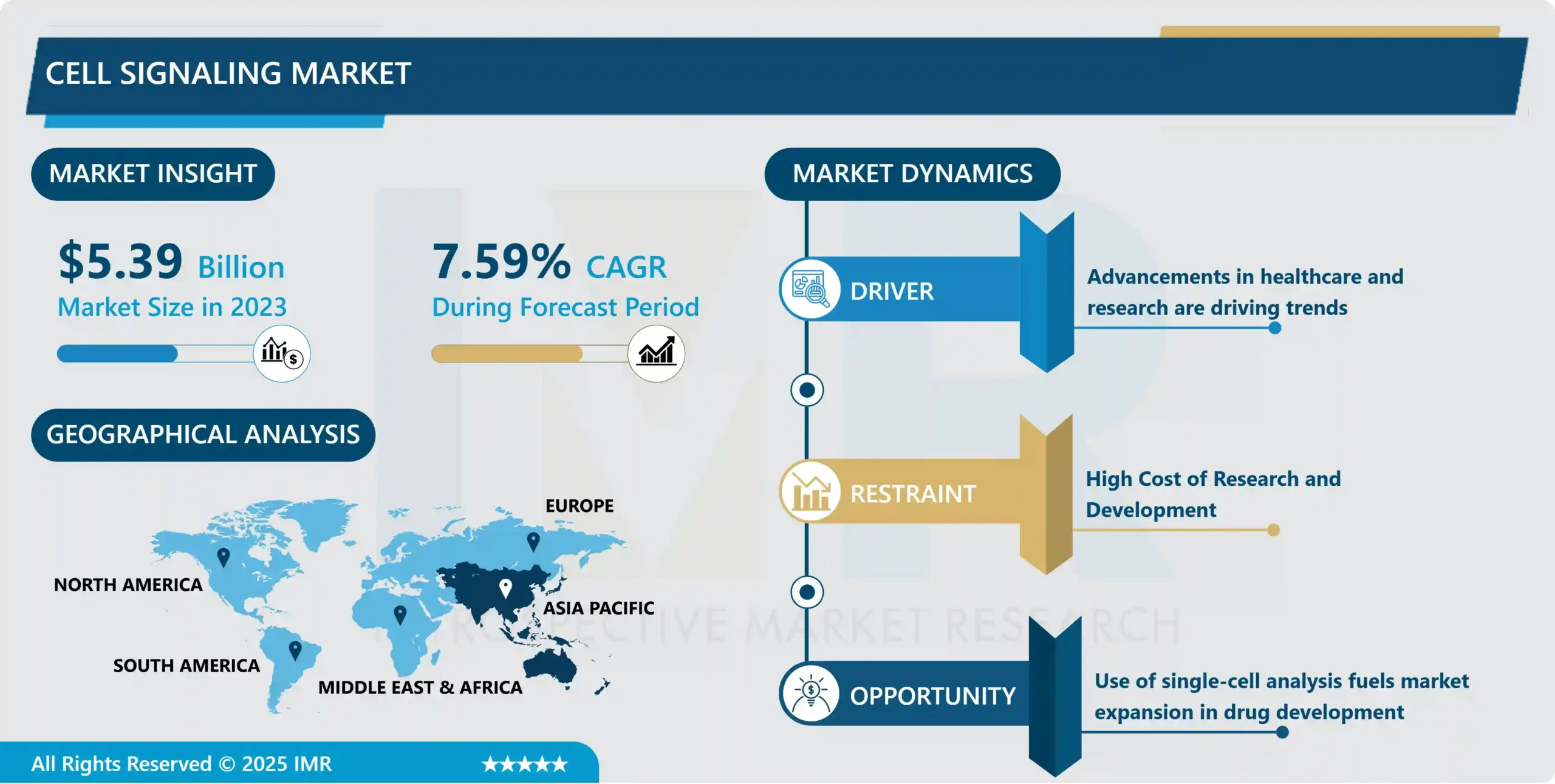
Cell Signaling Market Size Was Valued at USD 5.39 Billion in 2023, and is Projected to Reach USD 10.41 Billion by 2032, Growing at a CAGR of 7.59% From 2024-2032.
Cell Signaling Market: The cell signaling market refers to the sector of the biotechnology and pharmaceutical industry that focuses on the study, development, and commercialization of products and technologies related to cellular signaling pathways. Cell signaling involves the complex system of communication that governs cellular activities and coordinates cellular responses to external and internal stimuli. This market encompasses a range of products, including reagents, kits, instruments, and technologies used to investigate and manipulate signaling pathways within cells.
Studies and therapy for cancer, cardiovascular illnesses, and neurological disorders concentrate on comprehending cell signaling pathways. Specific treatments like tyrosine kinase inhibitors and monoclonal antibodies have proven to be effective in the field of cancer studies.
Research into signaling pathways is the driving force behind the advancement of new treatments and diagnostic tools for cardiovascular diseases and neurological disorders. The single-cell technologies market, particularly RNA sequencing, is expanding quickly. AI in drug discovery is growing to anticipate the response of signaling pathways to novel drugs. Research and investment are predominant in North America, while Europe and Asia-Pacific are witnessing advancements in research and healthcare technology.
Cell Signaling Market Trend Analysis
Advancements in Healthcare and Research
Research advancements and healthcare changes are shaping the trends and opportunities in the cell signaling market in North America. Important developments include the rise of precision medicine, which hones in on specific factors for tailored treatments, and progress in omics technologies that offer an enhanced understanding of cell signaling networks. These patterns are fueling the need for technologies and assays, resulting in a rise in research and development.
AI and ML are revolutionizing cell signaling analysis and fueling discoveries. Cell signaling research primarily focuses on cancer and chronic diseases, resulting in progress in drug discovery and therapeutic approaches. The need for research tools to comprehend signaling networks and therapeutic targets is on the rise.
Growing cooperation among academia, industry, and government agencies is spurring innovation in cell signaling research. Collaborations enable the sharing of resources, knowledge, and data, resulting in a decreased time to market for new treatments. The advancement of targeted treatments and immunotherapies is also gaining momentum, resulting in increased research funding.
Use of Single-Cell Analysis Fuels Market Expansion in Drug Development.
Chances for growth in the cell signaling industry involve venturing into developing disease fields such as infectious diseases, autoimmune disorders, and rare diseases, resulting in the discovery of new signaling pathways and treatments. Progress in single-cell analysis provides an in-depth understanding of variations within cells in diseases such as cancer, fueling market expansion with uses in drug development and tailored medical treatments.
The identification and advancement of new forms of treatment, like gene therapy, RNA therapies, and cell therapies, present significant possibilities in the cell signaling industry. These approaches focus on particular signaling pathways, leading to an increased need for research tools and technologies and generating additional income for businesses. Moreover, the increasing need for companion diagnostics, which assist in identifying the best treatment based on certain signaling pathway changes, offers chances for firms to create and sell new tests that can enhance patient results and increase market possibilities.
Investment in early-stage research, regenerative medicine, and stem cell research is growing, creating possibilities for innovation in the cell signaling market. These sectors have the potential to generate new treatments and boost economic expansion.
Cell Signaling Market Segment Analysis:
Cell Signaling Market Segmented based on Product, Signaling Type, Technology, Application, and End-User.
By Signaling Type, Endocrine Segment Is Expected to Dominate the Market During the Forecast Period
Endocrine signaling plays a crucial role in controlling physiological functions and is important in various disease situations. Glands such as the thyroid and pancreas release hormones into the blood, affecting growth, metabolism, and reproduction. Conditions such as diabetes and metabolic syndromes are widespread, underscoring the importance of studying endocrine signaling for treating diseases and managing long-term health issues.
Pharmaceutical companies are dedicating resources to create hormone-based medications for diseases such as diabetes and thyroid issues. Endocrine signaling pathways provide precise objectives for drug advancement, concentrating on hormone replacement treatments and insulin analogs. The intricate web of hormonal communication offers various opportunities for therapeutic intervention.
Improvements in Diagnostic and Therapeutic Technologies have enhanced the identification and tracking of endocrine signals. Advancements in therapy such as biosimilar hormones and drug delivery systems have broadened research and practical uses. Global health efforts focus on addressing non-communicable diseases, allocating more resources to research, and managing the role of endocrine signaling in regulating physiological functions and creating specific treatments.
By Application, Cancer Segment Held the Largest Share
Cancer research has a significant presence in the cell signaling market because of its essential contribution to cancer comprehension, advancement, and treatment. Changes in oncogenes and tumor suppressor genes, modifications in signaling pathways, and the advancement of targeted therapy highlight the importance of cell signaling in oncology.
Cancer is a global health priority due to its high prevalence and burden, leading to extensive research funded by governments, non-profit organizations, and pharmaceutical companies. Advanced technologies like NGS and CRISPR/Cas9 enable innovative research into cell signaling pathways and biomarker discovery for early detection and treatment monitoring.
Cancer is a complicated and varied illness, having various types with distinct genetic changes. The development of cancer can be affected by the tumor microenvironment, which consists of immune cells and signaling molecules. Studies on cellular communication influence the creation of medications and medical experiments, with an emphasis on specific treatments and finding solutions to resistance mechanisms. The study of how signaling pathways affect immune responses against tumors is gaining interest as an emerging field known as immuno-oncology. In general, cancer research holds a key position in cell signaling due to the significance of signaling pathways in cancer biology, the demand for precise treatments, the worldwide impact of cancer, and progress in research and technology.
Cell Signaling Market Regional Insights:
Asia Pacific is Expected to Dominate the Market Over the Forecast Period
The strong presence of North America in the cell signaling market is due to its well-developed research facilities, investments in biotechnology and pharmaceuticals, efficient healthcare systems, and emphasis on creative solutions. The top-notch institutions, partnership networks, substantial venture capital support, and government backing in research all play a role in paving the way for excellence in cell signaling research and drug development. The area’s ecosystem speeds up transforming research into usable applications, strengthening its position in the market.
North America’s sophisticated healthcare system incorporates advanced technologies and treatments derived from cell signaling studies. Prominent hospitals and research institutes support the transformation of research into clinical care, emphasizing precision medicine. The area is home to top pharmaceutical and biotech companies such as Pfizer and Amgen, which are leading advancements in cell signaling research. Innovation hubs in cities such as San Francisco and Boston draw in top talent and cultivate a vibrant environment for research.
North America is at the forefront of cell signaling research, supported by the FDA, with access to the market, and a focus on technology and high-impact diseases such as cancer. The research is also driven by the increasing elderly population in the area, impacting worldwide efforts and establishing benchmarks for innovation. Strong infrastructure, investments, healthcare systems, regulatory support, and dedication to innovation drive its leadership in the market.
Cell Signaling Market Active Players
Thermo Fisher Scientific (United States)
Abbott Laboratories (United States)
Becton, Dickinson and Company (BD) (United States)
Bio-Rad Laboratories (United States)
PerkinElmer (United States)
Merck KGaA (Germany)
R&D Systems (a part of Bio-Techne) (United States)
Agilent Technologies (United States)
Cell Signaling Technology (CST) (United States)
GE Healthcare (United States)
Eppendorf AG (Germany)
Takara Bio Inc. (Japan)
Lonza Group (Switzerland)
MilliporeSigma (a part of Merck KGaA) (United States)
SABiosciences (a part of QIAGEN) (United States)
Abcam plc (United Kingdom)
Illumina, Inc. (United States)
Qiagen N.V. (Netherlands)
Agena Bioscience (United States)
Horizon Discovery (United Kingdom)
F. Hoffmann-La Roche Ltd. (Switzerland)
Coriell Institute for Medical Research (United States)
Enzo Biochem, Inc. (United States)
Molecular Devices, LLC (United States)
KaliVir Immunotherapeutics (United States)
Biolegend, Inc. (United States)
Synlogic (United States)
Incyte Corporation (United States)
NantWorks, LLC (United States)
OncoGenex Pharmaceuticals, Inc. (United States)
Key Industry Developments in the Cell Signaling Market:
In February 2023, Bio-Techne Corporation & Cell Signaling Technology established a partnership, thus adding the Simple Western validation to Cell Signaling Technology antibodies. This agreement would help improve researchers’ ability to analyze critical molecular signaling pathways effectively.
In September 2023, Cell Signaling Technology unveiled its SignalStar Multiplex IHC technology, an innovation for spatial biology investigations through mid-plex, high-capacity immunohistochemistry (IHC) assays.
Chapter 1: Introduction
1.1 Scope and Coverage
Chapter 2:Executive Summary
Chapter 3: Market Landscape
3.1 Market Dynamics
3.1.1 Drivers
3.1.2 Restraints
3.1.3 Opportunities
3.1.4 Challenges
3.2 Market Trend Analysis
3.3 PESTLE Analysis
3.4 Porter’s Five Forces Analysis
3.5 Industry Value Chain Analysis
3.6 Ecosystem
3.7 Regulatory Landscape
3.8 Price Trend Analysis
3.9 Patent Analysis
3.10 Technology Evolution
3.11 Investment Pockets
3.12 Import-Export Analysis
Chapter 4: Cell Signaling Market by Product (2018-2032)
4.1 Cell Signaling Market Snapshot and Growth Engine
4.2 Market Overview
4.3 Reagents
4.3.1 Introduction and Market Overview
4.3.2 Historic and Forecasted Market Size in Value USD and Volume Units
4.3.3 Key Market Trends, Growth Factors, and Opportunities
4.3.4 Geographic Segmentation Analysis
4.4 Kits
4.5 Instruments
Chapter 5: Cell Signaling Market by Signaling Type (2018-2032)
5.1 Cell Signaling Market Snapshot and Growth Engine
5.2 Market Overview
5.3 Endocrine Signaling
5.3.1 Introduction and Market Overview
5.3.2 Historic and Forecasted Market Size in Value USD and Volume Units
5.3.3 Key Market Trends, Growth Factors, and Opportunities
5.3.4 Geographic Segmentation Analysis
5.4 Paracrine Signaling
5.5 Autocrine Signaling
5.6 Juxtacrine Signaling
5.7 Synaptic Signaling
Chapter 6: Cell Signaling Market by Technology (2018-2032)
6.1 Cell Signaling Market Snapshot and Growth Engine
6.2 Market Overview
6.3 Western Blotting
6.3.1 Introduction and Market Overview
6.3.2 Historic and Forecasted Market Size in Value USD and Volume Units
6.3.3 Key Market Trends, Growth Factors, and Opportunities
6.3.4 Geographic Segmentation Analysis
6.4 ELISA (Enzyme-Linked Immunosorbent Assay)
6.5 PCR (Polymerase Chain Reaction)
6.6 Immunohistochemistry
6.7 Flow Cytometry
6.8 Mass Spectrometry
Chapter 7: Cell Signaling Market by Application (2018-2032)
7.1 Cell Signaling Market Snapshot and Growth Engine
7.2 Market Overview
7.3 Cancer Research
7.3.1 Introduction and Market Overview
7.3.2 Historic and Forecasted Market Size in Value USD and Volume Units
7.3.3 Key Market Trends, Growth Factors, and Opportunities
7.3.4 Geographic Segmentation Analysis
7.4 Neurological Research
7.5 Cardiovascular Research
Chapter 8: Cell Signaling Market by End-User (2018-2032)
8.1 Cell Signaling Market Snapshot and Growth Engine
8.2 Market Overview
8.3 Academic and Research Institutes
8.3.1 Introduction and Market Overview
8.3.2 Historic and Forecasted Market Size in Value USD and Volume Units
8.3.3 Key Market Trends, Growth Factors, and Opportunities
8.3.4 Geographic Segmentation Analysis
8.4 Pharmaceutical and Biotechnology Companies
8.5 Clinical Diagnostic Laboratories
Chapter 9: Company Profiles and Competitive Analysis
9.1 Competitive Landscape
9.1.1 Competitive Benchmarking
9.1.2 Cell Signaling Market Share by Manufacturer (2024)
9.1.3 Industry BCG Matrix
9.1.4 Heat Map Analysis
9.1.5 Mergers and Acquisitions
9.2 THERMO FISHER SCIENTIFIC (UNITED STATES)
9.2.1 Company Overview
9.2.2 Key Executives
9.2.3 Company Snapshot
9.2.4 Role of the Company in the Market
9.2.5 Sustainability and Social Responsibility
9.2.6 Operating Business Segments
9.2.7 Product Portfolio
9.2.8 Business Performance
9.2.9 Key Strategic Moves and Recent Developments
9.2.10 SWOT Analysis
9.3 ABBOTT LABORATORIES (UNITED STATES)
9.4 BECTON
9.5 DICKINSON AND COMPANY (BD) (UNITED STATES)
9.6 BIO-RAD LABORATORIES (UNITED STATES)
9.7 PERKINELMER (UNITED STATES)
9.8 MERCK KGAA (GERMANY)
9.9 R&D SYSTEMS (A PART OF BIO-TECHNE) (UNITED STATES)
9.10 AGILENT TECHNOLOGIES (UNITED STATES)
9.11 CELL SIGNALING TECHNOLOGY (CST) (UNITED STATES)
9.12 GE HEALTHCARE (UNITED STATES)
9.13 EPPENDORF AG (GERMANY)
9.14 TAKARA BIO INC. (JAPAN)
9.15 LONZA GROUP (SWITZERLAND)
9.16 MILLIPORESIGMA (A PART OF MERCK KGAA) (UNITED STATES)
9.17 SABIOSCIENCES (A PART OF QIAGEN) (UNITED STATES)
9.18 ABCAM PLC (UNITED KINGDOM)
9.19 ILLUMINA INC. (UNITED STATES)
9.20 QIAGEN N.V. (NETHERLANDS)
9.21 AGENA BIOSCIENCE (UNITED STATES)
9.22 HORIZON DISCOVERY (UNITED KINGDOM)
9.23 F. HOFFMANN-LA ROCHE LTD. (SWITZERLAND)
9.24 CORIELL INSTITUTE FOR MEDICAL RESEARCH (UNITED STATES)
9.25 ENZO BIOCHEM INC. (UNITED STATES)
9.26 MOLECULAR DEVICES
9.27 LLC (UNITED STATES)
9.28 KALIVIR IMMUNOTHERAPEUTICS (UNITED STATES)
9.29 BIOLEGEND INC. (UNITED STATES)
9.30 SYNLOGIC (UNITED STATES) INCYTE CORPORATION (UNITED STATES)
9.31 NANTWORKS
9.32 LLC (UNITED STATES)
9.33 ONCOGENEX PHARMACEUTICALS INC. (UNITED STATES)
Chapter 10: Global Cell Signaling Market By Region
10.1 Overview
10.2. North America Cell Signaling Market
10.2.1 Key Market Trends, Growth Factors and Opportunities
10.2.2 Top Key Companies
10.2.3 Historic and Forecasted Market Size by Segments
10.2.4 Historic and Forecasted Market Size by Product
10.2.4.1 Reagents
10.2.4.2 Kits
10.2.4.3 Instruments
10.2.5 Historic and Forecasted Market Size by Signaling Type
10.2.5.1 Endocrine Signaling
10.2.5.2 Paracrine Signaling
10.2.5.3 Autocrine Signaling
10.2.5.4 Juxtacrine Signaling
10.2.5.5 Synaptic Signaling
10.2.6 Historic and Forecasted Market Size by Technology
10.2.6.1 Western Blotting
10.2.6.2 ELISA (Enzyme-Linked Immunosorbent Assay)
10.2.6.3 PCR (Polymerase Chain Reaction)
10.2.6.4 Immunohistochemistry
10.2.6.5 Flow Cytometry
10.2.6.6 Mass Spectrometry
10.2.7 Historic and Forecasted Market Size by Application
10.2.7.1 Cancer Research
10.2.7.2 Neurological Research
10.2.7.3 Cardiovascular Research
10.2.8 Historic and Forecasted Market Size by End-User
10.2.8.1 Academic and Research Institutes
10.2.8.2 Pharmaceutical and Biotechnology Companies
10.2.8.3 Clinical Diagnostic Laboratories
10.2.9 Historic and Forecast Market Size by Country
10.2.9.1 US
10.2.9.2 Canada
10.2.9.3 Mexico
10.3. Eastern Europe Cell Signaling Market
10.3.1 Key Market Trends, Growth Factors and Opportunities
10.3.2 Top Key Companies
10.3.3 Historic and Forecasted Market Size by Segments
10.3.4 Historic and Forecasted Market Size by Product
10.3.4.1 Reagents
10.3.4.2 Kits
10.3.4.3 Instruments
10.3.5 Historic and Forecasted Market Size by Signaling Type
10.3.5.1 Endocrine Signaling
10.3.5.2 Paracrine Signaling
10.3.5.3 Autocrine Signaling
10.3.5.4 Juxtacrine Signaling
10.3.5.5 Synaptic Signaling
10.3.6 Historic and Forecasted Market Size by Technology
10.3.6.1 Western Blotting
10.3.6.2 ELISA (Enzyme-Linked Immunosorbent Assay)
10.3.6.3 PCR (Polymerase Chain Reaction)
10.3.6.4 Immunohistochemistry
10.3.6.5 Flow Cytometry
10.3.6.6 Mass Spectrometry
10.3.7 Historic and Forecasted Market Size by Application
10.3.7.1 Cancer Research
10.3.7.2 Neurological Research
10.3.7.3 Cardiovascular Research
10.3.8 Historic and Forecasted Market Size by End-User
10.3.8.1 Academic and Research Institutes
10.3.8.2 Pharmaceutical and Biotechnology Companies
10.3.8.3 Clinical Diagnostic Laboratories
10.3.9 Historic and Forecast Market Size by Country
10.3.9.1 Russia
10.3.9.2 Bulgaria
10.3.9.3 The Czech Republic
10.3.9.4 Hungary
10.3.9.5 Poland
10.3.9.6 Romania
10.3.9.7 Rest of Eastern Europe
10.4. Western Europe Cell Signaling Market
10.4.1 Key Market Trends, Growth Factors and Opportunities
10.4.2 Top Key Companies
10.4.3 Historic and Forecasted Market Size by Segments
10.4.4 Historic and Forecasted Market Size by Product
10.4.4.1 Reagents
10.4.4.2 Kits
10.4.4.3 Instruments
10.4.5 Historic and Forecasted Market Size by Signaling Type
10.4.5.1 Endocrine Signaling
10.4.5.2 Paracrine Signaling
10.4.5.3 Autocrine Signaling
10.4.5.4 Juxtacrine Signaling
10.4.5.5 Synaptic Signaling
10.4.6 Historic and Forecasted Market Size by Technology
10.4.6.1 Western Blotting
10.4.6.2 ELISA (Enzyme-Linked Immunosorbent Assay)
10.4.6.3 PCR (Polymerase Chain Reaction)
10.4.6.4 Immunohistochemistry
10.4.6.5 Flow Cytometry
10.4.6.6 Mass Spectrometry
10.4.7 Historic and Forecasted Market Size by Application
10.4.7.1 Cancer Research
10.4.7.2 Neurological Research
10.4.7.3 Cardiovascular Research
10.4.8 Historic and Forecasted Market Size by End-User
10.4.8.1 Academic and Research Institutes
10.4.8.2 Pharmaceutical and Biotechnology Companies
10.4.8.3 Clinical Diagnostic Laboratories
10.4.9 Historic and Forecast Market Size by Country
10.4.9.1 Germany
10.4.9.2 UK
10.4.9.3 France
10.4.9.4 The Netherlands
10.4.9.5 Italy
10.4.9.6 Spain
10.4.9.7 Rest of Western Europe
10.5. Asia Pacific Cell Signaling Market
10.5.1 Key Market Trends, Growth Factors and Opportunities
10.5.2 Top Key Companies
10.5.3 Historic and Forecasted Market Size by Segments
10.5.4 Historic and Forecasted Market Size by Product
10.5.4.1 Reagents
10.5.4.2 Kits
10.5.4.3 Instruments
10.5.5 Historic and Forecasted Market Size by Signaling Type
10.5.5.1 Endocrine Signaling
10.5.5.2 Paracrine Signaling
10.5.5.3 Autocrine Signaling
10.5.5.4 Juxtacrine Signaling
10.5.5.5 Synaptic Signaling
10.5.6 Historic and Forecasted Market Size by Technology
10.5.6.1 Western Blotting
10.5.6.2 ELISA (Enzyme-Linked Immunosorbent Assay)
10.5.6.3 PCR (Polymerase Chain Reaction)
10.5.6.4 Immunohistochemistry
10.5.6.5 Flow Cytometry
10.5.6.6 Mass Spectrometry
10.5.7 Historic and Forecasted Market Size by Application
10.5.7.1 Cancer Research
10.5.7.2 Neurological Research
10.5.7.3 Cardiovascular Research
10.5.8 Historic and Forecasted Market Size by End-User
10.5.8.1 Academic and Research Institutes
10.5.8.2 Pharmaceutical and Biotechnology Companies
10.5.8.3 Clinical Diagnostic Laboratories
10.5.9 Historic and Forecast Market Size by Country
10.5.9.1 China
10.5.9.2 India
10.5.9.3 Japan
10.5.9.4 South Korea
10.5.9.5 Malaysia
10.5.9.6 Thailand
10.5.9.7 Vietnam
10.5.9.8 The Philippines
10.5.9.9 Australia
10.5.9.10 New Zealand
10.5.9.11 Rest of APAC
10.6. Middle East & Africa Cell Signaling Market
10.6.1 Key Market Trends, Growth Factors and Opportunities
10.6.2 Top Key Companies
10.6.3 Historic and Forecasted Market Size by Segments
10.6.4 Historic and Forecasted Market Size by Product
10.6.4.1 Reagents
10.6.4.2 Kits
10.6.4.3 Instruments
10.6.5 Historic and Forecasted Market Size by Signaling Type
10.6.5.1 Endocrine Signaling
10.6.5.2 Paracrine Signaling
10.6.5.3 Autocrine Signaling
10.6.5.4 Juxtacrine Signaling
10.6.5.5 Synaptic Signaling
10.6.6 Historic and Forecasted Market Size by Technology
10.6.6.1 Western Blotting
10.6.6.2 ELISA (Enzyme-Linked Immunosorbent Assay)
10.6.6.3 PCR (Polymerase Chain Reaction)
10.6.6.4 Immunohistochemistry
10.6.6.5 Flow Cytometry
10.6.6.6 Mass Spectrometry
10.6.7 Historic and Forecasted Market Size by Application
10.6.7.1 Cancer Research
10.6.7.2 Neurological Research
10.6.7.3 Cardiovascular Research
10.6.8 Historic and Forecasted Market Size by End-User
10.6.8.1 Academic and Research Institutes
10.6.8.2 Pharmaceutical and Biotechnology Companies
10.6.8.3 Clinical Diagnostic Laboratories
10.6.9 Historic and Forecast Market Size by Country
10.6.9.1 Turkiye
10.6.9.2 Bahrain
10.6.9.3 Kuwait
10.6.9.4 Saudi Arabia
10.6.9.5 Qatar
10.6.9.6 UAE
10.6.9.7 Israel
10.6.9.8 South Africa
10.7. South America Cell Signaling Market
10.7.1 Key Market Trends, Growth Factors and Opportunities
10.7.2 Top Key Companies
10.7.3 Historic and Forecasted Market Size by Segments
10.7.4 Historic and Forecasted Market Size by Product
10.7.4.1 Reagents
10.7.4.2 Kits
10.7.4.3 Instruments
10.7.5 Historic and Forecasted Market Size by Signaling Type
10.7.5.1 Endocrine Signaling
10.7.5.2 Paracrine Signaling
10.7.5.3 Autocrine Signaling
10.7.5.4 Juxtacrine Signaling
10.7.5.5 Synaptic Signaling
10.7.6 Historic and Forecasted Market Size by Technology
10.7.6.1 Western Blotting
10.7.6.2 ELISA (Enzyme-Linked Immunosorbent Assay)
10.7.6.3 PCR (Polymerase Chain Reaction)
10.7.6.4 Immunohistochemistry
10.7.6.5 Flow Cytometry
10.7.6.6 Mass Spectrometry
10.7.7 Historic and Forecasted Market Size by Application
10.7.7.1 Cancer Research
10.7.7.2 Neurological Research
10.7.7.3 Cardiovascular Research
10.7.8 Historic and Forecasted Market Size by End-User
10.7.8.1 Academic and Research Institutes
10.7.8.2 Pharmaceutical and Biotechnology Companies
10.7.8.3 Clinical Diagnostic Laboratories
10.7.9 Historic and Forecast Market Size by Country
10.7.9.1 Brazil
10.7.9.2 Argentina
10.7.9.3 Rest of SA
Chapter 11 Analyst Viewpoint and Conclusion
11.1 Recommendations and Concluding Analysis
11.2 Potential Market Strategies
Chapter 12 Research Methodology
12.1 Research Process
12.2 Primary Research
12.3 Secondary Research
Q1: What would be the forecast period in the Cell Signaling Market research report?
A1: The forecast period in the Cell Signaling Market research report is 2024-2032.
Q2: Who are the key players in the Cell Signaling Market?
A2: Thermo Fisher Scientific (United States), Abbott Laboratories (United States), Becton, Dickinson and Company (BD) (United States), Bio-Rad Laboratories (United States), PerkinElmer (United States), Merck KGaA (Germany), R&D Systems (a part of Bio-Techne) (United States), Agilent Technologies (United States), Cell Signaling Technology (CST) (United States), GE Healthcare (United States), Eppendorf AG (Germany), Takara Bio Inc. (Japan), Lonza Group (Switzerland), MilliporeSigma (a part of Merck KGaA) (United States), SABiosciences (a part of QIAGEN) (United States), Abcam plc (United Kingdom), Illumina, Inc. (United States), Qiagen N.V. (Netherlands), Agena Bioscience (United States), Horizon Discovery (United Kingdom), F. Hoffmann-La Roche Ltd. (Switzerland), Coriell Institute for Medical Research (United States), Enzo Biochem, Inc. (United States), Molecular Devices, LLC (United States), KaliVir Immunotherapeutics (United States), Biolegend, Inc. (United States), Synlogic (United States), Incyte Corporation (United States), NantWorks, LLC (United States), OncoGenex Pharmaceuticals, Inc. (United States) and Other Active Players.
Q3: What are the segments of the Cell Signaling Market?
A3: The Cell Signaling Market is segmented into Product, Signaling Type, Technology, Application, End-User, and region. By Product, the market is categorized into Reagents, Kits, and Instruments. By Signaling Type, the market is categorized into Endocrine Signaling, Paracrine Signaling, Autocrine Signaling, Juxtacrine Signaling, and Synaptic Signaling. By Technology, the market is categorized into Western Blotting, ELISA (Enzyme-Linked Immunosorbent Assay), PCR (Polymerase Chain Reaction), Immunohistochemistry, Flow Cytometry, And Mass Spectrometry. By Application, the market is categorized into Cancer Research, Neurological Research, and Cardiovascular Research. By End-User, The Market Is Categorized Into Academic and Research Institutes, Pharmaceutical and Biotechnology Companies, and Clinical Diagnostic Laboratories. By region, it is analyzed across North America (U.S.; Canada; Mexico), Eastern Europe (Bulgaria; The Czech Republic; Hungary; Poland; Romania; Rest of Eastern Europe), Western Europe (Germany; UK; France; Netherlands; Italy; Russia; Spain; Rest of Western Europe), Asia-Pacific (China; India; Japan; Southeast Asia, etc.), South America (Brazil; Argentina, etc.), Middle East & Africa (Saudi Arabia; South Africa, etc.).
Q4: What is the Cell Signaling Market?
A4: Cell Signaling Market: The cell signaling market refers to the sector of the biotechnology and pharmaceutical industry that focuses on the study, development, and commercialization of products and technologies related to cellular signaling pathways. Cell signaling involves the complex system of communication that governs cellular activities and coordinates cellular responses to external and internal stimuli. This market encompasses a range of products, including reagents, kits, instruments, and technologies used to investigate and manipulate signaling pathways within cells.
Q5: How big is the Cell Signaling Market?
A5: Cell Signaling Market Size Was Valued at USD 5.39 Billion in 2023, and is Projected to Reach USD 10.41 Billion by 2032, Growing at a CAGR of 7.59% From 2024-2032.
How to Buy a Report from eminsights.jp
On the product page, choose the license you want: Single-User License, Multi-User License or Enterprise License.
If you required report in your native language, then you can click on Translated Report button and fill out the form with report name and language you want, then our team will contact you as soon as possible.
Click the Buy Now button.
You will be redirected to the checkout page. Enter your company details and payment information.
Click Place Order to complete the purchase.
Confirmation: You’ll receive an order confirmation and our team will contact you shortly with your ordered report.
If you have any questions, fill out the contact form below or email us at [email protected].
Thank you for choosing eminsights.jp!