Stay Ahead in Fast-Growing Economies.
Browse Reports Now
Architectural Coatings Market – Analysis Report 2024-2032
Architectural Surface Coatings are typically considered to be a non-industrial category that homeowners and painting contractors use for coating the interior and exterior of houses, buildings, and other surfaces. This category includes emissions from the application of paint, primer, or varnish to surfaces, the use of solvents as thinners as well as for cleanup.

IMR Group
Description
Architectural Coatings Market Synopsis
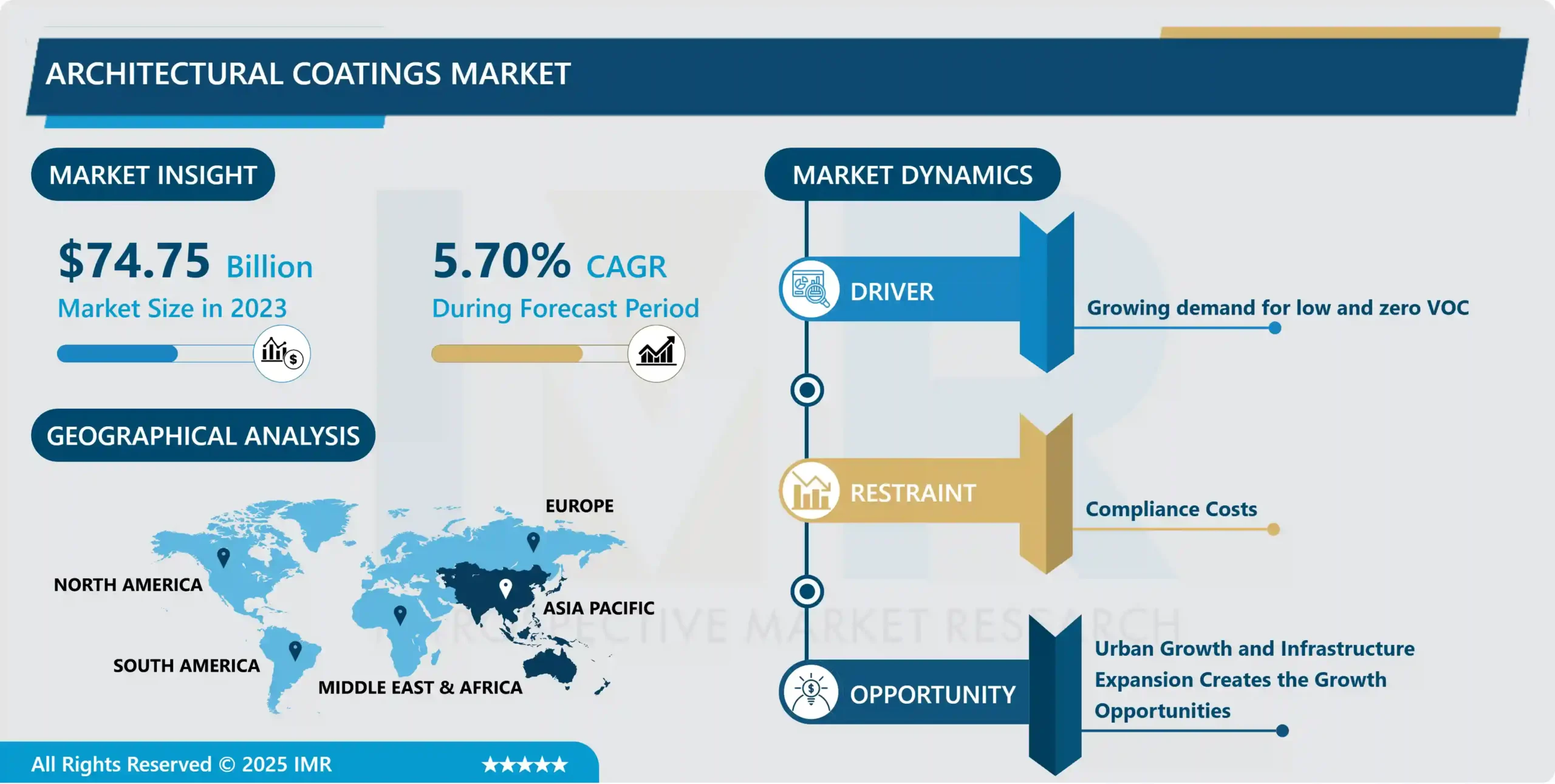
Architectural Coatings Market Size Was Valued at USD 74.75 Billion in 2023 and is Projected to Reach USD 88.27 Billion by 2032, Growing at a CAGR of 5.7% From 2024-2032.
Architectural Surface Coatings are typically considered to be a non-industrial category that homeowners and painting contractors use for coating the interior and exterior of houses, buildings, and other surfaces. This category includes emissions from the application of paint, primer, or varnish to surfaces, the use of solvents as thinners as well as for cleanup.
Architectural Surface Coatings are typically considered to be a non-industrial category that homeowners and painting contractors use for coating the interior and exterior of houses, buildings, and other surfaces. This category includes emissions from the application of paint, primer, or varnish to surfaces, the use of solvents as thinners as well as for cleanup.
Architectural Coatings Market Trend Analysis
Growing demand for low and zero VOC
The growing popularity of low and zero-VOC coatings is driven by health and environmental awareness, resulting in minimized effects on indoor air quality and environmental impact. Interest in biodegradable and natural coatings is increasing, in line with a growing focus on sustainability. There is a growing market for durable coatings that provide extended protection, alongside a rise in the popularity of multi-functional coatings that offer various advantages.
Consumer interest in unique surfaces is driving the growth in demand for textured and decorative finishes. Current design trends influence product offerings based on emerging color trends. Manufacturers are adjusting to more stringent environmental laws by creating compliant and innovative products for energy efficiency and thermal insulation in line with building codes.
Digital tools are revolutionizing color matching for painters and DIY enthusiasts by providing accuracy and ease. The popularity of Augmented Reality applications is increasing as they allow users to preview coatings in their surroundings, enhancing engagement and satisfaction.
Urban Growth and Infrastructure Expansion Creates the Growth Opportunities
Increasing chances for architectural coatings in developing markets, fueled by urban growth, infrastructure improvement, and growing middle-class population. Manufacturers can take advantage of the demand for customized solutions and a range of color and finish choices.
Sustainable coatings with low VOC content and eco-friendly materials are propelled by a focus on sustainability for environmentally conscious construction. Advancements such as smart coatings and nanotechnology improve characteristics and provide additional benefits, creating fresh market prospects within the industry.
The expansion of e-commerce provides manufacturers with an opportunity to increase their audience and offer convenient buying choices. Digital platforms enhance interaction with customers. Tools for virtual design improve marketing strategies and customer satisfaction.
Architectural Coatings Market Segment Analysis:
Architectural Coatings Market Segmented on the basis of Coating Type, Technology, Application, Resin Type, Distribution Channel, And End-User.
By Technology, Water-based Segment Is Expected to Dominate the Market During the Forecast Period
Water-based coatings are projected to lead the architectural coatings industry because of their environmental advantages, adherence to regulations, and popularity among consumers. These coatings emit less VOCs, making them environmentally friendly and safer for indoor applications. Due to growing concern for the environment, water-based coatings are now the top pick for both manufacturers and consumers looking for healthier and more sustainable alternatives.
It is simpler to apply and clean up water-based coatings in comparison to solvent-based ones. They have a fast-drying time, less smell, and are easy to reapply, which is why they are favored by professionals and do-it-yourself enthusiasts. Cleaning up is easy with only water and gentle soap, minimizing the use of strong chemicals. Water-based coatings are long-lasting, and versatile, and provide great color retention, making them a dependable option for a variety of surfaces.
Water-based coatings have a broad range of uses on different surfaces, from homes to commercial environments. They are available in customizable finishes and can be colored in different shades to match specific design requirements. Improvements in technology have enhanced their performance, rendering them equal to or better than solvent-based coatings. Products that come with extra features are now on the market. Even though they may be more expensive at the beginning, their durability ultimately results in cost savings over time. The market for waterborne coatings is growing due to a higher need for sustainable materials.
By Resin Type, the Acrylic Segment Held the Largest Share
Acrylic resins are set to take over the architectural coatings industry because of their flexibility and long-lasting quality. Different applications, such as high-gloss finishes or long-lasting coatings, can be customized for them. Furthermore, their ability to work well with additives improves characteristics such as resistance to UV rays, flexibility, and adhesiveness, guaranteeing durability and protection against abrasion.
Acrylic coatings resistant to UV rays shield against sunlight, preventing deterioration and color loss. They also offer resistance to moisture, mold, and mildew, and can withstand temperature changes without cracking or losing adhesion, making them perfect for a variety of uses.
Acrylic coatings provide sleek surfaces and personalized color options to enhance visual appeal. Their low VOC emissions make them eco-friendly, and they can be easily applied and cleaned with water. Although they may not be the most affordable choice, their durability and accessibility make them a financially savvy option in the market.
Architectural Coatings Market Regional Insights:
Asia Pacific is Expected to Dominate the Market Over the Forecast Period
The global architectural coatings market is dominated by the Asia-Pacific region because of fast urbanization, infrastructure development, a strong construction sector, and positive economic factors. Population growth, rural-to-urban migration, government initiatives, and projects such as India’s Smart Cities Mission are among the factors driving change. These patterns stimulate the need for coatings in both residential and commercial constructions.
Increased construction projects in Asia-Pacific are fueling growth in the industry, with a focus on residential, commercial, and industrial developments. Increased economic activity, higher disposable incomes, and property investments are driving the need for architectural coatings for both indoor and outdoor use in different industries.
The industrialization in nations such as China and India has created new industrial areas that need specialized coatings to protect them. Governments provide tax incentives and financial support for environmentally friendly materials. Stricter environmental rules are driving the industry towards eco-friendly coatings such as water-based choices. The Asia-Pacific region is incorporating new coating technologies such as nanocoatings. Increasing earnings fuel the desire for personalized coatings in different shades and textures.
Architectural Coatings Market Active Players
PPG Industries (USA)
Sherwin-Williams (USA)
AkzoNobel (Netherlands)
Nippon Paint Holdings (Japan)
BASF Coatings (Germany)
Asian Paints (India)
RPM International (USA)
Axalta Coating Systems (USA)
Kansai Paint (Japan)
Jotun Group (Norway)
Masco Corporation (USA)
Hempel Group (Denmark)
Benjamin Moore & Co. (USA)
DAW SE (Germany)
Valspar (now part of Sherwin-Williams) (USA)
Sika AG (Switzerland)
DuluxGroup (Australia)
Berger Paints (India)
Teknos Group (Finland)
Carpoly Chemical Group (China)
Diamond Vogel Paints (USA)
National Paints (United Arab Emirates)
Indigo Paints (India)
DAIKIN Industries (through its subsidiary, PT Daikin Airconditioning Indonesia) (Japan)
Kelly-Moore Paints (USA)
Tikkurila Oyj (Finland)
Cloverdale Paint Inc. (Canada)
Noroo Paint & Coatings (South Korea)
Nerolac Paints (a subsidiary of Kansai Paint) (India)
Axalta Coating Systems (USA) and Other Active Players
Key Industry Developments in the Architectural Coatings Market:
In May 2023: PPG Industries signed an agreement with Brightland Homes. Under this agreement, Brightland Homes agreed to offer PPG paints and coatings to customers across all its operating areas in the U.S.
In Nov 2023, Akzo Nobel N.V. launched the Interpon D1036 Low-E, a pioneer energy powder coating. This coating can be cured at temperatures as low as 150°C. The launch of this coating is likely to enable the company to achieve its target of 50% carbon reduction across the value chain by 2030.
In Mar 2023, Axalta Coating Systems launched its latest ICONICA collection of Alesta SD powder coatings as part of an exclusive global line for the U.S. market. These coatings are based on a super-durable polyester resin system. The collection combines higher-grade pigments and stabilizers with outstanding exterior durability. These powder coatings extend the lifecycle of architectural projects.
Chapter 1: Introduction
1.1 Scope and Coverage
Chapter 2:Executive Summary
Chapter 3: Market Landscape
3.1 Market Dynamics
3.1.1 Drivers
3.1.2 Restraints
3.1.3 Opportunities
3.1.4 Challenges
3.2 Market Trend Analysis
3.3 PESTLE Analysis
3.4 Porter’s Five Forces Analysis
3.5 Industry Value Chain Analysis
3.6 Ecosystem
3.7 Regulatory Landscape
3.8 Price Trend Analysis
3.9 Patent Analysis
3.10 Technology Evolution
3.11 Investment Pockets
3.12 Import-Export Analysis
Chapter 4: Architectural Coatings Market by Coating type (2018-2032)
4.1 Architectural Coatings Market Snapshot and Growth Engine
4.2 Market Overview
4.3 Waterborne
4.3.1 Introduction and Market Overview
4.3.2 Historic and Forecasted Market Size in Value USD and Volume Units
4.3.3 Key Market Trends, Growth Factors, and Opportunities
4.3.4 Geographic Segmentation Analysis
4.4 Solvent-borne
4.5 Powder
Chapter 5: Architectural Coatings Market by Technology (2018-2032)
5.1 Architectural Coatings Market Snapshot and Growth Engine
5.2 Market Overview
5.3 Water-based
5.3.1 Introduction and Market Overview
5.3.2 Historic and Forecasted Market Size in Value USD and Volume Units
5.3.3 Key Market Trends, Growth Factors, and Opportunities
5.3.4 Geographic Segmentation Analysis
5.4 Solvent-based
5.5 Powder-based
Chapter 6: Architectural Coatings Market by Application (2018-2032)
6.1 Architectural Coatings Market Snapshot and Growth Engine
6.2 Market Overview
6.3 Residential
6.3.1 Introduction and Market Overview
6.3.2 Historic and Forecasted Market Size in Value USD and Volume Units
6.3.3 Key Market Trends, Growth Factors, and Opportunities
6.3.4 Geographic Segmentation Analysis
6.4 Non-residential
6.5 Industrial
Chapter 7: Architectural Coatings Market by Resin Type (2018-2032)
7.1 Architectural Coatings Market Snapshot and Growth Engine
7.2 Market Overview
7.3 Acrylic
7.3.1 Introduction and Market Overview
7.3.2 Historic and Forecasted Market Size in Value USD and Volume Units
7.3.3 Key Market Trends, Growth Factors, and Opportunities
7.3.4 Geographic Segmentation Analysis
7.4 Alkyd
7.5 Epoxy
7.6 Polyurethane
7.7 Polyester
7.8 Urethane
Chapter 8: Architectural Coatings Market by Distribution Channel (2018-2032)
8.1 Architectural Coatings Market Snapshot and Growth Engine
8.2 Market Overview
8.3 DIY (Do-It-Yourself)
8.3.1 Introduction and Market Overview
8.3.2 Historic and Forecasted Market Size in Value USD and Volume Units
8.3.3 Key Market Trends, Growth Factors, and Opportunities
8.3.4 Geographic Segmentation Analysis
8.4 Professional
Chapter 9: Architectural Coatings Market by End-User (2018-2032)
9.1 Architectural Coatings Market Snapshot and Growth Engine
9.2 Market Overview
9.3 New Construction
9.3.1 Introduction and Market Overview
9.3.2 Historic and Forecasted Market Size in Value USD and Volume Units
9.3.3 Key Market Trends, Growth Factors, and Opportunities
9.3.4 Geographic Segmentation Analysis
9.4 Renovation/Repainting
Chapter 10: Company Profiles and Competitive Analysis
10.1 Competitive Landscape
10.1.1 Competitive Benchmarking
10.1.2 Architectural Coatings Market Share by Manufacturer (2024)
10.1.3 Industry BCG Matrix
10.1.4 Heat Map Analysis
10.1.5 Mergers and Acquisitions
10.2 PPG INDUSTRIES (USA)
10.2.1 Company Overview
10.2.2 Key Executives
10.2.3 Company Snapshot
10.2.4 Role of the Company in the Market
10.2.5 Sustainability and Social Responsibility
10.2.6 Operating Business Segments
10.2.7 Product Portfolio
10.2.8 Business Performance
10.2.9 Key Strategic Moves and Recent Developments
10.2.10 SWOT Analysis
10.3 SHERWIN-WILLIAMS (USA)
10.4 AKZONOBEL (NETHERLANDS)
10.5 NIPPON PAINT HOLDINGS (JAPAN)
10.6 BASF COATINGS (GERMANY)
10.7 ASIAN PAINTS (INDIA)
10.8 RPM INTERNATIONAL (USA)
10.9 AXALTA COATING SYSTEMS (USA)
10.10 KANSAI PAINT (JAPAN)
10.11 JOTUN GROUP (NORWAY)
10.12 MASCO CORPORATION (USA)
10.13 HEMPEL GROUP (DENMARK)
10.14 BENJAMIN MOORE & CO. (USA)
10.15 DAW SE (GERMANY)
10.16 VALSPAR (NOW PART OF SHERWIN-WILLIAMS) (USA)
10.17 SIKA AG (SWITZERLAND)
10.18 DULUXGROUP (AUSTRALIA)
10.19 BERGER PAINTS (INDIA)
10.20 TEKNOS GROUP (FINLAND)
10.21 CARPOLY CHEMICAL GROUP (CHINA)
10.22 DIAMOND VOGEL PAINTS (USA)
10.23 NATIONAL PAINTS (UNITED ARAB EMIRATES)
10.24 INDIGO PAINTS (INDIA)
10.25 DAIKIN INDUSTRIES (THROUGH ITS SUBSIDIARY
10.26 PT DAIKIN AIRCONDITIONING INDONESIA) (JAPAN)
10.27 KELLY-MOORE PAINTS (USA)
10.28 TIKKURILA OYJ (FINLAND)
10.29 CLOVERDALE PAINT INC. (CANADA)
10.30 NOROO PAINT & COATINGS (SOUTH KOREA)
10.31 NEROLAC PAINTS (ASUBSIDIARY OF KANSAI PAINT) (INDIA)
10.32 AXALTA COATING SYSTEMS (USA)
Chapter 11: Global Architectural Coatings Market By Region
11.1 Overview
11.2. North America Architectural Coatings Market
11.2.1 Key Market Trends, Growth Factors and Opportunities
11.2.2 Top Key Companies
11.2.3 Historic and Forecasted Market Size by Segments
11.2.4 Historic and Forecasted Market Size by Coating type
11.2.4.1 Waterborne
11.2.4.2 Solvent-borne
11.2.4.3 Powder
11.2.5 Historic and Forecasted Market Size by Technology
11.2.5.1 Water-based
11.2.5.2 Solvent-based
11.2.5.3 Powder-based
11.2.6 Historic and Forecasted Market Size by Application
11.2.6.1 Residential
11.2.6.2 Non-residential
11.2.6.3 Industrial
11.2.7 Historic and Forecasted Market Size by Resin Type
11.2.7.1 Acrylic
11.2.7.2 Alkyd
11.2.7.3 Epoxy
11.2.7.4 Polyurethane
11.2.7.5 Polyester
11.2.7.6 Urethane
11.2.8 Historic and Forecasted Market Size by Distribution Channel
11.2.8.1 DIY (Do-It-Yourself)
11.2.8.2 Professional
11.2.9 Historic and Forecasted Market Size by End-User
11.2.9.1 New Construction
11.2.9.2 Renovation/Repainting
11.2.10 Historic and Forecast Market Size by Country
11.2.10.1 US
11.2.10.2 Canada
11.2.10.3 Mexico
11.3. Eastern Europe Architectural Coatings Market
11.3.1 Key Market Trends, Growth Factors and Opportunities
11.3.2 Top Key Companies
11.3.3 Historic and Forecasted Market Size by Segments
11.3.4 Historic and Forecasted Market Size by Coating type
11.3.4.1 Waterborne
11.3.4.2 Solvent-borne
11.3.4.3 Powder
11.3.5 Historic and Forecasted Market Size by Technology
11.3.5.1 Water-based
11.3.5.2 Solvent-based
11.3.5.3 Powder-based
11.3.6 Historic and Forecasted Market Size by Application
11.3.6.1 Residential
11.3.6.2 Non-residential
11.3.6.3 Industrial
11.3.7 Historic and Forecasted Market Size by Resin Type
11.3.7.1 Acrylic
11.3.7.2 Alkyd
11.3.7.3 Epoxy
11.3.7.4 Polyurethane
11.3.7.5 Polyester
11.3.7.6 Urethane
11.3.8 Historic and Forecasted Market Size by Distribution Channel
11.3.8.1 DIY (Do-It-Yourself)
11.3.8.2 Professional
11.3.9 Historic and Forecasted Market Size by End-User
11.3.9.1 New Construction
11.3.9.2 Renovation/Repainting
11.3.10 Historic and Forecast Market Size by Country
11.3.10.1 Russia
11.3.10.2 Bulgaria
11.3.10.3 The Czech Republic
11.3.10.4 Hungary
11.3.10.5 Poland
11.3.10.6 Romania
11.3.10.7 Rest of Eastern Europe
11.4. Western Europe Architectural Coatings Market
11.4.1 Key Market Trends, Growth Factors and Opportunities
11.4.2 Top Key Companies
11.4.3 Historic and Forecasted Market Size by Segments
11.4.4 Historic and Forecasted Market Size by Coating type
11.4.4.1 Waterborne
11.4.4.2 Solvent-borne
11.4.4.3 Powder
11.4.5 Historic and Forecasted Market Size by Technology
11.4.5.1 Water-based
11.4.5.2 Solvent-based
11.4.5.3 Powder-based
11.4.6 Historic and Forecasted Market Size by Application
11.4.6.1 Residential
11.4.6.2 Non-residential
11.4.6.3 Industrial
11.4.7 Historic and Forecasted Market Size by Resin Type
11.4.7.1 Acrylic
11.4.7.2 Alkyd
11.4.7.3 Epoxy
11.4.7.4 Polyurethane
11.4.7.5 Polyester
11.4.7.6 Urethane
11.4.8 Historic and Forecasted Market Size by Distribution Channel
11.4.8.1 DIY (Do-It-Yourself)
11.4.8.2 Professional
11.4.9 Historic and Forecasted Market Size by End-User
11.4.9.1 New Construction
11.4.9.2 Renovation/Repainting
11.4.10 Historic and Forecast Market Size by Country
11.4.10.1 Germany
11.4.10.2 UK
11.4.10.3 France
11.4.10.4 The Netherlands
11.4.10.5 Italy
11.4.10.6 Spain
11.4.10.7 Rest of Western Europe
11.5. Asia Pacific Architectural Coatings Market
11.5.1 Key Market Trends, Growth Factors and Opportunities
11.5.2 Top Key Companies
11.5.3 Historic and Forecasted Market Size by Segments
11.5.4 Historic and Forecasted Market Size by Coating type
11.5.4.1 Waterborne
11.5.4.2 Solvent-borne
11.5.4.3 Powder
11.5.5 Historic and Forecasted Market Size by Technology
11.5.5.1 Water-based
11.5.5.2 Solvent-based
11.5.5.3 Powder-based
11.5.6 Historic and Forecasted Market Size by Application
11.5.6.1 Residential
11.5.6.2 Non-residential
11.5.6.3 Industrial
11.5.7 Historic and Forecasted Market Size by Resin Type
11.5.7.1 Acrylic
11.5.7.2 Alkyd
11.5.7.3 Epoxy
11.5.7.4 Polyurethane
11.5.7.5 Polyester
11.5.7.6 Urethane
11.5.8 Historic and Forecasted Market Size by Distribution Channel
11.5.8.1 DIY (Do-It-Yourself)
11.5.8.2 Professional
11.5.9 Historic and Forecasted Market Size by End-User
11.5.9.1 New Construction
11.5.9.2 Renovation/Repainting
11.5.10 Historic and Forecast Market Size by Country
11.5.10.1 China
11.5.10.2 India
11.5.10.3 Japan
11.5.10.4 South Korea
11.5.10.5 Malaysia
11.5.10.6 Thailand
11.5.10.7 Vietnam
11.5.10.8 The Philippines
11.5.10.9 Australia
11.5.10.10 New Zealand
11.5.10.11 Rest of APAC
11.6. Middle East & Africa Architectural Coatings Market
11.6.1 Key Market Trends, Growth Factors and Opportunities
11.6.2 Top Key Companies
11.6.3 Historic and Forecasted Market Size by Segments
11.6.4 Historic and Forecasted Market Size by Coating type
11.6.4.1 Waterborne
11.6.4.2 Solvent-borne
11.6.4.3 Powder
11.6.5 Historic and Forecasted Market Size by Technology
11.6.5.1 Water-based
11.6.5.2 Solvent-based
11.6.5.3 Powder-based
11.6.6 Historic and Forecasted Market Size by Application
11.6.6.1 Residential
11.6.6.2 Non-residential
11.6.6.3 Industrial
11.6.7 Historic and Forecasted Market Size by Resin Type
11.6.7.1 Acrylic
11.6.7.2 Alkyd
11.6.7.3 Epoxy
11.6.7.4 Polyurethane
11.6.7.5 Polyester
11.6.7.6 Urethane
11.6.8 Historic and Forecasted Market Size by Distribution Channel
11.6.8.1 DIY (Do-It-Yourself)
11.6.8.2 Professional
11.6.9 Historic and Forecasted Market Size by End-User
11.6.9.1 New Construction
11.6.9.2 Renovation/Repainting
11.6.10 Historic and Forecast Market Size by Country
11.6.10.1 Turkiye
11.6.10.2 Bahrain
11.6.10.3 Kuwait
11.6.10.4 Saudi Arabia
11.6.10.5 Qatar
11.6.10.6 UAE
11.6.10.7 Israel
11.6.10.8 South Africa
11.7. South America Architectural Coatings Market
11.7.1 Key Market Trends, Growth Factors and Opportunities
11.7.2 Top Key Companies
11.7.3 Historic and Forecasted Market Size by Segments
11.7.4 Historic and Forecasted Market Size by Coating type
11.7.4.1 Waterborne
11.7.4.2 Solvent-borne
11.7.4.3 Powder
11.7.5 Historic and Forecasted Market Size by Technology
11.7.5.1 Water-based
11.7.5.2 Solvent-based
11.7.5.3 Powder-based
11.7.6 Historic and Forecasted Market Size by Application
11.7.6.1 Residential
11.7.6.2 Non-residential
11.7.6.3 Industrial
11.7.7 Historic and Forecasted Market Size by Resin Type
11.7.7.1 Acrylic
11.7.7.2 Alkyd
11.7.7.3 Epoxy
11.7.7.4 Polyurethane
11.7.7.5 Polyester
11.7.7.6 Urethane
11.7.8 Historic and Forecasted Market Size by Distribution Channel
11.7.8.1 DIY (Do-It-Yourself)
11.7.8.2 Professional
11.7.9 Historic and Forecasted Market Size by End-User
11.7.9.1 New Construction
11.7.9.2 Renovation/Repainting
11.7.10 Historic and Forecast Market Size by Country
11.7.10.1 Brazil
11.7.10.2 Argentina
11.7.10.3 Rest of SA
Chapter 12 Analyst Viewpoint and Conclusion
12.1 Recommendations and Concluding Analysis
12.2 Potential Market Strategies
Chapter 13 Research Methodology
13.1 Research Process
13.2 Primary Research
13.3 Secondary Research
Q1: What would be the forecast period in the Architectural Coatings Market research report?
A1: The forecast period in the Architectural Coatings Market research report is 2024-2032.
Q2: Who are the key players in the Architectural Coatings Market?
A2: PPG Industries (USA), Sherwin-Williams (USA), AkzoNobel (Netherlands), Nippon Paint Holdings (Japan), BASF Coatings (Germany), Asian Paints (India), RPM International (USA), Axalta Coating Systems (USA), Kansai Paint (Japan), Jotun Group (Norway), Masco Corporation (USA), Hempel Group (Denmark), Benjamin Moore & Co. (USA), DAW SE (Germany), Valspar (now part of Sherwin-Williams) (USA), Sika AG (Switzerland), DuluxGroup (Australia), Berger Paints (India), Teknos Group (Finland), Carpoly Chemical Group (China), Diamond Vogel Paints (USA), National Paints (United Arab Emirates), Indigo Paints (India), DAIKIN Industries (through its subsidiary, PT Daikin Airconditioning Indonesia) (Japan), Kelly-Moore Paints (USA), Tikkurila Oyj (Finland), Cloverdale Paint Inc. (Canada), Noroo Paint & Coatings (South Korea), Nerolac Paints (subsidiary of Kansai Paint) (India), Axalta Coating Systems (USA) and Other Active Players.
Q3: What are the segments of the Architectural Coatings Market?
A3: The Architectural Coatings Market is segmented into Coating Type, Technology, Application, Resin Type, Distribution Channel, End-User, and Region. By Coating type, the market is categorized into Waterborne, Solvent-borne, and Powder. By Technology, the market is categorized into Water-based, Solvent-based, and Powder-based. By Application, the market is categorized into Residential, Non-residential, and Industrial. By Resin Type, the market is categorized into Acrylic, Alkyd, Epoxy, Polyurethane, Polyester, And Urethane. By Distribution Channel, The Market Is Categorized into DIY (Do-It-Yourself) and professional. By End-User, the market is categorized into New Construction, Renovation/Repainting. By region, it is analyzed across North America (U.S.; Canada; Mexico), Eastern Europe (Bulgaria; The Czech Republic; Hungary; Poland; Romania; Rest of Eastern Europe), Western Europe (Germany; UK; France; Netherlands; Italy; Russia; Spain; Rest of Western Europe), Asia-Pacific (China; India; Japan; Southeast Asia, etc.), South America (Brazil; Argentina, etc.), Middle East & Africa (Saudi Arabia; South Africa, etc.).
Q4: What is the Architectural Coatings Market?
A4: Architectural Surface Coatings are typically considered to be a non-industrial category that homeowners and painting contractors use for coating the interior and exterior of houses, buildings, and other surfaces. This category includes emissions from the application of paint, primer, or varnish to surfaces, the use of solvents as thinners as well as for cleanup.
Q5: How big is the Architectural Coatings Market?
A5: Architectural Coatings Market Size Was Valued at USD 74.75 Billion in 2023 and is Projected to Reach USD 88.27 Billion by 2032, Growing at a CAGR of 5.7% From 2024-2032.
How to Buy a Report from eminsights.jp
On the product page, choose the license you want: Single-User License, Multi-User License or Enterprise License.
If you required report in your native language, then you can click on Translated Report button and fill out the form with report name and language you want, then our team will contact you as soon as possible.
Click the Buy Now button.
You will be redirected to the checkout page. Enter your company details and payment information.
Click Place Order to complete the purchase.
Confirmation: You’ll receive an order confirmation and our team will contact you shortly with your ordered report.
If you have any questions, fill out the contact form below or email us at [email protected].
Thank you for choosing eminsights.jp!