Stay Ahead in Fast-Growing Economies.
Browse Reports Now
Threat Intelligence Market | Insights for Business Growth
Organizations are increasingly acknowledging the need for proactive cybersecurity measures to protect against the emergence of digital threats, which is why the threat intelligence market is expanding at a rapid pace. This market encompasses solutions and services designed to gather, scrutinize, and decipher information about potential security threats, enabling businesses to foresee and alleviate risks before they materialize. Companies are investing in advanced threat intelligence tools to improve their security posture in response to the increasing complexity and frequency of intrusions, such as ransomware and advanced persistent threats.

IMR Group
Description
Threat Intelligence Market Synopsis
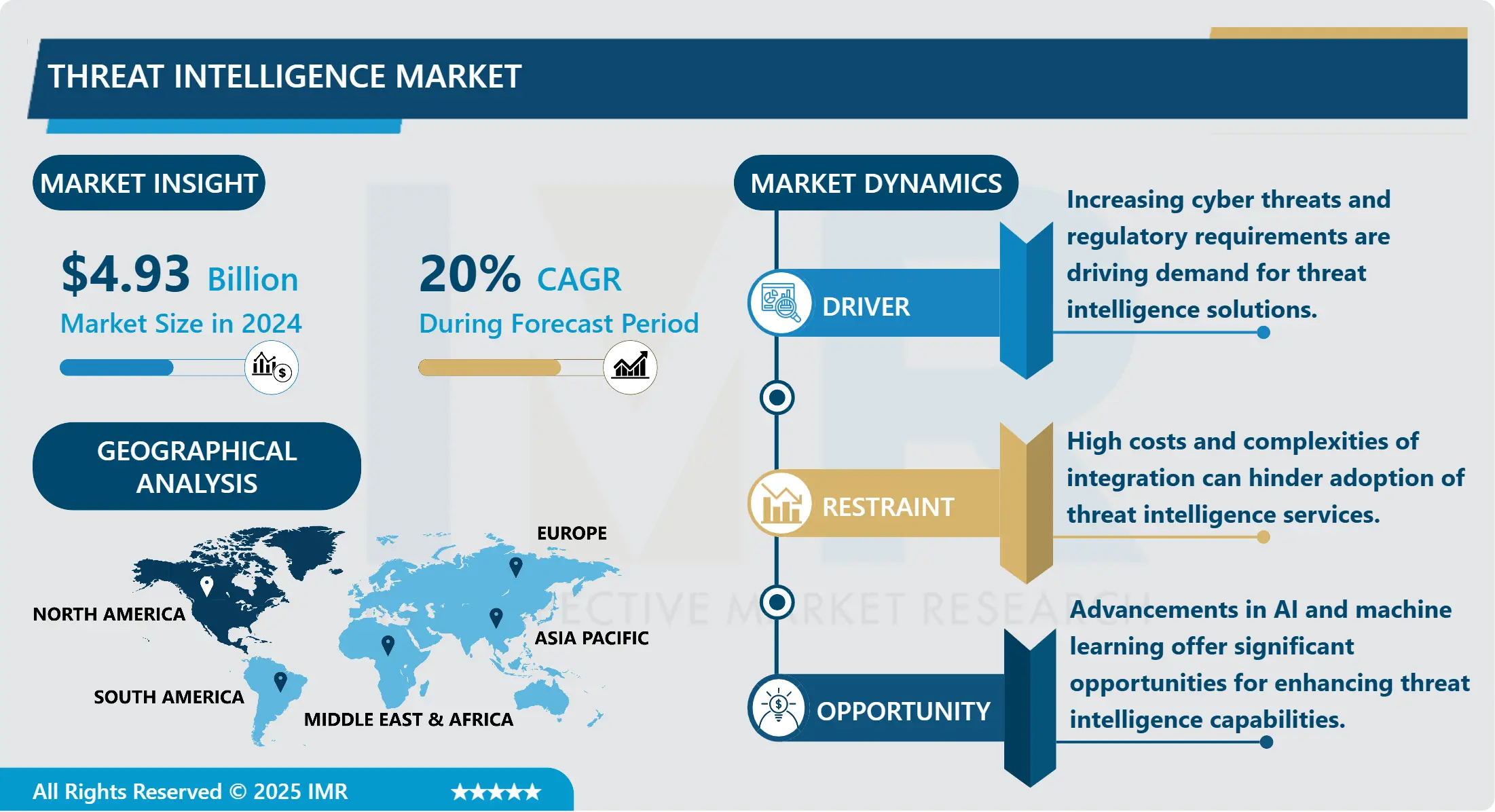
Threat Intelligence Market Size is Valued at USD 4.93 Billion in 2024 and is Projected to Reach USD 21.20 Billion by 2032, Growing at a CAGR of 20% From 2025-2032.
Organizations are increasingly acknowledging the need for proactive cybersecurity measures to protect against the emergence of digital threats, which is why the threat intelligence market is expanding at a rapid pace. This market encompasses solutions and services designed to gather, scrutinize, and decipher information about potential security threats, enabling businesses to foresee and alleviate risks before they materialize. Companies are investing in advanced threat intelligence tools to improve their security posture in response to the increasing complexity and frequency of intrusions, such as ransomware and advanced persistent threats. These tools offer organizations the ability to protect their digital assets and preserve operational integrity by providing actionable insights, threat detection, and response strategies. The threat intelligence market is on the brink of substantial growth as the cyber threat landscape continues to evolve, fueled by the necessity for advanced, real-time threat detection and response capabilities.
The threat intelligence market is a sector that is expanding at a rapid pace, with the primary objective of supplying organizations with the necessary information to identify, evaluate, and respond to cybersecurity threats. This market encompasses a wide range of services and solutions, including threat detection, risk assessment, and incident response, all aimed at enhancing an organization’s ability to proactively manage and mitigate security risks.
The increasing frequency and sophistication of intrusions, along with the growing regulatory requirements for data protection, are driving the demand for advanced threat intelligence solutions. Companies from a variety of industries are investing in these technologies to safeguard their digital assets, guarantee business continuity, and uphold compliance.
The expansion of digital infrastructure, the rise in cybercrime, and the need for real-time threat intelligence to effectively address emergent threats are all contributing factors to market growth. The threat intelligence market is expanding to provide more sophisticated and integrated solutions as organizations continue to confront complex and evolving cybersecurity challenges.
Advancements in artificial intelligence, machine learning, and big data analytics further enhance the capabilities of threat intelligence systems, enabling organizations to improve their overall security posture and stay ahead of potential threats.
Threat Intelligence Market Trend Analysis
Increased Integration of AI and Machine Learning
The threat intelligence market is experiencing significant growth due to the increased integration of artificial intelligence (AI) and machine learning (ML) technologies. These advanced technologies are revolutionizing threat detection and response by enabling more sophisticated analysis and faster identification of potential security threats.
AI and ML algorithms enhance threat intelligence platforms by automating the analysis of vast amounts of data, identifying patterns and anomalies that might indicate emerging threats. This integration improves the accuracy and efficiency of threat detection, allowing organizations to respond more swiftly and effectively to potential cyber threats.
Furthermore, as cyber threats become more complex and sophisticated, the need for advanced threat intelligence solutions has grown. The application of AI and ML in threat intelligence provides organizations with predictive capabilities, helping them anticipate and mitigate risks before they materialize. This trend is driving the development of more advanced and proactive cybersecurity solutions, positioning AI and ML as critical components in the ongoing battle against cyber threats.
Growing Focus on Threat Intelligence Sharing
The increasing complexity and sophistication of cyber threats have led to a significant trend in the threat intelligence market: a growing emphasis on threat intelligence exchange. Organizations and governments are acknowledging the necessity of collaborative cybersecurity strategies, as individual defenses are frequently inadequate against coordinated attacks and advanced persistent threats.
Entities can improve their response strategies, strengthen their overall security postures, and gain a better comprehension of emerging threats by sharing threat intelligence. This collaborative endeavor enables the identification of vulnerabilities in a more expeditious and precise manner, thereby reducing the potential risks that may arise in various industries.
The emphasis on threat intelligence sharing is facilitating the development of new technologies and platforms that facilitate secure and efficient information exchange. As cyber threats continue to develop, we anticipate an increase in demand for integrated threat intelligence solutions that facilitate collaborative defense mechanisms. This trend not only enhances organizational resilience but also contributes to a more robust global cybersecurity ecosystem, where collective knowledge and expertise are essential in the fight against cyber threats.
Threat Intelligence Market Segment Analysis:
Threat Intelligence Market Segmented on the basis of Component, Type, Deployment, Enterprise Type, End-user, and Region.
By Component, Solutions segment is expected to dominate the market during the forecast period
The threat intelligence market is experiencing significant growth as organizations strive to improve their cybersecurity measures in response to new threats. The market divides into two categories: solutions and services. Solutions in the threat intelligence market are software tools and platforms designed to gather, analyze, and interpret data about potential security threats.
These solutions offer organizations the ability to protect their digital assets from sophisticated cyber-attacks by providing real-time insights and automated responses to mitigate risks. Threat intelligence platforms (TIPs), security information and event management (SIEM) platforms, and threat detection systems are among the most prominent examples.
Conversely, the threat intelligence market offers consulting, managed services, and training services that facilitate the implementation and management of threat intelligence solutions. These services provide organizations with continuous monitoring, customized threat assessments, and expert guidance to ensure that they remain ahead of emergent threats.
As the demand for comprehensive threat intelligence solutions and services rises in response to the increasing complexity and pervasiveness of cyber threats, we anticipate the market to expand and innovate.
By End-user, Manufacturing segment held the largest share in 2024
The threat intelligence market is expanding to serve a wide variety of end-users, such as BFSI (Banking, Financial Services, and Insurance), IT & Telecom, Manufacturing, Healthcare, Energy & Utilities, Retail, and the like. The distinct cybersecurity challenges and threats that each of these sectors encounters drive the demand for specialized threat intelligence solutions.
BFSI and healthcare, in particular, are significant contributors to market growth as a result of their imperative to safeguard sensitive data and adhere to rigorous regulations. In the same vein, the IT & Telecom sector heavily relies on threat intelligence to protect network infrastructures, while the Manufacturing, Energy & Utilities, and Retail sectors necessitate robust solutions to thwart industrial espionage and cyber-attacks that target operational systems.
The threat intelligence market is rapidly expanding as organizations in a variety of industries continue to acknowledge the importance of proactive threat management. Advanced analytics, machine learning, and AI technologies are improving the efficacy of threat detection and response. Threat intelligence solutions are becoming indispensable instruments for safeguarding business assets and preserving cybersecurity resilience in a variety of industries by offering real-time data and actionable insights on emergent threats.
Threat Intelligence Market Regional Insights:
North America market held the largest threat intelligence market share in 2024.
North America held the largest market share in the threat intelligence market in 2024, driven by the region’s advanced technological infrastructure and high adoption rates of cybersecurity solutions. The presence of major technology firms, coupled with significant investments in threat intelligence capabilities by both public and private sectors, has positioned North America as a leader in the market. The region’s proactive approach to addressing cybersecurity threats and its robust regulatory environment contribute to its dominant position, as organizations seek to protect sensitive data and mitigate potential risks.
Furthermore, the increasing frequency and sophistication of cyberattacks across various industries in North America are fueling demand for comprehensive threat intelligence solutions. Companies are investing in advanced tools and services to enhance their security posture and respond effectively to emerging threats. As cybersecurity threats continue to evolve, North America’s strong focus on innovation and its well-established cybersecurity ecosystem ensure its continued leadership in the threat intelligence market.
Active Key Players in the Threat Intelligence Market
CrowdStrike, Inc. (U.S.)
AO Kaspersky Lab. (Russia)
IBM Corporation (U.S.)
Vmware, Inc. (U.S.)
Cisco Systems, Inc. (U.S.)
Dell, Inc. (U.S.)
Fortinet, Inc. (U.S.)
Anomali, Inc. (U.S.)
Check Point Software Technologies (Israel)
Huawei Technologies (China)
other Active Players
Chapter 1: Introduction
1.1 Scope and Coverage
Chapter 2:Executive Summary
Chapter 3: Market Landscape
3.1 Market Dynamics
3.1.1 Drivers
3.1.2 Restraints
3.1.3 Opportunities
3.1.4 Challenges
3.2 Market Trend Analysis
3.3 PESTLE Analysis
3.4 Porter’s Five Forces Analysis
3.5 Industry Value Chain Analysis
3.6 Ecosystem
3.7 Regulatory Landscape
3.8 Price Trend Analysis
3.9 Patent Analysis
3.10 Technology Evolution
3.11 Investment Pockets
3.12 Import-Export Analysis
Chapter 4: Threat Intelligence Market by Component (2018-2032)
4.1 Threat Intelligence Market Snapshot and Growth Engine
4.2 Market Overview
4.3 Solutions
4.3.1 Introduction and Market Overview
4.3.2 Historic and Forecasted Market Size in Value USD and Volume Units
4.3.3 Key Market Trends, Growth Factors, and Opportunities
4.3.4 Geographic Segmentation Analysis
4.4 Services
Chapter 5: Threat Intelligence Market by Type (2018-2032)
5.1 Threat Intelligence Market Snapshot and Growth Engine
5.2 Market Overview
5.3 Strategic
5.3.1 Introduction and Market Overview
5.3.2 Historic and Forecasted Market Size in Value USD and Volume Units
5.3.3 Key Market Trends, Growth Factors, and Opportunities
5.3.4 Geographic Segmentation Analysis
5.4 Tactical
5.5 Operational
Chapter 6: Threat Intelligence Market by Deployment (2018-2032)
6.1 Threat Intelligence Market Snapshot and Growth Engine
6.2 Market Overview
6.3 Cloud
6.3.1 Introduction and Market Overview
6.3.2 Historic and Forecasted Market Size in Value USD and Volume Units
6.3.3 Key Market Trends, Growth Factors, and Opportunities
6.3.4 Geographic Segmentation Analysis
6.4 On-Premise
Chapter 7: Threat Intelligence Market by Enterprise Type (2018-2032)
7.1 Threat Intelligence Market Snapshot and Growth Engine
7.2 Market Overview
7.3 SMEs
7.3.1 Introduction and Market Overview
7.3.2 Historic and Forecasted Market Size in Value USD and Volume Units
7.3.3 Key Market Trends, Growth Factors, and Opportunities
7.3.4 Geographic Segmentation Analysis
7.4 Large Enterprise
Chapter 8: Threat Intelligence Market by End-user (2018-2032)
8.1 Threat Intelligence Market Snapshot and Growth Engine
8.2 Market Overview
8.3 BFSI
8.3.1 Introduction and Market Overview
8.3.2 Historic and Forecasted Market Size in Value USD and Volume Units
8.3.3 Key Market Trends, Growth Factors, and Opportunities
8.3.4 Geographic Segmentation Analysis
8.4 IT & Telecom
8.5 Manufacturing
8.6 Healthcare
8.7 Energy & Utilities
8.8 Retail
8.9 Others
Chapter 9: Company Profiles and Competitive Analysis
9.1 Competitive Landscape
9.1.1 Competitive Benchmarking
9.1.2 Threat Intelligence Market Share by Manufacturer (2024)
9.1.3 Industry BCG Matrix
9.1.4 Heat Map Analysis
9.1.5 Mergers and Acquisitions
9.2 CROWDSTRIKE INC. (U.S.)
9.2.1 Company Overview
9.2.2 Key Executives
9.2.3 Company Snapshot
9.2.4 Role of the Company in the Market
9.2.5 Sustainability and Social Responsibility
9.2.6 Operating Business Segments
9.2.7 Product Portfolio
9.2.8 Business Performance
9.2.9 Key Strategic Moves and Recent Developments
9.2.10 SWOT Analysis
9.3 AO KASPERSKY LAB. (RUSSIA)
9.4 IBM CORPORATION (U.S.)
9.5 VMWARE INC. (U.S.)
9.6 CISCO SYSTEMS INC. (U.S.)
9.7 DELL INC. (U.S.)
9.8 FORTINET INC. (U.S.)
9.9 ANOMALI INC. (U.S.)
9.10 CHECK POINT SOFTWARE TECHNOLOGIES (ISRAEL)
9.11 HUAWEI TECHNOLOGIES (CHINA)
9.12 OTHERS
9.13
Chapter 10: Global Threat Intelligence Market By Region
10.1 Overview
10.2. North America Threat Intelligence Market
10.2.1 Key Market Trends, Growth Factors and Opportunities
10.2.2 Top Key Companies
10.2.3 Historic and Forecasted Market Size by Segments
10.2.4 Historic and Forecasted Market Size by Component
10.2.4.1 Solutions
10.2.4.2 Services
10.2.5 Historic and Forecasted Market Size by Type
10.2.5.1 Strategic
10.2.5.2 Tactical
10.2.5.3 Operational
10.2.6 Historic and Forecasted Market Size by Deployment
10.2.6.1 Cloud
10.2.6.2 On-Premise
10.2.7 Historic and Forecasted Market Size by Enterprise Type
10.2.7.1 SMEs
10.2.7.2 Large Enterprise
10.2.8 Historic and Forecasted Market Size by End-user
10.2.8.1 BFSI
10.2.8.2 IT & Telecom
10.2.8.3 Manufacturing
10.2.8.4 Healthcare
10.2.8.5 Energy & Utilities
10.2.8.6 Retail
10.2.8.7 Others
10.2.9 Historic and Forecast Market Size by Country
10.2.9.1 US
10.2.9.2 Canada
10.2.9.3 Mexico
10.3. Eastern Europe Threat Intelligence Market
10.3.1 Key Market Trends, Growth Factors and Opportunities
10.3.2 Top Key Companies
10.3.3 Historic and Forecasted Market Size by Segments
10.3.4 Historic and Forecasted Market Size by Component
10.3.4.1 Solutions
10.3.4.2 Services
10.3.5 Historic and Forecasted Market Size by Type
10.3.5.1 Strategic
10.3.5.2 Tactical
10.3.5.3 Operational
10.3.6 Historic and Forecasted Market Size by Deployment
10.3.6.1 Cloud
10.3.6.2 On-Premise
10.3.7 Historic and Forecasted Market Size by Enterprise Type
10.3.7.1 SMEs
10.3.7.2 Large Enterprise
10.3.8 Historic and Forecasted Market Size by End-user
10.3.8.1 BFSI
10.3.8.2 IT & Telecom
10.3.8.3 Manufacturing
10.3.8.4 Healthcare
10.3.8.5 Energy & Utilities
10.3.8.6 Retail
10.3.8.7 Others
10.3.9 Historic and Forecast Market Size by Country
10.3.9.1 Russia
10.3.9.2 Bulgaria
10.3.9.3 The Czech Republic
10.3.9.4 Hungary
10.3.9.5 Poland
10.3.9.6 Romania
10.3.9.7 Rest of Eastern Europe
10.4. Western Europe Threat Intelligence Market
10.4.1 Key Market Trends, Growth Factors and Opportunities
10.4.2 Top Key Companies
10.4.3 Historic and Forecasted Market Size by Segments
10.4.4 Historic and Forecasted Market Size by Component
10.4.4.1 Solutions
10.4.4.2 Services
10.4.5 Historic and Forecasted Market Size by Type
10.4.5.1 Strategic
10.4.5.2 Tactical
10.4.5.3 Operational
10.4.6 Historic and Forecasted Market Size by Deployment
10.4.6.1 Cloud
10.4.6.2 On-Premise
10.4.7 Historic and Forecasted Market Size by Enterprise Type
10.4.7.1 SMEs
10.4.7.2 Large Enterprise
10.4.8 Historic and Forecasted Market Size by End-user
10.4.8.1 BFSI
10.4.8.2 IT & Telecom
10.4.8.3 Manufacturing
10.4.8.4 Healthcare
10.4.8.5 Energy & Utilities
10.4.8.6 Retail
10.4.8.7 Others
10.4.9 Historic and Forecast Market Size by Country
10.4.9.1 Germany
10.4.9.2 UK
10.4.9.3 France
10.4.9.4 The Netherlands
10.4.9.5 Italy
10.4.9.6 Spain
10.4.9.7 Rest of Western Europe
10.5. Asia Pacific Threat Intelligence Market
10.5.1 Key Market Trends, Growth Factors and Opportunities
10.5.2 Top Key Companies
10.5.3 Historic and Forecasted Market Size by Segments
10.5.4 Historic and Forecasted Market Size by Component
10.5.4.1 Solutions
10.5.4.2 Services
10.5.5 Historic and Forecasted Market Size by Type
10.5.5.1 Strategic
10.5.5.2 Tactical
10.5.5.3 Operational
10.5.6 Historic and Forecasted Market Size by Deployment
10.5.6.1 Cloud
10.5.6.2 On-Premise
10.5.7 Historic and Forecasted Market Size by Enterprise Type
10.5.7.1 SMEs
10.5.7.2 Large Enterprise
10.5.8 Historic and Forecasted Market Size by End-user
10.5.8.1 BFSI
10.5.8.2 IT & Telecom
10.5.8.3 Manufacturing
10.5.8.4 Healthcare
10.5.8.5 Energy & Utilities
10.5.8.6 Retail
10.5.8.7 Others
10.5.9 Historic and Forecast Market Size by Country
10.5.9.1 China
10.5.9.2 India
10.5.9.3 Japan
10.5.9.4 South Korea
10.5.9.5 Malaysia
10.5.9.6 Thailand
10.5.9.7 Vietnam
10.5.9.8 The Philippines
10.5.9.9 Australia
10.5.9.10 New Zealand
10.5.9.11 Rest of APAC
10.6. Middle East & Africa Threat Intelligence Market
10.6.1 Key Market Trends, Growth Factors and Opportunities
10.6.2 Top Key Companies
10.6.3 Historic and Forecasted Market Size by Segments
10.6.4 Historic and Forecasted Market Size by Component
10.6.4.1 Solutions
10.6.4.2 Services
10.6.5 Historic and Forecasted Market Size by Type
10.6.5.1 Strategic
10.6.5.2 Tactical
10.6.5.3 Operational
10.6.6 Historic and Forecasted Market Size by Deployment
10.6.6.1 Cloud
10.6.6.2 On-Premise
10.6.7 Historic and Forecasted Market Size by Enterprise Type
10.6.7.1 SMEs
10.6.7.2 Large Enterprise
10.6.8 Historic and Forecasted Market Size by End-user
10.6.8.1 BFSI
10.6.8.2 IT & Telecom
10.6.8.3 Manufacturing
10.6.8.4 Healthcare
10.6.8.5 Energy & Utilities
10.6.8.6 Retail
10.6.8.7 Others
10.6.9 Historic and Forecast Market Size by Country
10.6.9.1 Turkiye
10.6.9.2 Bahrain
10.6.9.3 Kuwait
10.6.9.4 Saudi Arabia
10.6.9.5 Qatar
10.6.9.6 UAE
10.6.9.7 Israel
10.6.9.8 South Africa
10.7. South America Threat Intelligence Market
10.7.1 Key Market Trends, Growth Factors and Opportunities
10.7.2 Top Key Companies
10.7.3 Historic and Forecasted Market Size by Segments
10.7.4 Historic and Forecasted Market Size by Component
10.7.4.1 Solutions
10.7.4.2 Services
10.7.5 Historic and Forecasted Market Size by Type
10.7.5.1 Strategic
10.7.5.2 Tactical
10.7.5.3 Operational
10.7.6 Historic and Forecasted Market Size by Deployment
10.7.6.1 Cloud
10.7.6.2 On-Premise
10.7.7 Historic and Forecasted Market Size by Enterprise Type
10.7.7.1 SMEs
10.7.7.2 Large Enterprise
10.7.8 Historic and Forecasted Market Size by End-user
10.7.8.1 BFSI
10.7.8.2 IT & Telecom
10.7.8.3 Manufacturing
10.7.8.4 Healthcare
10.7.8.5 Energy & Utilities
10.7.8.6 Retail
10.7.8.7 Others
10.7.9 Historic and Forecast Market Size by Country
10.7.9.1 Brazil
10.7.9.2 Argentina
10.7.9.3 Rest of SA
Chapter 11 Analyst Viewpoint and Conclusion
11.1 Recommendations and Concluding Analysis
11.2 Potential Market Strategies
Chapter 12 Research Methodology
12.1 Research Process
12.2 Primary Research
12.3 Secondary Research
Q1: What would be the forecast period in the Threat Intelligence Market research report?
A1: The forecast period in the Threat Intelligence Market research report is 2024-2032.
Q2: Who are the key players in the Threat Intelligence Market?
A2: CrowdStrike, Inc. (U.S.), AO Kaspersky Lab (Russia), IBM Corporation (U.S.), VMware, Inc. (U.S.), Cisco Systems, Inc. (U.S.), Dell, Inc. (U.S.), Fortinet, Inc. (U.S.), Anomali, Inc. (U.S.), Check Point Software Technologies (Israel), Huawei Technologies (China), Other Active Players.
Q3: What are the segments of the Threat Intelligence Market?
A3: The Threat Intelligence Market is segmented into By Component (Solutions, Services), By Type (Strategic, Tactical, Operational), By Deployment (Cloud, On-Premise), By Enterprise Type (SMEs, Large Enterprise), By End-user (BFSI, IT & Telecom, Manufacturing, Healthcare, Energy & Utilities, Retail, Others). By Region, it is analyzed across North America (U.S.; Canada; Mexico), Eastern Europe (Russia; Bulgaria; The Czech Republic; Hungary; Poland; Romania; Rest of Eastern Europe), Western Europe (Germany; UK; France; The Netherlands; Italy; Spain; Rest of Western Europe), Asia-Pacific (China; India; Japan; South Korea; Malaysia; Thailand; Vietnam; The Philippines; Australia; New Zealand; Rest of APAC), Middle East & Africa (Türkiye; Bahrain; Kuwait; Saudi Arabia; Qatar; UAE; Israel; South Africa), South America (Brazil; Argentina; Rest of SA.).
Q4: What is the Threat Intelligence Market?
A4: Threat intelligence refers to the collection, analysis, and dissemination of information regarding potential or existing cyber threats to an organization's digital assets. It involves gathering data from various sources, such as cybersecurity reports, threat feeds, and incident databases, and analyzing this information to identify patterns, trends, and indicators of compromise. The goal of threat intelligence is to provide actionable insights that help organizations anticipate, detect, and respond to cyber threats more effectively. By understanding the tactics, techniques, and procedures used by threat actors, organizations can enhance their security measures, improve incident response strategies, and better protect their networks and data from cyberattacks.
Q5: How big is the Threat Intelligence Market?
A5: Threat Intelligence Market Size is Valued at USD 4.93 Billion in 2024 and is Projected to Reach USD 21.20 Billion by 2032, Growing at a CAGR of 20% From 2025-2032.
How to Buy a Report from eminsights.jp
On the product page, choose the license you want: Single-User License, Multi-User License or Enterprise License.
If you required report in your native language, then you can click on Translated Report button and fill out the form with report name and language you want, then our team will contact you as soon as possible.
Click the Buy Now button.
You will be redirected to the checkout page. Enter your company details and payment information.
Click Place Order to complete the purchase.
Confirmation: You’ll receive an order confirmation and our team will contact you shortly with your ordered report.
If you have any questions, fill out the contact form below or email us at [email protected].
Thank you for choosing eminsights.jp!