Stay Ahead in Fast-Growing Economies.
Browse Reports Now


Krill Oil Market-Global Demand & Upcoming Industry Trends
Krill oil is type of nutrient supplements obtained from small shoaling fish species referred to as krill which inhabit the ocean floor in the polar regions. It contains omega three fatty acids, particularly EPA and DHA and incorporates antioxidants which are astaxanthin. It is normally taken to enhance the well-being of a body especially the heart, lessen inflammation, and several other uses. Omega-3 in flaxseed is thought to be absorbed and remain more potent because if their phospholipid shell while fish oil are only in triglyceride form.

IMR Group
Description
Krill Oil Market Synopsis
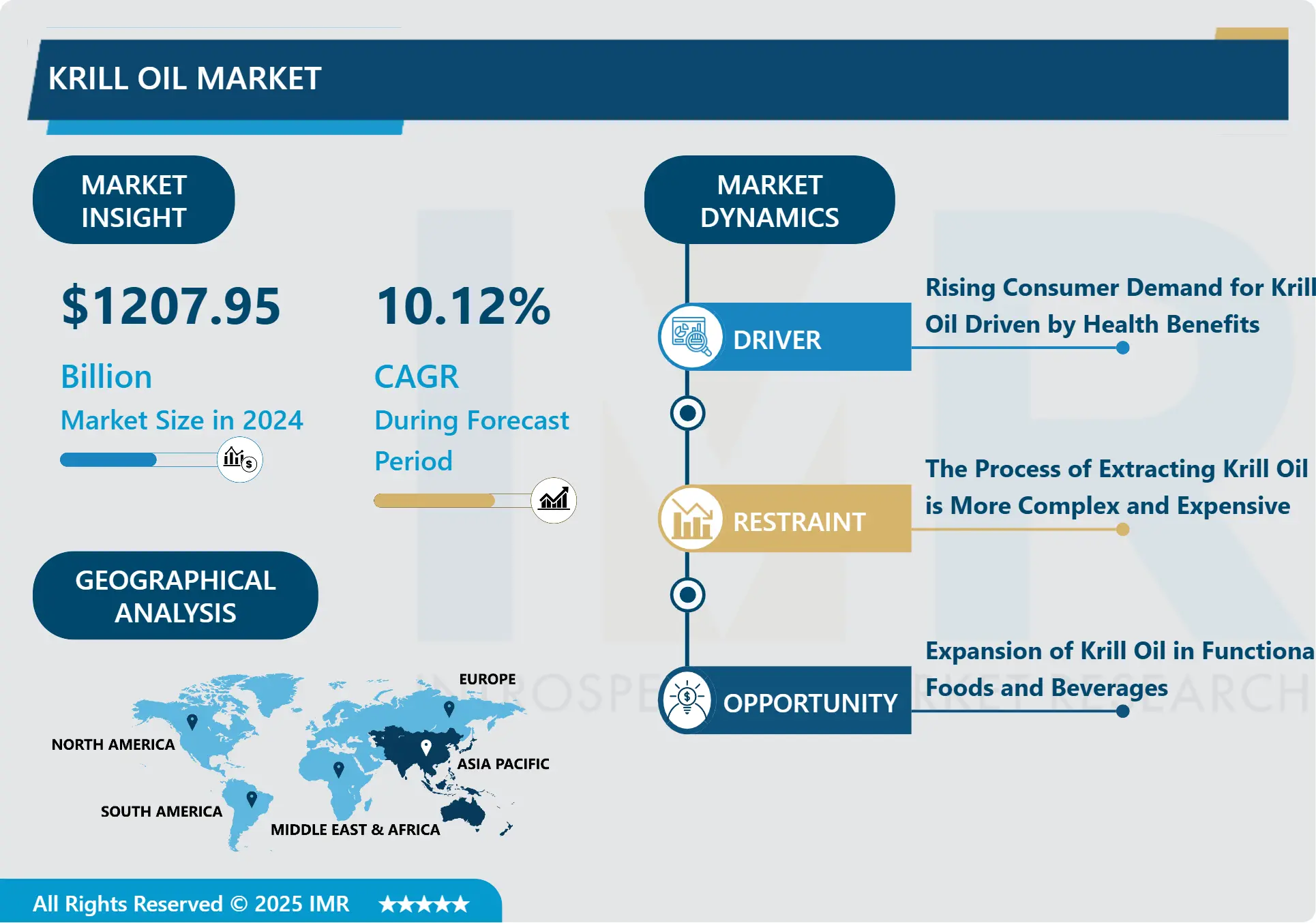
Krill Oil Market Size Was Valued at USD 1207.95 Million in 2024 and is Projected to Reach USD 2612.03 Million by 2032, Growing at a CAGR of 10.12% From 2025-2032.
Krill oil is a dietary supplement derived from the Antarctic krill species, Euphausia superba. It contains omega-3 fatty acids, similar to those found in fish oil, and phospholipid-derived fatty acids (PLFA), primarily phosphatidylcholine, also known as marine lecithin. Krill oil is praised for its potential health benefits, including supporting heart health, reducing inflammation, and promoting cognitive function.
Krill oil is extracted from small, shrimp-like marine creatures known as Antarctic krill, primarily Euphausia superba. These tiny crustaceans are abundant in the Southern Ocean and play a crucial role in the marine food web. Krill oil is particularly valued for its high content of omega-3 fatty acids, specifically eicosapentaenoic acid (EPA) and docosahexaenoic acid (DHA), which are essential for various bodily functions.
The primary health benefits of krill oil are attributed to its omega-3 fatty acids. Unlike many nutrients, the human body cannot produce sufficient amounts of omega-3 fatty acids on its own, making dietary sources essential. Omega-3s are known for their anti-inflammatory properties, which can help reduce pain and swelling throughout the body. They also play a vital role in cardiovascular health by improving lipid profiles and reducing the risk of heart disease.
Krill oil is often marketed for several health conditions, with one of its more common uses being for dry eye syndrome. It is also used as a supplement for managing high triglyceride levels, high cholesterol, diabetes, and even depression. However, while many individuals report positive effects from krill oil supplementation, the scientific evidence supporting these claims varies significantly. Research is still ongoing to clarify its efficacy in treating these conditions.
In addition to omega-3 fatty acids, krill oil contains phospholipids, primarily phosphatidylcholine, which may enhance the bioavailability of omega-3s in the body. This unique structure allows for better absorption compared to traditional fish oil supplements. Krill oil also provides antioxidants, including astaxanthin, which may offer additional health benefits by protecting cells from oxidative damage.
krill oil is a rich source of omega-3 fatty acids and other beneficial compounds, making it a popular dietary supplement. While it shows promise for various health benefits, more robust scientific evidence is needed to fully support many of its claimed uses. As with any supplement, individuals should approach krill oil with a balanced perspective, prioritizing consultation with healthcare professionals to tailor their nutritional choices to their specific health needs.
Composition of the Krill Oil:
S. No.
Fatty Acid Type
% (Approx.)
1
Polyunsaturated fatty acids
36.7
A
n-3 Fatty acids (total)
33.6
(i)
n-3 Eicosapentaenoic acid (EPA)
17.2
(ii)
n-3 Docosahexaenoic acid (DHA)
11.3
(iii)
n-3 Docosapentaenoic acid (DPA)
0.6
B
n-6 Fatty acids (total)
1.6
(i)
n-6 Linoleic acid
1.4
C
n-9 Fatty acids (total)
9.6
2
Monounsaturated fatty acids
22.1
(i)
Oleic acid
8.6
3
Saturated fatty acids
29.8
4
Trans-fatty acids
0.01
Biochemical Profile of Krill Oil
S. No.
Parameter
Amount
1
Saponification value
175 mg/g
2
Iodine value
138 g/100 g
3
Peroxide value
0.1
4
p-Anisidine value
1.0
Other Important Constituents in Krill Oil
Constituent
Content
Vitamin A
260 IU/g
Vitamin E
0.65 IU/g
Astaxanthin (esterified)
163 mg/100 g
Protein
3.0 g/100 g
Krill Oil Market Trend Analysis
Rising Consumer Demand for Krill Oil Driven by Health Benefits
The rising consumer demand for krill oil is significantly driven by its well-researched health benefits, making it an appealing supplement for individuals seeking to enhance their overall well-being. As consumers become more health-conscious and informed about dietary supplements, they increasingly look for natural products that offer multiple therapeutic advantages. Krill oil, rich in omega-3 fatty acids, antioxidants like astaxanthin, and other bioactive compounds, presents a comprehensive solution for a variety of health concerns, ranging from cardiovascular health to cognitive function and joint inflammation.
One of the primary drivers of this demand is the growing awareness of cardiovascular diseases and the importance of maintaining heart health. With an increasing prevalence of obesity and sedentary lifestyles globally, consumers are actively seeking natural alternatives to pharmaceutical interventions. Krill oil has been shown to reduce triglyceride levels, improve endothelial function, and lower blood pressure, making it a sought-after option f
Chapter 1: Introduction
1.1 Scope and Coverage
Chapter 2:Executive Summary
Chapter 3: Market Landscape
3.1 Market Dynamics
3.1.1 Drivers
3.1.2 Restraints
3.1.3 Opportunities
3.1.4 Challenges
3.2 Market Trend Analysis
3.3 PESTLE Analysis
3.4 Porter’s Five Forces Analysis
3.5 Industry Value Chain Analysis
3.6 Ecosystem
3.7 Regulatory Landscape
3.8 Price Trend Analysis
3.9 Patent Analysis
3.10 Technology Evolution
3.11 Investment Pockets
3.12 Import-Export Analysis
Chapter 4: Krill Oil Market by Type (2018-2032)
4.1 Krill Oil Market Snapshot and Growth Engine
4.2 Market Overview
4.3 Liquids
4.3.1 Introduction and Market Overview
4.3.2 Historic and Forecasted Market Size in Value USD and Volume Units
4.3.3 Key Market Trends, Growth Factors, and Opportunities
4.3.4 Geographic Segmentation Analysis
4.4 Soft gels capsuless
4.5 Gummies
4.6 Powder
Chapter 5: Krill Oil Market by Application (2018-2032)
5.1 Krill Oil Market Snapshot and Growth Engine
5.2 Market Overview
5.3 Dietary supplements
5.3.1 Introduction and Market Overview
5.3.2 Historic and Forecasted Market Size in Value USD and Volume Units
5.3.3 Key Market Trends, Growth Factors, and Opportunities
5.3.4 Geographic Segmentation Analysis
5.4 Animal feed]
5.5 Functional Food & Beverages
5.6 Pharmaceuticals
5.7 Others
Chapter 6: Krill Oil Market by Distribution Channel (2018-2032)
6.1 Krill Oil Market Snapshot and Growth Engine
6.2 Market Overview
6.3 Supermarkets/ Hypermarkets
6.3.1 Introduction and Market Overview
6.3.2 Historic and Forecasted Market Size in Value USD and Volume Units
6.3.3 Key Market Trends, Growth Factors, and Opportunities
6.3.4 Geographic Segmentation Analysis
6.4 Drug Stores & Pharmacies
6.5 Online Retailers
6.6 Others
Chapter 7: Company Profiles and Competitive Analysis
7.1 Competitive Landscape
7.1.1 Competitive Benchmarking
7.1.2 Krill Oil Market Share by Manufacturer (2024)
7.1.3 Industry BCG Matrix
7.1.4 Heat Map Analysis
7.1.5 Mergers and Acquisitions
7.2 AKER BIOMARINE (NORWAY)
7.2.1 Company Overview
7.2.2 Key Executives
7.2.3 Company Snapshot
7.2.4 Role of the Company in the Market
7.2.5 Sustainability and Social Responsibility
7.2.6 Operating Business Segments
7.2.7 Product Portfolio
7.2.8 Business Performance
7.2.9 Key Strategic Moves and Recent Developments
7.2.10 SWOT Analysis
7.3 COASTSIDE BIO RESOURCES (USA)
7.4 RIMFROST KRILL (NORWAY)
7.5 NUTRIGOLD (USA)
7.6 BIOCORP COLTD (SOUTH KOREA)
7.7 KAIRA ORGANIC WORLD (INDIA)
7.8 KABIR LIFESCIENCES (INDIA)
7.9 QINGDAO ANTARCTIC WEIKANG BIOTECHNOLOGY COLTD. (CHINA)
7.10 NUTRACODE LLC (USA)
7.11 BIOEXTRACTION TECHNOLOGY (MALAYSIA)
7.12 BIOTHRIVE SCIENCES (USA)
Chapter 8: Global Krill Oil Market By Region
8.1 Overview
8.2. North America Krill Oil Market
8.2.1 Key Market Trends, Growth Factors and Opportunities
8.2.2 Top Key Companies
8.2.3 Historic and Forecasted Market Size by Segments
8.2.4 Historic and Forecasted Market Size by Type
8.2.4.1 Liquids
8.2.4.2 Soft gels capsuless
8.2.4.3 Gummies
8.2.4.4 Powder
8.2.5 Historic and Forecasted Market Size by Application
8.2.5.1 Dietary supplements
8.2.5.2 Animal feed]
8.2.5.3 Functional Food & Beverages
8.2.5.4 Pharmaceuticals
8.2.5.5 Others
8.2.6 Historic and Forecasted Market Size by Distribution Channel
8.2.6.1 Supermarkets/ Hypermarkets
8.2.6.2 Drug Stores & Pharmacies
8.2.6.3 Online Retailers
8.2.6.4 Others
8.2.7 Historic and Forecast Market Size by Country
8.2.7.1 US
8.2.7.2 Canada
8.2.7.3 Mexico
8.3. Eastern Europe Krill Oil Market
8.3.1 Key Market Trends, Growth Factors and Opportunities
8.3.2 Top Key Companies
8.3.3 Historic and Forecasted Market Size by Segments
8.3.4 Historic and Forecasted Market Size by Type
8.3.4.1 Liquids
8.3.4.2 Soft gels capsuless
8.3.4.3 Gummies
8.3.4.4 Powder
8.3.5 Historic and Forecasted Market Size by Application
8.3.5.1 Dietary supplements
8.3.5.2 Animal feed]
8.3.5.3 Functional Food & Beverages
8.3.5.4 Pharmaceuticals
8.3.5.5 Others
8.3.6 Historic and Forecasted Market Size by Distribution Channel
8.3.6.1 Supermarkets/ Hypermarkets
8.3.6.2 Drug Stores & Pharmacies
8.3.6.3 Online Retailers
8.3.6.4 Others
8.3.7 Historic and Forecast Market Size by Country
8.3.7.1 Russia
8.3.7.2 Bulgaria
8.3.7.3 The Czech Republic
8.3.7.4 Hungary
8.3.7.5 Poland
8.3.7.6 Romania
8.3.7.7 Rest of Eastern Europe
8.4. Western Europe Krill Oil Market
8.4.1 Key Market Trends, Growth Factors and Opportunities
8.4.2 Top Key Companies
8.4.3 Historic and Forecasted Market Size by Segments
8.4.4 Historic and Forecasted Market Size by Type
8.4.4.1 Liquids
8.4.4.2 Soft gels capsuless
8.4.4.3 Gummies
8.4.4.4 Powder
8.4.5 Historic and Forecasted Market Size by Application
8.4.5.1 Dietary supplements
8.4.5.2 Animal feed]
8.4.5.3 Functional Food & Beverages
8.4.5.4 Pharmaceuticals
8.4.5.5 Others
8.4.6 Historic and Forecasted Market Size by Distribution Channel
8.4.6.1 Supermarkets/ Hypermarkets
8.4.6.2 Drug Stores & Pharmacies
8.4.6.3 Online Retailers
8.4.6.4 Others
8.4.7 Historic and Forecast Market Size by Country
8.4.7.1 Germany
8.4.7.2 UK
8.4.7.3 France
8.4.7.4 The Netherlands
8.4.7.5 Italy
8.4.7.6 Spain
8.4.7.7 Rest of Western Europe
8.5. Asia Pacific Krill Oil Market
8.5.1 Key Market Trends, Growth Factors and Opportunities
8.5.2 Top Key Companies
8.5.3 Historic and Forecasted Market Size by Segments
8.5.4 Historic and Forecasted Market Size by Type
8.5.4.1 Liquids
8.5.4.2 Soft gels capsuless
8.5.4.3 Gummies
8.5.4.4 Powder
8.5.5 Historic and Forecasted Market Size by Application
8.5.5.1 Dietary supplements
8.5.5.2 Animal feed]
8.5.5.3 Functional Food & Beverages
8.5.5.4 Pharmaceuticals
8.5.5.5 Others
8.5.6 Historic and Forecasted Market Size by Distribution Channel
8.5.6.1 Supermarkets/ Hypermarkets
8.5.6.2 Drug Stores & Pharmacies
8.5.6.3 Online Retailers
8.5.6.4 Others
8.5.7 Historic and Forecast Market Size by Country
8.5.7.1 China
8.5.7.2 India
8.5.7.3 Japan
8.5.7.4 South Korea
8.5.7.5 Malaysia
8.5.7.6 Thailand
8.5.7.7 Vietnam
8.5.7.8 The Philippines
8.5.7.9 Australia
8.5.7.10 New Zealand
8.5.7.11 Rest of APAC
8.6. Middle East & Africa Krill Oil Market
8.6.1 Key Market Trends, Growth Factors and Opportunities
8.6.2 Top Key Companies
8.6.3 Historic and Forecasted Market Size by Segments
8.6.4 Historic and Forecasted Market Size by Type
8.6.4.1 Liquids
8.6.4.2 Soft gels capsuless
8.6.4.3 Gummies
8.6.4.4 Powder
8.6.5 Historic and Forecasted Market Size by Application
8.6.5.1 Dietary supplements
8.6.5.2 Animal feed]
8.6.5.3 Functional Food & Beverages
8.6.5.4 Pharmaceuticals
8.6.5.5 Others
8.6.6 Historic and Forecasted Market Size by Distribution Channel
8.6.6.1 Supermarkets/ Hypermarkets
8.6.6.2 Drug Stores & Pharmacies
8.6.6.3 Online Retailers
8.6.6.4 Others
8.6.7 Historic and Forecast Market Size by Country
8.6.7.1 Turkiye
8.6.7.2 Bahrain
8.6.7.3 Kuwait
8.6.7.4 Saudi Arabia
8.6.7.5 Qatar
8.6.7.6 UAE
8.6.7.7 Israel
8.6.7.8 South Africa
8.7. South America Krill Oil Market
8.7.1 Key Market Trends, Growth Factors and Opportunities
8.7.2 Top Key Companies
8.7.3 Historic and Forecasted Market Size by Segments
8.7.4 Historic and Forecasted Market Size by Type
8.7.4.1 Liquids
8.7.4.2 Soft gels capsuless
8.7.4.3 Gummies
8.7.4.4 Powder
8.7.5 Historic and Forecasted Market Size by Application
8.7.5.1 Dietary supplements
8.7.5.2 Animal feed]
8.7.5.3 Functional Food & Beverages
8.7.5.4 Pharmaceuticals
8.7.5.5 Others
8.7.6 Historic and Forecasted Market Size by Distribution Channel
8.7.6.1 Supermarkets/ Hypermarkets
8.7.6.2 Drug Stores & Pharmacies
8.7.6.3 Online Retailers
8.7.6.4 Others
8.7.7 Historic and Forecast Market Size by Country
8.7.7.1 Brazil
8.7.7.2 Argentina
8.7.7.3 Rest of SA
Chapter 9 Analyst Viewpoint and Conclusion
9.1 Recommendations and Concluding Analysis
9.2 Potential Market Strategies
Chapter 10 Research Methodology
10.1 Research Process
10.2 Primary Research
10.3 Secondary Research
Q1: What would be the forecast period in the Krill Oil Market research report?
A1: The forecast period in the Krill Oil Market research report is 2025-2032.
Q2: Who are the key players in the Krill Oil Market?
A2: Aker Biomarine (Norway), Coastside Bio Resources (USA), Rimfrost Krill (Norway), Nutrigold (USA), Biocorp Co., Ltd (South Korea), Kaira Organic World (India), Kabir Lifesciences (India), Qingdao Antarctic Weikang Biotechnology Co., Ltd. (China), Nutracode LLC (USA), Bioextraction Technology (Malaysia), BioThrive Sciences (USA), and other active players.
Q3: What are the segments of the Krill Oil Market?
A3: The Krill Oil Market is segmented into Product, Application, Distribution Channel, and region. By Product, the market is categorized into Liquids, Soft gels capsules, Gummies, Powder. By Application, the market is categorized into Dietary supplements, Animal feed, Functional Food & Beverages, Pharmaceuticals, and Others. By Distribution Channel, the market is categorized into Supermarkets/ Hypermarkets, Drug Stores & Pharmacies, Online Retailers, Others. By region, it is analyzed across North America (U.S.; Canada; Mexico), Eastern Europe (Bulgaria; The Czech Republic; Hungary; Poland; Romania; Rest of Eastern Europe), Western Europe (Germany; UK; France; Netherlands; Italy; Russia; Spain; Rest of Western Europe), Asia-Pacific (China; India; Japan; Southeast Asia, etc.), South America (Brazil; Argentina, etc.), Middle East & Africa (Saudi Arabia; South Africa, etc.).
Q4: What is the Krill Oil Market?
A4: Krill oil is a dietary supplement derived from the Antarctic krill species, Euphausia superba. It contains omega-3 fatty acids, similar to those found in fish oil, and phospholipid-derived fatty acids (PLFA), primarily phosphatidylcholine, also known as marine lecithin. Krill oil is praised for its potential health benefits, including supporting heart health, reducing inflammation, and promoting cognitive function.
Q5: How big is the Krill Oil Market?
A5: Krill Oil Market Size Was Valued at USD 1207.95 Million in 2024 and is Projected to Reach USD 2612.03 Million by 2032, Growing at a CAGR of 10.12% From 2025-2032.
How to Buy a Report from eminsights.jp
On the product page, choose the license you want: Single-User License, Multi-User License or Enterprise License.
If you required report in your native language, then you can click on Translated Report button and fill out the form with report name and language you want, then our team will contact you as soon as possible.
Click the Buy Now button.
You will be redirected to the checkout page. Enter your company details and payment information.
Click Place Order to complete the purchase.
Confirmation: You’ll receive an order confirmation and our team will contact you shortly with your ordered report.
If you have any questions, fill out the contact form below or email us at [email protected].
Thank you for choosing eminsights.jp!