Stay Ahead in Fast-Growing Economies.
Browse Reports Now
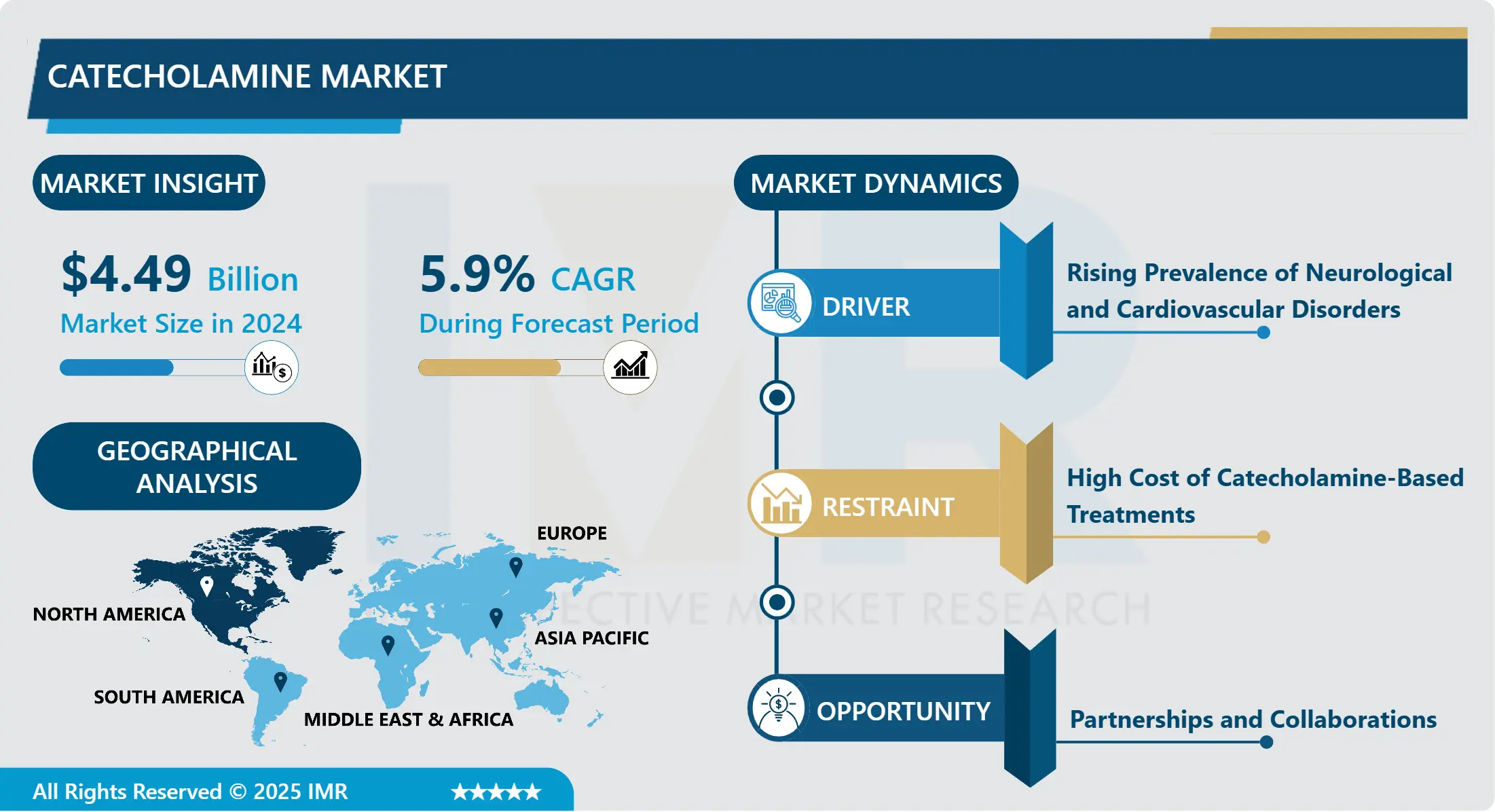
Catecholamine Market – Industry Growth & Deployment Analysis By 2032
The Catecholamine market refers to the global industry focused on the production, distribution, and application of catecholamines, which are organic compounds derived from the amino acid tyrosine. These include neurotransmitters such as dopamine, norepinephrine, and epinephrine, which play a critical role in the body’s response to stress, regulation of blood pressure, and various neurological functions. The market encompasses the pharmaceutical and biotechnology sectors, where catecholamines are utilized in therapeutic drugs, diagnostics, and research, particularly in the treatment of cardiovascular diseases, shock, and certain mental health conditions.

IMR Group
Description
Catecholamine Market Synopsis
Catecholamine Market Size Was Valued at USD 4.49 Billion in 2024, and is Projected to Reach USD 7.10 Billion by 2032, Growing at a CAGR of 5.90% From 2025-2032.
The Catecholamine market refers to the global industry focused on the production, distribution, and application of catecholamines, which are organic compounds derived from the amino acid tyrosine. These include neurotransmitters such as dopamine, norepinephrine, and epinephrine, which play a critical role in the body’s response to stress, regulation of blood pressure, and various neurological functions. The market encompasses the pharmaceutical and biotechnology sectors, where catecholamines are utilized in therapeutic drugs, diagnostics, and research, particularly in the treatment of cardiovascular diseases, shock, and certain mental health conditions.
The global catecholamine market is experiencing steady growth, driven by increasing demand in the medical and pharmaceutical sectors. Catecholamines, which include epinephrine, norepinephrine, and dopamine, are critical in treating various cardiovascular and respiratory conditions, as well as in the management of certain neurological disorders. The rising prevalence of these conditions, coupled with advancements in medical research, has led to a greater focus on catecholamine-based therapies, thus boosting market demand.
However, the market faces certain challenges. The high cost of catecholamine drugs, stringent regulatory approvals, and the potential for side effects associated with these compounds can hinder market growth. Moreover, the production of catecholamines is complex, requiring specialized facilities and expertise, which adds to the overall cost and limits the entry of new players into the market.
Geographically, North America dominates the catecholamine market due to a well-established healthcare infrastructure and significant investments in research and development. However, the Asia-Pacific region is expected to witness the fastest growth, driven by increasing healthcare spending, a growing population, and rising awareness of advanced treatments. Companies are increasingly focusing on expanding their presence in this region to tap into the emerging opportunities.
In summary, while the catecholamine market presents promising growth prospects, particularly in emerging economies, the challenges related to cost and regulatory hurdles need to be addressed to fully realize its potential.
Catecholamine Market Trend Analysis
Catecholamine Market Growth Driver- Increasing Demand for Catecholamine Drugs in Cardiovascular Disease Management
The rising demand for catecholamine drugs in the treatment of cardiovascular diseases, particularly heart failure and hypertension, is a key driver in the market. Cardiovascular diseases remain one of the leading causes of mortality worldwide, and as the global population continues to age, the incidence of these conditions is expected to increase significantly. Catecholamines, such as epinephrine, norepinephrine, and dopamine, are critical in managing acute and chronic cardiovascular conditions. They play a vital role in regulating heart rate, blood pressure, and overall cardiac function. In cases of heart failure, catecholamines are often administered to improve cardiac output and stabilize patients, especially in emergency settings. The effectiveness of these drugs in critical care has solidified their position as essential therapeutic agents in cardiology, driving demand within the market.
Furthermore, the growing incidence of hypertension, often referred to as the “silent killer,” is contributing to the increased utilization of catecholamine drugs. Hypertension is a major risk factor for both heart failure and other cardiovascular diseases, and its prevalence is rising globally due to factors such as sedentary lifestyles, poor diet, and increased stress levels. Catecholamine drugs are used to manage severe hypertension, particularly in cases where patients do not respond adequately to standard antihypertensive therapies. The expanding global burden of hypertension, coupled with the rising awareness of its associated risks, is leading to a greater emphasis on early detection and treatment, further driving the market for catecholamine drugs. As healthcare systems around the world continue to focus on addressing cardiovascular health, the demand for effective catecholamine-based treatments is poised to grow, bolstering the market’s expansion.
Catecholamine Market Expansion Opportunity- Growing Emphasis on Mental Health Driving Demand for Catecholamine-Related Drugs
The increasing focus on mental health is emerging as a significant trend in the catecholamine market, as these neurotransmitters play a crucial role in the management of various mental health conditions. Catecholamine-related drugs, including those that influence the levels of dopamine, norepinephrine, and epinephrine in the brain, are widely used to treat disorders such as depression, anxiety, and attention deficit hyperactivity disorder (ADHD). For instance, medications that modulate dopamine levels are central to the treatment of ADHD, helping to improve focus and reduce impulsivity in affected individuals. Similarly, norepinephrine reuptake inhibitors are commonly prescribed to alleviate symptoms of depression and anxiety. As research continues to uncover the intricate relationship between catecholamines and mental health, the demand for these medications is expected to grow, particularly as personalized medicine and targeted therapies become more prevalent in mental health care.
The rising awareness of mental health issues, coupled with the ongoing destigmatization of mental health treatment, is contributing significantly to the growing demand for catecholamine-related drugs. In recent years, there has been a global shift in the perception of mental health, with more people recognizing the importance of seeking treatment for psychological conditions. This change is partly due to increased public health campaigns, greater media coverage, and the efforts of mental health advocates. As a result, individuals are more likely to seek medical intervention, including the use of catecholamine-modulating drugs, to manage their mental health conditions effectively. Moreover, the expansion of mental health services and the integration of mental health care into primary care settings are making these treatments more accessible, further driving market growth. This trend is expected to continue as mental health becomes an increasingly prioritized aspect of overall well-being, leading to sustained demand for catecholamine-based therapies.
Catecholamine Market Segment Analysis:
Catecholamine Market Segmented based on Type, Route of Administration, Indication, Distribution Channel, and Region.
By Type, Epinephrine (adrenaline) segment is expected to dominate the market during the forecast period
Epinephrine (adrenaline) holds a commanding position in the catecholamine market primarily because of its crucial role in managing severe medical emergencies. As a life-saving medication, epinephrine is the first-line treatment for anaphylaxis, a severe allergic reaction that can rapidly escalate into a life-threatening situation. Its ability to quickly counteract the effects of severe allergic reactions by constricting blood vessels, relaxing airway muscles, and reducing swelling makes it indispensable in emergency care settings. This swift, multi-faceted action is critical in preventing fatal outcomes, driving substantial demand for epinephrine across healthcare systems globally.
Moreover, epinephrine’s efficacy extends to other critical scenarios, such as cardiac arrest and acute asthma attacks. In cardiac arrest situations, epinephrine enhances the chances of resuscitation by stimulating cardiac function and improving blood flow. Its role in acute asthma attacks involves bronchodilation, which helps alleviate breathing difficulties and restore normal respiratory function. The versatility and effectiveness of epinephrine in addressing these severe conditions ensure its continued dominance in the catecholamine market, reinforcing its vital importance in emergency medical treatment and contributing to its significant market share.
By Distribution Channel, Hospital pharmacy segment held the largest share in 2024
Hospital pharmacies represent the largest segment in the catecholamine market, largely due to their critical role in emergency and intensive care settings. These pharmacies are equipped to handle the immediate and often high-volume demand for life-saving medications like epinephrine, norepinephrine, and dopamine. The acute nature of conditions such as anaphylaxis, cardiac arrest, and shock necessitates swift access to these drugs, positioning hospital pharmacies as the primary distribution channel for catecholamines.
Hospital pharmacies are integral to the efficient and effective management of patient care in critical situations. They provide not only the medication but also the expertise needed to ensure proper dosing and administration, which is crucial for achieving the desired therapeutic outcomes. The increasing prevalence of emergency medical conditions and advancements in critical care medicine drive the demand for these drugs, reinforcing the dominance of hospital pharmacies in the market. Additionally, hospitals are investing in advanced inventory management systems and emergency response protocols to better manage the availability and distribution of catecholamines, further solidifying their key role in the healthcare system.
Catecholamine Market Regional Insights:
North America’s is Expected to Dominate the Market Over the Forecast period
North America’s dominance in the catecholamine market can be attributed to its highly advanced healthcare infrastructure and a well-established system that supports early diagnosis and effective management of catecholamine-related disorders. The region benefits from a high level of awareness among healthcare professionals and patients about the significance of catecholamines in conditions such as hypertension, heart failure, and stress-related disorders. This awareness has led to a strong demand for diagnostic tests, therapies, and monitoring systems that are integral to managing these conditions. Moreover, the regulatory environment in North America, particularly in the U.S., is conducive to the rapid approval and commercialization of new treatments and technologies related to catecholamines, further fueling market growth.
The U.S. plays a pivotal role in driving the North American catecholamine market, thanks to its significant healthcare spending and the presence of leading pharmaceutical companies that are heavily invested in research and development. The rising incidence of cardiovascular diseases, such as hypertension and heart failure, which are closely linked to catecholamine imbalances, has created a robust demand for related diagnostic and therapeutic solutions. The U.S. healthcare system’s focus on preventive care and chronic disease management also encourages the use of advanced diagnostic tests for early detection and ongoing monitoring of catecholamine levels. Furthermore, the strong emphasis on innovation in the U.S. has led to the development of new drug formulations and advanced treatment protocols, solidifying the country’s leadership position in the global catecholamine market.
Active Key Players in the Catecholamine Market
Viatris, Inc.
Novartis International AG
Amneal Pharmaceuticals
Teva Pharmaceutical Industries Ltd
Baxter International
Breckenridge Pharmaceutical, Inc
Other Active Players
Chapter 1: Introduction
1.1 Scope and Coverage
Chapter 2:Executive Summary
Chapter 3: Market Landscape
3.1 Market Dynamics
3.1.1 Drivers
3.1.2 Restraints
3.1.3 Opportunities
3.1.4 Challenges
3.2 Market Trend Analysis
3.3 PESTLE Analysis
3.4 Porter’s Five Forces Analysis
3.5 Industry Value Chain Analysis
3.6 Ecosystem
3.7 Regulatory Landscape
3.8 Price Trend Analysis
3.9 Patent Analysis
3.10 Technology Evolution
3.11 Investment Pockets
3.12 Import-Export Analysis
Chapter 4: Catecholamine Market by Type (2018-2032)
4.1 Catecholamine Market Snapshot and Growth Engine
4.2 Market Overview
4.3 Epinephrine (adrenaline)
4.3.1 Introduction and Market Overview
4.3.2 Historic and Forecasted Market Size in Value USD and Volume Units
4.3.3 Key Market Trends, Growth Factors, and Opportunities
4.3.4 Geographic Segmentation Analysis
4.4 Norepinephrine (noradrenaline)
4.5 Dopamine
Chapter 5: Catecholamine Market by Route of Administration (2018-2032)
5.1 Catecholamine Market Snapshot and Growth Engine
5.2 Market Overview
5.3 Intravenous
5.3.1 Introduction and Market Overview
5.3.2 Historic and Forecasted Market Size in Value USD and Volume Units
5.3.3 Key Market Trends, Growth Factors, and Opportunities
5.3.4 Geographic Segmentation Analysis
5.4 Inhalation
5.5 Transdermal
5.6 Other routes of administration
Chapter 6: Catecholamine Market by Indication (2018-2032)
6.1 Catecholamine Market Snapshot and Growth Engine
6.2 Market Overview
6.3 Anaphylaxis
6.3.1 Introduction and Market Overview
6.3.2 Historic and Forecasted Market Size in Value USD and Volume Units
6.3.3 Key Market Trends, Growth Factors, and Opportunities
6.3.4 Geographic Segmentation Analysis
6.4 Cardiac arrest
6.5 Shock
6.6 Acute asthma
6.7 Hypertension
6.8 Other indications
Chapter 7: Catecholamine Market by Distribution Channel (2018-2032)
7.1 Catecholamine Market Snapshot and Growth Engine
7.2 Market Overview
7.3 Hospital pharmacy
7.3.1 Introduction and Market Overview
7.3.2 Historic and Forecasted Market Size in Value USD and Volume Units
7.3.3 Key Market Trends, Growth Factors, and Opportunities
7.3.4 Geographic Segmentation Analysis
7.4 Retail pharmacy
7.5 Online pharmacy
Chapter 8: Company Profiles and Competitive Analysis
8.1 Competitive Landscape
8.1.1 Competitive Benchmarking
8.1.2 Catecholamine Market Share by Manufacturer (2024)
8.1.3 Industry BCG Matrix
8.1.4 Heat Map Analysis
8.1.5 Mergers and Acquisitions
8.2 VIATRIS INCNOVARTIS INTERNATIONAL AG
8.2.1 Company Overview
8.2.2 Key Executives
8.2.3 Company Snapshot
8.2.4 Role of the Company in the Market
8.2.5 Sustainability and Social Responsibility
8.2.6 Operating Business Segments
8.2.7 Product Portfolio
8.2.8 Business Performance
8.2.9 Key Strategic Moves and Recent Developments
8.2.10 SWOT Analysis
8.3 AMNEAL PHARMACEUTICALS
8.4 TEVA PHARMACEUTICAL INDUSTRIES LTD
8.5 BAXTER INTERNATIONAL
8.6 BRECKENRIDGE PHARMACEUTICAL INC
8.7 OTHER KEY PLAYERS
8.8
Chapter 9: Global Catecholamine Market By Region
9.1 Overview
9.2. North America Catecholamine Market
9.2.1 Key Market Trends, Growth Factors and Opportunities
9.2.2 Top Key Companies
9.2.3 Historic and Forecasted Market Size by Segments
9.2.4 Historic and Forecasted Market Size by Type
9.2.4.1 Epinephrine (adrenaline)
9.2.4.2 Norepinephrine (noradrenaline)
9.2.4.3 Dopamine
9.2.5 Historic and Forecasted Market Size by Route of Administration
9.2.5.1 Intravenous
9.2.5.2 Inhalation
9.2.5.3 Transdermal
9.2.5.4 Other routes of administration
9.2.6 Historic and Forecasted Market Size by Indication
9.2.6.1 Anaphylaxis
9.2.6.2 Cardiac arrest
9.2.6.3 Shock
9.2.6.4 Acute asthma
9.2.6.5 Hypertension
9.2.6.6 Other indications
9.2.7 Historic and Forecasted Market Size by Distribution Channel
9.2.7.1 Hospital pharmacy
9.2.7.2 Retail pharmacy
9.2.7.3 Online pharmacy
9.2.8 Historic and Forecast Market Size by Country
9.2.8.1 US
9.2.8.2 Canada
9.2.8.3 Mexico
9.3. Eastern Europe Catecholamine Market
9.3.1 Key Market Trends, Growth Factors and Opportunities
9.3.2 Top Key Companies
9.3.3 Historic and Forecasted Market Size by Segments
9.3.4 Historic and Forecasted Market Size by Type
9.3.4.1 Epinephrine (adrenaline)
9.3.4.2 Norepinephrine (noradrenaline)
9.3.4.3 Dopamine
9.3.5 Historic and Forecasted Market Size by Route of Administration
9.3.5.1 Intravenous
9.3.5.2 Inhalation
9.3.5.3 Transdermal
9.3.5.4 Other routes of administration
9.3.6 Historic and Forecasted Market Size by Indication
9.3.6.1 Anaphylaxis
9.3.6.2 Cardiac arrest
9.3.6.3 Shock
9.3.6.4 Acute asthma
9.3.6.5 Hypertension
9.3.6.6 Other indications
9.3.7 Historic and Forecasted Market Size by Distribution Channel
9.3.7.1 Hospital pharmacy
9.3.7.2 Retail pharmacy
9.3.7.3 Online pharmacy
9.3.8 Historic and Forecast Market Size by Country
9.3.8.1 Russia
9.3.8.2 Bulgaria
9.3.8.3 The Czech Republic
9.3.8.4 Hungary
9.3.8.5 Poland
9.3.8.6 Romania
9.3.8.7 Rest of Eastern Europe
9.4. Western Europe Catecholamine Market
9.4.1 Key Market Trends, Growth Factors and Opportunities
9.4.2 Top Key Companies
9.4.3 Historic and Forecasted Market Size by Segments
9.4.4 Historic and Forecasted Market Size by Type
9.4.4.1 Epinephrine (adrenaline)
9.4.4.2 Norepinephrine (noradrenaline)
9.4.4.3 Dopamine
9.4.5 Historic and Forecasted Market Size by Route of Administration
9.4.5.1 Intravenous
9.4.5.2 Inhalation
9.4.5.3 Transdermal
9.4.5.4 Other routes of administration
9.4.6 Historic and Forecasted Market Size by Indication
9.4.6.1 Anaphylaxis
9.4.6.2 Cardiac arrest
9.4.6.3 Shock
9.4.6.4 Acute asthma
9.4.6.5 Hypertension
9.4.6.6 Other indications
9.4.7 Historic and Forecasted Market Size by Distribution Channel
9.4.7.1 Hospital pharmacy
9.4.7.2 Retail pharmacy
9.4.7.3 Online pharmacy
9.4.8 Historic and Forecast Market Size by Country
9.4.8.1 Germany
9.4.8.2 UK
9.4.8.3 France
9.4.8.4 The Netherlands
9.4.8.5 Italy
9.4.8.6 Spain
9.4.8.7 Rest of Western Europe
9.5. Asia Pacific Catecholamine Market
9.5.1 Key Market Trends, Growth Factors and Opportunities
9.5.2 Top Key Companies
9.5.3 Historic and Forecasted Market Size by Segments
9.5.4 Historic and Forecasted Market Size by Type
9.5.4.1 Epinephrine (adrenaline)
9.5.4.2 Norepinephrine (noradrenaline)
9.5.4.3 Dopamine
9.5.5 Historic and Forecasted Market Size by Route of Administration
9.5.5.1 Intravenous
9.5.5.2 Inhalation
9.5.5.3 Transdermal
9.5.5.4 Other routes of administration
9.5.6 Historic and Forecasted Market Size by Indication
9.5.6.1 Anaphylaxis
9.5.6.2 Cardiac arrest
9.5.6.3 Shock
9.5.6.4 Acute asthma
9.5.6.5 Hypertension
9.5.6.6 Other indications
9.5.7 Historic and Forecasted Market Size by Distribution Channel
9.5.7.1 Hospital pharmacy
9.5.7.2 Retail pharmacy
9.5.7.3 Online pharmacy
9.5.8 Historic and Forecast Market Size by Country
9.5.8.1 China
9.5.8.2 India
9.5.8.3 Japan
9.5.8.4 South Korea
9.5.8.5 Malaysia
9.5.8.6 Thailand
9.5.8.7 Vietnam
9.5.8.8 The Philippines
9.5.8.9 Australia
9.5.8.10 New Zealand
9.5.8.11 Rest of APAC
9.6. Middle East & Africa Catecholamine Market
9.6.1 Key Market Trends, Growth Factors and Opportunities
9.6.2 Top Key Companies
9.6.3 Historic and Forecasted Market Size by Segments
9.6.4 Historic and Forecasted Market Size by Type
9.6.4.1 Epinephrine (adrenaline)
9.6.4.2 Norepinephrine (noradrenaline)
9.6.4.3 Dopamine
9.6.5 Historic and Forecasted Market Size by Route of Administration
9.6.5.1 Intravenous
9.6.5.2 Inhalation
9.6.5.3 Transdermal
9.6.5.4 Other routes of administration
9.6.6 Historic and Forecasted Market Size by Indication
9.6.6.1 Anaphylaxis
9.6.6.2 Cardiac arrest
9.6.6.3 Shock
9.6.6.4 Acute asthma
9.6.6.5 Hypertension
9.6.6.6 Other indications
9.6.7 Historic and Forecasted Market Size by Distribution Channel
9.6.7.1 Hospital pharmacy
9.6.7.2 Retail pharmacy
9.6.7.3 Online pharmacy
9.6.8 Historic and Forecast Market Size by Country
9.6.8.1 Turkiye
9.6.8.2 Bahrain
9.6.8.3 Kuwait
9.6.8.4 Saudi Arabia
9.6.8.5 Qatar
9.6.8.6 UAE
9.6.8.7 Israel
9.6.8.8 South Africa
9.7. South America Catecholamine Market
9.7.1 Key Market Trends, Growth Factors and Opportunities
9.7.2 Top Key Companies
9.7.3 Historic and Forecasted Market Size by Segments
9.7.4 Historic and Forecasted Market Size by Type
9.7.4.1 Epinephrine (adrenaline)
9.7.4.2 Norepinephrine (noradrenaline)
9.7.4.3 Dopamine
9.7.5 Historic and Forecasted Market Size by Route of Administration
9.7.5.1 Intravenous
9.7.5.2 Inhalation
9.7.5.3 Transdermal
9.7.5.4 Other routes of administration
9.7.6 Historic and Forecasted Market Size by Indication
9.7.6.1 Anaphylaxis
9.7.6.2 Cardiac arrest
9.7.6.3 Shock
9.7.6.4 Acute asthma
9.7.6.5 Hypertension
9.7.6.6 Other indications
9.7.7 Historic and Forecasted Market Size by Distribution Channel
9.7.7.1 Hospital pharmacy
9.7.7.2 Retail pharmacy
9.7.7.3 Online pharmacy
9.7.8 Historic and Forecast Market Size by Country
9.7.8.1 Brazil
9.7.8.2 Argentina
9.7.8.3 Rest of SA
Chapter 10 Analyst Viewpoint and Conclusion
10.1 Recommendations and Concluding Analysis
10.2 Potential Market Strategies
Chapter 11 Research Methodology
11.1 Research Process
11.2 Primary Research
11.3 Secondary Research
Q1: What would be the forecast period in the Catecholamine Market research report?
A1: The forecast period in the Catecholamine Market research report is 2025-2032.
Q2: Who are the key players in the Catecholamine Market?
A2: Viatris, Inc., Novartis International AG, Amneal Pharmaceuticals, Teva Pharmaceutical Industries Ltd, Baxter International, Breckenridge Pharmaceutical, Inc and Other Active Players.
Q3: What are the segments of the Catecholamine Market?
A3: The Catecholamine Market is segmented into By Type, By Route of Administration, By Indication, By Distribution Channel and region. By Type, the market is categorized into Epinephrine (adrenaline), Norepinephrine (noradrenaline) and Dopamine. By Route of Administration, the market is categorized into Intravenous, Inhalation, Transdermal and Other routes of administration. By Indication, the market is categorized into Anaphylaxis, Cardiac arrest, Shock, Acute asthma, Hypertension and Other indications. By Distribution Channel, the market is categorized into Hospital pharmacy, Retail pharmacy and Online pharmacy. By Region, it is analyzed across North America (U.S.; Canada; Mexico), Eastern Europe (Russia; Bulgaria; The Czech Republic; Hungary; Poland; Romania; Rest of Eastern Europe), Western Europe (Germany; UK; France; The Netherlands; Italy; Spain; Rest of Western Europe), Asia-Pacific (China; India; Japan; South Korea; Malaysia; Thailand; Vietnam; The Philippines; Australia; New Zealand; Rest of APAC), Middle East & Africa (Türkiye; Bahrain; Kuwait; Saudi Arabia; Qatar; UAE; Israel; South Africa), South America (Brazil; Argentina; Rest of SA.).
Q4: What is the Catecholamine Market?
A4: The Catecholamine market refers to the global industry focused on the production, distribution, and application of catecholamines, which are organic compounds derived from the amino acid tyrosine. These include neurotransmitters such as dopamine, norepinephrine, and epinephrine, which play a critical role in the body's response to stress, regulation of blood pressure, and various neurological functions. The market encompasses the pharmaceutical and biotechnology sectors, where catecholamines are utilized in therapeutic drugs, diagnostics, and research, particularly in the treatment of cardiovascular diseases, shock, and certain mental health conditions.
Q5: How big is the Catecholamine Market?
A5: Catecholamine Market Size Was Valued at USD 4.49 Billion in 2024, and is Projected to Reach USD 7.10 Billion by 2032, Growing at a CAGR of 5.90% From 2025-2032.
How to Buy a Report from eminsights.jp
On the product page, choose the license you want: Single-User License, Multi-User License or Enterprise License.
If you required report in your native language, then you can click on Translated Report button and fill out the form with report name and language you want, then our team will contact you as soon as possible.
Click the Buy Now button.
You will be redirected to the checkout page. Enter your company details and payment information.
Click Place Order to complete the purchase.
Confirmation: You’ll receive an order confirmation and our team will contact you shortly with your ordered report.
If you have any questions, fill out the contact form below or email us at [email protected].
Thank you for choosing eminsights.jp!