Stay Ahead in Fast-Growing Economies.
Browse Reports Now
Cleaning Robot Market- Global Industry Analysis And Growth Factor (2025-2032)
The cleaning robot market refers to the industry segment focused on automated devices designed to clean various indoor environments autonomously or with minimal human intervention. These robots typically utilize sensors, artificial intelligence, and navigation technologies to navigate spaces, identify obstacles, and perform cleaning tasks such as vacuuming, mopping, and sweeping. They are increasingly adopted in households, commercial spaces, and industrial settings to enhance efficiency, reduce labor costs, and maintain cleanliness.

IMR Group
Description
Cleaning Robot Market Synopsis
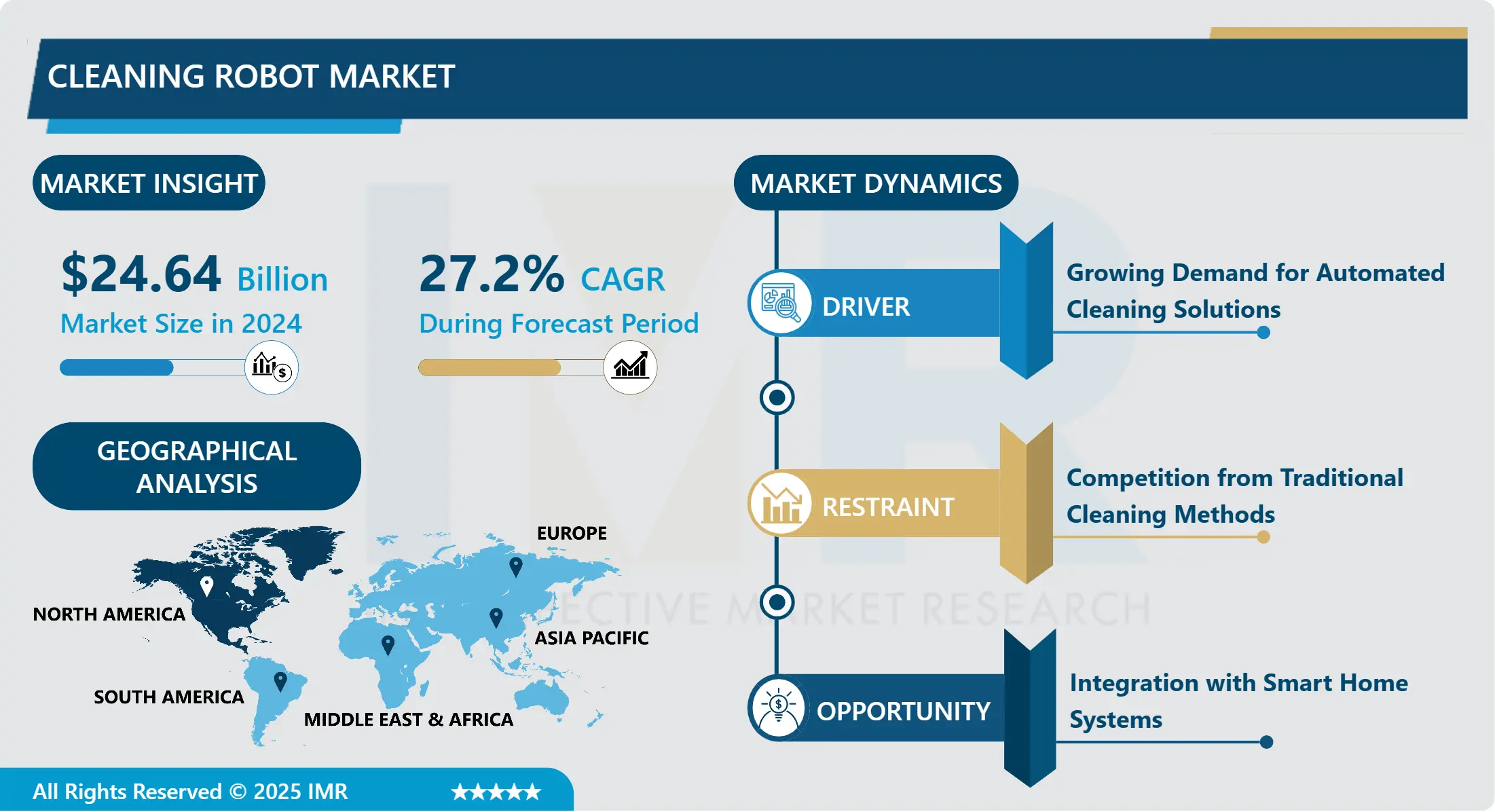
Cleaning Robot Market Size Was Valued at USD 24.64 Billion in 2024, and is Projected to Reach USD 168.86 Billion by 2032, Growing at a CAGR of 27.20% From 2025-2032.
The cleaning robot market refers to the industry segment focused on automated devices designed to clean various indoor environments autonomously or with minimal human intervention. These robots typically utilize sensors, artificial intelligence, and navigation technologies to navigate spaces, identify obstacles, and perform cleaning tasks such as vacuuming, mopping, and sweeping. They are increasingly adopted in households, commercial spaces, and industrial settings to enhance efficiency, reduce labor costs, and maintain cleanliness. The market includes a variety of products ranging from simple robotic vacuums to advanced multifunctional cleaning robots capable of handling diverse surfaces and tasks, driven by increasing consumer demand for smart home solutions and technological advancements in robotics and AI.
The growing usage of automation in both residential and commercial cleaning solutions is propelling the market for cleaning robots worldwide. The growing need for time-saving, effective, and convenient cleaning technologies is the main driver of this expansion, especially in metropolitan regions where hectic lives and the desire for smart home solutions are common. Due to its capacity to independently traverse and clean a variety of surfaces, cleaning robots have become more popular. These advantages include increased productivity, less labor expenses, and better cleanliness.
Developments in technology have a significant impact on how markets are shaped. Advanced sensor technologies, AI-driven navigation systems, and connection with smart home ecosystems have greatly improved the capabilities and attractiveness of cleaning robots. In addition to increasing cleaning effectiveness, these technologies also make it possible to schedule and monitor remotely via smartphone applications, which makes users’ lives easier.
Due to their larger discretionary incomes, early adoption of smart home technology, and emphasis on ease when it comes to domestic duties, North America and Europe now retain the top spots in the market. But due to rising urbanization, rising consumer awareness of smart living options, and better economic conditions, the Asia-Pacific region is becoming a major development sector.
To stay competitive, major companies in the industry are aggressively pursuing strategic alliances and product innovation. There are still many obstacles to overcome, including high startup costs, maintenance and dependability issues, and the ongoing need for technical breakthroughs. However, during the course of the forecast period, rising consumer acceptance of robotic technologies along with continuous advancements in functionality and cost are anticipated to fuel market expansion for cleaning robots globally.
Cleaning Robot Market Trend Analysis
Cleaning Robot Market Growth Driver- Growing Consumer Preference for Automated and Hands-Free Cleaning Solutions
The rising customer preference for automated and hands-free cleaning solutions is one of the main factors propelling the cleaning robot industry. It’s getting harder for many people and families to find time for regular household duties as our lives get faster and faster. The need for technology that can improve convenience and streamline daily chores has increased as a result of this change in lifestyle. Cleaning robots are the ideal way to keep your home clean while requiring the least amount of human involvement. They can clean floors, carpets, and other surfaces on their own. Busy professionals, parents, and older people with potential physical restrictions are drawn to these robots because of their simplicity of use and time-saving features.
The COVID-19 epidemic has increased people’s awareness of cleanliness and hygiene, which has increased demand for cleaning robots. An increasing number of homes are using automated solutions to guarantee a higher standard of sanitation due to worries about virus transmission and the necessity for frequent cleaning. Advanced features like UV sterilization, allergy management, and HEPA filtration have made cleaning robots with these qualities attractive options for keeping homes clean and healthy. Furthermore, these machines’ attractiveness has been further increased by the incorporation of smart capabilities like voice control via virtual assistants (like Amazon Alexa and Google Assistant), smartphone app connectivity for remote control and monitoring, and programmed cleaning regimens. Tech-savvy customers value the ease of use and personalization that these intelligent features offer, as it makes it simple for them to manage and maximize their cleaning schedules.
Cleaning Robot Market Expansion Opportunity- Significant Contribution of the Commercial Sector to Cleaning Robot Market Growth
The commercial sector is also a significant contributor to the growth of the cleaning robot market, with industries such as hospitality, healthcare, and retail leading the charge. In these sectors, maintaining high standards of cleanliness and sanitation is paramount for ensuring customer satisfaction, safety, and compliance with health regulations. Cleaning robots offer an efficient solution by providing consistent and thorough cleaning, which is particularly important in high-traffic areas. By investing in these automated systems, businesses can significantly reduce labor costs as robots can operate continuously without the need for breaks, unlike human workers. This reduction in labor dependency allows human staff to focus on more complex, value-added tasks, enhancing overall operational efficiency.
Moreover, the growing trend of green cleaning and sustainability is further driving the adoption of cleaning robots in the commercial sector. Many businesses are seeking to reduce their environmental footprint and adhere to eco-friendly practices. Cleaning robots that use less water and energy compared to traditional cleaning methods align perfectly with these sustainability goals. For instance, robotic cleaners often employ advanced technologies to optimize cleaning routes and minimize resource usage, making them more environmentally friendly. Additionally, the ability to program cleaning schedules during off-peak hours helps in reducing energy consumption and operational costs. As businesses increasingly prioritize sustainability, the demand for cleaning robots that support these initiatives is expected to rise, further propelling market growth.
Cleaning Robot Market Segment Analysis:
Cleaning Robot Market Segmented based on Type, Product, Charging Type, Operation Mode, Distribution Channel, End-use, and Region.
By Type, Floor-cleaning Robot segment is expected to dominate the market during the forecast period
Floor-cleaning robots dominate the cleaning robot market because they are highly versatile and efficient, making them suitable for a variety of floor types including hardwood, tile, and carpet. Their extensive use in both residential and business settings demonstrates their attractiveness and practicality. These robots have sophisticated sensors and navigation systems that allow them to avoid obstructions and clean completely, providing a thorough cleaning experience. To further improve customer comfort, a lot of models come with customizable schedules and remote control via mobile applications. The incorporation of functionalities like multi-surface brushes and automated dirt removal enhances their efficiency and appeal to a wider range of customers.
The rising popularity of smart homes and the growing need for automated solutions are further factors contributing to the domination of floor-cleaning robots. Floor-cleaning robots easily interact with other smart devices as more homes embrace smart home technology, providing improved management and monitoring through voice commands and home automation systems. The need for these robots is also fueled by customers’ hectic schedules and need for quick and easy cleaning solutions. The regular and dependable performance of floor-cleaning robots benefits commercial venues as well, such as offices, hotels, and retail stores, by eliminating the need for manual labor and cutting operating expenses. The large market share and potential for future expansion of floor-cleaning robots are highlighted by their broad acceptance in both the residential and commercial sectors.
By End-use, Residential segment held the largest share in 2024
The need for quick and effective cleaning solutions among homeowners is driving the majority of the cleaning robot market, with the residential segment accounting for the highest share. Time-saving technologies are highly appreciated in current living trends, and these robots offer considerable benefits that align with those trends. Cleaning robots provide a hands-free method of keeping things clean for families and busy individuals, freeing them up to enjoy their free time or concentrate on other activities. People who value work-life balance and those who live in dual-income homes find this convenience especially appealing.
Furthermore, a big part of the appeal of household cleaning robots is their effectiveness. These robots are capable of cleaning a variety of surfaces and navigating around obstacles with little assistance because to their sophisticated cleaning technologies, which include strong suction, clever navigation systems, and mapping capabilities. The flexibility to adjust to various surface types—from hardwood floors to carpets—guarantees thorough cleaning without sacrificing effectiveness. In addition, a lot of models come with scheduling features and smart home system integration, so customers can plan cleaning schedules or operate the robot from a distance using voice commands or mobile applications.
In addition to their efficiency and convenience, cleaning robots are becoming more and more accessible and affordable, which has accelerated their adoption in residential settings. Manufacturers are staying innovative as the industry grows more established, providing a variety of models at various price points to meet the demands and budgets of a wide spectrum of consumers. Because of their accessibility and ongoing technological improvements, cleaning robots are a mainstay of contemporary homes, which helps explain their dominance in the market for residential cleaning products.
Cleaning Robot Market Regional Insights:
North America is Expected to Dominate the Market Over the Forecast period
The market for cleaning robots in North America is expanding rapidly, mostly due to the high rate of adoption of cutting-edge technology and consumers’ growing inclination towards smart home appliances. The main players in this industry are the United States and Canada, whose strong economies and high levels of disposable income allow their citizens to purchase cutting-edge household appliances. A consumer base that is both tech-savvy and eager to spend money on items that increase convenience is supported by this economic strength. Key industry players like iRobot, Neato Robotics, and SharkNinja, who consistently develop and provide a wide range of products to fulfill varied customer demands, further support the market. Additionally, customers may more easily obtain these cutting-edge cleaning products thanks to robust distribution channels that include both online and physical retail stores.
Growing awareness of hygiene and cleanliness, particularly in the wake of the COVID-19 epidemic, is a major driver driving the market’s expansion. need for automated cleaning solutions has increased because to the increased awareness of the need to keep places free of germs. This need is present not just in domestic areas but also in commercial spaces like offices, hotels, and hospitals. A large audience seeking to maintain high levels of cleanliness with little effort finds great satisfaction in the convenience provided by cleaning robots, which can function independently and effectively. Furthermore, the functionality and effectiveness of cleaning robots have been improved by advances in AI and IoT technologies, making them more effective and user-friendly and encouraging wider acceptance in the North American market.
Active Key Players in the Cleaning Robot Market
Ecovacs Robotics Inc.
ILIFE Robotics Technology
iRobot Corporation
LG Electronics
Maytronics
Milagrow Business and Knowledge Solutions Pvt. Ltd.
Neato Robotics Inc.
Nilfisk Group
Pentair Plc
Samsung Electronics Co. Ltd.
Other Active Players
Chapter 1: Introduction
1.1 Scope and Coverage
Chapter 2:Executive Summary
Chapter 3: Market Landscape
3.1 Market Dynamics
3.1.1 Drivers
3.1.2 Restraints
3.1.3 Opportunities
3.1.4 Challenges
3.2 Market Trend Analysis
3.3 PESTLE Analysis
3.4 Porter’s Five Forces Analysis
3.5 Industry Value Chain Analysis
3.6 Ecosystem
3.7 Regulatory Landscape
3.8 Price Trend Analysis
3.9 Patent Analysis
3.10 Technology Evolution
3.11 Investment Pockets
3.12 Import-Export Analysis
Chapter 4: Cleaning Robot Market by Type (2018-2032)
4.1 Cleaning Robot Market Snapshot and Growth Engine
4.2 Market Overview
4.3 Floor-cleaning Robot
4.3.1 Introduction and Market Overview
4.3.2 Historic and Forecasted Market Size in Value USD and Volume Units
4.3.3 Key Market Trends, Growth Factors, and Opportunities
4.3.4 Geographic Segmentation Analysis
4.4 Pool-cleaning Robot
4.5 Window-cleaning Robot
4.6 Lawn-cleaning Robot
4.7 Others
Chapter 5: Cleaning Robot Market by Product (2018-2032)
5.1 Cleaning Robot Market Snapshot and Growth Engine
5.2 Market Overview
5.3 In-house
5.3.1 Introduction and Market Overview
5.3.2 Historic and Forecasted Market Size in Value USD and Volume Units
5.3.3 Key Market Trends, Growth Factors, and Opportunities
5.3.4 Geographic Segmentation Analysis
5.4 Outdoor
Chapter 6: Cleaning Robot Market by Charging Type (2018-2032)
6.1 Cleaning Robot Market Snapshot and Growth Engine
6.2 Market Overview
6.3 Automatic Charging
6.3.1 Introduction and Market Overview
6.3.2 Historic and Forecasted Market Size in Value USD and Volume Units
6.3.3 Key Market Trends, Growth Factors, and Opportunities
6.3.4 Geographic Segmentation Analysis
6.4 Manual Charging
Chapter 7: Cleaning Robot Market by Operation Mode (2018-2032)
7.1 Cleaning Robot Market Snapshot and Growth Engine
7.2 Market Overview
7.3 Self-drive
7.3.1 Introduction and Market Overview
7.3.2 Historic and Forecasted Market Size in Value USD and Volume Units
7.3.3 Key Market Trends, Growth Factors, and Opportunities
7.3.4 Geographic Segmentation Analysis
7.4 Remote Control
Chapter 8: Cleaning Robot Market by Distribution Channel (2018-2032)
8.1 Cleaning Robot Market Snapshot and Growth Engine
8.2 Market Overview
8.3 Online
8.3.1 Introduction and Market Overview
8.3.2 Historic and Forecasted Market Size in Value USD and Volume Units
8.3.3 Key Market Trends, Growth Factors, and Opportunities
8.3.4 Geographic Segmentation Analysis
8.4 Offline
Chapter 9: Cleaning Robot Market by End-use (2018-2032)
9.1 Cleaning Robot Market Snapshot and Growth Engine
9.2 Market Overview
9.3 Residential
9.3.1 Introduction and Market Overview
9.3.2 Historic and Forecasted Market Size in Value USD and Volume Units
9.3.3 Key Market Trends, Growth Factors, and Opportunities
9.3.4 Geographic Segmentation Analysis
9.4 Commercial
9.5 Industrial
Chapter 10: Company Profiles and Competitive Analysis
10.1 Competitive Landscape
10.1.1 Competitive Benchmarking
10.1.2 Cleaning Robot Market Share by Manufacturer (2024)
10.1.3 Industry BCG Matrix
10.1.4 Heat Map Analysis
10.1.5 Mergers and Acquisitions
10.2 ECOVACS ROBOTICS INC
10.2.1 Company Overview
10.2.2 Key Executives
10.2.3 Company Snapshot
10.2.4 Role of the Company in the Market
10.2.5 Sustainability and Social Responsibility
10.2.6 Operating Business Segments
10.2.7 Product Portfolio
10.2.8 Business Performance
10.2.9 Key Strategic Moves and Recent Developments
10.2.10 SWOT Analysis
10.3 ILIFE ROBOTICS TECHNOLOGY
10.4 IROBOT CORPORATION
10.5 LG ELECTRONICS
10.6 MAYTRONICS
10.7 MILAGROW BUSINESS & KNOWLEDGE SOLUTIONS PVT LTD
10.8 NEATO ROBOTICS INC
10.9 NILFISK GROUP
10.10 PENTAIR PLC
10.11 SAMSUNG ELECTRONICS CO LTD
10.12 OTHER KEY PLAYERS
Chapter 11: Global Cleaning Robot Market By Region
11.1 Overview
11.2. North America Cleaning Robot Market
11.2.1 Key Market Trends, Growth Factors and Opportunities
11.2.2 Top Key Companies
11.2.3 Historic and Forecasted Market Size by Segments
11.2.4 Historic and Forecasted Market Size by Type
11.2.4.1 Floor-cleaning Robot
11.2.4.2 Pool-cleaning Robot
11.2.4.3 Window-cleaning Robot
11.2.4.4 Lawn-cleaning Robot
11.2.4.5 Others
11.2.5 Historic and Forecasted Market Size by Product
11.2.5.1 In-house
11.2.5.2 Outdoor
11.2.6 Historic and Forecasted Market Size by Charging Type
11.2.6.1 Automatic Charging
11.2.6.2 Manual Charging
11.2.7 Historic and Forecasted Market Size by Operation Mode
11.2.7.1 Self-drive
11.2.7.2 Remote Control
11.2.8 Historic and Forecasted Market Size by Distribution Channel
11.2.8.1 Online
11.2.8.2 Offline
11.2.9 Historic and Forecasted Market Size by End-use
11.2.9.1 Residential
11.2.9.2 Commercial
11.2.9.3 Industrial
11.2.10 Historic and Forecast Market Size by Country
11.2.10.1 US
11.2.10.2 Canada
11.2.10.3 Mexico
11.3. Eastern Europe Cleaning Robot Market
11.3.1 Key Market Trends, Growth Factors and Opportunities
11.3.2 Top Key Companies
11.3.3 Historic and Forecasted Market Size by Segments
11.3.4 Historic and Forecasted Market Size by Type
11.3.4.1 Floor-cleaning Robot
11.3.4.2 Pool-cleaning Robot
11.3.4.3 Window-cleaning Robot
11.3.4.4 Lawn-cleaning Robot
11.3.4.5 Others
11.3.5 Historic and Forecasted Market Size by Product
11.3.5.1 In-house
11.3.5.2 Outdoor
11.3.6 Historic and Forecasted Market Size by Charging Type
11.3.6.1 Automatic Charging
11.3.6.2 Manual Charging
11.3.7 Historic and Forecasted Market Size by Operation Mode
11.3.7.1 Self-drive
11.3.7.2 Remote Control
11.3.8 Historic and Forecasted Market Size by Distribution Channel
11.3.8.1 Online
11.3.8.2 Offline
11.3.9 Historic and Forecasted Market Size by End-use
11.3.9.1 Residential
11.3.9.2 Commercial
11.3.9.3 Industrial
11.3.10 Historic and Forecast Market Size by Country
11.3.10.1 Russia
11.3.10.2 Bulgaria
11.3.10.3 The Czech Republic
11.3.10.4 Hungary
11.3.10.5 Poland
11.3.10.6 Romania
11.3.10.7 Rest of Eastern Europe
11.4. Western Europe Cleaning Robot Market
11.4.1 Key Market Trends, Growth Factors and Opportunities
11.4.2 Top Key Companies
11.4.3 Historic and Forecasted Market Size by Segments
11.4.4 Historic and Forecasted Market Size by Type
11.4.4.1 Floor-cleaning Robot
11.4.4.2 Pool-cleaning Robot
11.4.4.3 Window-cleaning Robot
11.4.4.4 Lawn-cleaning Robot
11.4.4.5 Others
11.4.5 Historic and Forecasted Market Size by Product
11.4.5.1 In-house
11.4.5.2 Outdoor
11.4.6 Historic and Forecasted Market Size by Charging Type
11.4.6.1 Automatic Charging
11.4.6.2 Manual Charging
11.4.7 Historic and Forecasted Market Size by Operation Mode
11.4.7.1 Self-drive
11.4.7.2 Remote Control
11.4.8 Historic and Forecasted Market Size by Distribution Channel
11.4.8.1 Online
11.4.8.2 Offline
11.4.9 Historic and Forecasted Market Size by End-use
11.4.9.1 Residential
11.4.9.2 Commercial
11.4.9.3 Industrial
11.4.10 Historic and Forecast Market Size by Country
11.4.10.1 Germany
11.4.10.2 UK
11.4.10.3 France
11.4.10.4 The Netherlands
11.4.10.5 Italy
11.4.10.6 Spain
11.4.10.7 Rest of Western Europe
11.5. Asia Pacific Cleaning Robot Market
11.5.1 Key Market Trends, Growth Factors and Opportunities
11.5.2 Top Key Companies
11.5.3 Historic and Forecasted Market Size by Segments
11.5.4 Historic and Forecasted Market Size by Type
11.5.4.1 Floor-cleaning Robot
11.5.4.2 Pool-cleaning Robot
11.5.4.3 Window-cleaning Robot
11.5.4.4 Lawn-cleaning Robot
11.5.4.5 Others
11.5.5 Historic and Forecasted Market Size by Product
11.5.5.1 In-house
11.5.5.2 Outdoor
11.5.6 Historic and Forecasted Market Size by Charging Type
11.5.6.1 Automatic Charging
11.5.6.2 Manual Charging
11.5.7 Historic and Forecasted Market Size by Operation Mode
11.5.7.1 Self-drive
11.5.7.2 Remote Control
11.5.8 Historic and Forecasted Market Size by Distribution Channel
11.5.8.1 Online
11.5.8.2 Offline
11.5.9 Historic and Forecasted Market Size by End-use
11.5.9.1 Residential
11.5.9.2 Commercial
11.5.9.3 Industrial
11.5.10 Historic and Forecast Market Size by Country
11.5.10.1 China
11.5.10.2 India
11.5.10.3 Japan
11.5.10.4 South Korea
11.5.10.5 Malaysia
11.5.10.6 Thailand
11.5.10.7 Vietnam
11.5.10.8 The Philippines
11.5.10.9 Australia
11.5.10.10 New Zealand
11.5.10.11 Rest of APAC
11.6. Middle East & Africa Cleaning Robot Market
11.6.1 Key Market Trends, Growth Factors and Opportunities
11.6.2 Top Key Companies
11.6.3 Historic and Forecasted Market Size by Segments
11.6.4 Historic and Forecasted Market Size by Type
11.6.4.1 Floor-cleaning Robot
11.6.4.2 Pool-cleaning Robot
11.6.4.3 Window-cleaning Robot
11.6.4.4 Lawn-cleaning Robot
11.6.4.5 Others
11.6.5 Historic and Forecasted Market Size by Product
11.6.5.1 In-house
11.6.5.2 Outdoor
11.6.6 Historic and Forecasted Market Size by Charging Type
11.6.6.1 Automatic Charging
11.6.6.2 Manual Charging
11.6.7 Historic and Forecasted Market Size by Operation Mode
11.6.7.1 Self-drive
11.6.7.2 Remote Control
11.6.8 Historic and Forecasted Market Size by Distribution Channel
11.6.8.1 Online
11.6.8.2 Offline
11.6.9 Historic and Forecasted Market Size by End-use
11.6.9.1 Residential
11.6.9.2 Commercial
11.6.9.3 Industrial
11.6.10 Historic and Forecast Market Size by Country
11.6.10.1 Turkiye
11.6.10.2 Bahrain
11.6.10.3 Kuwait
11.6.10.4 Saudi Arabia
11.6.10.5 Qatar
11.6.10.6 UAE
11.6.10.7 Israel
11.6.10.8 South Africa
11.7. South America Cleaning Robot Market
11.7.1 Key Market Trends, Growth Factors and Opportunities
11.7.2 Top Key Companies
11.7.3 Historic and Forecasted Market Size by Segments
11.7.4 Historic and Forecasted Market Size by Type
11.7.4.1 Floor-cleaning Robot
11.7.4.2 Pool-cleaning Robot
11.7.4.3 Window-cleaning Robot
11.7.4.4 Lawn-cleaning Robot
11.7.4.5 Others
11.7.5 Historic and Forecasted Market Size by Product
11.7.5.1 In-house
11.7.5.2 Outdoor
11.7.6 Historic and Forecasted Market Size by Charging Type
11.7.6.1 Automatic Charging
11.7.6.2 Manual Charging
11.7.7 Historic and Forecasted Market Size by Operation Mode
11.7.7.1 Self-drive
11.7.7.2 Remote Control
11.7.8 Historic and Forecasted Market Size by Distribution Channel
11.7.8.1 Online
11.7.8.2 Offline
11.7.9 Historic and Forecasted Market Size by End-use
11.7.9.1 Residential
11.7.9.2 Commercial
11.7.9.3 Industrial
11.7.10 Historic and Forecast Market Size by Country
11.7.10.1 Brazil
11.7.10.2 Argentina
11.7.10.3 Rest of SA
Chapter 12 Analyst Viewpoint and Conclusion
12.1 Recommendations and Concluding Analysis
12.2 Potential Market Strategies
Chapter 13 Research Methodology
13.1 Research Process
13.2 Primary Research
13.3 Secondary Research
Q1: What would be the forecast period in the Cloud Data Security Market research report?
A1: The forecast period in the Cloud Data Security Market research report is 2025-2032.
Q2: Who are the key players in the Cleaning Robot Market?
A2: Ecovacs Robotics Inc.; ILIFE Robotics Technology; iRobot Corporation; LG Electronics; Maytronics; Milagrow Business and Knowledge Solutions Pvt. Ltd.; Neato Robotics Inc.; Nilfisk Group; Pentair Plc; Samsung Electronics Co. Ltd? and Other Active Players.
Q3: What are the segments of the Cleaning Robot Market?
A3: The Cleaning Robot Market is segmented into By Type, By Product, By Charging Type, By Operation Mode, By Distribution Channel and By End-use and region. By Type, the market is categorized into Floor-cleaning Robot, Pool-cleaning Robot, Window-cleaning Robot, Lawn-cleaning Robot and Others. By Product, the market is categorized into In-house and Outdoor. By Charging Type, the market is categorized into Automatic Charging and Manual Charging. By Operation Mode, the market is categorized into Self-drive and Remote Control. By Distribution Channel, the market is categorized into Online and Offline.By End-use, the market is categorized into Residential, Commercial and Industrial. By Region, it is analyzed across North America (U.S.; Canada; Mexico), Eastern Europe (Russia; Bulgaria; The Czech Republic; Hungary; Poland; Romania; Rest of Eastern Europe), Western Europe (Germany; UK; France; The Netherlands; Italy; Spain; Rest of Western Europe), Asia-Pacific (China; India; Japan; South Korea; Malaysia; Thailand; Vietnam; The Philippines; Australia; New Zealand; Rest of APAC), Middle East & Africa (Türkiye; Bahrain; Kuwait; Saudi Arabia; Qatar; UAE; Israel; South Africa), South America (Brazil; Argentina; Rest of SA.).
Q4: What is the Cleaning Robot Market?
A4: The cleaning robot market refers to the industry segment focused on automated devices designed to clean various indoor environments autonomously or with minimal human intervention. These robots typically utilize sensors, artificial intelligence, and navigation technologies to navigate spaces, identify obstacles, and perform cleaning tasks such as vacuuming, mopping, and sweeping. They are increasingly adopted in households, commercial spaces, and industrial settings to enhance efficiency, reduce labor costs, and maintain cleanliness. The market includes a variety of products ranging from simple robotic vacuums to advanced multifunctional cleaning robots capable of handling diverse surfaces and tasks, driven by increasing consumer demand for smart home solutions and technological advancements in robotics and AI.
Q5: How big is the Cleaning Robot Market?
A5: Cleaning Robot Market Size Was Valued at USD 24.64 Billion in 2024, and is Projected to Reach USD 168.86 Billion by 2032, Growing at a CAGR of 27.20% From 2025-2032.
How to Buy a Report from eminsights.jp
On the product page, choose the license you want: Single-User License, Multi-User License or Enterprise License.
If you required report in your native language, then you can click on Translated Report button and fill out the form with report name and language you want, then our team will contact you as soon as possible.
Click the Buy Now button.
You will be redirected to the checkout page. Enter your company details and payment information.
Click Place Order to complete the purchase.
Confirmation: You’ll receive an order confirmation and our team will contact you shortly with your ordered report.
If you have any questions, fill out the contact form below or email us at [email protected].
Thank you for choosing eminsights.jp!