Stay Ahead in Fast-Growing Economies.
Browse Reports Now




Virtual Private Server Market- Global Size & Upcoming Industry Trends By 2032
A Virtual Private Server also referred to as VPS is manifested by dividing a physical server into multiple servers that are virtual. Every VPS runs on its OS, CPU, RAM, and storage, and one VPS can be controlled without affecting other VPSs even if they are located on the same physical server. Due to the increased Virtualization technology, VPS hosting is more preferable than shared hosting because it can provide the client with more control, more flexibility and the ability to control security on the site or the application that is on the server without having to rent the full server which will be too expensive.

IMR Group
Description
Virtual Private Server Market Synopsis
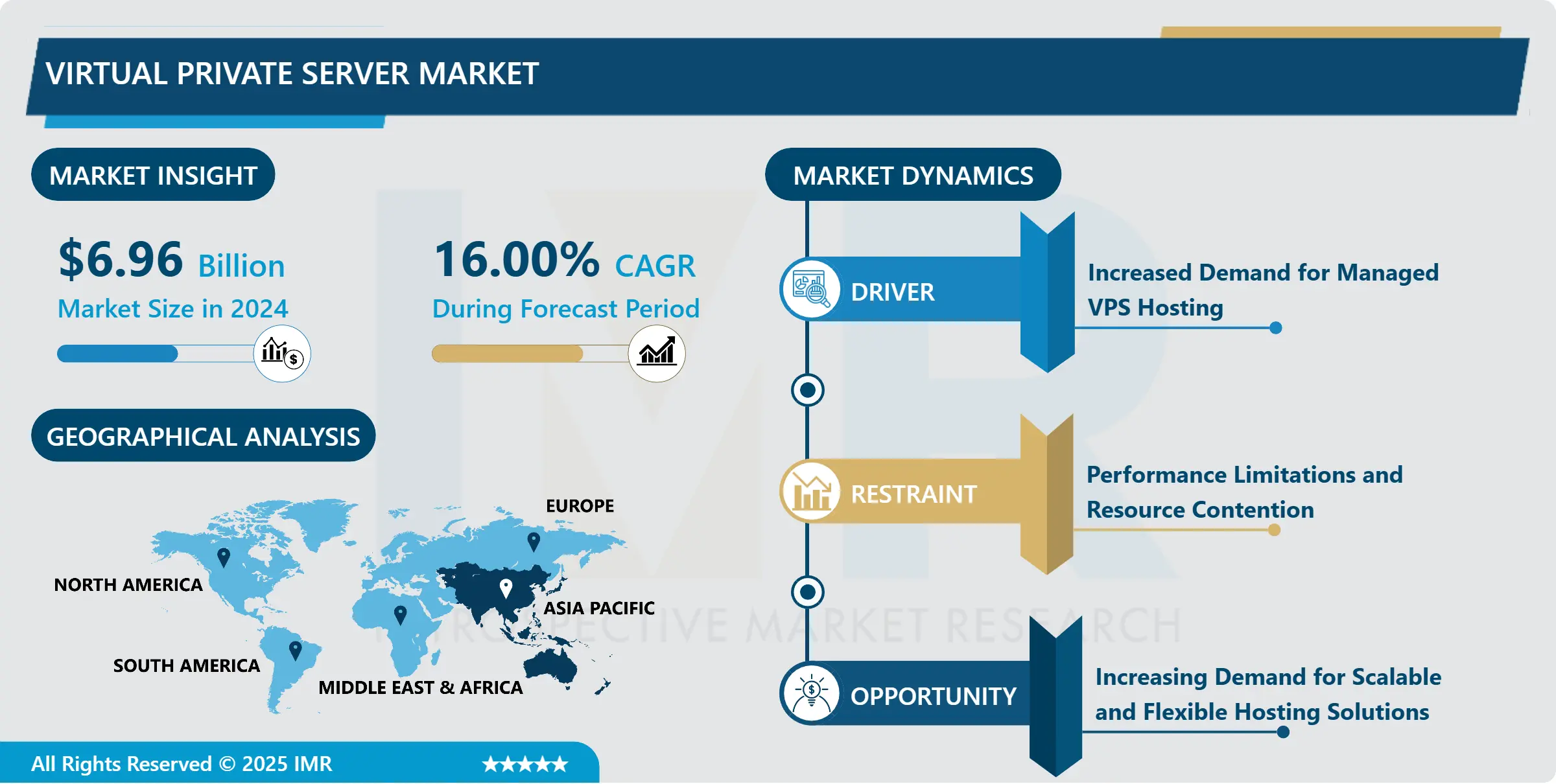
Virtual Private Server Market Size Was Valued at USD 6.96 Billion in 2024, and is Projected to Reach USD 22.82 Billion by 2032, Growing at a CAGR of 16.00% From 2025-2032.
A Virtual Private Server also referred to as VPS is manifested by dividing a physical server into multiple servers that are virtual. Every VPS runs on its OS, CPU, RAM, and storage, and one VPS can be controlled without affecting other VPSs even if they are located on the same physical server. Due to the increased Virtualization technology, VPS hosting is more preferable than shared hosting because it can provide the client with more control, more flexibility and the ability to control security on the site or the application that is on the server without having to rent the full server which will be too expensive.
The market for Virtual Private Server (VPS) has grown enormously because of the growth in implementation of cloud computing and Virtualization technologies. As a hosting solution VPS is much more affordable to businesses that require more advanced level of control than shared hosting but do not want to rent dedicated servers. This market is rather saturated, and offers a plethora of choices in regard to providers and services, ranging from very simple virtual machines to the managed VPS.
Some of the most thriving factors in the VPS market are the flexibility of resource allocation: increasing or decreasing resources, such as a CPU, RAM, and storage space, which optimizes the performance of the business in its operations. Security is another important aspect where VPS hosting providers ensure the Web hosts and customers obtain exceptional firewalls, secure encoding, and distinctive niches to shield information and programs.
Furthermore, virtualization, automation, and the containerization of services have added to the developmental spiral of the market. These innovations allow VPS providers to provide quicker provisioning, smooth migration, and reinforcement of uptime, hence fulfilling all the current business prerequisites of reliability and performance.
The structure of the VPS market contains leaders and oriented on the segments of the market companies and companies which work on the international level. Tarifs are flexible, with providers tend to use mainstream pricing models to enable users to get multiple plans that followed by features and performance assurance. Subsequently, customer support together with SLAs are essential in customer loyalty since reliability of VPS hosting solution together with responsive support from the businesses are valued among customers.
In the future, the market of VPS is expected to grow further as a larger number of organizations will be transferring towards cloud hosting and leveraging advanced digital experiences. These are streamline workload with AI and ML, and the use of green technology and sustainability in the operation of data centers. Legal formalities and many more especially the aspect of data privacy and sovereignty will also help shape the markets especially as organizations unfder pain the stresses of data protection laws across the world.
Therefore, the Virtual Private Server market can be considered as active and new, with constant technological advancements, flexible demands in terms of scalability, and customers’ changing requirements concerning the quality of services and protection. Providers will have to go on coming up with various and sundry ways on how they can set themselves apart from each other in this new world that’s unceasingly developing.
Virtual Private Server Market Trend Analysis
Virtual Private Server Market Growth Drivers- Increased Demand for Managed VPS Hosting
The need to get Managed VPS Hosting (Virtual Private Server) has been growing as a result of some essential factors in the market. Delving deeper into this, Managed VPS Hosting solutions are being chosen by businesses because it occupies a place between shared hosting and dedicated servers and offers improved performance, security, and flexibility of a dedicated server without requiring the complexity of setting up an independent server within the firm. The services provided by Managed VPS Hosting providers include; the setup and management of the server, installation of patches, backup services and providing technical suppos which makes the activity more appealing to companies that want to look at idealistic activities more than the technical ones for instance installation of patches. This trend rises from the increased uptake of small to medium-sized enterprises, and startup companies who need affordable, and consistent hosting but cannot afford dedicated servers.
Moreover, the increased use of the cloud computing and virtualization contributes to the demand of Managed VPS Hosting as it is now more affordable and the businesses can easily expand or decrease the resources without large investments. This aspect also has to do with security where most Managed VPS Hosting providers offer high levels of security and the right compliance standards to ensure the business’s data is secure and credits compliance standards. In conclusion, the Managed VPS Hosting market will consistently progress as organizations always look for ways to enhance business processes on the server side in terms of productivity, flexibility, and protection.
Virtual Private Server Market Opportunities- Increasing Demand for Scalable and Flexible Hosting Solutions
The Virtual Private Server (VPS) market is on an upward trend because of the growing proportion of companies that require hosted services that are elastic and can be easily customized. VPS serves as an appealing option to the problem since it will give users clients isolated from other clients but operating as a dedicated server on a physical entity. This exposes businesses to cost saving aspect because it is scale-by-need and it does not involve the costs of physical infrastructure such as CPU, RAM, and storage like in the traditional model. VPS particularly is valuable for companies because its application helps in following the changes in the IT needs and focuses on being present on the market as a start up, SME or even a large company that wants to overtake the IT structure of the market.
In addition, cloud has grown to become a major booster of the VPS market where some providers are offering cloud based VPS solutions that improve on aspects such as reliability, accessibility and business continuity in case of a disaster. This indicates that there will be a continuous high demand for VPS to the industries as they embrace digitization of their services in adaptation to shocks like remote working, e-commerce, and business intelligence and analytics, whereby scalable hosting services are highly embraced.
Virtual Private Server Market Segment Analysis:
Virtual Private Server Market Segmented based on Operating System (OS) , Service Type, Deployment Type, End-user and Industry Vertical.
By Operating System (OS), Windows VPS segment is expected to dominate the market during the forecast period
In the Virtual Private Server (VPS), operating systems (OS) are significant in defining the service portfolios and consumers’ choice. Windows VPS and Linux VPS have become the most popular options since they fulfill the different requirements of users. Windows VPS has the largest audience that is used to working in Microsoft environments, while providing compatibility with Windows applications and certain functions. It is considered preferable in business environments where the integration with Microsoft products such as Active Directory is needed. However, Linux VPS hosting is valued for its effectiveness, security and flexibility, some of the distributions being Ubuntu, CentOS and Debian.
Linux VPS has the popularity among developers, system administrators, and adherent of technically focused people due to its open-source character, tunable options, and effective command-line environment. Besides these two market Goliaths, customers are looking for other OSs, although not as rampant as the former. These may include; specialised OS configurations for different applications or different markets to meet specific application needs or requirements. Diversity remains essential in VPS market growth as the OS fulfills the different needs of the businesses, developers, and individual users who require reliable and scalable hosting.
By Industry Vertical, IT and Telecom segment held the largest share in 2024
Virtual Private Servers (VPS) is a multi-Industry vertical market in which organizations harness VPS in diverse manners. In the IT and Telecom sector, VPS helps to provide web hosting and other facilities similar to telecommunication and web hosting where organizations can bring variability in their customer’s needs by establishing agile resources. When it comes to the sector of BFSI (Banking, Financial Services, Insurance), VPS guarantees the correct and safe data administration keeping compliance with the most demanding regulations which are crucial for online banking and transactions, financial operations and data analysis.
Healthcare uses VPS as EHRs, applications for telemedicine, and medical image archives because of security and data availability. Retail adopts VPS for web-based stores and other systems used in managing stocks and customers such as customer relationship management or CRM applications to improve on shopping online and business productivity. VPS are used by government agencies for data storage, citizens’ interface solutions, and administrative purposes while satisfying the data sovereignty requirements. In these and other domains, VPS solutions offer affordable solutions of business scale, high levels of security, and stable performance, thus promoting business flexibility and industry-specific digital initiatives.
Virtual Private Server Market Regional Insights:
Asia Pacific is Expected to Dominate the Market Over the Forecast period
The Asia Pacific region is expected to take a commanding position in the overall Virtual Private Server (VPS) market within the course of the forecast period for various reasons. Still, one of the critical considerations is the advancement of cloud services and digitalization trends in countries such as China, India, Japan, and South Korea. These countries have experienced the high increase in internet usage especially in business resulting to high demand for IT infrastructures and data centers and as such increases the demand for hosting services like VPS. In addition, the increasing number of SME companies in the region and increasing outsourcing of the IT services require VPS solutions.
Also, growing adoption of smart city projects and digital economy policies by the government furthers the growth of the VPS market in the region. In addition, such factors as increase in virtualization technology and key global CSPs’ investment in Asia Pacific data centers will help enhance the growth of the VPS market. The aforementioned factors make asia pacific a belt of a powerful player in pushing for the adoption and growth of VPS solutions across the different industries through the forecast time.
Active Key Players in the Virtual Private Server Market
Amazon Web Services (AWS) (USA)
Microsoft Azure (USA)
Google Cloud Platform (USA)
Alibaba Cloud (China)
DigitalOcean (USA)
Vultr (USA)
Linode (USA)
HostGator (USA)
Bluehost (USA)
DreamHost (USA) and Other Active Players
Key Industry Developments in the Virtual Private Server Market
In February 2023, Dell announced the forthcoming availability of a new line of PowerEdge servers powered by 4th Generation Xeon scalable processors and new partnerships with cloud networking providers and hardware makers for private 5G networks. The new PowerEdge server models are the XR8000, XR7620, and XR5610. They are mainly designed with modularity and scalability, making deploying and maintaining them easy, even under challenging conditions.
In October 2022, Cloud provider Serverspace launched a new range of virtual servers. It would allow the users to create a Linux or Windows server powered by the vStack hyper-converged platform. Servers are deployed in secure data centers in four countries: the Netherlands, the USA, Russia, and Kazakhstan.
Chapter 1: Introduction
1.1 Scope and Coverage
Chapter 2:Executive Summary
Chapter 3: Market Landscape
3.1 Market Dynamics
3.1.1 Drivers
3.1.2 Restraints
3.1.3 Opportunities
3.1.4 Challenges
3.2 Market Trend Analysis
3.3 PESTLE Analysis
3.4 Porter’s Five Forces Analysis
3.5 Industry Value Chain Analysis
3.6 Ecosystem
3.7 Regulatory Landscape
3.8 Price Trend Analysis
3.9 Patent Analysis
3.10 Technology Evolution
3.11 Investment Pockets
3.12 Import-Export Analysis
Chapter 4: Virtual Private Server Market by Operating System (OS) (2018-2032)
4.1 Virtual Private Server Market Snapshot and Growth Engine
4.2 Market Overview
4.3 Windows VPS
4.3.1 Introduction and Market Overview
4.3.2 Historic and Forecasted Market Size in Value USD and Volume Units
4.3.3 Key Market Trends, Growth Factors, and Opportunities
4.3.4 Geographic Segmentation Analysis
4.4 Linux VPS
4.5 Others
Chapter 5: Virtual Private Server Market by Service Type (2018-2032)
5.1 Virtual Private Server Market Snapshot and Growth Engine
5.2 Market Overview
5.3 Managed VPS
5.3.1 Introduction and Market Overview
5.3.2 Historic and Forecasted Market Size in Value USD and Volume Units
5.3.3 Key Market Trends, Growth Factors, and Opportunities
5.3.4 Geographic Segmentation Analysis
5.4 Unmanaged (Self-managed) VPS
Chapter 6: Virtual Private Server Market by Deployment Type (2018-2032)
6.1 Virtual Private Server Market Snapshot and Growth Engine
6.2 Market Overview
6.3 Cloud-based VPS
6.3.1 Introduction and Market Overview
6.3.2 Historic and Forecasted Market Size in Value USD and Volume Units
6.3.3 Key Market Trends, Growth Factors, and Opportunities
6.3.4 Geographic Segmentation Analysis
6.4 On-premises VPS
Chapter 7: Virtual Private Server Market by End-user (2018-2032)
7.1 Virtual Private Server Market Snapshot and Growth Engine
7.2 Market Overview
7.3 Small and Medium-sized Enterprises (SMEs)
7.3.1 Introduction and Market Overview
7.3.2 Historic and Forecasted Market Size in Value USD and Volume Units
7.3.3 Key Market Trends, Growth Factors, and Opportunities
7.3.4 Geographic Segmentation Analysis
7.4 Large Enterprises
7.5 Individuals
Chapter 8: Virtual Private Server Market by Industry Vertical (2018-2032)
8.1 Virtual Private Server Market Snapshot and Growth Engine
8.2 Market Overview
8.3 IT and Telecom
8.3.1 Introduction and Market Overview
8.3.2 Historic and Forecasted Market Size in Value USD and Volume Units
8.3.3 Key Market Trends, Growth Factors, and Opportunities
8.3.4 Geographic Segmentation Analysis
8.4 BFSI (Banking
8.5 Financial Services
8.6 and Insurance)
8.7 Healthcare
8.8 Retail
8.9 Government
8.10 Others
Chapter 9: Company Profiles and Competitive Analysis
9.1 Competitive Landscape
9.1.1 Competitive Benchmarking
9.1.2 Virtual Private Server Market Share by Manufacturer (2024)
9.1.3 Industry BCG Matrix
9.1.4 Heat Map Analysis
9.1.5 Mergers and Acquisitions
9.2 AMAZON WEB SERVICES (AWS) (USA)
9.2.1 Company Overview
9.2.2 Key Executives
9.2.3 Company Snapshot
9.2.4 Role of the Company in the Market
9.2.5 Sustainability and Social Responsibility
9.2.6 Operating Business Segments
9.2.7 Product Portfolio
9.2.8 Business Performance
9.2.9 Key Strategic Moves and Recent Developments
9.2.10 SWOT Analysis
9.3 MICROSOFT AZURE (USA)
9.4 GOOGLE CLOUD PLATFORM (USA)
9.5 ALIBABA CLOUD (CHINA)
9.6 DIGITALOCEAN (USA)
9.7 VULTR (USA)
9.8 LINODE (USA)
9.9 HOSTGATOR (USA)
9.10 BLUEHOST (USA)
9.11 DREAMHOST (USA)
Chapter 10: Global Virtual Private Server Market By Region
10.1 Overview
10.2. North America Virtual Private Server Market
10.2.1 Key Market Trends, Growth Factors and Opportunities
10.2.2 Top Key Companies
10.2.3 Historic and Forecasted Market Size by Segments
10.2.4 Historic and Forecasted Market Size by Operating System (OS)
10.2.4.1 Windows VPS
10.2.4.2 Linux VPS
10.2.4.3 Others
10.2.5 Historic and Forecasted Market Size by Service Type
10.2.5.1 Managed VPS
10.2.5.2 Unmanaged (Self-managed) VPS
10.2.6 Historic and Forecasted Market Size by Deployment Type
10.2.6.1 Cloud-based VPS
10.2.6.2 On-premises VPS
10.2.7 Historic and Forecasted Market Size by End-user
10.2.7.1 Small and Medium-sized Enterprises (SMEs)
10.2.7.2 Large Enterprises
10.2.7.3 Individuals
10.2.8 Historic and Forecasted Market Size by Industry Vertical
10.2.8.1 IT and Telecom
10.2.8.2 BFSI (Banking
10.2.8.3 Financial Services
10.2.8.4 and Insurance)
10.2.8.5 Healthcare
10.2.8.6 Retail
10.2.8.7 Government
10.2.8.8 Others
10.2.9 Historic and Forecast Market Size by Country
10.2.9.1 US
10.2.9.2 Canada
10.2.9.3 Mexico
10.3. Eastern Europe Virtual Private Server Market
10.3.1 Key Market Trends, Growth Factors and Opportunities
10.3.2 Top Key Companies
10.3.3 Historic and Forecasted Market Size by Segments
10.3.4 Historic and Forecasted Market Size by Operating System (OS)
10.3.4.1 Windows VPS
10.3.4.2 Linux VPS
10.3.4.3 Others
10.3.5 Historic and Forecasted Market Size by Service Type
10.3.5.1 Managed VPS
10.3.5.2 Unmanaged (Self-managed) VPS
10.3.6 Historic and Forecasted Market Size by Deployment Type
10.3.6.1 Cloud-based VPS
10.3.6.2 On-premises VPS
10.3.7 Historic and Forecasted Market Size by End-user
10.3.7.1 Small and Medium-sized Enterprises (SMEs)
10.3.7.2 Large Enterprises
10.3.7.3 Individuals
10.3.8 Historic and Forecasted Market Size by Industry Vertical
10.3.8.1 IT and Telecom
10.3.8.2 BFSI (Banking
10.3.8.3 Financial Services
10.3.8.4 and Insurance)
10.3.8.5 Healthcare
10.3.8.6 Retail
10.3.8.7 Government
10.3.8.8 Others
10.3.9 Historic and Forecast Market Size by Country
10.3.9.1 Russia
10.3.9.2 Bulgaria
10.3.9.3 The Czech Republic
10.3.9.4 Hungary
10.3.9.5 Poland
10.3.9.6 Romania
10.3.9.7 Rest of Eastern Europe
10.4. Western Europe Virtual Private Server Market
10.4.1 Key Market Trends, Growth Factors and Opportunities
10.4.2 Top Key Companies
10.4.3 Historic and Forecasted Market Size by Segments
10.4.4 Historic and Forecasted Market Size by Operating System (OS)
10.4.4.1 Windows VPS
10.4.4.2 Linux VPS
10.4.4.3 Others
10.4.5 Historic and Forecasted Market Size by Service Type
10.4.5.1 Managed VPS
10.4.5.2 Unmanaged (Self-managed) VPS
10.4.6 Historic and Forecasted Market Size by Deployment Type
10.4.6.1 Cloud-based VPS
10.4.6.2 On-premises VPS
10.4.7 Historic and Forecasted Market Size by End-user
10.4.7.1 Small and Medium-sized Enterprises (SMEs)
10.4.7.2 Large Enterprises
10.4.7.3 Individuals
10.4.8 Historic and Forecasted Market Size by Industry Vertical
10.4.8.1 IT and Telecom
10.4.8.2 BFSI (Banking
10.4.8.3 Financial Services
10.4.8.4 and Insurance)
10.4.8.5 Healthcare
10.4.8.6 Retail
10.4.8.7 Government
10.4.8.8 Others
10.4.9 Historic and Forecast Market Size by Country
10.4.9.1 Germany
10.4.9.2 UK
10.4.9.3 France
10.4.9.4 The Netherlands
10.4.9.5 Italy
10.4.9.6 Spain
10.4.9.7 Rest of Western Europe
10.5. Asia Pacific Virtual Private Server Market
10.5.1 Key Market Trends, Growth Factors and Opportunities
10.5.2 Top Key Companies
10.5.3 Historic and Forecasted Market Size by Segments
10.5.4 Historic and Forecasted Market Size by Operating System (OS)
10.5.4.1 Windows VPS
10.5.4.2 Linux VPS
10.5.4.3 Others
10.5.5 Historic and Forecasted Market Size by Service Type
10.5.5.1 Managed VPS
10.5.5.2 Unmanaged (Self-managed) VPS
10.5.6 Historic and Forecasted Market Size by Deployment Type
10.5.6.1 Cloud-based VPS
10.5.6.2 On-premises VPS
10.5.7 Historic and Forecasted Market Size by End-user
10.5.7.1 Small and Medium-sized Enterprises (SMEs)
10.5.7.2 Large Enterprises
10.5.7.3 Individuals
10.5.8 Historic and Forecasted Market Size by Industry Vertical
10.5.8.1 IT and Telecom
10.5.8.2 BFSI (Banking
10.5.8.3 Financial Services
10.5.8.4 and Insurance)
10.5.8.5 Healthcare
10.5.8.6 Retail
10.5.8.7 Government
10.5.8.8 Others
10.5.9 Historic and Forecast Market Size by Country
10.5.9.1 China
10.5.9.2 India
10.5.9.3 Japan
10.5.9.4 South Korea
10.5.9.5 Malaysia
10.5.9.6 Thailand
10.5.9.7 Vietnam
10.5.9.8 The Philippines
10.5.9.9 Australia
10.5.9.10 New Zealand
10.5.9.11 Rest of APAC
10.6. Middle East & Africa Virtual Private Server Market
10.6.1 Key Market Trends, Growth Factors and Opportunities
10.6.2 Top Key Companies
10.6.3 Historic and Forecasted Market Size by Segments
10.6.4 Historic and Forecasted Market Size by Operating System (OS)
10.6.4.1 Windows VPS
10.6.4.2 Linux VPS
10.6.4.3 Others
10.6.5 Historic and Forecasted Market Size by Service Type
10.6.5.1 Managed VPS
10.6.5.2 Unmanaged (Self-managed) VPS
10.6.6 Historic and Forecasted Market Size by Deployment Type
10.6.6.1 Cloud-based VPS
10.6.6.2 On-premises VPS
10.6.7 Historic and Forecasted Market Size by End-user
10.6.7.1 Small and Medium-sized Enterprises (SMEs)
10.6.7.2 Large Enterprises
10.6.7.3 Individuals
10.6.8 Historic and Forecasted Market Size by Industry Vertical
10.6.8.1 IT and Telecom
10.6.8.2 BFSI (Banking
10.6.8.3 Financial Services
10.6.8.4 and Insurance)
10.6.8.5 Healthcare
10.6.8.6 Retail
10.6.8.7 Government
10.6.8.8 Others
10.6.9 Historic and Forecast Market Size by Country
10.6.9.1 Turkiye
10.6.9.2 Bahrain
10.6.9.3 Kuwait
10.6.9.4 Saudi Arabia
10.6.9.5 Qatar
10.6.9.6 UAE
10.6.9.7 Israel
10.6.9.8 South Africa
10.7. South America Virtual Private Server Market
10.7.1 Key Market Trends, Growth Factors and Opportunities
10.7.2 Top Key Companies
10.7.3 Historic and Forecasted Market Size by Segments
10.7.4 Historic and Forecasted Market Size by Operating System (OS)
10.7.4.1 Windows VPS
10.7.4.2 Linux VPS
10.7.4.3 Others
10.7.5 Historic and Forecasted Market Size by Service Type
10.7.5.1 Managed VPS
10.7.5.2 Unmanaged (Self-managed) VPS
10.7.6 Historic and Forecasted Market Size by Deployment Type
10.7.6.1 Cloud-based VPS
10.7.6.2 On-premises VPS
10.7.7 Historic and Forecasted Market Size by End-user
10.7.7.1 Small and Medium-sized Enterprises (SMEs)
10.7.7.2 Large Enterprises
10.7.7.3 Individuals
10.7.8 Historic and Forecasted Market Size by Industry Vertical
10.7.8.1 IT and Telecom
10.7.8.2 BFSI (Banking
10.7.8.3 Financial Services
10.7.8.4 and Insurance)
10.7.8.5 Healthcare
10.7.8.6 Retail
10.7.8.7 Government
10.7.8.8 Others
10.7.9 Historic and Forecast Market Size by Country
10.7.9.1 Brazil
10.7.9.2 Argentina
10.7.9.3 Rest of SA
Chapter 11 Analyst Viewpoint and Conclusion
11.1 Recommendations and Concluding Analysis
11.2 Potential Market Strategies
Chapter 12 Research Methodology
12.1 Research Process
12.2 Primary Research
12.3 Secondary Research
Q1: What would be the forecast period in the Virtual Private Server Market research report?
A1: The forecast period in the Virtual Private Server Market research report is 2025-2032.
Q2: Who are the key players in the Virtual Private Server Market ?
A2: Amazon Web Services (AWS) (USA),Microsoft Azure (USA),Google Cloud Platform (USA),Alibaba Cloud (China),DigitalOcean (USA),Vultr (USA),Linode (USA) ,and Other active Players.
Q3: What are the segments of the Virtual Private Server Market ?
A3: The Virtual Private Server Market is segmented into Operating System (OS), Service Type, Deployment Type, End-user, Industry Vertical and Region. By Operating System (OS), the market is categorized into Windows VPS,Linux VPS,Others. By Service Type, the market is categorized into Managed VPS,Unmanaged (Self-managed) VPS.By Deployment Type, the market is categorized into Cloud-based VPS,On-premises VPS. By End-user, the market is categorized into Small and Medium-sized Enterprises (SMEs),Large Enterprises,Individuals. By Industry Vertical, the market is categorized into IT and Telecom,BFSI (Banking, Financial Services, and Insurance),Healthcare,Retail,Government,Others. By region, it is analyzed across • North America (U.S., Canada, Mexico) • Eastern Europe (Russia, Bulgaria, The Czech Republic, Hungary, Poland, Romania, Rest of Eastern Europe) • Western Europe (Germany, UK, France, The Netherlands, Italy, Spain, Rest of Western Europe) • Asia Pacific (China, India, Japan, South Korea, Malaysia, Thailand, Vietnam, The Philippines, Australia, New Zealand, Rest of APAC) • Middle East & Africa (Türkiye, Bahrain, Kuwait, Saudi Arabia, Qatar, UAE, Israel, South Africa) • South America (Brazil, Argentina, Rest of SA)
Q4: What is the Virtual Private Server Market?
A4: A Virtual Private Server also referred to as VPS is manifested by dividing a physical server into multiple servers that are virtual. Every VPS runs on its OS, CPU, RAM, and storage, and one VPS can be controlled without affecting other VPSs even if they are located on the same physical server. Due to the increased Virtualization technology, VPS hosting is more preferable than shared hosting because it can provide the client with more control, more flexibility and the ability to control security on the site or the application that is on the server without having to rent the full server which will be too expensive.
Q5: How big is the Virtual Private Server Market ?
A5: Virtual Private Server Market Size Was Valued at USD 6.96 Billion in 2024, and is Projected to Reach USD 22.82 Billion by 2032, Growing at a CAGR of 16.00% From 2025-2032.
How to Buy a Report from eminsights.jp
On the product page, choose the license you want: Single-User License, Multi-User License or Enterprise License.
If you required report in your native language, then you can click on Translated Report button and fill out the form with report name and language you want, then our team will contact you as soon as possible.
Click the Buy Now button.
You will be redirected to the checkout page. Enter your company details and payment information.
Click Place Order to complete the purchase.
Confirmation: You’ll receive an order confirmation and our team will contact you shortly with your ordered report.
If you have any questions, fill out the contact form below or email us at [email protected].
Thank you for choosing eminsights.jp!