Stay Ahead in Fast-Growing Economies.
Browse Reports Now




Fitness Equipment Market: Global Growth & Trend Analysis
People are becoming more sensitive of their health, which has raised awareness of the need of regular exercise for general wellbeing. This pattern has encouraged more money to be spent on workout equipment, along with increased disposable incomes. Exercise equipment is necessary for a variety of activities that target improving physical health, controlling weight, and increasing muscle mass and endurance. Increased health concerns, an increasing youth population, and the high prevalence of obesity are all factors driving market expansion.

IMR Group
Description
Fitness Equipment Market Synopsis
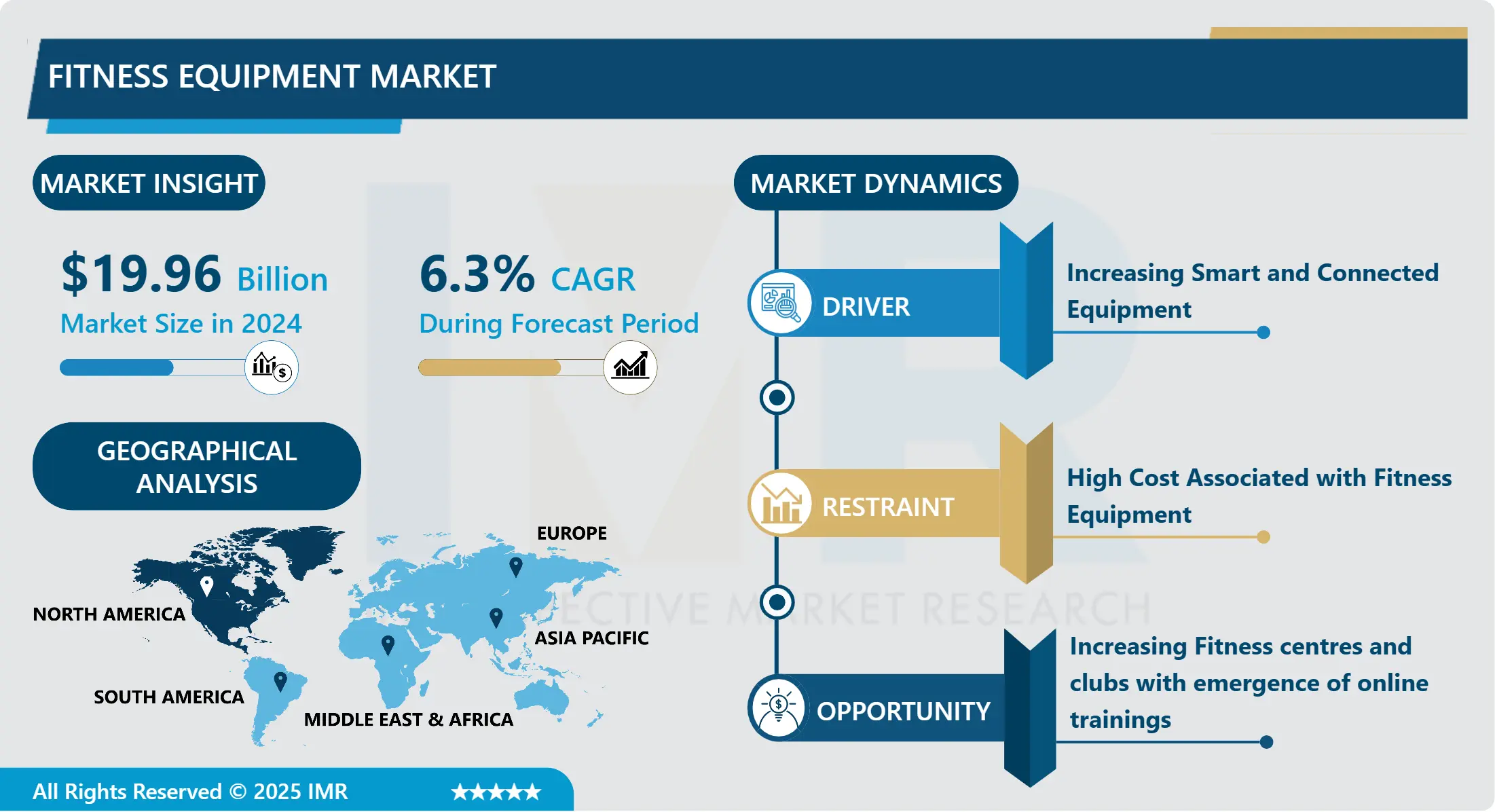
Fitness Equipment Market Size Was Valued at 19.96 Billion in 2024, and is Projected to Reach USD 32.54 Billion by 2032, Growing at a CAGR of 6.3% From 2025-2032.
People are becoming more sensitive of their health, which has raised awareness of the need of regular exercise for general wellbeing. This pattern has encouraged more money to be spent on workout equipment, along with increased disposable incomes.
Exercise equipment is necessary for a variety of activities that target improving physical health, controlling weight, and increasing muscle mass and endurance. Increased health concerns, an increasing youth population, and the high prevalence of obesity are all factors driving market expansion. This market includes a wide range of goods made for home and business usage, such as equipment for gyms, sports teams, fitness centres, and individual users.
The fitness sector offers a wide range of products to meet the demands and tastes of its customers, from weight machines and free weights to stationary bikes and treadmills. It is anticipated that as the market for fitness solutions expands, new products and technologies that improve efficacy and user experience will emerge. Fitness equipment is now more widely available because to the development of e-commerce platforms, which let users compare products, read reviews, and make purchases. A noteworthy factor bolstering the market expansion is the heightened emphasis on corporate wellness initiatives.
Corporate wellness initiatives are being implemented by numerous businesses as a result of their recognition of the value of promoting the health and well-being of their workforce. Businesses are investing in on-site workout facilities within their office buildings to promote corporate wellness initiatives. Exercise equipment like weight machines, yoga mats, treadmills, and exercise bikes are frequently available in these facilities. The market is growing because of the demand for exercise equipment in these settings.
Fitness Equipment Market Trend Analysis
Fitness Equipment Market Growth Driver- Increasing Smart and Connected Equipment
A notable trend in the fitness equipment market is the rise of smart and connected equipment, which is reshaping the landscape of the sector in a number of ways. Technological developments and the rising desire for a customised, practical, and enjoyable workout experience are the driving forces behind this trend. In order to add value to their equipment, businesses are providing virtual lessons, training courses, and wellness material via subscription services.
Rising demand for home fitness solutions has led to the development of space-saving and versatile equipment, such as foldable treadmills and all-in-one gym systems. Growth of online workout programs and virtual personal training sessions that can be accessed via home fitness equipment. Increased use of sustainable and recyclable materials in the manufacturing of fitness equipment. Development of self-powered machines, like treadmills and ellipticals that generate power as they are used.
Equipment that can tailor workouts to an individual’s fitness level, goals, and preferences, often through AI and machine learning algorithms. Machines that allow users to customize resistance and settings easily, catering to a range of fitness levels. Growing popularity of equipment designed for recovery and rehabilitation, such as foam rollers, massage guns, and stretching machines. Expansion of product lines to include items that support overall wellness, including yoga mats, meditation cushions, and balance trainers.
Fitness Equipment Market Expansion Opportunity- Increasing Fitness centres and clubs with emergence of online trainings
Many peoples are engaging in online training programs, there is a higher demand for home fitness equipment. Peoples are investing in treadmills, stationary bikes, dumbbells, resistance bands, and other portable fitness gear to facilitate their at-home workouts.so the demand for home fitness equipment’s are rising. The convergence of technology and fitness has led to the development of smart fitness equipment. These devices often integrate with fitness apps, providing real-time feedback, virtual coaching, and community engagement, enhancing the overall workout experience.
Many Corporates arrange the health training programs, companies are increasingly recognizing the importance of employee wellness, leading to the implementation of corporate wellness programs that include fitness equipment for offices or subsidized memberships to fitness centres. This trend can drive bulk purchases of fitness equipment by organizations looking to support their employees’ health and productivity.
Rising of online training and a more customization approach to fitness, there is a growing market for customized fitness equipment. Consumers are demanding for equipment that fits their specific needs, preferences, and space constraints. This opens up opportunities for companies to offer bespoke solutions, such as adjustable dumbbells, foldable exercise bikes, and modular home gym systems.
Fitness Equipment Market Segment Analysis:
Fitness Equipment Market is Segmented on The Basis of Product Type, Application, Gender, Buyer Type, Gender, End-User, Type, Distribution Channel and Region.
By Type, Cardiovascular Training Equipment segment is expected to dominate the market during the forecast period
Cardiovascular training equipment dominates the fitness equipment market, driven by the increasing focus on cardiovascular health, weight management, and overall fitness. The health benefits of cardiovascular exercise are well-known, and they include enhancing lung capacity, lowering the risk of chronic diseases like hypertension, diabetes, and obesity, as well as assisting in weight loss. This type advantages make cardio hardware interesting to an expansive crowd.
Cardio gear like treadmills, exercise bikes, circular machines, and paddling machines take care of different wellness levels and inclinations. They provide a variety of workout options, ranging from high-intensity interval training to more interactive and engaging cardio equipment. The user experience has been enhanced by built-in screens, virtual coaching, online classes, and performance tracking, making workouts more enjoyable and motivating.
A greater understanding of the significance of cardiovascular health has led people to purchase cardiac equipment. Fitness gurus and public health initiatives frequently highlight the importance of physical activity in preserving general health and wellness. Cardio equipment is often an excellent investment for both individuals and fitness centres since it provides a nice balance between cost and functionality. Its commercial appeal keeps it at the top of the market.
By End-Users, Home Consumer segment held the Largest Share in 2024
Many home consumers facing the space problem so compact and foldable fitness equipment is in high demand. Folding treadmills, portable exercise cycles, and mini elliptical trainers are examples of products that are made to fit into smaller living spaces without sacrificing functionality. Users can quickly put up and store their training equipment thanks to these space-saving alternatives.
The need for portable exercise equipment that is convenient to use in different parts of the house is growing. Products like kettlebells, resistance bands, adjustable dumbbells, and small rowing machines are convenient and versatile for individuals who require a variety of training options and demanding this type of products. With rising popularity of online fitness classes has surged, allowing home consumers to participate in live or on-demand workout sessions led by professional trainers.
Platforms like Peloton, iFit, and Echelon provide interactive classes for various fitness levels and interests, and helps to consumer stay engaged and motivated. The home consumer market is becoming more and more concerned with overall wellbeing and health. As a result, there is a growing need for gear that promotes both mental and physical health. Incorporating yoga mats, mindfulness equipment, and meditation applications into home workout regimens is becoming more typical.
Fitness Equipment Market Regional Insights:
North America is Expected to Dominate the Market Over the Forecast period
In North America there is rising awareness of health and fitness among the people. Many people are increasingly realizing the importance of regular exercise and leading a healthy lifestyle, which drives the demand for fitness equipment. In this region, particularly the United States, has been facing an obesity epidemic for several years. This has led to a heightened focus on weight management, physical activity, and overall wellness, resulting in a robust demand for fitness equipment.
North America has a relative population with high disposable income to spend on fitness and wellness products. This purchasing power drives the market for high-quality fitness equipment, including advanced cardiovascular machines, strength training equipment, and home gym setups. The region is a hub for innovation and technological advancements in the fitness industry. North American companies continuously develop cutting-edge fitness equipment with features like connectivity, virtual training, and personalized workout programs, catering to the evolving needs and preferences of consumers.
Strong fitness culture in this region, with a significant emphasis on physical appearance, health, and wellness. This cultural mindset fosters a continuous demand for fitness equipment and services, supporting the market’s dominance in the region.
From this graph, it is shown that the wholesale sales data for fitness equipment in the U.S. from 2020 to 2023 indicates a fluctuating trend. In 2020, wholesale sales of fitness equipment in the U.S. amounted to $5.59 billion. This figure increased to $6.42 billion in 2021, reflecting a significant rise in demand for fitness equipment. However, in 2022, there was a slight decrease in wholesale sales, dropping to $6.08 billion. By 2023, the wholesale sales of fitness equipment rebounded, reaching $6.56 billion. That the fitness equipment market experienced overall growth during this period, albeit with some fluctuations. In 2022, the market demonstrated resilience and recovered swiftly, achieving a higher sales figure in 2023 compared to the previous years.
Fitness Equipment Market Top Key Players:
Life Fitness (USA)
Technogym (Italy)
Nautilus, Inc. (USA)
Precor (USA)
Johnson Health Tech (Taiwan)
Peloton Interactive (USA)
ICON Health & Fitness (USA)
TRUE Fitness (USA)
Cybex International (USA)
Matrix Fitness (USA)
Keiser Corporation (USA)
Spirit Fitness (USA)
Star Trac (USA)
Torque Fitness (USA)
Dyaco International (Taiwan)
Body-Solid, Inc. (USA)
Hoist Fitness (USA)
Hammer Strength (USA)
Panatta (Italy)
SportsArt (Taiwan)
Core Health & Fitness (USA)
Woodway USA (USA)
Rogue Fitness (USA)
Atlantis Strength (Canada)
BH Fitness (Spain)
Impulse Group (China)
Jerai Fitness Ltd (India)
Gym80 International GmbH (Germany)
Other Active players.
Key Industry Developments in the Fitness Equipment Market:
In Jan 2024, EGYM, the global fitness technology and corporate health innovation leader, and Life Fitness, the global leader in commercial fitness equipment, are thrilled to announce the expansion of t
Chapter 1: Introduction
1.1 Scope and Coverage
Chapter 2:Executive Summary
Chapter 3: Market Landscape
3.1 Market Dynamics
3.1.1 Drivers
3.1.2 Restraints
3.1.3 Opportunities
3.1.4 Challenges
3.2 Market Trend Analysis
3.3 PESTLE Analysis
3.4 Porter’s Five Forces Analysis
3.5 Industry Value Chain Analysis
3.6 Ecosystem
3.7 Regulatory Landscape
3.8 Price Trend Analysis
3.9 Patent Analysis
3.10 Technology Evolution
3.11 Investment Pockets
3.12 Import-Export Analysis
Chapter 4: Fitness Equipment Market by Product Type (2018-2032)
4.1 Fitness Equipment Market Snapshot and Growth Engine
4.2 Market Overview
4.3 Strength Training Equipment
4.3.1 Introduction and Market Overview
4.3.2 Historic and Forecasted Market Size in Value USD and Volume Units
4.3.3 Key Market Trends, Growth Factors, and Opportunities
4.3.4 Geographic Segmentation Analysis
4.4 Cardiovascular Training Equipment
4.5 Body Composition Analyser
4.6 Fitness Monitoring Equipment and Others
Chapter 5: Fitness Equipment Market by Application (2018-2032)
5.1 Fitness Equipment Market Snapshot and Growth Engine
5.2 Market Overview
5.3 Weight Loss
5.3.1 Introduction and Market Overview
5.3.2 Historic and Forecasted Market Size in Value USD and Volume Units
5.3.3 Key Market Trends, Growth Factors, and Opportunities
5.3.4 Geographic Segmentation Analysis
5.4 Body Building
5.5 Physical Fitness
5.6 Mental Fitness and Others
Chapter 6: Fitness Equipment Market by Gender (2018-2032)
6.1 Fitness Equipment Market Snapshot and Growth Engine
6.2 Market Overview
6.3 Male
6.3.1 Introduction and Market Overview
6.3.2 Historic and Forecasted Market Size in Value USD and Volume Units
6.3.3 Key Market Trends, Growth Factors, and Opportunities
6.3.4 Geographic Segmentation Analysis
6.4 Female
Chapter 7: Fitness Equipment Market by Buyer Type (2018-2032)
7.1 Fitness Equipment Market Snapshot and Growth Engine
7.2 Market Overview
7.3 Individual
7.3.1 Introduction and Market Overview
7.3.2 Historic and Forecasted Market Size in Value USD and Volume Units
7.3.3 Key Market Trends, Growth Factors, and Opportunities
7.3.4 Geographic Segmentation Analysis
7.4 Institution
Chapter 8: Fitness Equipment Market by Usage (2018-2032)
8.1 Fitness Equipment Market Snapshot and Growth Engine
8.2 Market Overview
8.3 Residential
8.3.1 Introduction and Market Overview
8.3.2 Historic and Forecasted Market Size in Value USD and Volume Units
8.3.3 Key Market Trends, Growth Factors, and Opportunities
8.3.4 Geographic Segmentation Analysis
8.4 Commercial
Chapter 9: Fitness Equipment Market by Type (2018-2032)
9.1 Fitness Equipment Market Snapshot and Growth Engine
9.2 Market Overview
9.3 Outdoor
9.3.1 Introduction and Market Overview
9.3.2 Historic and Forecasted Market Size in Value USD and Volume Units
9.3.3 Key Market Trends, Growth Factors, and Opportunities
9.3.4 Geographic Segmentation Analysis
9.4 Indoor
Chapter 10: Company Profiles and Competitive Analysis
10.1 Competitive Landscape
10.1.1 Competitive Benchmarking
10.1.2 Fitness Equipment Market Share by Manufacturer (2024)
10.1.3 Industry BCG Matrix
10.1.4 Heat Map Analysis
10.1.5 Mergers and Acquisitions
10.2 LIFE FITNESS (USA)
10.2.1 Company Overview
10.2.2 Key Executives
10.2.3 Company Snapshot
10.2.4 Role of the Company in the Market
10.2.5 Sustainability and Social Responsibility
10.2.6 Operating Business Segments
10.2.7 Product Portfolio
10.2.8 Business Performance
10.2.9 Key Strategic Moves and Recent Developments
10.2.10 SWOT Analysis
10.3 TECHNOGYM (ITALY)
10.4 NAUTILUS INC. (USA)
10.5 PRECOR (USA)
10.6 JOHNSON HEALTH TECH (TAIWAN)
10.7 PELOTON INTERACTIVE (USA)
10.8 ICON HEALTH & FITNESS (USA)
10.9 TRUE FITNESS (USA)
10.10 CYBEX INTERNATIONAL (USA)
10.11 MATRIX FITNESS (USA)
10.12 KEISER CORPORATION (USA)
10.13 SPIRIT FITNESS (USA)
10.14 STAR TRAC (USA)
10.15 TORQUE FITNESS (USA)
10.16 DYACO INTERNATIONAL (TAIWAN)
10.17 BODY-SOLID INC. (USA)
10.18 HOIST FITNESS (USA)
10.19 HAMMER STRENGTH (USA)
10.20 PANATTA (ITALY)
10.21 SPORTSART (TAIWAN)
10.22 CORE HEALTH & FITNESS (USA)
10.23 WOODWAY USA (USA)
10.24 ROGUE FITNESS (USA)
10.25 ATLANTIS STRENGTH (CANADA)
10.26 BH FITNESS (SPAIN)
10.27 IMPULSE GROUP (CHINA)
10.28 JERAI FITNESS LTD (INDIA)
10.29 GYM80 INTERNATIONAL GMBH (GERMANY)
Chapter 11: Global Fitness Equipment Market By Region
11.1 Overview
11.2. North America Fitness Equipment Market
11.2.1 Key Market Trends, Growth Factors and Opportunities
11.2.2 Top Key Companies
11.2.3 Historic and Forecasted Market Size by Segments
11.2.4 Historic and Forecasted Market Size by Product Type
11.2.4.1 Strength Training Equipment
11.2.4.2 Cardiovascular Training Equipment
11.2.4.3 Body Composition Analyser
11.2.4.4 Fitness Monitoring Equipment and Others
11.2.5 Historic and Forecasted Market Size by Application
11.2.5.1 Weight Loss
11.2.5.2 Body Building
11.2.5.3 Physical Fitness
11.2.5.4 Mental Fitness and Others
11.2.6 Historic and Forecasted Market Size by Gender
11.2.6.1 Male
11.2.6.2 Female
11.2.7 Historic and Forecasted Market Size by Buyer Type
11.2.7.1 Individual
11.2.7.2 Institution
11.2.8 Historic and Forecasted Market Size by Usage
11.2.8.1 Residential
11.2.8.2 Commercial
11.2.9 Historic and Forecasted Market Size by Type
11.2.9.1 Outdoor
11.2.9.2 Indoor
11.2.10 Historic and Forecast Market Size by Country
11.2.10.1 US
11.2.10.2 Canada
11.2.10.3 Mexico
11.3. Eastern Europe Fitness Equipment Market
11.3.1 Key Market Trends, Growth Factors and Opportunities
11.3.2 Top Key Companies
11.3.3 Historic and Forecasted Market Size by Segments
11.3.4 Historic and Forecasted Market Size by Product Type
11.3.4.1 Strength Training Equipment
11.3.4.2 Cardiovascular Training Equipment
11.3.4.3 Body Composition Analyser
11.3.4.4 Fitness Monitoring Equipment and Others
11.3.5 Historic and Forecasted Market Size by Application
11.3.5.1 Weight Loss
11.3.5.2 Body Building
11.3.5.3 Physical Fitness
11.3.5.4 Mental Fitness and Others
11.3.6 Historic and Forecasted Market Size by Gender
11.3.6.1 Male
11.3.6.2 Female
11.3.7 Historic and Forecasted Market Size by Buyer Type
11.3.7.1 Individual
11.3.7.2 Institution
11.3.8 Historic and Forecasted Market Size by Usage
11.3.8.1 Residential
11.3.8.2 Commercial
11.3.9 Historic and Forecasted Market Size by Type
11.3.9.1 Outdoor
11.3.9.2 Indoor
11.3.10 Historic and Forecast Market Size by Country
11.3.10.1 Russia
11.3.10.2 Bulgaria
11.3.10.3 The Czech Republic
11.3.10.4 Hungary
11.3.10.5 Poland
11.3.10.6 Romania
11.3.10.7 Rest of Eastern Europe
11.4. Western Europe Fitness Equipment Market
11.4.1 Key Market Trends, Growth Factors and Opportunities
11.4.2 Top Key Companies
11.4.3 Historic and Forecasted Market Size by Segments
11.4.4 Historic and Forecasted Market Size by Product Type
11.4.4.1 Strength Training Equipment
11.4.4.2 Cardiovascular Training Equipment
11.4.4.3 Body Composition Analyser
11.4.4.4 Fitness Monitoring Equipment and Others
11.4.5 Historic and Forecasted Market Size by Application
11.4.5.1 Weight Loss
11.4.5.2 Body Building
11.4.5.3 Physical Fitness
11.4.5.4 Mental Fitness and Others
11.4.6 Historic and Forecasted Market Size by Gender
11.4.6.1 Male
11.4.6.2 Female
11.4.7 Historic and Forecasted Market Size by Buyer Type
11.4.7.1 Individual
11.4.7.2 Institution
11.4.8 Historic and Forecasted Market Size by Usage
11.4.8.1 Residential
11.4.8.2 Commercial
11.4.9 Historic and Forecasted Market Size by Type
11.4.9.1 Outdoor
11.4.9.2 Indoor
11.4.10 Historic and Forecast Market Size by Country
11.4.10.1 Germany
11.4.10.2 UK
11.4.10.3 France
11.4.10.4 The Netherlands
11.4.10.5 Italy
11.4.10.6 Spain
11.4.10.7 Rest of Western Europe
11.5. Asia Pacific Fitness Equipment Market
11.5.1 Key Market Trends, Growth Factors and Opportunities
11.5.2 Top Key Companies
11.5.3 Historic and Forecasted Market Size by Segments
11.5.4 Historic and Forecasted Market Size by Product Type
11.5.4.1 Strength Training Equipment
11.5.4.2 Cardiovascular Training Equipment
11.5.4.3 Body Composition Analyser
11.5.4.4 Fitness Monitoring Equipment and Others
11.5.5 Historic and Forecasted Market Size by Application
11.5.5.1 Weight Loss
11.5.5.2 Body Building
11.5.5.3 Physical Fitness
11.5.5.4 Mental Fitness and Others
11.5.6 Historic and Forecasted Market Size by Gender
11.5.6.1 Male
11.5.6.2 Female
11.5.7 Historic and Forecasted Market Size by Buyer Type
11.5.7.1 Individual
11.5.7.2 Institution
11.5.8 Historic and Forecasted Market Size by Usage
11.5.8.1 Residential
11.5.8.2 Commercial
11.5.9 Historic and Forecasted Market Size by Type
11.5.9.1 Outdoor
11.5.9.2 Indoor
11.5.10 Historic and Forecast Market Size by Country
11.5.10.1 China
11.5.10.2 India
11.5.10.3 Japan
11.5.10.4 South Korea
11.5.10.5 Malaysia
11.5.10.6 Thailand
11.5.10.7 Vietnam
11.5.10.8 The Philippines
11.5.10.9 Australia
11.5.10.10 New Zealand
11.5.10.11 Rest of APAC
11.6. Middle East & Africa Fitness Equipment Market
11.6.1 Key Market Trends, Growth Factors and Opportunities
11.6.2 Top Key Companies
11.6.3 Historic and Forecasted Market Size by Segments
11.6.4 Historic and Forecasted Market Size by Product Type
11.6.4.1 Strength Training Equipment
11.6.4.2 Cardiovascular Training Equipment
11.6.4.3 Body Composition Analyser
11.6.4.4 Fitness Monitoring Equipment and Others
11.6.5 Historic and Forecasted Market Size by Application
11.6.5.1 Weight Loss
11.6.5.2 Body Building
11.6.5.3 Physical Fitness
11.6.5.4 Mental Fitness and Others
11.6.6 Historic and Forecasted Market Size by Gender
11.6.6.1 Male
11.6.6.2 Female
11.6.7 Historic and Forecasted Market Size by Buyer Type
11.6.7.1 Individual
11.6.7.2 Institution
11.6.8 Historic and Forecasted Market Size by Usage
11.6.8.1 Residential
11.6.8.2 Commercial
11.6.9 Historic and Forecasted Market Size by Type
11.6.9.1 Outdoor
11.6.9.2 Indoor
11.6.10 Historic and Forecast Market Size by Country
11.6.10.1 Turkiye
11.6.10.2 Bahrain
11.6.10.3 Kuwait
11.6.10.4 Saudi Arabia
11.6.10.5 Qatar
11.6.10.6 UAE
11.6.10.7 Israel
11.6.10.8 South Africa
11.7. South America Fitness Equipment Market
11.7.1 Key Market Trends, Growth Factors and Opportunities
11.7.2 Top Key Companies
11.7.3 Historic and Forecasted Market Size by Segments
11.7.4 Historic and Forecasted Market Size by Product Type
11.7.4.1 Strength Training Equipment
11.7.4.2 Cardiovascular Training Equipment
11.7.4.3 Body Composition Analyser
11.7.4.4 Fitness Monitoring Equipment and Others
11.7.5 Historic and Forecasted Market Size by Application
11.7.5.1 Weight Loss
11.7.5.2 Body Building
11.7.5.3 Physical Fitness
11.7.5.4 Mental Fitness and Others
11.7.6 Historic and Forecasted Market Size by Gender
11.7.6.1 Male
11.7.6.2 Female
11.7.7 Historic and Forecasted Market Size by Buyer Type
11.7.7.1 Individual
11.7.7.2 Institution
11.7.8 Historic and Forecasted Market Size by Usage
11.7.8.1 Residential
11.7.8.2 Commercial
11.7.9 Historic and Forecasted Market Size by Type
11.7.9.1 Outdoor
11.7.9.2 Indoor
11.7.10 Historic and Forecast Market Size by Country
11.7.10.1 Brazil
11.7.10.2 Argentina
11.7.10.3 Rest of SA
Chapter 12 Analyst Viewpoint and Conclusion
12.1 Recommendations and Concluding Analysis
12.2 Potential Market Strategies
Chapter 13 Research Methodology
13.1 Research Process
13.2 Primary Research
13.3 Secondary Research
Q1: What would be the forecast period in the Fitness Equipment Market research report?
A1: The forecast period in the Fitness Equipment Market research report is 2025-2032.
Q2: Who are the key players in the Fitness Equipment Market?
A2: Life Fitness (USA), Technogym (Italy), Nautilus, Inc. (USA), Precor (USA), Johnson Health Tech (Taiwan), Peloton Interactive (USA), ICON Health & Fitness (USA), TRUE Fitness (USA), Cybex International (USA), Matrix Fitness (USA), Keiser Corporation (USA), Spirit Fitness (USA), Star Trac (USA), Torque Fitness (USA), Dyaco International (Taiwan), Body-Solid, Inc. (USA), Hoist Fitness (USA), Hammer Strength (USA), Panatta (Italy), SportsArt (Taiwan), Core Health & Fitness (USA), Woodway USA (USA), Rogue Fitness (USA), Atlantis Strength (Canada), BH Fitness (Spain), Impulse Group (China), Jerai Fitness Ltd (India), Gym80 International GmbH (Germany) and Other Active Players.
Q3: What are the segments of the Fitness Equipment Market?
A3: The Fitness Equipment Market is segmented into Product Type, Application, Gender, Buyer Type, End-User, by Type, Distribution Channel and region. By Product Type, the market is categorized into Strength Training Equipment, Cardiovascular Training Equipment, Body Composition Analyzers, Fitness Monitoring Equipment and Others. By Application, the market is categorized into Weight Loss, Body Building, Physical Fitness, Mental Fitness and Others. By Gender, the market is categorized into Male and Female. By Buyer Type market is categorized into Individual and Institution. By usage, the market is categorized into Residential and Commercial. By type market is categorized into Outdoor and Indoor.by End-User, market is categorized into Health Clubs/Gyms, Home Consumer, Hotels, Corporates, Hospital and Medical Centre, Public Institutions and Other. By Distribution Channel, market is categorized (Supermarket and Hypermarket, Retail Stores, Specialty and Sports Shops, Department and Discount Stores, Online and Others. By Region, it is analyzed across North America (U.S.; Canada; Mexico), Eastern Europe (Russia; Bulgaria; The Czech Republic; Hungary; Poland; Romania; Rest of Eastern Europe), Western Europe (Germany; UK; France; The Netherlands; Italy; Spain; Rest of Western Europe), Asia-Pacific (China; India; Japan; South Korea; Malaysia; Thailand; Vietnam; The Philippines; Australia; New Zealand; Rest of APAC), Middle East & Africa (Türkiye; Bahrain; Kuwait; Saudi Arabia; Qatar; UAE; Israel; South Africa), South America (Brazil; Argentina; Rest of SA.).
Q4: What is the Fitness Equipment Market?
A4: Exercise equipment is necessary for a variety of activities that target improving physical health, controlling weight, and increasing muscle mass and endurance. Increased health concerns, an increasing youth population, and the high prevalence of obesity are all factors driving market expansion.
Q5: How big is the Fitness Equipment Market?
A5: Fitness Equipment Market Size Was Valued at 19.96 Billion in 2024, and is Projected to Reach USD 32.54 Billion by 2032, Growing at a CAGR of 6.3% From 2025-2032.
How to Buy a Report from eminsights.jp
On the product page, choose the license you want: Single-User License, Multi-User License or Enterprise License.
If you required report in your native language, then you can click on Translated Report button and fill out the form with report name and language you want, then our team will contact you as soon as possible.
Click the Buy Now button.
You will be redirected to the checkout page. Enter your company details and payment information.
Click Place Order to complete the purchase.
Confirmation: You’ll receive an order confirmation and our team will contact you shortly with your ordered report.
If you have any questions, fill out the contact form below or email us at [email protected].
Thank you for choosing eminsights.jp!