Stay Ahead in Fast-Growing Economies.
Browse Reports Now
Water Heater Market- Comprehensive Study Report & Recent Trends
The water heater market involves manufacturing, distributing, and selling devices that heat water for residential, commercial, and industrial purposes.

IMR Group
Description
Water Heater Market Synopsis
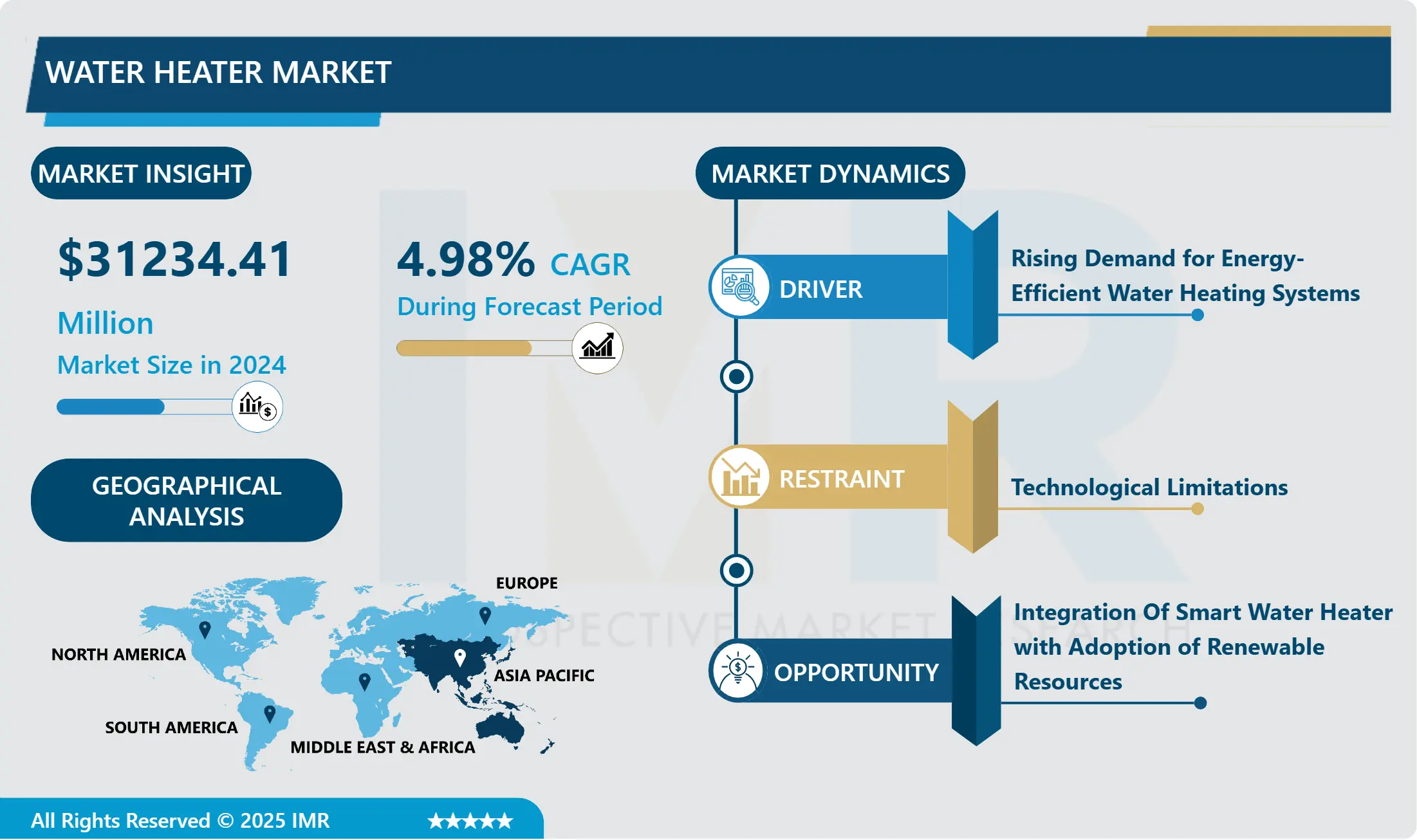
Water Heater Market Size Was Valued at USD 31234.41 Million in 2024, and is Projected to Reach USD 46077.18 Million by 2032, Growing at a CAGR of 4.98% From 2025-2032.
The water heater market involves manufacturing, distributing, and selling devices that heat water for residential, commercial, and industrial purposes. These appliances are vital for providing hot water for bathing, cleaning, cooking, and space heating, utilizing various technologies and energy sources like tank-based, tankless, electric, gas, and solar-powered units.
Increasing residential building projects drive up the need for water heaters. The increasing urbanization and population growth increase the demand for dependable hot water solutions. Tankless and solar heaters, equipped with smart controls and energy-saving features, are gaining popularity for their effectiveness and environmentally friendly nature in satisfying the needs of city residents living in multi-family buildings.
Government rules and regulations regarding energy efficiency and carbon emissions play a significant role in shaping the market. Smart technologies and IoT integration in water heaters are transforming how they are used due to technological advancements. The increasing popularity of environmentally friendly water heaters, fueled by a growing emphasis on energy efficiency and sustainability, is boosting market demand.
Manufacturers have integrated smart technology, allowing users to remotely control water heaters using smartphone applications. This technology is capable of identifying leaks and stopping potential system damage. Rigorous regulations worldwide are resulting in strict criteria for product safety, performance, and environmental impact. The market is being influenced by consumer choices for water heaters that are energy-efficient, affordable, and available for purchase online.
Water Heater Market Trend Analysis
Water Heater Market Growth Driver- Rising Demand for Energy-Efficient Water Heating Systems
The emphasis on reducing greenhouse gas emissions has been spurred by environmental issues such as global warming and climate change. Energy-saving water heaters assist by using less energy, decreasing carbon footprints. Efficient water heating systems also help save resources and support wider sustainability objectives held by individuals, organizations, and governments. Progress in technology has increased the effectiveness of heating systems by introducing advancements such as condensing technology, heat pumps, and solar thermal systems.
Water heaters that are energy-efficient can help reduce energy costs, leading to long-term savings. Even though they may be more expensive initially, the potential for long-term savings makes them an appealing choice for customers. Reduced energy costs can drive demand for such systems, leading to recovery of the initial investment. Governments worldwide are implementing rules on energy efficiency for appliances such as water heaters, leading manufacturers to create models that are more efficient. Incentives and rebates are given to incentivize consumers to select energy-efficient choices, making them more cost-effective and attractive.
Incorporating smart technology features such as smart thermostats and timers enables more efficient management and optimization of energy usage in water heating systems. Consumers are becoming more conscious of the environmental effects of their decisions and are learning about the advantages of using energy-efficient appliances. Educational initiatives by governments, NGOs, and manufacturers play a crucial role in increasing awareness. Environmentally conscious consumers are increasingly seeking out green products, such as energy-efficient water heaters. Energy-saving systems provide enhanced characteristics and superior parts, boosting longevity and dependability, attracting customers seeking lasting advantages.
Water Heater Market Expansion Opportunity- Integration Of Smart Water Heater with Adoption of Renewable Resources
Smart water heaters can reduce waste by learning usage habits and heating water efficiently based on actual needs. They have the ability to modify settings according to high and low electricity rates, leading to cost savings. Hybrid systems alternate between solar energy and traditional power sources to improve efficiency and save money. Intelligent water heaters take part in demand response initiatives by modifying energy consumption during peak hours. Users can utilize real-time monitoring to make informed choices that can lead to additional reductions in energy consumption and expenses. In general, these characteristics improve energy efficiency and result in cost savings for consumers.
Solar energy water heaters decrease dependence on fossil fuels, leading to a reduction in greenhouse gas emissions and carbon footprint. They function without producing emissions, promoting cleaner air and a more healthful environment. Incorporating sustainable energy sources can assist in meeting environmental guidelines and rules, possibly leading to receiving eco-friendly certifications. Individuals can take advantage of government incentives, subsidies, and tax credits that encourage the affordability of smart solar water heaters.
The integration of IoT and AI into water heaters enables enhanced capabilities such as predictive maintenance and automatically adapting to weather conditions, which in turn decreases reliance on the grid. Combining battery storage with solar water heaters guarantees a steady supply of hot water even when the sun is not shining. Manufacturers have the opportunity to set their products apart by incorporating advanced features and linking with renewable energy sources, attracting customers who are tech-savvy and care about the environment. Consistent innovation may result in improved systems and a competitive edge.
Water Heater Market Segment Analysis:
Water Heater Market is segmented on the basis of Type, Technology, Application, Capacity, Distribution Channel, and Region.
By Type, Electric Segment is Expected to Dominate the Market During the Forecast Period
Electric water heaters are easily accessible worldwide, readily obtained from retailers, online stores, or manufacturers. Their widespread availability and easy access through multiple distribution channels make them convenient for consumers in developed and developing countries alike. Electric water heaters are simple to install and operate compared to gas or solar heaters. They don’t need fuel storage, making installation easier and safer. They are suitable for various residential and commercial settings due to their easy installation process and lack of complex venting systems or gas lines.
Electric water heaters can be used indoors without the need for venting due to their versatility. They are available in small, compact designs that are perfect for limited spaces such as underneath sinks or within cabinets. This versatility permits installation in different indoor settings. Modern electric water heaters are equipped with highly developed heating components and insulation in order to improve energy efficiency. Renewable energy sources such as solar panels or wind turbines can also be combined with them in order to lower energy expenses and environmental footprint.
Electric water heaters are a secure and dependable choice since they do not present a fire hazard similar to gas water heaters. They also provide reliable functioning and need minimal upkeep. This makes them a budget-friendly option for customers, particularly in regions with minimal gas resources. Electric water heaters must comply with rigorous safety and efficiency regulations established by governmental agencies in different countries to guarantee consumer safety and trust. Manufacturers subject their products to testing and certification in order to comply with industry standards regarding safety and reliability.
By Application, Residential Segment Held the Largest Share in 2024
Residential properties worldwide have a constant and significant demand for reliable hot water supply, as access to hot water is an everyday necessity for bathing, cooking, and cleaning. This enhances residents’ quality of life, especially during colder months, making residential water heaters crucial for comfort in chilly climates. The increasing world population and urbanization are fuelling the need for water heaters in newly built houses and renovated existing homes. Increased numbers of homes in urban areas are continuing to drive up the need for essential services in densely populated regions.
Homeowners prioritize convenience and comfort by choosing fundamental conveniences, such as having hot water accessible in their home. They appreciate the ability to personalize and regulate their hot water preferences. Residential water heaters fulfil these requirements by offering instant hot water supply and the ability to adjust temperature and timing as needed. Residential water heaters are cheaper and easier to obtain compared to commercial or industrial heaters, with lower initial expenses and simple installation, making them ideal for homeowners with tight budgets or in established residences.
Continuous technological developments in home water heaters involve energy-saving heating components, intelligent controls, and improved insulation materials, which boost efficiency and lower operational expenses. Integration of smart home technology allows for monitoring and controlling devices from a distance using smartphones or other gadgets. House owners are progressively turning to solar water heating systems to cut down on energy expenses and minimize their environmental footprint. Government incentives also encourage the use of renewable energy-powered water heaters in homes, which stimulates sustainable behaviours and contributes to the expansion of the market.
Water Heater Market Regional Insights:
Asia Pacific is Expected to Dominate the Market Over the Forecast Period
The Asia Pacific region is heavily populated, especially in countries like China and India. This results in increased urbanization levels, creating a need for housing and infrastructure. The increase in population drives the demand for water heating solutions in homes, hotels, hospitals, and offices. The increase in economic development in countries such as China, India, Indonesia, and Vietnam have caused a growth in the middle class, leading to higher levels of disposable income. This has in turn increased the affordability and demand for household appliances such as water heaters.
Metropolitan areas in the Asia Pacific region also display elevated levels of living standards, leading to an increased need for water heaters that offer enhanced features and efficiency. The varied climates in Asia Pacific, ranging from tropical to temperate, affect the demand for hot water supply. Cultural standards in the area emphasize the importance of using hot water for bathing, cooking, and cleaning, resulting in a constant need for water heaters to satisfy these choices.
Countries in the Asia Pacific region is at the lead of water heater production, developing cutting-edge products with advanced functionalities for domestic and international markets. Through the use of local manufacturing capacities, businesses are able to create products rapidly, tailor them to specific needs, and manufacture them in a cost-efficient manner, thereby enhancing market expansion and competitiveness. Infrastructure development and construction activities drive the need for reliable water heating solutions in ongoing residential, commercial, and industrial projects. The booming real estate sector in Asia Pacific countries further increases the demand for water heaters in new constructions and renovations.
From this graph, it is shown that the size of the online water heater in China from 2019 to 2020. In 2023 their highest growth about 4120 billion yaun.
Water Heater Market Active Players
Rheem Manufacturing Company (United States)
A.O. Smith Corporation (United States)
Bradford White Corporation (United States)
Bosch Thermotechnology Corp. (Germany)
Ariston Thermo Group (Italy)
Rinnai Corporation (Japan)
State Industries, Inc. (United States)
Noritz Corporation (Japan)
Ferroli S.p.A. (Italy)
Whirlpool Corporation (United States)
Eemax, Inc. (United States)
Navien, Inc. (South Korea)
Vaillant Group (Germany)
Haier Group Corporation (China)
Atmor Industries Ltd. (Israel)
Stiebel Eltron GmbH & Co. KG (Germany)
Nihon Itomic Co., Ltd. (Japan)
Hubbell Incorporated (United States)
Kenmore Appliances (United States)
Lochinvar, LLC (United States)
Eccotemp Systems, LLC (United States)
HTP Comfort Solutions LLC (United States)
Heat Transfer Products Group, LLC (United States)
Marey Heater Corp. (United States)
Whisen (South Korea)
Other Active Players.
Chapter 1: Introduction
1.1 Scope and Coverage
Chapter 2:Executive Summary
Chapter 3: Market Landscape
3.1 Market Dynamics
3.1.1 Drivers
3.1.2 Restraints
3.1.3 Opportunities
3.1.4 Challenges
3.2 Market Trend Analysis
3.3 PESTLE Analysis
3.4 Porter’s Five Forces Analysis
3.5 Industry Value Chain Analysis
3.6 Ecosystem
3.7 Regulatory Landscape
3.8 Price Trend Analysis
3.9 Patent Analysis
3.10 Technology Evolution
3.11 Investment Pockets
3.12 Import-Export Analysis
Chapter 4: Water Heater Market by Type (2018-2032)
4.1 Water Heater Market Snapshot and Growth Engine
4.2 Market Overview
4.3 Electric
4.3.1 Introduction and Market Overview
4.3.2 Historic and Forecasted Market Size in Value USD and Volume Units
4.3.3 Key Market Trends, Growth Factors, and Opportunities
4.3.4 Geographic Segmentation Analysis
4.4 Solar
4.5 Gas
4.6 Hybrid
Chapter 5: Water Heater Market by Technology (2018-2032)
5.1 Water Heater Market Snapshot and Growth Engine
5.2 Market Overview
5.3 Tankless
5.3.1 Introduction and Market Overview
5.3.2 Historic and Forecasted Market Size in Value USD and Volume Units
5.3.3 Key Market Trends, Growth Factors, and Opportunities
5.3.4 Geographic Segmentation Analysis
5.4 Storage
5.5 Heat Pump
Chapter 6: Water Heater Market by Application (2018-2032)
6.1 Water Heater Market Snapshot and Growth Engine
6.2 Market Overview
6.3 Residential
6.3.1 Introduction and Market Overview
6.3.2 Historic and Forecasted Market Size in Value USD and Volume Units
6.3.3 Key Market Trends, Growth Factors, and Opportunities
6.3.4 Geographic Segmentation Analysis
6.4 Commercial
6.5 Industrial
Chapter 7: Water Heater Market by Capacity (2018-2032)
7.1 Water Heater Market Snapshot and Growth Engine
7.2 Market Overview
7.3 Below 30 Liters
7.3.1 Introduction and Market Overview
7.3.2 Historic and Forecasted Market Size in Value USD and Volume Units
7.3.3 Key Market Trends, Growth Factors, and Opportunities
7.3.4 Geographic Segmentation Analysis
7.4 30-100 Liters
7.5 100-250 Liters
7.6 250-400 Liters
7.7 Above 400 Liters
Chapter 8: Water Heater Market by Distribution Channel (2018-2032)
8.1 Water Heater Market Snapshot and Growth Engine
8.2 Market Overview
8.3 Supermarket and Hypermarket
8.3.1 Introduction and Market Overview
8.3.2 Historic and Forecasted Market Size in Value USD and Volume Units
8.3.3 Key Market Trends, Growth Factors, and Opportunities
8.3.4 Geographic Segmentation Analysis
8.4 Electric Stores
8.5 Speciality Stores
8.6 E-commerce Platforms
Chapter 9: Company Profiles and Competitive Analysis
9.1 Competitive Landscape
9.1.1 Competitive Benchmarking
9.1.2 Water Heater Market Share by Manufacturer (2024)
9.1.3 Industry BCG Matrix
9.1.4 Heat Map Analysis
9.1.5 Mergers and Acquisitions
9.2 RHEEM MANUFACTURING COMPANY (UNITED STATES)
9.2.1 Company Overview
9.2.2 Key Executives
9.2.3 Company Snapshot
9.2.4 Role of the Company in the Market
9.2.5 Sustainability and Social Responsibility
9.2.6 Operating Business Segments
9.2.7 Product Portfolio
9.2.8 Business Performance
9.2.9 Key Strategic Moves and Recent Developments
9.2.10 SWOT Analysis
9.3 A.O. SMITH CORPORATION (UNITED STATES)
9.4 BRADFORD WHITE CORPORATION (UNITED STATES)
9.5 BOSCH THERMOTECHNOLOGY CORP. (GERMANY)
9.6 ARISTON THERMO GROUP (ITALY)
9.7 RINNAI CORPORATION (JAPAN)
9.8 STATE INDUSTRIES INC. (UNITED STATES)
9.9 NORITZ CORPORATION (JAPAN)
9.10 FERROLI S.P.A. (ITALY)
9.11 WHIRLPOOL CORPORATION (UNITED STATES)
9.12 EEMAX INC. (UNITED STATES)
9.13 NAVIEN INC. (SOUTH KOREA)
9.14 VAILLANT GROUP (GERMANY)
9.15 HAIER GROUP CORPORATION (CHINA)
9.16 ATMOR INDUSTRIES LTD. (ISRAEL)
9.17 STIEBEL ELTRON GMBH & CO. KG (GERMANY)
9.18 NIHON ITOMIC COLTD. (JAPAN)
9.19 HUBBELL INCORPORATED (UNITED STATES)
9.20 KENMORE APPLIANCES (UNITED STATES)
9.21 LOCHINVAR
9.22 LLC (UNITED STATES)
9.23 ECCOTEMP SYSTEMS
9.24 LLC (UNITED STATES)
9.25 HTP COMFORT SOLUTIONS LLC (UNITED STATES)
9.26 HEAT TRANSFER PRODUCTS GROUP
9.27 LLC (UNITED STATES)
9.28 MAREY HEATER CORP. (UNITED STATES)
9.29 WHISEN (SOUTH KOREA)
9.30 GROUPE ATLANTIC (FRANCE)
9.31 US CRAFTMASTER WATER HEATERS (UNITED STATES) OTHER MAJOR KEY PLAYERS.
Chapter 10: Global Water Heater Market By Region
10.1 Overview
10.2. North America Water Heater Market
10.2.1 Key Market Trends, Growth Factors and Opportunities
10.2.2 Top Key Companies
10.2.3 Historic and Forecasted Market Size by Segments
10.2.4 Historic and Forecasted Market Size by Type
10.2.4.1 Electric
10.2.4.2 Solar
10.2.4.3 Gas
10.2.4.4 Hybrid
10.2.5 Historic and Forecasted Market Size by Technology
10.2.5.1 Tankless
10.2.5.2 Storage
10.2.5.3 Heat Pump
10.2.6 Historic and Forecasted Market Size by Application
10.2.6.1 Residential
10.2.6.2 Commercial
10.2.6.3 Industrial
10.2.7 Historic and Forecasted Market Size by Capacity
10.2.7.1 Below 30 Liters
10.2.7.2 30-100 Liters
10.2.7.3 100-250 Liters
10.2.7.4 250-400 Liters
10.2.7.5 Above 400 Liters
10.2.8 Historic and Forecasted Market Size by Distribution Channel
10.2.8.1 Supermarket and Hypermarket
10.2.8.2 Electric Stores
10.2.8.3 Speciality Stores
10.2.8.4 E-commerce Platforms
10.2.9 Historic and Forecast Market Size by Country
10.2.9.1 US
10.2.9.2 Canada
10.2.9.3 Mexico
10.3. Eastern Europe Water Heater Market
10.3.1 Key Market Trends, Growth Factors and Opportunities
10.3.2 Top Key Companies
10.3.3 Historic and Forecasted Market Size by Segments
10.3.4 Historic and Forecasted Market Size by Type
10.3.4.1 Electric
10.3.4.2 Solar
10.3.4.3 Gas
10.3.4.4 Hybrid
10.3.5 Historic and Forecasted Market Size by Technology
10.3.5.1 Tankless
10.3.5.2 Storage
10.3.5.3 Heat Pump
10.3.6 Historic and Forecasted Market Size by Application
10.3.6.1 Residential
10.3.6.2 Commercial
10.3.6.3 Industrial
10.3.7 Historic and Forecasted Market Size by Capacity
10.3.7.1 Below 30 Liters
10.3.7.2 30-100 Liters
10.3.7.3 100-250 Liters
10.3.7.4 250-400 Liters
10.3.7.5 Above 400 Liters
10.3.8 Historic and Forecasted Market Size by Distribution Channel
10.3.8.1 Supermarket and Hypermarket
10.3.8.2 Electric Stores
10.3.8.3 Speciality Stores
10.3.8.4 E-commerce Platforms
10.3.9 Historic and Forecast Market Size by Country
10.3.9.1 Russia
10.3.9.2 Bulgaria
10.3.9.3 The Czech Republic
10.3.9.4 Hungary
10.3.9.5 Poland
10.3.9.6 Romania
10.3.9.7 Rest of Eastern Europe
10.4. Western Europe Water Heater Market
10.4.1 Key Market Trends, Growth Factors and Opportunities
10.4.2 Top Key Companies
10.4.3 Historic and Forecasted Market Size by Segments
10.4.4 Historic and Forecasted Market Size by Type
10.4.4.1 Electric
10.4.4.2 Solar
10.4.4.3 Gas
10.4.4.4 Hybrid
10.4.5 Historic and Forecasted Market Size by Technology
10.4.5.1 Tankless
10.4.5.2 Storage
10.4.5.3 Heat Pump
10.4.6 Historic and Forecasted Market Size by Application
10.4.6.1 Residential
10.4.6.2 Commercial
10.4.6.3 Industrial
10.4.7 Historic and Forecasted Market Size by Capacity
10.4.7.1 Below 30 Liters
10.4.7.2 30-100 Liters
10.4.7.3 100-250 Liters
10.4.7.4 250-400 Liters
10.4.7.5 Above 400 Liters
10.4.8 Historic and Forecasted Market Size by Distribution Channel
10.4.8.1 Supermarket and Hypermarket
10.4.8.2 Electric Stores
10.4.8.3 Speciality Stores
10.4.8.4 E-commerce Platforms
10.4.9 Historic and Forecast Market Size by Country
10.4.9.1 Germany
10.4.9.2 UK
10.4.9.3 France
10.4.9.4 The Netherlands
10.4.9.5 Italy
10.4.9.6 Spain
10.4.9.7 Rest of Western Europe
10.5. Asia Pacific Water Heater Market
10.5.1 Key Market Trends, Growth Factors and Opportunities
10.5.2 Top Key Companies
10.5.3 Historic and Forecasted Market Size by Segments
10.5.4 Historic and Forecasted Market Size by Type
10.5.4.1 Electric
10.5.4.2 Solar
10.5.4.3 Gas
10.5.4.4 Hybrid
10.5.5 Historic and Forecasted Market Size by Technology
10.5.5.1 Tankless
10.5.5.2 Storage
10.5.5.3 Heat Pump
10.5.6 Historic and Forecasted Market Size by Application
10.5.6.1 Residential
10.5.6.2 Commercial
10.5.6.3 Industrial
10.5.7 Historic and Forecasted Market Size by Capacity
10.5.7.1 Below 30 Liters
10.5.7.2 30-100 Liters
10.5.7.3 100-250 Liters
10.5.7.4 250-400 Liters
10.5.7.5 Above 400 Liters
10.5.8 Historic and Forecasted Market Size by Distribution Channel
10.5.8.1 Supermarket and Hypermarket
10.5.8.2 Electric Stores
10.5.8.3 Speciality Stores
10.5.8.4 E-commerce Platforms
10.5.9 Historic and Forecast Market Size by Country
10.5.9.1 China
10.5.9.2 India
10.5.9.3 Japan
10.5.9.4 South Korea
10.5.9.5 Malaysia
10.5.9.6 Thailand
10.5.9.7 Vietnam
10.5.9.8 The Philippines
10.5.9.9 Australia
10.5.9.10 New Zealand
10.5.9.11 Rest of APAC
10.6. Middle East & Africa Water Heater Market
10.6.1 Key Market Trends, Growth Factors and Opportunities
10.6.2 Top Key Companies
10.6.3 Historic and Forecasted Market Size by Segments
10.6.4 Historic and Forecasted Market Size by Type
10.6.4.1 Electric
10.6.4.2 Solar
10.6.4.3 Gas
10.6.4.4 Hybrid
10.6.5 Historic and Forecasted Market Size by Technology
10.6.5.1 Tankless
10.6.5.2 Storage
10.6.5.3 Heat Pump
10.6.6 Historic and Forecasted Market Size by Application
10.6.6.1 Residential
10.6.6.2 Commercial
10.6.6.3 Industrial
10.6.7 Historic and Forecasted Market Size by Capacity
10.6.7.1 Below 30 Liters
10.6.7.2 30-100 Liters
10.6.7.3 100-250 Liters
10.6.7.4 250-400 Liters
10.6.7.5 Above 400 Liters
10.6.8 Historic and Forecasted Market Size by Distribution Channel
10.6.8.1 Supermarket and Hypermarket
10.6.8.2 Electric Stores
10.6.8.3 Speciality Stores
10.6.8.4 E-commerce Platforms
10.6.9 Historic and Forecast Market Size by Country
10.6.9.1 Turkiye
10.6.9.2 Bahrain
10.6.9.3 Kuwait
10.6.9.4 Saudi Arabia
10.6.9.5 Qatar
10.6.9.6 UAE
10.6.9.7 Israel
10.6.9.8 South Africa
10.7. South America Water Heater Market
10.7.1 Key Market Trends, Growth Factors and Opportunities
10.7.2 Top Key Companies
10.7.3 Historic and Forecasted Market Size by Segments
10.7.4 Historic and Forecasted Market Size by Type
10.7.4.1 Electric
10.7.4.2 Solar
10.7.4.3 Gas
10.7.4.4 Hybrid
10.7.5 Historic and Forecasted Market Size by Technology
10.7.5.1 Tankless
10.7.5.2 Storage
10.7.5.3 Heat Pump
10.7.6 Historic and Forecasted Market Size by Application
10.7.6.1 Residential
10.7.6.2 Commercial
10.7.6.3 Industrial
10.7.7 Historic and Forecasted Market Size by Capacity
10.7.7.1 Below 30 Liters
10.7.7.2 30-100 Liters
10.7.7.3 100-250 Liters
10.7.7.4 250-400 Liters
10.7.7.5 Above 400 Liters
10.7.8 Historic and Forecasted Market Size by Distribution Channel
10.7.8.1 Supermarket and Hypermarket
10.7.8.2 Electric Stores
10.7.8.3 Speciality Stores
10.7.8.4 E-commerce Platforms
10.7.9 Historic and Forecast Market Size by Country
10.7.9.1 Brazil
10.7.9.2 Argentina
10.7.9.3 Rest of SA
Chapter 11 Analyst Viewpoint and Conclusion
11.1 Recommendations and Concluding Analysis
11.2 Potential Market Strategies
Chapter 12 Research Methodology
12.1 Research Process
12.2 Primary Research
12.3 Secondary Research
Q1: What would be the forecast period in the Water Heater Market research report?
A1: The forecast period in the Water Heater Market research report is 2025-2032.
Q2: Who are the key players in the Water Heater Market?
A2: Rheem Manufacturing Company (United States), A.O. Smith Corporation (United States), Bradford White Corporation (United States), Bosch Thermotechnology Corp. (Germany), Ariston Thermo Group (Italy), Rinnai Corporation (Japan), State Industries, Inc. (United States), Noritz Corporation (Japan), Ferroli S.p.A. (Italy), Whirlpool Corporation (United States), Eemax, Inc. (United States), Navien, Inc. (South Korea), Vaillant Group (Germany), Haier Group Corporation (China), Atmor Industries Ltd. (Israel), Stiebel Eltron GmbH & Co. KG (Germany), Nihon Itomic Co., Ltd. (Japan), Hubbell Incorporated (United States), Kenmore Appliances (United States), Lochinvar, LLC (United States), Eccotemp Systems, LLC (United States), HTP Comfort Solutions LLC (United States), Heat Transfer Products Group, LLC (United States), Marey Heater Corp. (United States), Whisen (South Korea), Groupe Atlantic (France), US Craftmaster Water Heaters (United States) and Other Active Players.
Q3: What are the segments of the Water Heater Market?
A3: The Water Heater Market is segmented into Type, Technology, Application, Capacity, Distribution Channel, Segment6, and region. By Type, the market is categorized into Electric, Solar, Gas, Hybrid. By Technology, the market is categorized into Tankless, Storage, Heat Pump. By Application, the market is categorized into Residential, Commercial, Industrial. By Capacity, the market is categorized into Below 30 Liters, 30-100 Liters, 100-250 Liters, 250-400 Liters, above 400 Liters. By Distribution Channel, The Market Is Categorized into Supermarket and Hypermarket, Electric Stores, Specialty Stores, E-commerce Platforms. By Region, it is analyzed across North America (U.S.; Canada; Mexico), Eastern Europe (Russia; Bulgaria; The Czech Republic; Hungary; Poland; Romania; Rest of Eastern Europe), Western Europe (Germany; UK; France; The Netherlands; Italy; Spain; Rest of Western Europe), Asia-Pacific (China; India; Japan; South Korea; Malaysia; Thailand; Vietnam; The Philippines; Australia; New Zealand; Rest of APAC), Middle East & Africa (Türkiye; Bahrain; Kuwait; Saudi Arabia; Qatar; UAE; Israel; South Africa), South America (Brazil; Argentina; Rest of SA.).
Q4: What is the Water Heater Market?
A4: The water heater market involves manufacturing, distributing, and selling devices that heat water for residential, commercial, and industrial purposes. These appliances are vital for providing hot water for bathing, cleaning, cooking, and space heating, utilizing various technologies and energy sources like tank-based, tankless, electric, gas, and solar-powered units.
Q5: How big is the Water Heater Market?
A5: Water Heater Market Size Was Valued at USD 31234.41 Million in 2024, and is Projected to Reach USD 46077.18 Million by 2032, Growing at a CAGR of 4.98% From 2025-2032.
How to Buy a Report from eminsights.jp
On the product page, choose the license you want: Single-User License, Multi-User License or Enterprise License.
If you required report in your native language, then you can click on Translated Report button and fill out the form with report name and language you want, then our team will contact you as soon as possible.
Click the Buy Now button.
You will be redirected to the checkout page. Enter your company details and payment information.
Click Place Order to complete the purchase.
Confirmation: You’ll receive an order confirmation and our team will contact you shortly with your ordered report.
If you have any questions, fill out the contact form below or email us at [email protected].
Thank you for choosing eminsights.jp!