Stay Ahead in Fast-Growing Economies.
Browse Reports Now
Beef Jelly Market-Latest Report Highlights Market Growth
Beef jelly is a dish made by cooking and then cooling beef in its gelatinous broth. It is seasoned with various herbs, spices, and sometimes with vegetables. The cooled broth solidifies and forms a gelatinous texture.

IMR Group
Description
Beef Jelly Market Synopsis
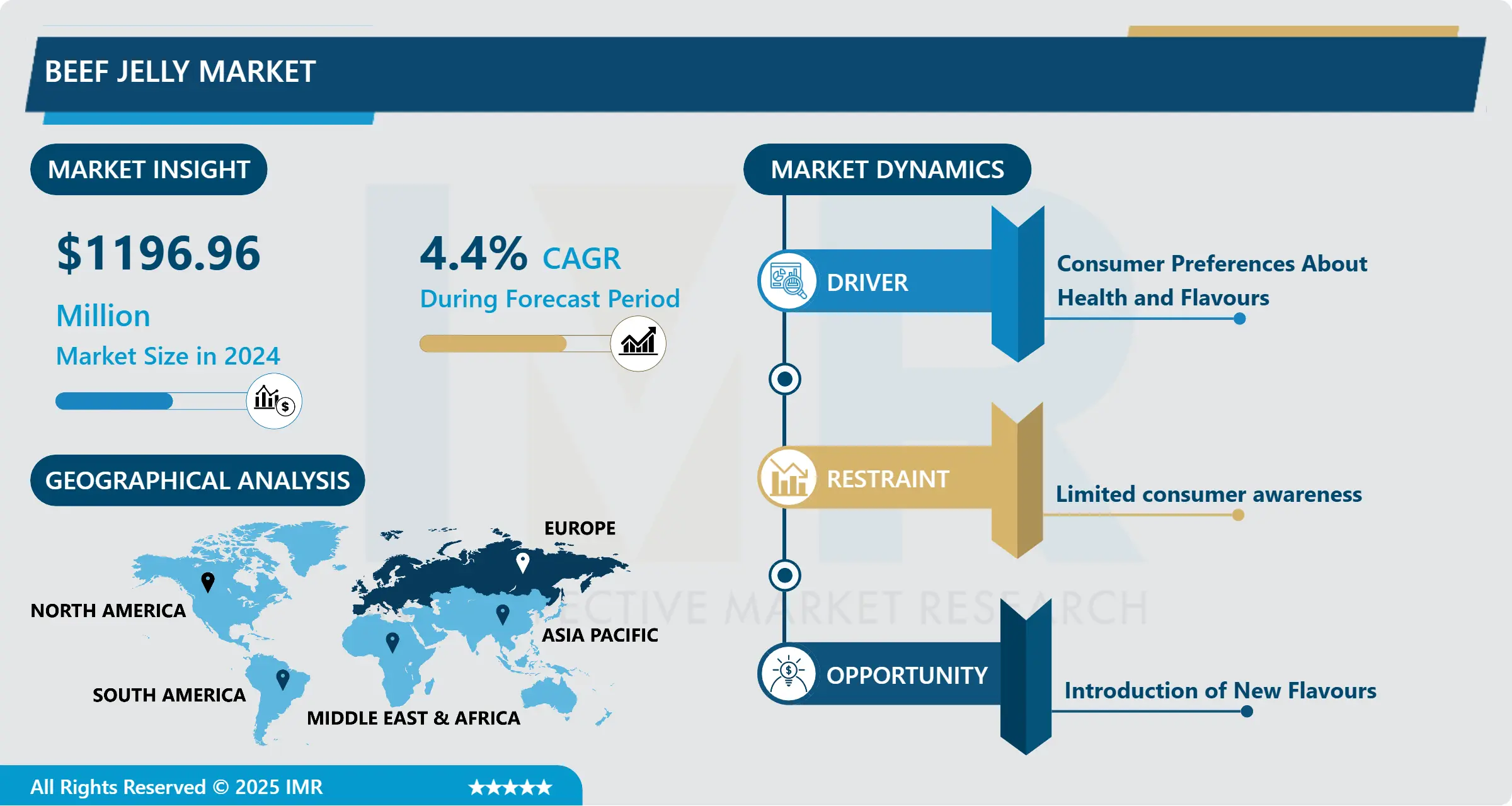
Beef Jelly Market Size Was Valued at USD 1196.96 Million in 2024, and is Projected to Reach USD 1689.20 Million by 2032, Growing at a CAGR of 4.4% From 2025-2032.
Beef jelly is a dish made by cooking and then cooling beef in its gelatinous broth. It is seasoned with various herbs, spices, and sometimes with vegetables. The cooled broth solidifies and forms a gelatinous texture.
Beef jelly can be used as an attractive and flavourful garnish for dishes to add a shiny and gelatinous layer. It can be a unique ingredient in dishes like jellied desserts, and jelly-filled dumplings. Beef jelly can be melted down and used as a base for stocks and sauces to enhance the taste of soups, stews, and gravies.
Beef jelly is generally low in calories, which makes it a good flavourful option for health-conscious people. It is also a rich source of collagen which plays a vital role in maintaining healthy skin, joints, and connective tissues. The gelatine in beef jelly may help improve digestion by supporting the production of digestive juices. It can also provide minerals such as calcium, magnesium, and phosphorus, which are necessary for maintaining strong bones and teeth and supporting nerve function.
Beef Jelly Market Trend Analysis
Beef Jelly Market Driving Factors- Consumer Preferences About Health and Flavours
Beef Jelly can be seen as a nutritious option due to its potential health benefits such as providing support for joint health, promoting skin elasticity, and contributing to overall gut health. It is often available in ready-to-eat or ready-to-serve formats, making it a convenient option for busy consumers who want a quick nutritious meal.
Consumers are mainly seeking functional and flavourful food options for them beef jelly is a good option. Beef Jelly contains low fat and sodium along with high proteins and natural ingredients like collagen. It is a high quality and superior taste product. Beef jelly has a long and prominent history in various ethnic cuisines worldwide. It is used for thickening sauces, gravies, and soups with adding flavour.
Beef Jelly Market Opportunity- Introduction of New Flavours
Consumers have diverse and evolving taste preferences. By introducing new flavours, the beef jelly market can cater to a wider range of consumers. Offering options such as spicy, tangy, sweet, or even unique and exotic flavours can help to ensure demand in the market. This can elevate the sensory pleasure and enjoyment of consuming beef jelly resulting in an overall increase in consumer satisfaction.
Introducing new flavours can help differentiate a brand or product from competitors. This can also help to attract new customer segments and retain old customers.
Beef Jelly Market Segment Analysis:
Beef Jelly Market Segmented based on Type, Application, And Distribution Channel.
By Type, Flavoured Beef Jelly Segment Is Expected to Dominate the Market During the Forecast Period
By product type, beef jelly is segmented into flavoured jelly and unflavoured jelly. Flavoured beef jelly segment is expected to dominate the market during the forecast period.
As consumers are becoming more open to exploring diverse food options, there is a growing demand for products that offer unique and exciting taste experiences. Flavoured beef jelly offers different flavours such as garlic, onion, and other herbs and spices to enhance the overall taste experience of consumers. Flavoured beef jelly can be used in a wide range of dishes like soups and sandwiches. The combination of different flavours and aromas stimulates the senses and makes it more enjoyable.
Flavoured jellies are available in variants such as low in sodium, and fat, containing natural ingredients. These are healthier options to attract consumers who are mindful of their dietary choices but still want to indulge in flavourful food experiences. Flavoured beef jelly products are readily available in various retail outlets making them demandable.
By Distribution Channel, the Supermarkets segment held the largest share in 2024
By distribution channel, beef jelly is segmented into supermarkets, specialty stores, online retail, and others such as retail stores, and food stores.
Supermarkets offer a one-stop shopping experience for consumers and also provide a wide range of products, including a variety of flavoured beef jellies, under a single roof. They can offer a larger selection of beef jellies from different brands, flavours, and packaging sizes to the customer. The quality and freshness of beef jellies are also superior.
Supermarkets offer competitive pricing for flavoured beef jellies. The discounts and bundle offers also contribute to the dominance of supermarkets. Supermarkets offer a wide range of complementary products such as bread, crackers, cheeses, meats, and other condiments.
Beef Jelly Market Regional Insights:
Europe is Expected to Dominate the Market Over the Forecast Period
Europe includes various traditional dishes and preparations where beef jelly plays a significant role. The European food industry is known for its innovation and experimentation with ingredients, flavours, and textures which leads to market dominance. Flavoured beef jelly, with its unique combination of savoury flavours and gelatinous texture, aligns well with European gourmet trends.
This region has a well-developed food processing industry with advanced manufacturing facilities and technologies. The rising preference for convenient, on-the-go food options in the Europe region drives the demand for beef jelly across various convenience food segments. The increasing meat consumption in this region further fuels the demand for beef jelly. Flavoured beef jelly, with its unique combination of savoury flavours and gelatinous texture, aligns well with European gourmet trends
Beef Jelly Market Active Key Players
Tianshan Livestock Biological Engineering (China)
Seccox Breeding Biotechnology (China)
Oaks Livestock (United States)
American International Resources Breeding Corporation (United States)
Simmas Consortium of Canada (Canada)
Other Active Players
Chapter 1: Introduction
1.1 Scope and Coverage
Chapter 2:Executive Summary
Chapter 3: Market Landscape
3.1 Market Dynamics
3.1.1 Drivers
3.1.2 Restraints
3.1.3 Opportunities
3.1.4 Challenges
3.2 Market Trend Analysis
3.3 PESTLE Analysis
3.4 Porter’s Five Forces Analysis
3.5 Industry Value Chain Analysis
3.6 Ecosystem
3.7 Regulatory Landscape
3.8 Price Trend Analysis
3.9 Patent Analysis
3.10 Technology Evolution
3.11 Investment Pockets
3.12 Import-Export Analysis
Chapter 4: Beef Jelly Market by Type (2018-2032)
4.1 Beef Jelly Market Snapshot and Growth Engine
4.2 Market Overview
4.3 Flavoured Beef Jelly
4.3.1 Introduction and Market Overview
4.3.2 Historic and Forecasted Market Size in Value USD and Volume Units
4.3.3 Key Market Trends, Growth Factors, and Opportunities
4.3.4 Geographic Segmentation Analysis
4.4 Unflavoured Beef Jelly
Chapter 5: Beef Jelly Market by Application (2018-2032)
5.1 Beef Jelly Market Snapshot and Growth Engine
5.2 Market Overview
5.3 Cooking
5.3.1 Introduction and Market Overview
5.3.2 Historic and Forecasted Market Size in Value USD and Volume Units
5.3.3 Key Market Trends, Growth Factors, and Opportunities
5.3.4 Geographic Segmentation Analysis
5.4 Spread/ Dip
5.5 Sandwich Filling
5.6 Salad Dressing
5.7 Garnish
5.8 Others
Chapter 6: Beef Jelly Market by Distribution Channel (2018-2032)
6.1 Beef Jelly Market Snapshot and Growth Engine
6.2 Market Overview
6.3 Supermarkets
6.3.1 Introduction and Market Overview
6.3.2 Historic and Forecasted Market Size in Value USD and Volume Units
6.3.3 Key Market Trends, Growth Factors, and Opportunities
6.3.4 Geographic Segmentation Analysis
6.4 Specialty Stores
6.5 Online Retail
6.6 Others
Chapter 7: Company Profiles and Competitive Analysis
7.1 Competitive Landscape
7.1.1 Competitive Benchmarking
7.1.2 Beef Jelly Market Share by Manufacturer (2024)
7.1.3 Industry BCG Matrix
7.1.4 Heat Map Analysis
7.1.5 Mergers and Acquisitions
7.2 TIANSHAN LIVESTOCK BIOLOGICAL ENGINEERING (CHINA)
7.2.1 Company Overview
7.2.2 Key Executives
7.2.3 Company Snapshot
7.2.4 Role of the Company in the Market
7.2.5 Sustainability and Social Responsibility
7.2.6 Operating Business Segments
7.2.7 Product Portfolio
7.2.8 Business Performance
7.2.9 Key Strategic Moves and Recent Developments
7.2.10 SWOT Analysis
7.3 SECCOX BREEDING BIOTECHNOLOGY (CHINA)
7.4 OAKS LIVESTOCK (UNITED STATES)
7.5 AMERICAN INTERNATIONAL RESOURCES BREEDING CORPORATION (UNITED STATES)
7.6 SIMMAS CONSORTIUM OF CANADA (CANADA)
7.7 YADA GENETICS OF CANADA (CANADA)
7.8 GINES BREEDING COMPANY (UNITED STATES)
7.9 NOTTINGLIN BREEDER GEN (UNITED STATES)
7.10 KRAFT HEINZ COMPANY (UNITED STATES)
7.11 DEL MONTE FOODS (UNITED STATES)
7.12 ROYAL (THAILAND)
7.13 UNILEVER (NETHERLANDS/UNITED KINGDOM)
7.14 SINPHAR PHARMACEUTICAL COLTD. (TAIWAN)
7.15 MARIGOLD (SINGAPORE)
7.16 BOVRIL (UNITED KINGDOM)
7.17 LIPTON (UNITED STATES)
7.18 JELLO (JELL-O) (UNITED STATES)
7.19 ALMARAI (SAUDI ARABIA)
7.20 AJINOMOTO (JAPAN)
7.21 YANLORD LAND GROUP (CHINA)
7.22 SEVEN SEAS (JAPAN)
7.23 KNOTT’S BERRY FARM (UNITED STATES)
7.24 CARAPELLI (ITALY)
7.25 MAGNOLIA (PHILIPPINES)
7.26 AGEL (RUSSIA) OTHER ACTIVE KEY PLAYERS
7.27
Chapter 8: Global Beef Jelly Market By Region
8.1 Overview
8.2. North America Beef Jelly Market
8.2.1 Key Market Trends, Growth Factors and Opportunities
8.2.2 Top Key Companies
8.2.3 Historic and Forecasted Market Size by Segments
8.2.4 Historic and Forecasted Market Size by Type
8.2.4.1 Flavoured Beef Jelly
8.2.4.2 Unflavoured Beef Jelly
8.2.5 Historic and Forecasted Market Size by Application
8.2.5.1 Cooking
8.2.5.2 Spread/ Dip
8.2.5.3 Sandwich Filling
8.2.5.4 Salad Dressing
8.2.5.5 Garnish
8.2.5.6 Others
8.2.6 Historic and Forecasted Market Size by Distribution Channel
8.2.6.1 Supermarkets
8.2.6.2 Specialty Stores
8.2.6.3 Online Retail
8.2.6.4 Others
8.2.7 Historic and Forecast Market Size by Country
8.2.7.1 US
8.2.7.2 Canada
8.2.7.3 Mexico
8.3. Eastern Europe Beef Jelly Market
8.3.1 Key Market Trends, Growth Factors and Opportunities
8.3.2 Top Key Companies
8.3.3 Historic and Forecasted Market Size by Segments
8.3.4 Historic and Forecasted Market Size by Type
8.3.4.1 Flavoured Beef Jelly
8.3.4.2 Unflavoured Beef Jelly
8.3.5 Historic and Forecasted Market Size by Application
8.3.5.1 Cooking
8.3.5.2 Spread/ Dip
8.3.5.3 Sandwich Filling
8.3.5.4 Salad Dressing
8.3.5.5 Garnish
8.3.5.6 Others
8.3.6 Historic and Forecasted Market Size by Distribution Channel
8.3.6.1 Supermarkets
8.3.6.2 Specialty Stores
8.3.6.3 Online Retail
8.3.6.4 Others
8.3.7 Historic and Forecast Market Size by Country
8.3.7.1 Russia
8.3.7.2 Bulgaria
8.3.7.3 The Czech Republic
8.3.7.4 Hungary
8.3.7.5 Poland
8.3.7.6 Romania
8.3.7.7 Rest of Eastern Europe
8.4. Western Europe Beef Jelly Market
8.4.1 Key Market Trends, Growth Factors and Opportunities
8.4.2 Top Key Companies
8.4.3 Historic and Forecasted Market Size by Segments
8.4.4 Historic and Forecasted Market Size by Type
8.4.4.1 Flavoured Beef Jelly
8.4.4.2 Unflavoured Beef Jelly
8.4.5 Historic and Forecasted Market Size by Application
8.4.5.1 Cooking
8.4.5.2 Spread/ Dip
8.4.5.3 Sandwich Filling
8.4.5.4 Salad Dressing
8.4.5.5 Garnish
8.4.5.6 Others
8.4.6 Historic and Forecasted Market Size by Distribution Channel
8.4.6.1 Supermarkets
8.4.6.2 Specialty Stores
8.4.6.3 Online Retail
8.4.6.4 Others
8.4.7 Historic and Forecast Market Size by Country
8.4.7.1 Germany
8.4.7.2 UK
8.4.7.3 France
8.4.7.4 The Netherlands
8.4.7.5 Italy
8.4.7.6 Spain
8.4.7.7 Rest of Western Europe
8.5. Asia Pacific Beef Jelly Market
8.5.1 Key Market Trends, Growth Factors and Opportunities
8.5.2 Top Key Companies
8.5.3 Historic and Forecasted Market Size by Segments
8.5.4 Historic and Forecasted Market Size by Type
8.5.4.1 Flavoured Beef Jelly
8.5.4.2 Unflavoured Beef Jelly
8.5.5 Historic and Forecasted Market Size by Application
8.5.5.1 Cooking
8.5.5.2 Spread/ Dip
8.5.5.3 Sandwich Filling
8.5.5.4 Salad Dressing
8.5.5.5 Garnish
8.5.5.6 Others
8.5.6 Historic and Forecasted Market Size by Distribution Channel
8.5.6.1 Supermarkets
8.5.6.2 Specialty Stores
8.5.6.3 Online Retail
8.5.6.4 Others
8.5.7 Historic and Forecast Market Size by Country
8.5.7.1 China
8.5.7.2 India
8.5.7.3 Japan
8.5.7.4 South Korea
8.5.7.5 Malaysia
8.5.7.6 Thailand
8.5.7.7 Vietnam
8.5.7.8 The Philippines
8.5.7.9 Australia
8.5.7.10 New Zealand
8.5.7.11 Rest of APAC
8.6. Middle East & Africa Beef Jelly Market
8.6.1 Key Market Trends, Growth Factors and Opportunities
8.6.2 Top Key Companies
8.6.3 Historic and Forecasted Market Size by Segments
8.6.4 Historic and Forecasted Market Size by Type
8.6.4.1 Flavoured Beef Jelly
8.6.4.2 Unflavoured Beef Jelly
8.6.5 Historic and Forecasted Market Size by Application
8.6.5.1 Cooking
8.6.5.2 Spread/ Dip
8.6.5.3 Sandwich Filling
8.6.5.4 Salad Dressing
8.6.5.5 Garnish
8.6.5.6 Others
8.6.6 Historic and Forecasted Market Size by Distribution Channel
8.6.6.1 Supermarkets
8.6.6.2 Specialty Stores
8.6.6.3 Online Retail
8.6.6.4 Others
8.6.7 Historic and Forecast Market Size by Country
8.6.7.1 Turkiye
8.6.7.2 Bahrain
8.6.7.3 Kuwait
8.6.7.4 Saudi Arabia
8.6.7.5 Qatar
8.6.7.6 UAE
8.6.7.7 Israel
8.6.7.8 South Africa
8.7. South America Beef Jelly Market
8.7.1 Key Market Trends, Growth Factors and Opportunities
8.7.2 Top Key Companies
8.7.3 Historic and Forecasted Market Size by Segments
8.7.4 Historic and Forecasted Market Size by Type
8.7.4.1 Flavoured Beef Jelly
8.7.4.2 Unflavoured Beef Jelly
8.7.5 Historic and Forecasted Market Size by Application
8.7.5.1 Cooking
8.7.5.2 Spread/ Dip
8.7.5.3 Sandwich Filling
8.7.5.4 Salad Dressing
8.7.5.5 Garnish
8.7.5.6 Others
8.7.6 Historic and Forecasted Market Size by Distribution Channel
8.7.6.1 Supermarkets
8.7.6.2 Specialty Stores
8.7.6.3 Online Retail
8.7.6.4 Others
8.7.7 Historic and Forecast Market Size by Country
8.7.7.1 Brazil
8.7.7.2 Argentina
8.7.7.3 Rest of SA
Chapter 9 Analyst Viewpoint and Conclusion
9.1 Recommendations and Concluding Analysis
9.2 Potential Market Strategies
Chapter 10 Research Methodology
10.1 Research Process
10.2 Primary Research
10.3 Secondary Research
Q1: What would be the forecast period in the Beef Jelly Market research report?
A1: The forecast period in the Beef Jelly Market research report is 2025-2032.
Q2: Who are the key players in the Beef Jelly Market?
A2: Tianshan Livestock Biological Engineering (China), Seccox Breeding Biotechnology (China), Oaks Livestock (United States), American International Resources Breeding Corporation (United States), Simmas Consortium Of Canada (Canada), and Other Active Players.
Q3: What are the segments of the Beef Jelly Market?
A3: The Beef Jelly Market is segmented into Type, Application, Distribution Channel, and region. By Type, the market is categorized into flavored and unflavored. By Application, the market is categorized into cooking, spread/ dip, sandwich filling, salad dressing, garnish, and others such as soups, and pet foods. By Distribution Channel, the market is categorized into supermarkets, speciality stores, online retail, and others such as retail stores and food stores. By region, it is analyzed across• North America (U.S., Canada, Mexico) • Eastern Europe (Russia, Bulgaria, The Czech Republic, Hungary, Poland, Romania, Rest of Eastern Europe) • Western Europe (Germany, UK, France, The Netherlands, Italy, Spain, Rest of Western Europe) • Asia Pacific (China, India, Japan, South Korea, Malaysia, Thailand, Vietnam, The Philippines, Australia, New Zealand, Rest of APAC) • Middle East & Africa (Türkiye, Bahrain, Kuwait, Saudi Arabia, Qatar, UAE, Israel, South Africa) • South America (Brazil, Argentina, Rest of SA)
Q4: What is the Beef Jelly Market?
A4: Beef jelly is a dish made by cooking and then cooling beef in its gelatinous broth. It is seasoned with various herbs, spices, and sometimes with vegetables. The cooled broth solidifies and forms a gelatinous texture.
Q5: How big is the Beef Jelly Market?
A5: Beef Jelly Market Size Was Valued at USD 1196.96 Million in 2024, and is Projected to Reach USD 1689.20 Million by 2032, Growing at a CAGR of 4.4% From 2025-2032.
How to Buy a Report from eminsights.jp
On the product page, choose the license you want: Single-User License, Multi-User License or Enterprise License.
If you required report in your native language, then you can click on Translated Report button and fill out the form with report name and language you want, then our team will contact you as soon as possible.
Click the Buy Now button.
You will be redirected to the checkout page. Enter your company details and payment information.
Click Place Order to complete the purchase.
Confirmation: You’ll receive an order confirmation and our team will contact you shortly with your ordered report.
If you have any questions, fill out the contact form below or email us at [email protected].
Thank you for choosing eminsights.jp!