Stay Ahead in Fast-Growing Economies.
Browse Reports Now
Saffron Market – Comprehensive Study Report & Recent Trends
Saffron is also known as Golden spice or Red gold and is one of the most expensive spices in the world. Saffron has antimicrobial, antibacterial, antifungal, antiseptic, and anti-inflammatory properties as well as a distinct flavor and aroma.

IMR Group
Description
Saffron Market Synopsis
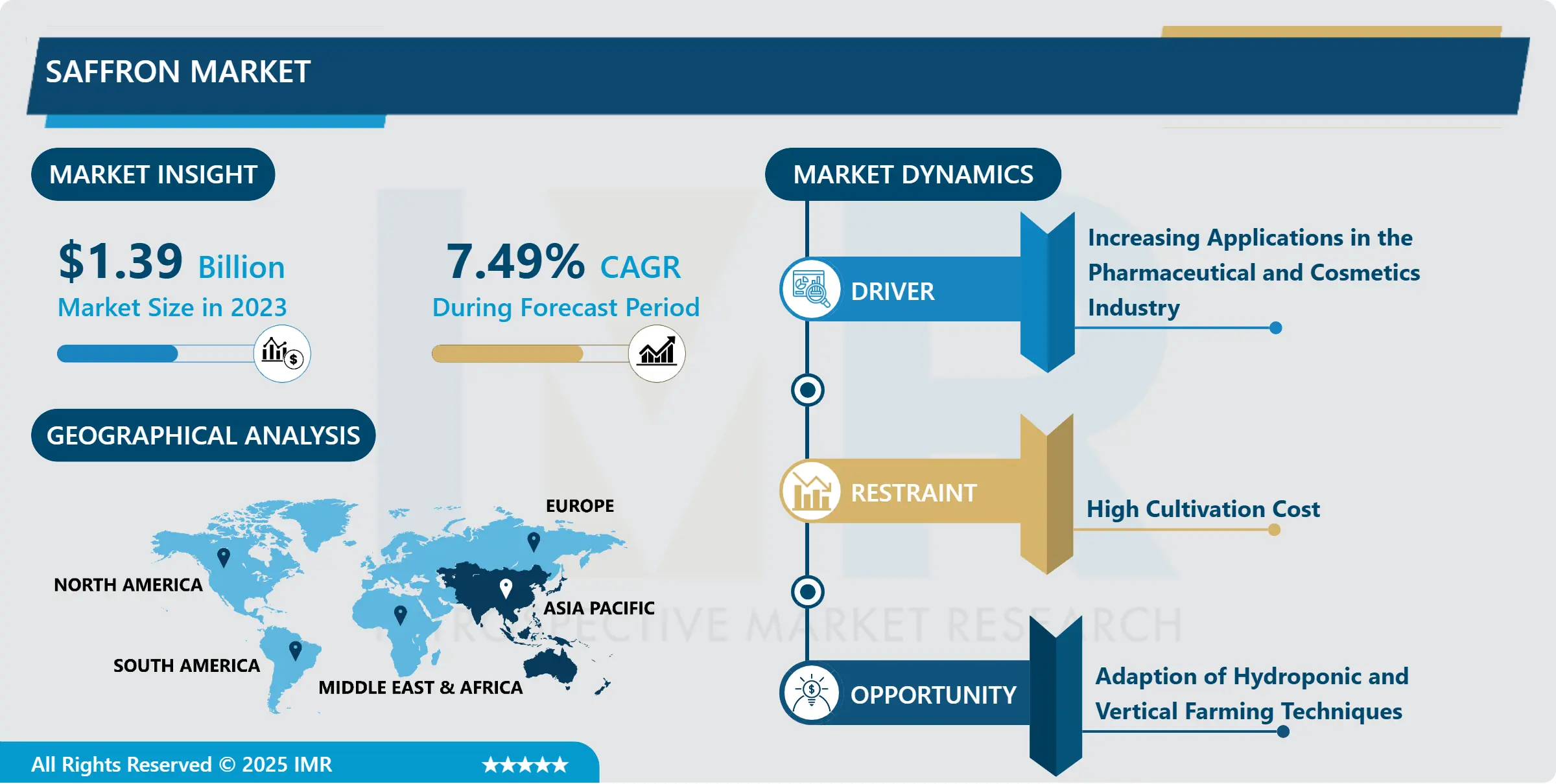
The global saffron market size was valued at USD 1.39 billion in 2023 and is estimated to reach USD 2.66 billion by 2032 at a CAGR of 7.49 %.
Saffron is also known as Golden spice or Red gold and is one of the most expensive spices in the world. Saffron has antimicrobial, antibacterial, antifungal, antiseptic, and anti-inflammatory properties as well as a distinct flavor and aroma.
Saffron has its distinct aroma and flavor which adds distinct flavor, scent, and color. Saffron is also used as a natural food color. Saffron spice can provide a lot of health benefits when consumed with the milk.
Saffron has some medicinal properties like antimicrobial, antifungal, antibacterial, antiseptic, and anti-inflammatory. Also, saffron contains chemicals that might kill cancer cells. The use of saffron in depressive disorders, Alzheimer’s disease, and menstruation abnormalities increases its demand in the pharmaceutical industry. It can strengthen eyesight and can prevent it from being affected by external matters.
In the cosmetics industry, it is used for skin treatment. Saffron helps reduce brown spots, hyperpigmentation, and scars leaving the skin even brighter. Due to its aroma and color, it is used in the perfume industry and the textile industry for dyeing the fabric yellow, or orange. Saffron has more than 150 volatile and aroma-producing compounds in Safranal is one of the main components of saffron essential oil.
Saffron Market Trend Analysis
Increasing Applications in the Pharmaceutical and Cosmetics Industry
Crocin and Safranal components of saffron have the best inhibitory action against cancer cells. Crocetin has the property to suppress breast, cervical, liver, lung, and pancreatic cancers. Saffron contains two important vitamins, ribo?avin and thiamine, and also a small quantity of ?-carotene. Strong evidence indicates that saffron and its components possess anticarcinogenic and antitumor effects.
Picrocrocin, Safranal, and Crocin compounds help to reduce oxidative damage and inflammation in the human brain and enhance memory. saffron and especially its main constituent molecules exert beneficial effects on frequent neuropsychiatric and age-related diseases
Saffron skin health, brighten the complexion and cure acne and blemishes. It is used in the cosmetics industry as a natural UV-absorbing agent. Saffron liquid is also used for the manufacturing of perfume.
Opportunities
Adaption of Hydroponic and Vertical Farming Techniques
New technologies such as hydroponics and vertical farming are used for the cultivation of saffron. These technologies minimize water usage along with providing year-round production of saffron.
In hydroponics, nutrient-rich water is used for production. Saffron production is extremely dependent on meteorological conditions. Hydroponic systems provide better control over factors like water, nutrients, and light which leads to higher yields and better-quality saffron. Hydroponics helps in increasing the quality of saffron produced with better color, taste, and aroma. It also helps in producing more flowers from each bulb of the saffron
In vertical farming, plants are stacked up vertically. Uncertain climate change, expansion of manufacturing, and urban construction projects have decreased the amount of land used to cultivate the crop by 60% in the last 20 years. This not only improves saffron production efficiency but also provides an opportunity for year-round production. It also helps to satisfy the market demand for saffron.
Saffron Market Segment Analysis:
The saffron market is segmented based on type, application, grade, form, distribution channel, end-user, and region
By Type, Organic Segment Is Expected to Dominate the Market During the Forecast Period
There are two types, Organic and Traditional in which the organic segment is expected to dominate the saffron market over the forecast period.
Organic saffron is becoming increasingly popular due to the growing demand of consumers for natural and healthy food products. Organic saffron is produced using natural methods of cultivation that do not involve the use of chemical fertilizers or pesticides. This makes it a healthier and more environment friendly choice for the consumers. Organic farming practices involve additional costs compared to conventional methods for careful attention to soil health, pest control, and harvesting techniques which contributes to premium pricing.
Organic saffron is expensive due to its limited production. This helps to boost the saffron market growth. Certification bodies verify the entire production process, from cultivation to packaging, ensuring compliance with organic farming guidelines. This certification provides consumers with confidence in the authenticity and purity of organic saffron, leading to increased demand.
This rise in organic saffron market value can be attributed to various factors such as rising government initiatives to promote organic farming, shifting consumer preferences towards healthy food, and increasing popularity of saffron in medical applications.
By Grade, Grade I Held the Largest Share In 2023
There are totally four grades (I, II, III, IV) in the market in grade I is expected to dominate the saffron market over the forecast period.
Grade I was the finest quality saffron in the world. It generated more than 60% of the total revenue in 2023 and it is expected to keep its dominance during the forecast period 2024-2032. The reason behind the Grade I segment’s dominance is due to the excellent coloring and flavoring strengths and aroma of its products. It consists of only the red stigmas of the saffron flower, which are carefully hand-picked and separated from the rest of the plant. This rigorous cleaning and sorting process ensures a higher level of purity in Grade I saffron along with no contaminants and adulterations.
The top-notch characteristics make Grade I saffron highly desirable for premium applications in food, fragrances, and personal care products. The rising trend of premium product consumption increases the demand for grade I saffron along with the growth of this market segment.
Saffron Market Regional Insights:
Asia Pacific is Expected to Dominate the Market Over the Forecast Period
The saffron market is segmented into North America, Eastern Europe, Western Europe, Asia-Pacific, South America, Middle East & Africa by region. The Asia Pacific region is expected to dominate the forecast period.
Saffron is produced by countries in the region, including India, Iran, and Afghanistan. Saffron is an essential element in meals such as biryanis, curries, and sweets. Saffron has traditional and cultural value in several countries of the Asia Pacific region which drives demand and usage of saffron. In many Asian countries like India and China, it is used in Ayurvedic medicine and other traditional healing systems.
Iran is the world’s largest producer of saffron and exports a significant amount of saffron to the Asia Pacific region. The region has seen a significant increase in online sales channels, with e-commerce platforms providing consumers easy access to a wide range of saffron products from around the world. Also, the Asia Pacific region is expected to dominate the saffron market over the forecast period due to increasing demand, high production, increasing purchasing power, and a growing export market.
Year-Wise Details Of Production And Productivity Of Saffron In J&K
Year
Total Area
Rejuvenated
cumulative Total
Area Ha
Total Area under
Traditional Method
Total Production
Rejuvenated Area
Mts
Total Production Inclusive
from Non-Traditional Area
Mts
Total Productivity
kgs/ Ha
2019-2020
3715
2578.75
1136.25
12.95
15.12
4.07
2020-2021
3715
2598.75
1116.25
13.36
18.05
4.86
2021-2022
3715
2598.75
1116.25
11.2
15.035
4.04
Chapter 1: Introduction
1.1 Scope and Coverage
Chapter 2:Executive Summary
Chapter 3: Market Landscape
3.1 Market Dynamics
3.1.1 Drivers
3.1.2 Restraints
3.1.3 Opportunities
3.1.4 Challenges
3.2 Market Trend Analysis
3.3 PESTLE Analysis
3.4 Porter’s Five Forces Analysis
3.5 Industry Value Chain Analysis
3.6 Ecosystem
3.7 Regulatory Landscape
3.8 Price Trend Analysis
3.9 Patent Analysis
3.10 Technology Evolution
3.11 Investment Pockets
3.12 Import-Export Analysis
Chapter 4: Saffron Market by Type (2018-2032)
4.1 Saffron Market Snapshot and Growth Engine
4.2 Market Overview
4.3 Organic Saffron
4.3.1 Introduction and Market Overview
4.3.2 Historic and Forecasted Market Size in Value USD and Volume Units
4.3.3 Key Market Trends, Growth Factors, and Opportunities
4.3.4 Geographic Segmentation Analysis
4.4 Traditional Saffron
Chapter 5: Saffron Market by Grade (2018-2032)
5.1 Saffron Market Snapshot and Growth Engine
5.2 Market Overview
5.3 Grade I
5.3.1 Introduction and Market Overview
5.3.2 Historic and Forecasted Market Size in Value USD and Volume Units
5.3.3 Key Market Trends, Growth Factors, and Opportunities
5.3.4 Geographic Segmentation Analysis
5.4 Grade II
5.5 Grade III
5.6 Grade IV
Chapter 6: Saffron Market by Application (2018-2032)
6.1 Saffron Market Snapshot and Growth Engine
6.2 Market Overview
6.3 Scent
6.3.1 Introduction and Market Overview
6.3.2 Historic and Forecasted Market Size in Value USD and Volume Units
6.3.3 Key Market Trends, Growth Factors, and Opportunities
6.3.4 Geographic Segmentation Analysis
6.4 Food Colouring
6.5 Skin Treatments
6.6 Fabric Dyeing
Chapter 7: Saffron Market by Form (2018-2032)
7.1 Saffron Market Snapshot and Growth Engine
7.2 Market Overview
7.3 Thread
7.3.1 Introduction and Market Overview
7.3.2 Historic and Forecasted Market Size in Value USD and Volume Units
7.3.3 Key Market Trends, Growth Factors, and Opportunities
7.3.4 Geographic Segmentation Analysis
7.4 Powder
7.5 Liquid
Chapter 8: Saffron Market by Distribution Channel (2018-2032)
8.1 Saffron Market Snapshot and Growth Engine
8.2 Market Overview
8.3 Speciality Stores
8.3.1 Introduction and Market Overview
8.3.2 Historic and Forecasted Market Size in Value USD and Volume Units
8.3.3 Key Market Trends, Growth Factors, and Opportunities
8.3.4 Geographic Segmentation Analysis
8.4 Retail Stores
8.5 Supermarkets
8.6 Wholesale Distributor
8.7 Online Stores
Chapter 9: Saffron Market by End-user (2018-2032)
9.1 Saffron Market Snapshot and Growth Engine
9.2 Market Overview
9.3 Food
9.3.1 Introduction and Market Overview
9.3.2 Historic and Forecasted Market Size in Value USD and Volume Units
9.3.3 Key Market Trends, Growth Factors, and Opportunities
9.3.4 Geographic Segmentation Analysis
9.4 Pharmaceutical
9.5 Personal Care Industry
Chapter 10: Company Profiles and Competitive Analysis
10.1 Competitive Landscape
10.1.1 Competitive Benchmarking
10.1.2 Saffron Market Share by Manufacturer (2024)
10.1.3 Industry BCG Matrix
10.1.4 Heat Map Analysis
10.1.5 Mergers and Acquisitions
10.2 GREAT AMERICAN SPICE (US)
10.2.1 Company Overview
10.2.2 Key Executives
10.2.3 Company Snapshot
10.2.4 Role of the Company in the Market
10.2.5 Sustainability and Social Responsibility
10.2.6 Operating Business Segments
10.2.7 Product Portfolio
10.2.8 Business Performance
10.2.9 Key Strategic Moves and Recent Developments
10.2.10 SWOT Analysis
10.3 MEHR SAFFRON (US)
10.4 ESFEDAN TRADING COMPANY (IRAN)
10.5 TARVAND SAFFRON CO. (IRAN)
10.6 GOHAR SAFFRON (IRAN)
10.7 ROWHANI SAFFRON CO. (IRAN)
10.8 FLORA SAFFRON (IRAN)
10.9 IRAN SAFFRON COMPANY (IRAN)
10.10 ROYAL SAFFRON COMPANY (INDIA)
10.11 TAJ AGRO PRODUCTS(INDIA)
10.12 JMD AGRO FOODS (INDIA)
10.13 KING KESARIYA (INDIA)
10.14 GRANDOR CO. (IRAN)
10.15 UPAKARMA (INDIA)
10.16 EVEREST SAFFRON (INDIA)
10.17 WARIS KESAR GROUP (INDIA)
10.18 ABNER ENTERPRISES (INDIA)
10.19 GLOBALSTAR COMPANY (INDIA)
10.20 LION SAFFRON (INDIA)
10.21 HOUSE OF SAFFRON (INDIA)
10.22 DRY FRUIT HUB (INDIA)
10.23 KEYNOTE (INDIA)
10.24 BABY BRAND SAFFRON (INDIA)
10.25 SAFRAN GLOBAL COMPANY S.L.U. (SPAIN)
Chapter 11: Global Saffron Market By Region
11.1 Overview
11.2. North America Saffron Market
11.2.1 Key Market Trends, Growth Factors and Opportunities
11.2.2 Top Key Companies
11.2.3 Historic and Forecasted Market Size by Segments
11.2.4 Historic and Forecasted Market Size by Type
11.2.4.1 Organic Saffron
11.2.4.2 Traditional Saffron
11.2.5 Historic and Forecasted Market Size by Grade
11.2.5.1 Grade I
11.2.5.2 Grade II
11.2.5.3 Grade III
11.2.5.4 Grade IV
11.2.6 Historic and Forecasted Market Size by Application
11.2.6.1 Scent
11.2.6.2 Food Colouring
11.2.6.3 Skin Treatments
11.2.6.4 Fabric Dyeing
11.2.7 Historic and Forecasted Market Size by Form
11.2.7.1 Thread
11.2.7.2 Powder
11.2.7.3 Liquid
11.2.8 Historic and Forecasted Market Size by Distribution Channel
11.2.8.1 Speciality Stores
11.2.8.2 Retail Stores
11.2.8.3 Supermarkets
11.2.8.4 Wholesale Distributor
11.2.8.5 Online Stores
11.2.9 Historic and Forecasted Market Size by End-user
11.2.9.1 Food
11.2.9.2 Pharmaceutical
11.2.9.3 Personal Care Industry
11.2.10 Historic and Forecast Market Size by Country
11.2.10.1 US
11.2.10.2 Canada
11.2.10.3 Mexico
11.3. Eastern Europe Saffron Market
11.3.1 Key Market Trends, Growth Factors and Opportunities
11.3.2 Top Key Companies
11.3.3 Historic and Forecasted Market Size by Segments
11.3.4 Historic and Forecasted Market Size by Type
11.3.4.1 Organic Saffron
11.3.4.2 Traditional Saffron
11.3.5 Historic and Forecasted Market Size by Grade
11.3.5.1 Grade I
11.3.5.2 Grade II
11.3.5.3 Grade III
11.3.5.4 Grade IV
11.3.6 Historic and Forecasted Market Size by Application
11.3.6.1 Scent
11.3.6.2 Food Colouring
11.3.6.3 Skin Treatments
11.3.6.4 Fabric Dyeing
11.3.7 Historic and Forecasted Market Size by Form
11.3.7.1 Thread
11.3.7.2 Powder
11.3.7.3 Liquid
11.3.8 Historic and Forecasted Market Size by Distribution Channel
11.3.8.1 Speciality Stores
11.3.8.2 Retail Stores
11.3.8.3 Supermarkets
11.3.8.4 Wholesale Distributor
11.3.8.5 Online Stores
11.3.9 Historic and Forecasted Market Size by End-user
11.3.9.1 Food
11.3.9.2 Pharmaceutical
11.3.9.3 Personal Care Industry
11.3.10 Historic and Forecast Market Size by Country
11.3.10.1 Russia
11.3.10.2 Bulgaria
11.3.10.3 The Czech Republic
11.3.10.4 Hungary
11.3.10.5 Poland
11.3.10.6 Romania
11.3.10.7 Rest of Eastern Europe
11.4. Western Europe Saffron Market
11.4.1 Key Market Trends, Growth Factors and Opportunities
11.4.2 Top Key Companies
11.4.3 Historic and Forecasted Market Size by Segments
11.4.4 Historic and Forecasted Market Size by Type
11.4.4.1 Organic Saffron
11.4.4.2 Traditional Saffron
11.4.5 Historic and Forecasted Market Size by Grade
11.4.5.1 Grade I
11.4.5.2 Grade II
11.4.5.3 Grade III
11.4.5.4 Grade IV
11.4.6 Historic and Forecasted Market Size by Application
11.4.6.1 Scent
11.4.6.2 Food Colouring
11.4.6.3 Skin Treatments
11.4.6.4 Fabric Dyeing
11.4.7 Historic and Forecasted Market Size by Form
11.4.7.1 Thread
11.4.7.2 Powder
11.4.7.3 Liquid
11.4.8 Historic and Forecasted Market Size by Distribution Channel
11.4.8.1 Speciality Stores
11.4.8.2 Retail Stores
11.4.8.3 Supermarkets
11.4.8.4 Wholesale Distributor
11.4.8.5 Online Stores
11.4.9 Historic and Forecasted Market Size by End-user
11.4.9.1 Food
11.4.9.2 Pharmaceutical
11.4.9.3 Personal Care Industry
11.4.10 Historic and Forecast Market Size by Country
11.4.10.1 Germany
11.4.10.2 UK
11.4.10.3 France
11.4.10.4 The Netherlands
11.4.10.5 Italy
11.4.10.6 Spain
11.4.10.7 Rest of Western Europe
11.5. Asia Pacific Saffron Market
11.5.1 Key Market Trends, Growth Factors and Opportunities
11.5.2 Top Key Companies
11.5.3 Historic and Forecasted Market Size by Segments
11.5.4 Historic and Forecasted Market Size by Type
11.5.4.1 Organic Saffron
11.5.4.2 Traditional Saffron
11.5.5 Historic and Forecasted Market Size by Grade
11.5.5.1 Grade I
11.5.5.2 Grade II
11.5.5.3 Grade III
11.5.5.4 Grade IV
11.5.6 Historic and Forecasted Market Size by Application
11.5.6.1 Scent
11.5.6.2 Food Colouring
11.5.6.3 Skin Treatments
11.5.6.4 Fabric Dyeing
11.5.7 Historic and Forecasted Market Size by Form
11.5.7.1 Thread
11.5.7.2 Powder
11.5.7.3 Liquid
11.5.8 Historic and Forecasted Market Size by Distribution Channel
11.5.8.1 Speciality Stores
11.5.8.2 Retail Stores
11.5.8.3 Supermarkets
11.5.8.4 Wholesale Distributor
11.5.8.5 Online Stores
11.5.9 Historic and Forecasted Market Size by End-user
11.5.9.1 Food
11.5.9.2 Pharmaceutical
11.5.9.3 Personal Care Industry
11.5.10 Historic and Forecast Market Size by Country
11.5.10.1 China
11.5.10.2 India
11.5.10.3 Japan
11.5.10.4 South Korea
11.5.10.5 Malaysia
11.5.10.6 Thailand
11.5.10.7 Vietnam
11.5.10.8 The Philippines
11.5.10.9 Australia
11.5.10.10 New Zealand
11.5.10.11 Rest of APAC
11.6. Middle East & Africa Saffron Market
11.6.1 Key Market Trends, Growth Factors and Opportunities
11.6.2 Top Key Companies
11.6.3 Historic and Forecasted Market Size by Segments
11.6.4 Historic and Forecasted Market Size by Type
11.6.4.1 Organic Saffron
11.6.4.2 Traditional Saffron
11.6.5 Historic and Forecasted Market Size by Grade
11.6.5.1 Grade I
11.6.5.2 Grade II
11.6.5.3 Grade III
11.6.5.4 Grade IV
11.6.6 Historic and Forecasted Market Size by Application
11.6.6.1 Scent
11.6.6.2 Food Colouring
11.6.6.3 Skin Treatments
11.6.6.4 Fabric Dyeing
11.6.7 Historic and Forecasted Market Size by Form
11.6.7.1 Thread
11.6.7.2 Powder
11.6.7.3 Liquid
11.6.8 Historic and Forecasted Market Size by Distribution Channel
11.6.8.1 Speciality Stores
11.6.8.2 Retail Stores
11.6.8.3 Supermarkets
11.6.8.4 Wholesale Distributor
11.6.8.5 Online Stores
11.6.9 Historic and Forecasted Market Size by End-user
11.6.9.1 Food
11.6.9.2 Pharmaceutical
11.6.9.3 Personal Care Industry
11.6.10 Historic and Forecast Market Size by Country
11.6.10.1 Turkiye
11.6.10.2 Bahrain
11.6.10.3 Kuwait
11.6.10.4 Saudi Arabia
11.6.10.5 Qatar
11.6.10.6 UAE
11.6.10.7 Israel
11.6.10.8 South Africa
11.7. South America Saffron Market
11.7.1 Key Market Trends, Growth Factors and Opportunities
11.7.2 Top Key Companies
11.7.3 Historic and Forecasted Market Size by Segments
11.7.4 Historic and Forecasted Market Size by Type
11.7.4.1 Organic Saffron
11.7.4.2 Traditional Saffron
11.7.5 Historic and Forecasted Market Size by Grade
11.7.5.1 Grade I
11.7.5.2 Grade II
11.7.5.3 Grade III
11.7.5.4 Grade IV
11.7.6 Historic and Forecasted Market Size by Application
11.7.6.1 Scent
11.7.6.2 Food Colouring
11.7.6.3 Skin Treatments
11.7.6.4 Fabric Dyeing
11.7.7 Historic and Forecasted Market Size by Form
11.7.7.1 Thread
11.7.7.2 Powder
11.7.7.3 Liquid
11.7.8 Historic and Forecasted Market Size by Distribution Channel
11.7.8.1 Speciality Stores
11.7.8.2 Retail Stores
11.7.8.3 Supermarkets
11.7.8.4 Wholesale Distributor
11.7.8.5 Online Stores
11.7.9 Historic and Forecasted Market Size by End-user
11.7.9.1 Food
11.7.9.2 Pharmaceutical
11.7.9.3 Personal Care Industry
11.7.10 Historic and Forecast Market Size by Country
11.7.10.1 Brazil
11.7.10.2 Argentina
11.7.10.3 Rest of SA
Chapter 12 Analyst Viewpoint and Conclusion
12.1 Recommendations and Concluding Analysis
12.2 Potential Market Strategies
Chapter 13 Research Methodology
13.1 Research Process
13.2 Primary Research
13.3 Secondary Research
Q1: What would be the forecast period in the saffron Market research report?
A1: The forecast period in the saffron Market research report is 2024-2032.
Q2: Who are the key players in the saffron Market?
A2: Safran Global Company S.L.U., Tarvand Saffron Co., Saffron Business Company, Gohar Saffron, Rowhani Saffron Co., Mehr Saffron and Other Major Players.
Q3: What are the segments of the saffron Market?
A3: The saffron Market is segmented into Type, Grade, Application, Form, and region. By Type, the market is categorized into Organic and Traditional. By Grade, the market is categorized into Grades I, II, III, and IV. By Application, the market is categorized into the Food, Pharmaceutical, and Personal Care industries. By form, it is classified into Thread, Powder, and Liquid. By region, it is analyzed across North America (U.S.; Canada; Mexico), Eastern Europe (Bulgaria; The Czech Republic; Hungary; Poland; Romania; Rest of Eastern Europe), Western Europe (Germany; UK; France; Netherlands; Italy; Russia; Spain; Rest of Western Europe), Asia-Pacific (China; India; Japan; Southeast Asia, etc.), South America (Brazil; Argentina, etc.), Middle East & Africa (Saudi Arabia; South Africa, etc.).
Q4: What is the Saffron Market?
A4: The Saffron Market involves the cultivation, production, and trade of saffron which is a high-value spice obtained from the flower of Crocus sativus.
Q5: How big is Saffron Market?
A5: The global saffron market size was valued at USD 1.39 billion in 2023 and is estimated to reach USD 2.66 billion by 2032 at a CAGR of 7.49 %.
How to Buy a Report from eminsights.jp
On the product page, choose the license you want: Single-User License, Multi-User License or Enterprise License.
If you required report in your native language, then you can click on Translated Report button and fill out the form with report name and language you want, then our team will contact you as soon as possible.
Click the Buy Now button.
You will be redirected to the checkout page. Enter your company details and payment information.
Click Place Order to complete the purchase.
Confirmation: You’ll receive an order confirmation and our team will contact you shortly with your ordered report.
If you have any questions, fill out the contact form below or email us at [email protected].
Thank you for choosing eminsights.jp!