Stay Ahead in Fast-Growing Economies.
Browse Reports Now
Battery Market – Global Industry Growth and Trend Analysis
A battery is an electrochemical device consisting of one or more electrochemical cells that can be charged and discharged with an electric current. These devices are commonly used to power small electric devices like mobile phones, remotes, and flashlights. Historically, the term

IMR Group
Description
Battery Market Synopsis
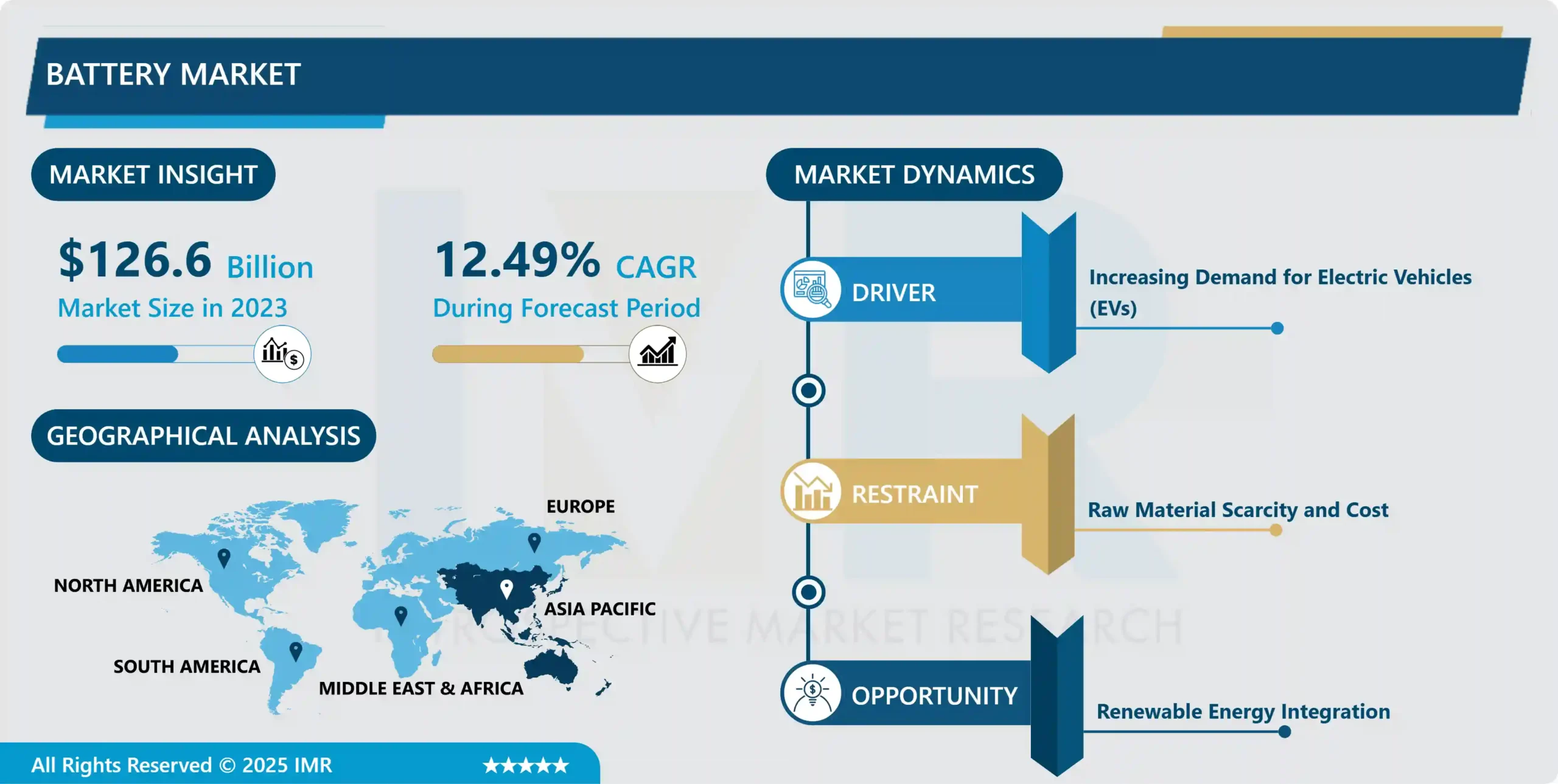
Global Battery Market Size Was Valued at USD 126.6 Billion in 2023 and is Projected to Reach USD 365.14 Billion by 2032, Growing at a CAGR of 12.49% From 2024-2032
A battery is an electrochemical device consisting of one or more electrochemical cells that can be charged and discharged with an electric current. These devices are commonly used to power small electric devices like mobile phones, remotes, and flashlights. Historically, the term “battery” was used to refer to a combination of two or more cells, but modern definitions now consider only a single cell.
Batteries are broadly classified into two categories, namely primary batteries and secondary batteries. Primary batteries, also known as use-and-throw batteries, can only be charged once and are discarded when completely discharged due to irreversible electrochemical reactions. They are also known as rechargeable batteries. On the other hand, secondary batteries, also known as rechargeable batteries, can be charged and reused for multiple cycles. These batteries are reversible, allowing for the creation of products and electricity when discharging. The flow of electrons into the battery facilitates the reverse reaction, where the products react to form the reactants. Both primary and secondary batteries are essential for various applications.
Battery use in various sectors includes home gadgets, health instruments, the medical sector, logistics and construction, firefighting and emergency response, military operations, and vehicles. Disposable batteries power devices like remote controls and torches, while rechargeable batteries like alkaline and lithium are used in devices like laptops. Health instruments use batteries for artificial limbs, insulin pumps, hearing aids, and valve assistance devices. The medical sector uses batteries for ECG heart monitors, heavy-duty batteries for forklifts, and lead-acid batteries in automobiles.
Firefighting and emergency response use batteries in radios, ECGs, flashlights, metal and fire detectors, and military operations. Lithium batteries provide longer life for devices, while silver oxide batteries are used in missiles and submarines. Electric vehicles (EVs) often use rechargeable batteries, typically lithium-ion, to power their electric motors. Overall, batteries play a crucial role in various sectors, ensuring safety, efficiency, and safety in various applications.
Battery Market Trend Analysis
Increasing Demand for Electric Vehicles (EVs)
The burgeoning demand for electric vehicles (EVs) serves as a pivotal catalyst propelling the battery market forward. This surge can be attributed to several factors. Global apprehensions regarding climate change and air pollution have spurred governments worldwide to enact stringent emission regulations and offer incentives to promote the adoption of zero-emission vehicles like EVs. These regulatory measures, combined with advancements in battery technology, have significantly heightened the appeal of EVs among consumers.
Enhancements in battery energy density, charging infrastructure, and driving range have effectively addressed critical obstacles to EV adoption, rendering them more practical and convenient options. Consequently, consumers are increasingly viewing EVs as viable substitutes for conventional internal combustion engine vehicles.
Escalating consumer consciousness regarding environmental sustainability and the inclination towards cleaner modes of transportation have further fueled the interest in EVs. The prospect of mitigating greenhouse gas emissions and reducing dependence on fossil fuels acts as a potent motivator for consumers to transition to electric vehicles, underpinned by advanced battery technologies for energy storage and propulsion.
Renewable Energy Integration
The battery market stands to benefit significantly from the integration of renewable energy sources. With the global shift towards cleaner and more sustainable energy generation, technologies like solar and wind power are gaining traction. However, these sources are subject to intermittency, meaning they produce electricity only when environmental conditions allow. This misalignment with demand poses a challenge.
Batteries offer a solution by enabling the storage of surplus energy generated during peak production periods. This stored energy can then be deployed during times of high demand or when renewable sources are inactive, enhancing grid stability and reducing reliance on traditional backup generation methods.
Batteries facilitate the deployment of distributed energy resources and microgrids, fostering greater community-level energy independence and resilience. As the demand for renewable energy integration continues to rise, batteries will play a pivotal role in optimizing the efficiency and reliability of renewable energy systems, creating significant opportunities for battery manufacturers and energy storage providers.
Battery Market Segment Analysis:
Battery Market Segmented on the basis of Type, Technology, and Application.
By Type, Secondary Batteries segment is expected to dominate the market during the forecast period
The secondary batteries segment, encompassing rechargeable batteries, is anticipated to dominate the battery market due to several compelling factors. Secondary Batteries are more environmentally friendly than primary batteries due to their ability to be recharged after discharge. They can be used repeatedly and generate less waste over time, especially for power-intensive devices. Secondary Batteries also have a high C-rate and better power output capabilities, making them suitable for high-power applications.
The adoption of rechargeable batteries is driven by sustainability and environmental consciousness, as they minimize waste and reduce environmental impact. These batteries offer significant cost savings over single-use batteries, as they can be recharged and reused multiple times, making them more attractive for consumers and businesses. Advancements in lithium-ion technology have improved energy density, performance, and cycle life, expanding their applications to electric vehicles, renewable energy storage, and portable electronics. This has further driven their dominance in the battery market. Overall, rechargeable batteries are becoming increasingly popular due to their environmental benefits and cost savings.
By Technology, Lithium-ion (Li-ion) Batteries segment is expected to dominate the market during the forecast period
Lithium-ion batteries (LIBs) are rechargeable secondary batteries used in electric vehicles and the aerospace industry. They have high energy capacity, no memory effect, and low self-discharge. Lithium ions pass from the negative electrode to the positive electrode during discharging and back when charging. They typically use an intercalated lithium compound in the positive electrode and graphite in the negative electrode as fuel. LIBs are highly desirable due to their versatility and low self-discharge.
The lithium-ion battery is a stable and safe battery with a high energy capacity, widely used in mobile phones and portable computers. It has a slow self-discharge and twice the energy capacity of the NiCad battery, making it a popular choice. Li-ion batteries are ideal for various applications due to their high energy density, making them suitable for electric vehicles, consumer electronics, and grid-scale energy storage systems.
Advancements in technology have improved performance, safety, and lifespan, making them more attractive to manufacturers and end-users. The growing demand for electric vehicles and government incentives to reduce carbon emissions are driving significant investments in Li-ion battery production, lowering costs and making them more competitive with traditional energy storage technologies. The lithium-ion (Li-ion) battery segment is poised to dominate the battery market for several compelling reasons.
Battery Market Regional Insights:
Asia Pacific is Expected to Dominate the Market Over the Forecast period
Asia Pacific is poised to take the lead in the battery market owing to several pivotal factors propelling its growth and prominence in the industry. The region functions as a manufacturing powerhouse for batteries and electric vehicles, with countries such as China, Japan, and South Korea spearheading production capacity and technological advancements. This manufacturing process is backed by a skilled labor force, resilient supply chains, and supportive governmental policies incentivizing investments in the battery sector.
Asia Pacific leads the global electric vehicle market both in production and consumption. Governments across the region have implemented ambitious targets and incentives to expedite the adoption of electric vehicles, thereby generating significant demand for batteries.
The rapid expansion of renewable energy integration in countries like China and India adds impetus to the demand for battery storage solutions, crucial for supporting grid stabilization and renewable energy integration endeavors. The amalgamation of manufacturing excellence, burgeoning electric vehicle demand, and the escalating deployment of renewable energy infrastructure positions Asia Pacific as the foremost contender in the global battery market.
Battery Market Top Key Players:
Exide Technologies (US)
Microvast Power Systems (US)
NEC Energy Solutions (US)
Aquion Energy (US)
Tesla, Inc. (US)
Duracell Inc. (US)
EnerSys (US)
Enphase Energy, Inc. (US)
East Penn Manufacturing Company, Inc. (US)
A123 Systems LLC (US)
QuantumScape Corporation (US)
Varta AG (Germany)
Johnson Controls International plc (Ireland)
Blue Solutions (Bolloré Group) (France)
Saft Groupe S.A. (France)
Northvolt AB (Sweden)
Samsung SDI Co., Ltd. (South Korea)
LG Chem Ltd. (South Korea)
BYD Company Limited (China)
Contemporary Amperex Technology Co. Limited (CATL) (China)
Sony Corporation (Japan)
Toshiba Corporation (Japan)
Panasonic Corporation (Japan)
GS Yuasa Corporation (Japan)
Mitsubishi Electric Corporation (Japan), and Other Major Players.
Key Industry Developments in the Battery Market:
In August 2022, MIT researchers devised a novel concept for cost-effective batteries utilizing readily available and affordable materials. The groundbreaking battery design employs aluminum and sulfur as its electrode components, with a molten salt electrolyte sandwiched between them. This innovative architecture offers a promising solution for inexpensive backup storage for renewable energy sources.
In January 2022, BYD and FAW are in the process of establishing a production facility dedicated to electric vehicle batteries in northeastern China. The planned facility boasts an annual production capacity of 45 GWh. Under the joint venture named FAW FinDreams New Energy Technology, a collaboration between BYD and FAW Group, a total registered capital of EUR 140 million has been allocated. BYD holds a controlling stake of 51% in the joint venture, with the remaining ownership belonging to FAW Group.
Chapter 1: Introduction
1.1 Scope and Coverage
Chapter 2:Executive Summary
Chapter 3: Market Landscape
3.1 Market Dynamics
3.1.1 Drivers
3.1.2 Restraints
3.1.3 Opportunities
3.1.4 Challenges
3.2 Market Trend Analysis
3.3 PESTLE Analysis
3.4 Porter’s Five Forces Analysis
3.5 Industry Value Chain Analysis
3.6 Ecosystem
3.7 Regulatory Landscape
3.8 Price Trend Analysis
3.9 Patent Analysis
3.10 Technology Evolution
3.11 Investment Pockets
3.12 Import-Export Analysis
Chapter 4: Battery Market by Type (2018-2032)
4.1 Battery Market Snapshot and Growth Engine
4.2 Market Overview
4.3 Primary Batteries
4.3.1 Introduction and Market Overview
4.3.2 Historic and Forecasted Market Size in Value USD and Volume Units
4.3.3 Key Market Trends, Growth Factors, and Opportunities
4.3.4 Geographic Segmentation Analysis
4.4 Secondary Batteries
Chapter 5: Battery Market by Technology (2018-2032)
5.1 Battery Market Snapshot and Growth Engine
5.2 Market Overview
5.3 Lithium-ion (Li-ion) Batteries
5.3.1 Introduction and Market Overview
5.3.2 Historic and Forecasted Market Size in Value USD and Volume Units
5.3.3 Key Market Trends, Growth Factors, and Opportunities
5.3.4 Geographic Segmentation Analysis
5.4 Lead-acid Batteries
5.5 Nickel-metal hydride (NiMH) Batteries
5.6 Nickel-cadmium (NiCd) Batteries
5.7 Flow batteries Batteries
5.8 Others
Chapter 6: Battery Market by Application (2018-2032)
6.1 Battery Market Snapshot and Growth Engine
6.2 Market Overview
6.3 Portable electronics
6.3.1 Introduction and Market Overview
6.3.2 Historic and Forecasted Market Size in Value USD and Volume Units
6.3.3 Key Market Trends, Growth Factors, and Opportunities
6.3.4 Geographic Segmentation Analysis
6.4 Automotive
6.5 Industrial
6.6 Consumer electronics
6.7 Medical devices
6.8 Aerospace and defense
Chapter 7: Company Profiles and Competitive Analysis
7.1 Competitive Landscape
7.1.1 Competitive Benchmarking
7.1.2 Battery Market Share by Manufacturer (2024)
7.1.3 Industry BCG Matrix
7.1.4 Heat Map Analysis
7.1.5 Mergers and Acquisitions
7.2 EXIDE TECHNOLOGIES (US)
7.2.1 Company Overview
7.2.2 Key Executives
7.2.3 Company Snapshot
7.2.4 Role of the Company in the Market
7.2.5 Sustainability and Social Responsibility
7.2.6 Operating Business Segments
7.2.7 Product Portfolio
7.2.8 Business Performance
7.2.9 Key Strategic Moves and Recent Developments
7.2.10 SWOT Analysis
7.3 MICROVAST POWER SYSTEMS (US)
7.4 NEC ENERGY SOLUTIONS (US)
7.5 AQUION ENERGY (US)
7.6 TESLA INC. (US)
7.7 DURACELL INC. (US)
7.8 ENERSYS (US)
7.9 ENPHASE ENERGY INC. (US)
7.10 EAST PENN MANUFACTURING COMPANY INC. (US)
7.11 A123 SYSTEMS LLC (US)
7.12 QUANTUMSCAPE CORPORATION (US)
7.13 VARTA AG (GERMANY)
7.14 JOHNSON CONTROLS INTERNATIONAL PLC (IRELAND)
7.15 BLUE SOLUTIONS (BOLLORÉ GROUP) (FRANCE)
7.16 SAFT GROUPE S.A. (FRANCE)
7.17 NORTHVOLT AB (SWEDEN)
7.18 SAMSUNG SDI COLTD. (SOUTH KOREA)
7.19 LG CHEM LTD. (SOUTH KOREA)
7.20 BYD COMPANY LIMITED (CHINA)
7.21 CONTEMPORARY AMPEREX TECHNOLOGY CO. LIMITED (CATL) (CHINA)
7.22 SONY CORPORATION (JAPAN)
7.23 TOSHIBA CORPORATION (JAPAN)
7.24 PANASONIC CORPORATION (JAPAN)
7.25 GS YUASA CORPORATION (JAPAN)
7.26 MITSUBISHI ELECTRIC CORPORATION (JAPAN)
7.27
Chapter 8: Global Battery Market By Region
8.1 Overview
8.2. North America Battery Market
8.2.1 Key Market Trends, Growth Factors and Opportunities
8.2.2 Top Key Companies
8.2.3 Historic and Forecasted Market Size by Segments
8.2.4 Historic and Forecasted Market Size by Type
8.2.4.1 Primary Batteries
8.2.4.2 Secondary Batteries
8.2.5 Historic and Forecasted Market Size by Technology
8.2.5.1 Lithium-ion (Li-ion) Batteries
8.2.5.2 Lead-acid Batteries
8.2.5.3 Nickel-metal hydride (NiMH) Batteries
8.2.5.4 Nickel-cadmium (NiCd) Batteries
8.2.5.5 Flow batteries Batteries
8.2.5.6 Others
8.2.6 Historic and Forecasted Market Size by Application
8.2.6.1 Portable electronics
8.2.6.2 Automotive
8.2.6.3 Industrial
8.2.6.4 Consumer electronics
8.2.6.5 Medical devices
8.2.6.6 Aerospace and defense
8.2.7 Historic and Forecast Market Size by Country
8.2.7.1 US
8.2.7.2 Canada
8.2.7.3 Mexico
8.3. Eastern Europe Battery Market
8.3.1 Key Market Trends, Growth Factors and Opportunities
8.3.2 Top Key Companies
8.3.3 Historic and Forecasted Market Size by Segments
8.3.4 Historic and Forecasted Market Size by Type
8.3.4.1 Primary Batteries
8.3.4.2 Secondary Batteries
8.3.5 Historic and Forecasted Market Size by Technology
8.3.5.1 Lithium-ion (Li-ion) Batteries
8.3.5.2 Lead-acid Batteries
8.3.5.3 Nickel-metal hydride (NiMH) Batteries
8.3.5.4 Nickel-cadmium (NiCd) Batteries
8.3.5.5 Flow batteries Batteries
8.3.5.6 Others
8.3.6 Historic and Forecasted Market Size by Application
8.3.6.1 Portable electronics
8.3.6.2 Automotive
8.3.6.3 Industrial
8.3.6.4 Consumer electronics
8.3.6.5 Medical devices
8.3.6.6 Aerospace and defense
8.3.7 Historic and Forecast Market Size by Country
8.3.7.1 Russia
8.3.7.2 Bulgaria
8.3.7.3 The Czech Republic
8.3.7.4 Hungary
8.3.7.5 Poland
8.3.7.6 Romania
8.3.7.7 Rest of Eastern Europe
8.4. Western Europe Battery Market
8.4.1 Key Market Trends, Growth Factors and Opportunities
8.4.2 Top Key Companies
8.4.3 Historic and Forecasted Market Size by Segments
8.4.4 Historic and Forecasted Market Size by Type
8.4.4.1 Primary Batteries
8.4.4.2 Secondary Batteries
8.4.5 Historic and Forecasted Market Size by Technology
8.4.5.1 Lithium-ion (Li-ion) Batteries
8.4.5.2 Lead-acid Batteries
8.4.5.3 Nickel-metal hydride (NiMH) Batteries
8.4.5.4 Nickel-cadmium (NiCd) Batteries
8.4.5.5 Flow batteries Batteries
8.4.5.6 Others
8.4.6 Historic and Forecasted Market Size by Application
8.4.6.1 Portable electronics
8.4.6.2 Automotive
8.4.6.3 Industrial
8.4.6.4 Consumer electronics
8.4.6.5 Medical devices
8.4.6.6 Aerospace and defense
8.4.7 Historic and Forecast Market Size by Country
8.4.7.1 Germany
8.4.7.2 UK
8.4.7.3 France
8.4.7.4 The Netherlands
8.4.7.5 Italy
8.4.7.6 Spain
8.4.7.7 Rest of Western Europe
8.5. Asia Pacific Battery Market
8.5.1 Key Market Trends, Growth Factors and Opportunities
8.5.2 Top Key Companies
8.5.3 Historic and Forecasted Market Size by Segments
8.5.4 Historic and Forecasted Market Size by Type
8.5.4.1 Primary Batteries
8.5.4.2 Secondary Batteries
8.5.5 Historic and Forecasted Market Size by Technology
8.5.5.1 Lithium-ion (Li-ion) Batteries
8.5.5.2 Lead-acid Batteries
8.5.5.3 Nickel-metal hydride (NiMH) Batteries
8.5.5.4 Nickel-cadmium (NiCd) Batteries
8.5.5.5 Flow batteries Batteries
8.5.5.6 Others
8.5.6 Historic and Forecasted Market Size by Application
8.5.6.1 Portable electronics
8.5.6.2 Automotive
8.5.6.3 Industrial
8.5.6.4 Consumer electronics
8.5.6.5 Medical devices
8.5.6.6 Aerospace and defense
8.5.7 Historic and Forecast Market Size by Country
8.5.7.1 China
8.5.7.2 India
8.5.7.3 Japan
8.5.7.4 South Korea
8.5.7.5 Malaysia
8.5.7.6 Thailand
8.5.7.7 Vietnam
8.5.7.8 The Philippines
8.5.7.9 Australia
8.5.7.10 New Zealand
8.5.7.11 Rest of APAC
8.6. Middle East & Africa Battery Market
8.6.1 Key Market Trends, Growth Factors and Opportunities
8.6.2 Top Key Companies
8.6.3 Historic and Forecasted Market Size by Segments
8.6.4 Historic and Forecasted Market Size by Type
8.6.4.1 Primary Batteries
8.6.4.2 Secondary Batteries
8.6.5 Historic and Forecasted Market Size by Technology
8.6.5.1 Lithium-ion (Li-ion) Batteries
8.6.5.2 Lead-acid Batteries
8.6.5.3 Nickel-metal hydride (NiMH) Batteries
8.6.5.4 Nickel-cadmium (NiCd) Batteries
8.6.5.5 Flow batteries Batteries
8.6.5.6 Others
8.6.6 Historic and Forecasted Market Size by Application
8.6.6.1 Portable electronics
8.6.6.2 Automotive
8.6.6.3 Industrial
8.6.6.4 Consumer electronics
8.6.6.5 Medical devices
8.6.6.6 Aerospace and defense
8.6.7 Historic and Forecast Market Size by Country
8.6.7.1 Turkiye
8.6.7.2 Bahrain
8.6.7.3 Kuwait
8.6.7.4 Saudi Arabia
8.6.7.5 Qatar
8.6.7.6 UAE
8.6.7.7 Israel
8.6.7.8 South Africa
8.7. South America Battery Market
8.7.1 Key Market Trends, Growth Factors and Opportunities
8.7.2 Top Key Companies
8.7.3 Historic and Forecasted Market Size by Segments
8.7.4 Historic and Forecasted Market Size by Type
8.7.4.1 Primary Batteries
8.7.4.2 Secondary Batteries
8.7.5 Historic and Forecasted Market Size by Technology
8.7.5.1 Lithium-ion (Li-ion) Batteries
8.7.5.2 Lead-acid Batteries
8.7.5.3 Nickel-metal hydride (NiMH) Batteries
8.7.5.4 Nickel-cadmium (NiCd) Batteries
8.7.5.5 Flow batteries Batteries
8.7.5.6 Others
8.7.6 Historic and Forecasted Market Size by Application
8.7.6.1 Portable electronics
8.7.6.2 Automotive
8.7.6.3 Industrial
8.7.6.4 Consumer electronics
8.7.6.5 Medical devices
8.7.6.6 Aerospace and defense
8.7.7 Historic and Forecast Market Size by Country
8.7.7.1 Brazil
8.7.7.2 Argentina
8.7.7.3 Rest of SA
Chapter 9 Analyst Viewpoint and Conclusion
9.1 Recommendations and Concluding Analysis
9.2 Potential Market Strategies
Chapter 10 Research Methodology
10.1 Research Process
10.2 Primary Research
10.3 Secondary Research
Q1: What would be the forecast period in the Battery Market research report?
A1: The forecast period in the Battery Market research report is 2024-2032.
Q2: Who are the key players in the Battery Market?
A2: Exide Technologies (US), Microvast Power Systems (US), NEC Energy Solutions (US), Aquion Energy (US), Tesla, Inc. (US), Duracell Inc. (US), EnerSys (US), Enphase Energy, Inc. (US), East Penn Manufacturing Company, Inc. (US), A123 Systems LLC (US), QuantumScape Corporation (US), Varta AG (Germany), Johnson Controls International plc (Ireland), Blue Solutions (Bolloré Group) (France), Saft Groupe S.A. (France), Northvolt AB (Sweden), Samsung SDI Co., Ltd. (South Korea), LG Chem Ltd. (South Korea), BYD Company Limited (China), Contemporary Amperex Technology Co. Limited (CATL) (China), Sony Corporation (Japan), Toshiba Corporation (Japan), Panasonic Corporation (Japan), GS Yuasa Corporation (Japan), Mitsubishi Electric Corporation (Japan), and Other Major Players.
Q3: What are the segments of the Battery Market?
A3: The Battery Market is segmented into Type, Technology, Application, and region. By Type, the market is categorized into Primary Batteries and Secondary Batteries. By Technology, the market is categorized into Lithium-ion (Li-ion) Batteries, Lead-acid Batteries, Nickel-metal hydride (NiMH) Batteries, Nickel-cadmium (NiCd) Batteries, Flow batteries Batteries, and Others. By Application, the market is categorized into Portable electronics, Automotive, Industrial, Consumer electronics, Medical devices, Aerospace, and defense. By region, it is analyzed across North America (U.S.; Canada; Mexico), Eastern Europe (Bulgaria; The Czech Republic; Hungary; Poland; Romania; Rest of Eastern Europe), Western Europe (Germany; UK; France; Netherlands; Italy; Russia; Spain; Rest of Western Europe), Asia-Pacific (China; India; Japan; Southeast Asia, etc.), South America (Brazil; Argentina, etc.), Middle East & Africa (Saudi Arabia; South Africa, etc.).
Q4: What is the Battery Market?
A4: A battery is an electrochemical device consisting of one or more electrochemical cells that can be charged and discharged with an electric current. These devices are commonly used to power small electric devices like mobile phones, remotes, and flashlights. Historically, the term "battery" was used to refer to a combination of two or more cells, but modern definitions now consider only a single cell.
Q5: How big is the Battery Market?
A5: Global Battery Market Size Was Valued at USD 126.6 Billion in 2023 and is Projected to Reach USD 365.14 Billion by 2032, Growing at a CAGR of 12.49% From 2024-2032.
How to Buy a Report from eminsights.jp
On the product page, choose the license you want: Single-User License, Multi-User License or Enterprise License.
If you required report in your native language, then you can click on Translated Report button and fill out the form with report name and language you want, then our team will contact you as soon as possible.
Click the Buy Now button.
You will be redirected to the checkout page. Enter your company details and payment information.
Click Place Order to complete the purchase.
Confirmation: You’ll receive an order confirmation and our team will contact you shortly with your ordered report.
If you have any questions, fill out the contact form below or email us at [email protected].
Thank you for choosing eminsights.jp!