Stay Ahead in Fast-Growing Economies.
Browse Reports Now




Hydrogel Market-Comprehensive Study Report & Recent Trends
Hydrogels are three-dimensional networks of polymer chains impervious to water and may retain significant amounts. They are widely used in biomedical applications and are the first biomaterials created for the human body. The subject of biomaterials has undergone a revolution as its new hydrogel production techniques.

IMR Group
Description
Hydrogel Market Synopsis
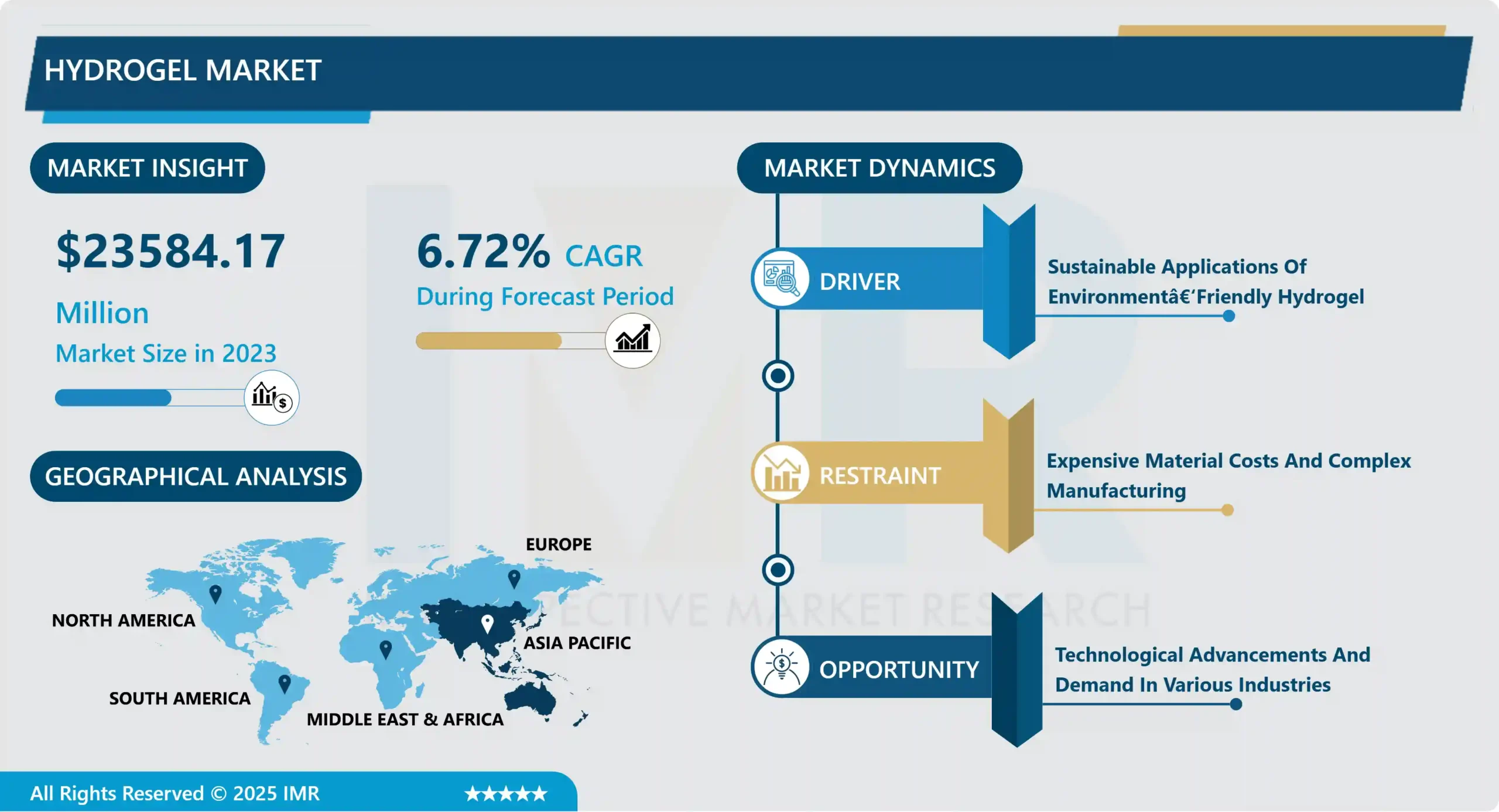
Hydrogel Market Size Was Valued at USD 23584.17 Million in 2023 and is Projected to Reach USD 42348.00 Million by 2032, Growing at a CAGR of 6.72% From 2024-2032.
Hydrogels are addressed as the class of regular/ engineered polymeric substances that can hold enormous measures of water as a result of their particular structures and ensuing growing properties. In light of this capacity, they established a wide assortment of utilizations, and on account of the likelihood of adjusting the polymeric structure to acquire desired usefulness, the territories of uses are quickly extending.
They may be structured so they may react with particular parameters comprising pH, temperature, light, and so on at a preferred stage and hence be receptive. Amongst the stunning attributes, biocompatibility and biodegradability developed them a ground-breaking possibility to utilize in natural and ecological implementation as inserts or substances for evacuation of dangerous toxins. Likewise, directing hydrogels is regularly a decent decision in structuring and manufacturing supercapacitors, which guarantee the fastest advancements in hardware.
Because of a biochemical or “physical bridge” of each polymeric chain, hydrogel addresses a Three-Dimensional (3D) framework of hydrophilic polymeric matrix that may expand in ???d and absorb an ample amount of water while maintaining its structure. Hydrogel products are a set of polymer composites with hydrophilic composition that allows them to bind large amounts of water in three-dimensional structures. Widespread use of such objects in a range of new and environmental settings is regarded as crucial. Natural hydrogels were gradually phased out in favor of engineered hydrogels, which have an increased water integration cap, a longer service life, and a wider range of synthetic chemical assets. Hydrogels have been around for a generation and are still used in a variety of methodologies ranging from industrial to normal. The production, characteristics, and applications of hydrogels have been the subject of several specific articles, audits, and monographs.
Hydrogel Market Trend Analysis
Sustainable applications of environment?friendly hydrogel
The development of hydrogel on microbial and fungal development, plant species growth, degradability, and water retention discovered in several studies and special investigations was conducted by Jacoby et?al. Dye-containing solutions may be cleaned up based on experimental results, a three-layer arti?cial neural network structure model to predict and analyse the adsorption process of Congo red dye on graphene oxide or chitosan-polyvinyl alcohol hydrogel. Soybean cellulose residue can help create green magnetic hydrogel to e?ciently remove copper ions from wastewater. Carboxymethyl cellulose hydrogel with increased adsorption capacity removed toxic metals from wastewater.
It is evident that the future of hydrogel research holds tremendous promise. While early studies focused on areas such as tissue and biomedical engineering, the analysis of hydrogels and their related bibliographical references suggests a growing viability of hydrogel research in various other ?elds. The importance of responsible and safe hydrogel development is paramount con-sidering their diverse applications.
To advance research in this domain, particular attention should be directed towards the study of polymer-related processes and the sustainable utilisation of hydrogels, particularly in enhancing absorption capaci-ties for wastewater treatment to protect the water resources on the planet. Looking ahead to future research on hydrogel development, we identi?ed three crucial focal points. First, considering escalating environmental concerns, research is expected to increasingly focus on biodegradable and highly e?cient superabsorbent polymers. Second, the integration of superabsorbent polymers into wastewater treatment pro-cesses promises to enhance environmental management. Finally, the performance of synthetic superabsorbent polymers can be further improved by combining mono-mers and polymers derived from bio-based sources.
Technological advancements and demand in various industries
The hydrogel industry is set to expand due to tech improvements and rising demand in diverse sectors. Advancements in biomedical applications for expansion opportunities include drug delivery systems, wound care, and tissue engineering. Stimuli-sensitive hydrogels have the potential to enhance targeted drug delivery, hydrogel dressings can promote wound healing, and utilizing hydrogels in 3D bioprinting may transform organ and tissue regeneration.
Hydrogel skincare products such as masks and moisturizers are in high demand in the personal care industry for their cooling and calming properties. Superabsorbent hydrogel polymers enhance absorption in diapers and hygiene products, leading to the development of fresh market sections. Hydrogels in agriculture increase soil water retention to boost crop productivity in regions susceptible to drought. They also assist in the treatment of wastewater by eliminating pollutants such as heavy metals and dyes.
Current advancements in up-and-coming technologies are centered on the progress of smart hydrogels and nanocomposite hydrogels. Intelligent hydrogels react to outside influences and are used in drug delivery, robotics, and sensors. Hydrogels with nanoparticles, known as nanocomposite hydrogels, improve mechanical properties and conductivity to be utilized in advanced technology applications. The contact lens industry is seeing an increased need for better comfort, performance, and specialized lenses to meet different vision issues and customer preferences.
Positive regulations concerning medical devices and pharmaceuticals can help with the implementation of hydrogel-based products. Growth opportunities are available in emerging markets across Asia-Pacific, Latin America, and Africa. Progress in medical uses, beauty items, and environmental remedies are fueling significant expansion in the hydrogel industry due to growing market demand and progress.
Hydrogel Market Segment Analysis:
Hydrogel Market Segmented on the basis of Source, Composition, Source, Preparation Techniques, Application.
By Source, Synthetic Segment Is Expected to Dominate the Market During the Forecast Period
The manufacture of synthetic hydrogels benefits from being able to scale up production and cost-effectively utilize industrial processes and readily available raw materials for mass production. Manipulating the porosity, mechanical strength, and degradation rates of synthetic hydrogels allows for customization to meet specific requirements.
Artificial hydrogels provide dependable quality and purity, lessening variations in important uses such as biomedical devices and pharmaceuticals. Artificial hydrogels are adaptable and practical, able to include various functional groups and react to particular stimuli, making them perfect for advanced uses.
Artificial hydrogels such as PEG and PVA are compatible with living organisms and safe, which is why they are suitable for medical and pharmaceutical purposes. Artificial hydrogels offer increased longevity and reliability compared to their natural counterparts, which makes them well-suited for extended usage across a range of applications.
Tailored artificial hydrogels are fueling creativity in different sectors such as environmental engineering, agriculture, and consumer goods. Continuous studies in polymer chemistry are broadening the potential of artificial hydrogels, ensuring their continued high demand. Synthetic hydrogels’ dominance in the market is due to their versatility, reliability, and wide range of applications. Synthetic hydrogels dominate market due to their beneficial characteristics and wide range of uses.
By Application, Drug Delivery Segment Held the Largest Share In 2023
Hydrogels are utilized for a range of purposes, including drug delivery, dye and heavy metal elimination, contact lenses, pH sensors, personal care, and agriculture. Yet, drug delivery is the primary use as hydrogels can offer regulated release mechanisms. This enables continuous and focused administration, enhancing treatment effectiveness and minimizing side effects.
Hydrogels like PEG and PVA are biocompatible and non-toxic, ideal for medical use. They can absorb water, aiding drug diffusion, and deliver both hydrophilic and hydrophobic drugs effectively. Hydrogels can react to pH, temperature, and enzymes in the body, allowing for precise drug delivery to specific locations. They are available in a range of forms including nanoparticles, microparticles, films, and injectable gels, allowing them to be used in different drug delivery systems.
Hydrogels shield delicate medications from breaking down and enhance durability. Injectable formulations provide a less invasive method for delivering drugs, which is advantageous for patients who require ongoing treatment or have chronic illnesses. Hydrogels are highly effective in drug delivery due to their precise and focused treatment, ability to work well with the body, diverse options for administration, and advantages in keeping drugs safe. Their cutting-edge offerings in the medical and pharmaceutical sectors establish them as a top contender.
Hydrogel Market Regional Insights:
Asia Pacific is Expected to Dominate the Market Over the Forecast Period
Investments in medical technology and infrastructure are increasing in the healthcare industry in Asia Pacific, with the use of hydrogels for a range of applications. Hydrogels play a crucial role in agriculture by enhancing soil moisture retention and increasing crop productivity, particularly in countries across the Asia Pacific region such as China and India.
The rise of the middle class and increased disposable incomes drive the demand for consumer products such as diapers, contact lenses, and hygiene items utilizing hydrogel technology. Both Japan and South Korea are making significant investments in research and development for hydrogel technology and new products, which is fueling innovation in both industries.
The Asia Pacific region has a robust manufacturing foundation for hydrogels because of efficient supply chains and cost benefits, which makes it attractive for manufacturing and exporting. Partnerships between universities, research institutions, and companies in the Asia Pacific region are accelerating innovation and expediting the commercialization of hydrogel applications. Asia Pacific is the leader in the hydrogel market because of the economic growth and industrial expansion in countries such as China, Japan, South Korea, and India. Quick industrial growth and urban expansion fuel the need for hydrogels in industries such as healthcare, agriculture, and consumer goods throughout the area.
Hydrogel Market Active Players
3M Company (US)
Cardinal Health (US)
CooperVision (US)
Smith & Nephew (UK)
Johnson & Johnson (US)
Paul Hartmann (Germany)
Medline Industries (US)
Essity (Sweden)
The Cooper Companies (US)
B. Braun Melsungen (Germany)
Ashland (US)
Procyon Corporation (US)
Momentive Performance Materials (US)
Derma Sciences (US)
Molnlycke Health Care (Sweden)
Coloplast (Denmark)
Ocular Therapeutix (US)
Convatec Inc. (UK)
Integra LifeSciences Corporation (US)
Royal DSM (Netherlands)
Dow Corning Corporation (US)
Evonik Industries (Germany)
Cosmo Bio USA (US)
MPM Medical (US)
Gentell (US)
Alliqua Biomedical (US)
AMERX Health Care Corporation (US)
Chapter 1: Introduction
1.1 Scope and Coverage
Chapter 2:Executive Summary
Chapter 3: Market Landscape
3.1 Market Dynamics
3.1.1 Drivers
3.1.2 Restraints
3.1.3 Opportunities
3.1.4 Challenges
3.2 Market Trend Analysis
3.3 PESTLE Analysis
3.4 Porter’s Five Forces Analysis
3.5 Industry Value Chain Analysis
3.6 Ecosystem
3.7 Regulatory Landscape
3.8 Price Trend Analysis
3.9 Patent Analysis
3.10 Technology Evolution
3.11 Investment Pockets
3.12 Import-Export Analysis
Chapter 4: Hydrogels Market by Source (2018-2032)
4.1 Hydrogels Market Snapshot and Growth Engine
4.2 Market Overview
4.3 Natural
4.3.1 Introduction and Market Overview
4.3.2 Historic and Forecasted Market Size in Value USD and Volume Units
4.3.3 Key Market Trends, Growth Factors, and Opportunities
4.3.4 Geographic Segmentation Analysis
4.4 Synthetic
Chapter 5: Hydrogels Market by Composition (2018-2032)
5.1 Hydrogels Market Snapshot and Growth Engine
5.2 Market Overview
5.3 Homo-polymeric hydrogels
5.3.1 Introduction and Market Overview
5.3.2 Historic and Forecasted Market Size in Value USD and Volume Units
5.3.3 Key Market Trends, Growth Factors, and Opportunities
5.3.4 Geographic Segmentation Analysis
5.4 Co-polymeric hydrogels
5.5 Multi-polymer interpenetrating polymeric hydrogels
Chapter 6: Hydrogels Market by Form (2018-2032)
6.1 Hydrogels Market Snapshot and Growth Engine
6.2 Market Overview
6.3 Amorphous
6.3.1 Introduction and Market Overview
6.3.2 Historic and Forecasted Market Size in Value USD and Volume Units
6.3.3 Key Market Trends, Growth Factors, and Opportunities
6.3.4 Geographic Segmentation Analysis
6.4 Crystalline
6.5 Semi-crystalline
Chapter 7: Hydrogels Market by Preparation Techniques (2018-2032)
7.1 Hydrogels Market Snapshot and Growth Engine
7.2 Market Overview
7.3 Bulk polymerization
7.3.1 Introduction and Market Overview
7.3.2 Historic and Forecasted Market Size in Value USD and Volume Units
7.3.3 Key Market Trends, Growth Factors, and Opportunities
7.3.4 Geographic Segmentation Analysis
7.4 Grafting technique
7.5 Polymerization
Chapter 8: Hydrogels Market by using irradiation (2018-2032)
8.1 Hydrogels Market Snapshot and Growth Engine
8.2 Market Overview
8.3
8.3.1 Introduction and Market Overview
8.3.2 Historic and Forecasted Market Size in Value USD and Volume Units
8.3.3 Key Market Trends, Growth Factors, and Opportunities
8.3.4 Geographic Segmentation Analysis
Chapter 9: Hydrogels Market by Application (2018-2032)
9.1 Hydrogels Market Snapshot and Growth Engine
9.2 Market Overview
9.3 Drug delivery
9.3.1 Introduction and Market Overview
9.3.2 Historic and Forecasted Market Size in Value USD and Volume Units
9.3.3 Key Market Trends, Growth Factors, and Opportunities
9.3.4 Geographic Segmentation Analysis
9.4 Removal of dyes and heavy metals
9.5 Contact lenses
9.6 PH sensors
9.7 Personal Care
9.8 Agricultural
Chapter 10: Company Profiles and Competitive Analysis
10.1 Competitive Landscape
10.1.1 Competitive Benchmarking
10.1.2 Hydrogels Market Share by Manufacturer (2024)
10.1.3 Industry BCG Matrix
10.1.4 Heat Map Analysis
10.1.5 Mergers and Acquisitions
10.2 3M COMPANY (US)
10.2.1 Company Overview
10.2.2 Key Executives
10.2.3 Company Snapshot
10.2.4 Role of the Company in the Market
10.2.5 Sustainability and Social Responsibility
10.2.6 Operating Business Segments
10.2.7 Product Portfolio
10.2.8 Business Performance
10.2.9 Key Strategic Moves and Recent Developments
10.2.10 SWOT Analysis
10.3 CARDINAL HEALTH (US)
10.4 COOPERVISION (US)
10.5 SMITH & NEPHEW (UK)
10.6 JOHNSON & JOHNSON (US)
10.7 PAUL HARTMANN (GERMANY)
10.8 MEDLINE INDUSTRIES (US)
10.9 ESSITY (SWEDEN)
10.10 THE COOPER COMPANIES (US)
10.11 B. BRAUN MELSUNGEN (GERMANY)
10.12 ASHLAND (US)
10.13 PROCYON CORPORATION (US)
10.14 MOMENTIVE PERFORMANCE MATERIALS (US)
10.15 DERMA SCIENCES (US)
10.16 MOLNLYCKE HEALTH CARE (SWEDEN)
10.17 COLOPLAST (DENMARK)
10.18 OCULAR THERAPEUTIX (US)
10.19 CONVATEC INC. (UK)
10.20 INTEGRA LIFESCIENCES CORPORATION (US)
10.21 ROYAL DSM (NETHERLANDS)
10.22 DOW CORNING CORPORATION (US)
10.23 EVONIK INDUSTRIES (GERMANY)
10.24 COSMO BIO USA (US)
10.25 MPM MEDICAL (US)
10.26 GENTELL (US)
10.27 ALLIQUA BIOMEDICAL (US)
10.28 AMERX HEALTH CARE CORPORATION (US)
10.29 NEXGEL (US)
10.30 AUL HARTMANN AG (GERMANY)
10.31 BSN MEDICAL GMBH (GERMANY)
10.32 BIOCAT GMBH (GERMANY)
10.33 CONVATEC GROUP (UK)
10.34 HOLLISTER (US)
10.35 AMBU (DENMARK)
Chapter 11: Global Hydrogels Market By Region
11.1 Overview
11.2. North America Hydrogels Market
11.2.1 Key Market Trends, Growth Factors and Opportunities
11.2.2 Top Key Companies
11.2.3 Historic and Forecasted Market Size by Segments
11.2.4 Historic and Forecasted Market Size by Source
11.2.4.1 Natural
11.2.4.2 Synthetic
11.2.5 Historic and Forecasted Market Size by Composition
11.2.5.1 Homo-polymeric hydrogels
11.2.5.2 Co-polymeric hydrogels
11.2.5.3 Multi-polymer interpenetrating polymeric hydrogels
11.2.6 Historic and Forecasted Market Size by Form
11.2.6.1 Amorphous
11.2.6.2 Crystalline
11.2.6.3 Semi-crystalline
11.2.7 Historic and Forecasted Market Size by Preparation Techniques
11.2.7.1 Bulk polymerization
11.2.7.2 Grafting technique
11.2.7.3 Polymerization
11.2.8 Historic and Forecasted Market Size by using irradiation
11.2.8.1
11.2.9 Historic and Forecasted Market Size by Application
11.2.9.1 Drug delivery
11.2.9.2 Removal of dyes and heavy metals
11.2.9.3 Contact lenses
11.2.9.4 PH sensors
11.2.9.5 Personal Care
11.2.9.6 Agricultural
11.2.10 Historic and Forecast Market Size by Country
11.2.10.1 US
11.2.10.2 Canada
11.2.10.3 Mexico
11.3. Eastern Europe Hydrogels Market
11.3.1 Key Market Trends, Growth Factors and Opportunities
11.3.2 Top Key Companies
11.3.3 Historic and Forecasted Market Size by Segments
11.3.4 Historic and Forecasted Market Size by Source
11.3.4.1 Natural
11.3.4.2 Synthetic
11.3.5 Historic and Forecasted Market Size by Composition
11.3.5.1 Homo-polymeric hydrogels
11.3.5.2 Co-polymeric hydrogels
11.3.5.3 Multi-polymer interpenetrating polymeric hydrogels
11.3.6 Historic and Forecasted Market Size by Form
11.3.6.1 Amorphous
11.3.6.2 Crystalline
11.3.6.3 Semi-crystalline
11.3.7 Historic and Forecasted Market Size by Preparation Techniques
11.3.7.1 Bulk polymerization
11.3.7.2 Grafting technique
11.3.7.3 Polymerization
11.3.8 Historic and Forecasted Market Size by using irradiation
11.3.8.1
11.3.9 Historic and Forecasted Market Size by Application
11.3.9.1 Drug delivery
11.3.9.2 Removal of dyes and heavy metals
11.3.9.3 Contact lenses
11.3.9.4 PH sensors
11.3.9.5 Personal Care
11.3.9.6 Agricultural
11.3.10 Historic and Forecast Market Size by Country
11.3.10.1 Russia
11.3.10.2 Bulgaria
11.3.10.3 The Czech Republic
11.3.10.4 Hungary
11.3.10.5 Poland
11.3.10.6 Romania
11.3.10.7 Rest of Eastern Europe
11.4. Western Europe Hydrogels Market
11.4.1 Key Market Trends, Growth Factors and Opportunities
11.4.2 Top Key Companies
11.4.3 Historic and Forecasted Market Size by Segments
11.4.4 Historic and Forecasted Market Size by Source
11.4.4.1 Natural
11.4.4.2 Synthetic
11.4.5 Historic and Forecasted Market Size by Composition
11.4.5.1 Homo-polymeric hydrogels
11.4.5.2 Co-polymeric hydrogels
11.4.5.3 Multi-polymer interpenetrating polymeric hydrogels
11.4.6 Historic and Forecasted Market Size by Form
11.4.6.1 Amorphous
11.4.6.2 Crystalline
11.4.6.3 Semi-crystalline
11.4.7 Historic and Forecasted Market Size by Preparation Techniques
11.4.7.1 Bulk polymerization
11.4.7.2 Grafting technique
11.4.7.3 Polymerization
11.4.8 Historic and Forecasted Market Size by using irradiation
11.4.8.1
11.4.9 Historic and Forecasted Market Size by Application
11.4.9.1 Drug delivery
11.4.9.2 Removal of dyes and heavy metals
11.4.9.3 Contact lenses
11.4.9.4 PH sensors
11.4.9.5 Personal Care
11.4.9.6 Agricultural
11.4.10 Historic and Forecast Market Size by Country
11.4.10.1 Germany
11.4.10.2 UK
11.4.10.3 France
11.4.10.4 The Netherlands
11.4.10.5 Italy
11.4.10.6 Spain
11.4.10.7 Rest of Western Europe
11.5. Asia Pacific Hydrogels Market
11.5.1 Key Market Trends, Growth Factors and Opportunities
11.5.2 Top Key Companies
11.5.3 Historic and Forecasted Market Size by Segments
11.5.4 Historic and Forecasted Market Size by Source
11.5.4.1 Natural
11.5.4.2 Synthetic
11.5.5 Historic and Forecasted Market Size by Composition
11.5.5.1 Homo-polymeric hydrogels
11.5.5.2 Co-polymeric hydrogels
11.5.5.3 Multi-polymer interpenetrating polymeric hydrogels
11.5.6 Historic and Forecasted Market Size by Form
11.5.6.1 Amorphous
11.5.6.2 Crystalline
11.5.6.3 Semi-crystalline
11.5.7 Historic and Forecasted Market Size by Preparation Techniques
11.5.7.1 Bulk polymerization
11.5.7.2 Grafting technique
11.5.7.3 Polymerization
11.5.8 Historic and Forecasted Market Size by using irradiation
11.5.8.1
11.5.9 Historic and Forecasted Market Size by Application
11.5.9.1 Drug delivery
11.5.9.2 Removal of dyes and heavy metals
11.5.9.3 Contact lenses
11.5.9.4 PH sensors
11.5.9.5 Personal Care
11.5.9.6 Agricultural
11.5.10 Historic and Forecast Market Size by Country
11.5.10.1 China
11.5.10.2 India
11.5.10.3 Japan
11.5.10.4 South Korea
11.5.10.5 Malaysia
11.5.10.6 Thailand
11.5.10.7 Vietnam
11.5.10.8 The Philippines
11.5.10.9 Australia
11.5.10.10 New Zealand
11.5.10.11 Rest of APAC
11.6. Middle East & Africa Hydrogels Market
11.6.1 Key Market Trends, Growth Factors and Opportunities
11.6.2 Top Key Companies
11.6.3 Historic and Forecasted Market Size by Segments
11.6.4 Historic and Forecasted Market Size by Source
11.6.4.1 Natural
11.6.4.2 Synthetic
11.6.5 Historic and Forecasted Market Size by Composition
11.6.5.1 Homo-polymeric hydrogels
11.6.5.2 Co-polymeric hydrogels
11.6.5.3 Multi-polymer interpenetrating polymeric hydrogels
11.6.6 Historic and Forecasted Market Size by Form
11.6.6.1 Amorphous
11.6.6.2 Crystalline
11.6.6.3 Semi-crystalline
11.6.7 Historic and Forecasted Market Size by Preparation Techniques
11.6.7.1 Bulk polymerization
11.6.7.2 Grafting technique
11.6.7.3 Polymerization
11.6.8 Historic and Forecasted Market Size by using irradiation
11.6.8.1
11.6.9 Historic and Forecasted Market Size by Application
11.6.9.1 Drug delivery
11.6.9.2 Removal of dyes and heavy metals
11.6.9.3 Contact lenses
11.6.9.4 PH sensors
11.6.9.5 Personal Care
11.6.9.6 Agricultural
11.6.10 Historic and Forecast Market Size by Country
11.6.10.1 Turkiye
11.6.10.2 Bahrain
11.6.10.3 Kuwait
11.6.10.4 Saudi Arabia
11.6.10.5 Qatar
11.6.10.6 UAE
11.6.10.7 Israel
11.6.10.8 South Africa
11.7. South America Hydrogels Market
11.7.1 Key Market Trends, Growth Factors and Opportunities
11.7.2 Top Key Companies
11.7.3 Historic and Forecasted Market Size by Segments
11.7.4 Historic and Forecasted Market Size by Source
11.7.4.1 Natural
11.7.4.2 Synthetic
11.7.5 Historic and Forecasted Market Size by Composition
11.7.5.1 Homo-polymeric hydrogels
11.7.5.2 Co-polymeric hydrogels
11.7.5.3 Multi-polymer interpenetrating polymeric hydrogels
11.7.6 Historic and Forecasted Market Size by Form
11.7.6.1 Amorphous
11.7.6.2 Crystalline
11.7.6.3 Semi-crystalline
11.7.7 Historic and Forecasted Market Size by Preparation Techniques
11.7.7.1 Bulk polymerization
11.7.7.2 Grafting technique
11.7.7.3 Polymerization
11.7.8 Historic and Forecasted Market Size by using irradiation
11.7.8.1
11.7.9 Historic and Forecasted Market Size by Application
11.7.9.1 Drug delivery
11.7.9.2 Removal of dyes and heavy metals
11.7.9.3 Contact lenses
11.7.9.4 PH sensors
11.7.9.5 Personal Care
11.7.9.6 Agricultural
11.7.10 Historic and Forecast Market Size by Country
11.7.10.1 Brazil
11.7.10.2 Argentina
11.7.10.3 Rest of SA
Chapter 12 Analyst Viewpoint and Conclusion
12.1 Recommendations and Concluding Analysis
12.2 Potential Market Strategies
Chapter 13 Research Methodology
13.1 Research Process
13.2 Primary Research
13.3 Secondary Research
Q1: What would be the forecast period in the Hydrogels Market research report?
A1: The forecast period in the Hydrogels Market research report is 2024-2032.
Q2: Who are the key players in the Hydrogels Market?
A2: 3M Company (US), Cardinal Health (US), CooperVision (US), Smith & Nephew (UK), Johnson & Johnson (US), Paul Hartmann (Germany), Medline Industries (US), Essity (Sweden), The Cooper Companies (US), B. Braun Melsungen (Germany), Ashland (US), Procyon Corporation (US), Momentive Performance Materials (US), Derma Sciences (US), Molnlycke Health Care (Sweden), Coloplast (Denmark), Ocular Therapeutix (US), Convatec Inc. (UK), Integra LifeSciences Corporation (US), Royal DSM (Netherlands), Dow Corning Corporation (US), Evonik Industries (Germany), Cosmo Bio USA (US), MPM Medical (US), Gentell (US), Alliqua Biomedical (US), AMERX Health Care Corporation (US), Nexgel (US), AUL HARTMANN AG (Germany), BSN Medical GmbH (Germany), BioCat GmbH (Germany), ConvaTec Group (UK), Hollister (US), AMBU (Denmark) and Other Active Players.
Q3: What are the segments of the Hydrogels Market?
A3: The Hydrogel Market is segmented into Source, Composition, Source, Preparation Techniques, Application, Segment6, and region. By Source, the market is categorized into Natural, Synthetic. By Composition, the market is categorized into Homo-polymeric hydrogels, Co-polymeric hydrogels, Multi-polymer interpenetrating polymeric hydrogels, Composition. By Form, the market is categorized into Amorphous, Crystalline, Semi-crystalline. By Preparation Techniques, the market is categorized into Bulk polymerization, Grafting technique, Polymerization by using irradiation. By Application, The Market Is Categorized Into Drug delivery, Removal of dyes and heavy metals, Contact lenses, PH sensors, Personal Care, And Agricultural. By region, it is analyzed across North America (U.S.; Canada; Mexico), Eastern Europe (Bulgaria; The Czech Republic; Hungary; Poland; Romania; Rest of Eastern Europe), Western Europe (Germany; UK; France; Netherlands; Italy; Russia; Spain; Rest of Western Europe), Asia-Pacific (China; India; Japan; Southeast Asia, etc.), South America (Brazil; Argentina, etc.), Middle East & Africa (Saudi Arabia; South Africa, etc.).
Q4: What is the Hydrogels Market?
A4: Hydrogels are addressed as the class of regular/ engineered polymeric substances that can hold enormous measures of water as a result of their particular structures and ensuing growing properties. In light of this capacity, they established a wide assortment of utilizations, and on account of the likelihood of adjusting the polymeric structure to acquire desired usefulness, the territories of uses are quickly extending.
Q5: How big is the Hydrogels Market?
A5: Hydrogel Market Size Was Valued at USD 23584.17 Million in 2023 and is Projected to Reach USD 42348.00 Million by 2032, Growing at a CAGR of 6.72% From 2024-2032.
How to Buy a Report from eminsights.jp
On the product page, choose the license you want: Single-User License, Multi-User License or Enterprise License.
If you required report in your native language, then you can click on Translated Report button and fill out the form with report name and language you want, then our team will contact you as soon as possible.
Click the Buy Now button.
You will be redirected to the checkout page. Enter your company details and payment information.
Click Place Order to complete the purchase.
Confirmation: You’ll receive an order confirmation and our team will contact you shortly with your ordered report.
If you have any questions, fill out the contact form below or email us at [email protected].
Thank you for choosing eminsights.jp!