Stay Ahead in Fast-Growing Economies.
Browse Reports Now
Beeswax Market-Latest Advancement And Industry Analysis (2024- 2032)
Beeswax is a natural wax extracted from the honeycomb dividers created by bumble bees. There is a diverse array of beeswax options, ranging from raw yellow beeswax to refined white beeswax produced through the refinement of the yellow variety. It is a mixture of several chemical compounds.

IMR Group
Description
Beeswax Market Synopsis
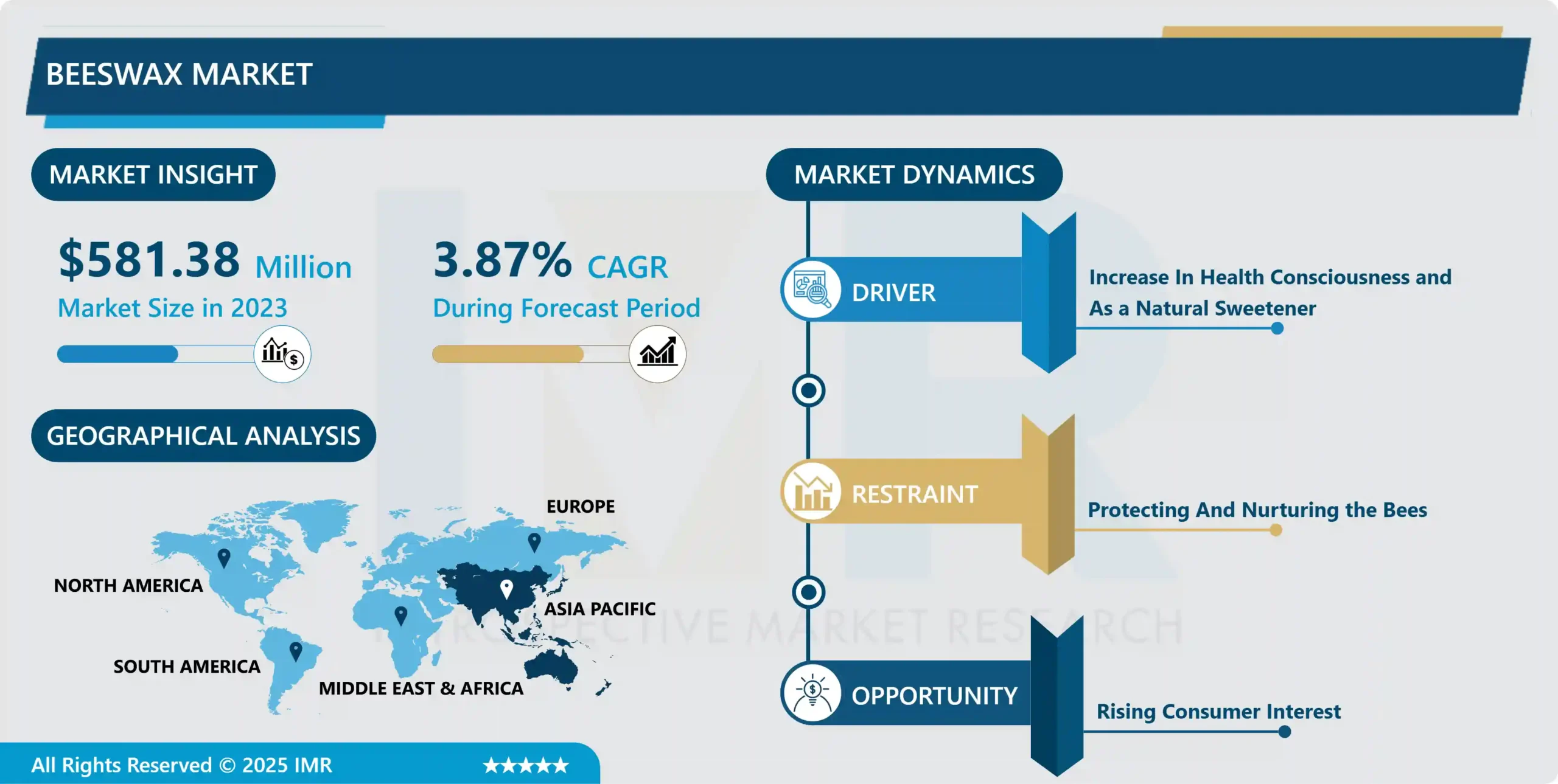
Global Beeswax Market size was valued at USD 581.38 million in 2023 and the total revenue is expected to grow at 3.87% through 2024 to 2032, reaching nearly USD 818.23 million.
Beeswax is a natural wax extracted from the honeycomb dividers created by bumble bees. There is a diverse array of beeswax options, ranging from raw yellow beeswax to refined white beeswax produced through the refinement of the yellow variety. It is a mixture of several chemical compounds.
Beeswax is widely used in skincare products such as lip balms, lotions, and creams due to its natural properties of locking the moisture and forming a protective barrier on the skin. Pharmaceuticals use beeswax to treat burns. It helps in providing hold, texture, and control to hairstyles when used in hair products like wax.
Beeswax is used in food applications such as coating fruits and vegetables to extend their shelf life, and sealing jars. Also used as a natural packaging material. It can also be used in various industrial applications such as lubricants, polishes, coatings, and waterproofing agents and manufacturing candles, soaps, and cosmetics. In the dental industry, it is utilized in creating dental molds, denture bases, and orthodontic impressions. It can prevent musical instruments and wooden tools from moisture damage. As a result, these growing and demanding uses and application leads to the growth of the market over forecast period.
Beeswax Market Trend Analysis
Rising Demand for Natural Ingredients
There is a growing awareness of the benefits of using natural ingredients such as beeswax between consumers. and Also, there is increasing awareness about synthetic chemicals and their potential harm to human health.
In the cosmetics and personal care industry, it is used in lip balms, lotions, creams, and other beauty products due to its moisturizing and protective properties. Beeswax is a non-toxic and hypoallergenic ingredient.
It is commonly used in the food industry for preserving and protecting food products by forming a natural barrier on the surface of fruits and vegetables. This helps to increase their shelf life.
Opportunity
Demand in The Cosmetics and Personal Care Industry
Beeswax can be a valuable ingredient in moisturizers, lotions, and creams by providing hydration and preventing dryness. It acts as a natural barrier against pollutants and irritants. When beeswax is combined with an ingredient such as borax, it acts as an emulsifier.
There is a high demand for beeswax in the manufacturing of lip balms, lipsticks, and lip glosses as a natural ingredient. In sunscreen formulations, it is used for enhancing water-resistant properties, and in perfume manufacturing, it is used for its natural honey-like fragrance. It is used as the base for lipsticks, and emollient skin creams, to increase a lipstick’s luster and hardness, and enhance its color. Beeswax can be a low-cost, natural ingredient in skincare products that is easily accessible. The factors such as increasing disposable income, urbanization, and evolving beauty standards fuel the usage and demand of beeswax in the market.
Beeswax Market Segment Analysis:
The beeswax market is segmented based on type, form, application, distribution channel, end-user, and region.
By Type, Conventional Segment of Beeswax Is Expected to Dominate the Market During the Forecast Period
There are two segments by type, organic and conventional. The conventional segment of beeswax is expected to dominate the market during the forecast period.
Conventional beeswax is produced by traditional beekeeping methods hence it is readily available in large quantities. It has consistent quality and properties that are useful in the manufacturing industries like cosmetics, and food industry.
It also has widespread acceptance and familiarity among manufacturers and consumers. The procurement of conventional beeswax in bulk quantities at competitive prices drives its dominance in the market. The awareness and education about the benefits of organic beeswax are still limited compared to conventional beeswax.
Conventional beeswax may be more cost-effective compared to organic beeswax due to efficient production methods. Conventional beeswax can remain dominant over the forecast period due to its lower price and various health benefits. Some consumers may prioritize affordability and accessibility over organic certification while purchasing beeswax-based products.
The well-established infrastructure for conventional beekeeping, including equipment, expertise, and supply chains supports the efficient production, processing, and distribution of conventional beeswax.
By Form, Beeswax Pellets Segment Held the Largest Share In 2023
There are four types by form, raw, blocks, pellets, and sheets which beeswax pellets segment is expected to dominate the market during the forecast period.
Beeswax pellets are small, bead-like forms of beeswax that are convenient for melting and use in formulations. This form is popular in the cosmetics, pharmaceutical, and food industries due to its ease of use in product formulation. Beeswax pellets offer convenience in handling and measuring compared to other forms such as raw beeswax or blocks due to their uniform size. Pellets have a higher surface area-to-volume ratio compared to other types, which facilitates faster melting and mixing when added to formulations resulting in time-saving and cost reduction.
This segment may be experiencing significant growth in the forecasted period due to the rising demand for natural and organic skincare products. Consumers are increasingly seeking alternatives to synthetic ingredients. This drives the demand for products containing beeswax. Beeswax pellets are well-suited for international trade and export due to their standardized packaging and ease of handling.
Beeswax Market Regional Insights:
Asia Pacific is Expected to Dominate the Market Over the Forecast Period
Countries like China, India, and Thailand, have a rich tradition of beekeeping resulting in the abundant availability of beeswax from these countries forms the foundation for the region’s dominance in the market. The Asia Pacific region serves various industries, including cosmetics, pharmaceuticals, and food processing which mainly raise the demand for beeswax.
In some Asian Pacific countries, the government provides training programs, incentives, and subsidies to increase production. Also, many parts of the region support healthy bee populations and abundant floral resources. The initiatives which mainly focused on organic certification and sustainability resonate well with consumers and drive the demand for high-quality beeswax products.
The Asia Pacific segment will remain the largest region over the forecast period due to growing consciousness among consumers regarding their appearance, demand for natural ingredients, and wide export chances. Strong demand from global markets, particularly North America and Europe, further drives the increase in export chances.
Active Key Players
Beeswax Co. (US)
Wedderspoon (New Zealand)
Burt’s Bees (US)
Bee Harmony (US)
Scotsburn Honey (Canada)
Bee & Flower (China)
Ecosoapia (UK)
Thymes (US)
Waxelene (US)
Apiario Silvestre (Brazil)
Weleda (Switzerland)
Moom (US)
Rosebud Perfume Co. (US)
Ecco Bella (US)
Waxing Kara (US)
Highland Bee Company (Scotland)
Honey Candles (Canada)
Taiga Company (Russia)
Toratai (Australia)
Bee Natural (South Africa)
Beeswax Industries (India)
Nyco Products Co. (US)
Everglow (Germany)
Kamill (Germany)
Natroma (UK)
Other active players
Key Developments in the Beeswax Market:
In 2023, One Good Thing company (UK) launched the ‘world’s first’ wrapper-free snack bars. These snack bars are coated with edible beeswax and other ingredients which act as a replacement for plastic wrappers.
In October 2022, NUXE, a cosmetic brand launched its honey-based lip balm collection with 100% natural ingredients, including beeswax, honey, and sunflower oil.
In October 2022, Sproutlings, a crayon maker company launched a made with a natural soy and beeswax blend, food-grade color pigments.
In February 2022, Lush, a cosmetics retailer, launched a series of moisturizers and cleansers that contain gentle oil, rosewater emulsion, and beeswax and help to remove dirt and keep the skin soft.
Chapter 1: Introduction
1.1 Scope and Coverage
Chapter 2:Executive Summary
Chapter 3: Market Landscape
3.1 Market Dynamics
3.1.1 Drivers
3.1.2 Restraints
3.1.3 Opportunities
3.1.4 Challenges
3.2 Market Trend Analysis
3.3 PESTLE Analysis
3.4 Porter’s Five Forces Analysis
3.5 Industry Value Chain Analysis
3.6 Ecosystem
3.7 Regulatory Landscape
3.8 Price Trend Analysis
3.9 Patent Analysis
3.10 Technology Evolution
3.11 Investment Pockets
3.12 Import-Export Analysis
Chapter 4: Beeswax Market by Type (2018-2032)
4.1 Beeswax Market Snapshot and Growth Engine
4.2 Market Overview
4.3 Organic
4.3.1 Introduction and Market Overview
4.3.2 Historic and Forecasted Market Size in Value USD and Volume Units
4.3.3 Key Market Trends, Growth Factors, and Opportunities
4.3.4 Geographic Segmentation Analysis
4.4 Conventional
Chapter 5: Beeswax Market by Form (2018-2032)
5.1 Beeswax Market Snapshot and Growth Engine
5.2 Market Overview
5.3 Raw beeswax
5.3.1 Introduction and Market Overview
5.3.2 Historic and Forecasted Market Size in Value USD and Volume Units
5.3.3 Key Market Trends, Growth Factors, and Opportunities
5.3.4 Geographic Segmentation Analysis
5.4 Beeswax Blocks
5.5 Beeswax Pellets
5.6 Beeswax Sheets
Chapter 6: Beeswax Market by Application (2018-2032)
6.1 Beeswax Market Snapshot and Growth Engine
6.2 Market Overview
6.3 Cosmetics
6.3.1 Introduction and Market Overview
6.3.2 Historic and Forecasted Market Size in Value USD and Volume Units
6.3.3 Key Market Trends, Growth Factors, and Opportunities
6.3.4 Geographic Segmentation Analysis
6.4 Skincare Products
6.5 Lubricants
6.6 Water Proofing
6.7 Candles
6.8 Packaging
Chapter 7: Beeswax Market by Distribution Channel (2018-2032)
7.1 Beeswax Market Snapshot and Growth Engine
7.2 Market Overview
7.3 Retail Stores
7.3.1 Introduction and Market Overview
7.3.2 Historic and Forecasted Market Size in Value USD and Volume Units
7.3.3 Key Market Trends, Growth Factors, and Opportunities
7.3.4 Geographic Segmentation Analysis
7.4 Supermarkets
7.5 Wholesale Distributor
7.6 Online Stores
Chapter 8: Beeswax Market by End-user (2018-2032)
8.1 Beeswax Market Snapshot and Growth Engine
8.2 Market Overview
8.3 Cosmetics and Personal Care industry
8.3.1 Introduction and Market Overview
8.3.2 Historic and Forecasted Market Size in Value USD and Volume Units
8.3.3 Key Market Trends, Growth Factors, and Opportunities
8.3.4 Geographic Segmentation Analysis
8.4 Candle Manufacturing Industry
8.5 Food industry
8.6 Others
Chapter 9: Company Profiles and Competitive Analysis
9.1 Competitive Landscape
9.1.1 Competitive Benchmarking
9.1.2 Beeswax Market Share by Manufacturer (2024)
9.1.3 Industry BCG Matrix
9.1.4 Heat Map Analysis
9.1.5 Mergers and Acquisitions
9.2 BEESWAX CO. (US)
9.2.1 Company Overview
9.2.2 Key Executives
9.2.3 Company Snapshot
9.2.4 Role of the Company in the Market
9.2.5 Sustainability and Social Responsibility
9.2.6 Operating Business Segments
9.2.7 Product Portfolio
9.2.8 Business Performance
9.2.9 Key Strategic Moves and Recent Developments
9.2.10 SWOT Analysis
9.3 WEDDERSPOON (NEW ZEALAND)
9.4 BURT’S BEES (US)
9.5 BEE HARMONY (US)
9.6 SCOTSBURN HONEY (CANADA)
9.7 BEE & FLOWER (CHINA)
9.8 ECOSOAPIA (UK)
9.9 THYMES (US)
9.10 WAXELENE (US)
9.11 APIARIO SILVESTRE (BRAZIL)
9.12 WELEDA (SWITZERLAND)
9.13 MOOM (US)
9.14 ROSEBUD PERFUME CO. (US)
9.15 ECCO BELLA (US)
9.16 WAXING KARA (US)
9.17 HIGHLAND BEE COMPANY (SCOTLAND)
9.18 HONEY CANDLES (CANADA)
9.19 TAIGA COMPANY (RUSSIA)
9.20 TORATAI (AUSTRALIA)
9.21 BEE NATURAL (SOUTH AFRICA)
9.22 BEESWAX INDUSTRIES (INDIA)
9.23 NYCO PRODUCTS CO. (US)
9.24 EVERGLOW (GERMANY)
9.25 KAMILL (GERMANY)
9.26 NATROMA (UK)
Chapter 10: Global Beeswax Market By Region
10.1 Overview
10.2. North America Beeswax Market
10.2.1 Key Market Trends, Growth Factors and Opportunities
10.2.2 Top Key Companies
10.2.3 Historic and Forecasted Market Size by Segments
10.2.4 Historic and Forecasted Market Size by Type
10.2.4.1 Organic
10.2.4.2 Conventional
10.2.5 Historic and Forecasted Market Size by Form
10.2.5.1 Raw beeswax
10.2.5.2 Beeswax Blocks
10.2.5.3 Beeswax Pellets
10.2.5.4 Beeswax Sheets
10.2.6 Historic and Forecasted Market Size by Application
10.2.6.1 Cosmetics
10.2.6.2 Skincare Products
10.2.6.3 Lubricants
10.2.6.4 Water Proofing
10.2.6.5 Candles
10.2.6.6 Packaging
10.2.7 Historic and Forecasted Market Size by Distribution Channel
10.2.7.1 Retail Stores
10.2.7.2 Supermarkets
10.2.7.3 Wholesale Distributor
10.2.7.4 Online Stores
10.2.8 Historic and Forecasted Market Size by End-user
10.2.8.1 Cosmetics and Personal Care industry
10.2.8.2 Candle Manufacturing Industry
10.2.8.3 Food industry
10.2.8.4 Others
10.2.9 Historic and Forecast Market Size by Country
10.2.9.1 US
10.2.9.2 Canada
10.2.9.3 Mexico
10.3. Eastern Europe Beeswax Market
10.3.1 Key Market Trends, Growth Factors and Opportunities
10.3.2 Top Key Companies
10.3.3 Historic and Forecasted Market Size by Segments
10.3.4 Historic and Forecasted Market Size by Type
10.3.4.1 Organic
10.3.4.2 Conventional
10.3.5 Historic and Forecasted Market Size by Form
10.3.5.1 Raw beeswax
10.3.5.2 Beeswax Blocks
10.3.5.3 Beeswax Pellets
10.3.5.4 Beeswax Sheets
10.3.6 Historic and Forecasted Market Size by Application
10.3.6.1 Cosmetics
10.3.6.2 Skincare Products
10.3.6.3 Lubricants
10.3.6.4 Water Proofing
10.3.6.5 Candles
10.3.6.6 Packaging
10.3.7 Historic and Forecasted Market Size by Distribution Channel
10.3.7.1 Retail Stores
10.3.7.2 Supermarkets
10.3.7.3 Wholesale Distributor
10.3.7.4 Online Stores
10.3.8 Historic and Forecasted Market Size by End-user
10.3.8.1 Cosmetics and Personal Care industry
10.3.8.2 Candle Manufacturing Industry
10.3.8.3 Food industry
10.3.8.4 Others
10.3.9 Historic and Forecast Market Size by Country
10.3.9.1 Russia
10.3.9.2 Bulgaria
10.3.9.3 The Czech Republic
10.3.9.4 Hungary
10.3.9.5 Poland
10.3.9.6 Romania
10.3.9.7 Rest of Eastern Europe
10.4. Western Europe Beeswax Market
10.4.1 Key Market Trends, Growth Factors and Opportunities
10.4.2 Top Key Companies
10.4.3 Historic and Forecasted Market Size by Segments
10.4.4 Historic and Forecasted Market Size by Type
10.4.4.1 Organic
10.4.4.2 Conventional
10.4.5 Historic and Forecasted Market Size by Form
10.4.5.1 Raw beeswax
10.4.5.2 Beeswax Blocks
10.4.5.3 Beeswax Pellets
10.4.5.4 Beeswax Sheets
10.4.6 Historic and Forecasted Market Size by Application
10.4.6.1 Cosmetics
10.4.6.2 Skincare Products
10.4.6.3 Lubricants
10.4.6.4 Water Proofing
10.4.6.5 Candles
10.4.6.6 Packaging
10.4.7 Historic and Forecasted Market Size by Distribution Channel
10.4.7.1 Retail Stores
10.4.7.2 Supermarkets
10.4.7.3 Wholesale Distributor
10.4.7.4 Online Stores
10.4.8 Historic and Forecasted Market Size by End-user
10.4.8.1 Cosmetics and Personal Care industry
10.4.8.2 Candle Manufacturing Industry
10.4.8.3 Food industry
10.4.8.4 Others
10.4.9 Historic and Forecast Market Size by Country
10.4.9.1 Germany
10.4.9.2 UK
10.4.9.3 France
10.4.9.4 The Netherlands
10.4.9.5 Italy
10.4.9.6 Spain
10.4.9.7 Rest of Western Europe
10.5. Asia Pacific Beeswax Market
10.5.1 Key Market Trends, Growth Factors and Opportunities
10.5.2 Top Key Companies
10.5.3 Historic and Forecasted Market Size by Segments
10.5.4 Historic and Forecasted Market Size by Type
10.5.4.1 Organic
10.5.4.2 Conventional
10.5.5 Historic and Forecasted Market Size by Form
10.5.5.1 Raw beeswax
10.5.5.2 Beeswax Blocks
10.5.5.3 Beeswax Pellets
10.5.5.4 Beeswax Sheets
10.5.6 Historic and Forecasted Market Size by Application
10.5.6.1 Cosmetics
10.5.6.2 Skincare Products
10.5.6.3 Lubricants
10.5.6.4 Water Proofing
10.5.6.5 Candles
10.5.6.6 Packaging
10.5.7 Historic and Forecasted Market Size by Distribution Channel
10.5.7.1 Retail Stores
10.5.7.2 Supermarkets
10.5.7.3 Wholesale Distributor
10.5.7.4 Online Stores
10.5.8 Historic and Forecasted Market Size by End-user
10.5.8.1 Cosmetics and Personal Care industry
10.5.8.2 Candle Manufacturing Industry
10.5.8.3 Food industry
10.5.8.4 Others
10.5.9 Historic and Forecast Market Size by Country
10.5.9.1 China
10.5.9.2 India
10.5.9.3 Japan
10.5.9.4 South Korea
10.5.9.5 Malaysia
10.5.9.6 Thailand
10.5.9.7 Vietnam
10.5.9.8 The Philippines
10.5.9.9 Australia
10.5.9.10 New Zealand
10.5.9.11 Rest of APAC
10.6. Middle East & Africa Beeswax Market
10.6.1 Key Market Trends, Growth Factors and Opportunities
10.6.2 Top Key Companies
10.6.3 Historic and Forecasted Market Size by Segments
10.6.4 Historic and Forecasted Market Size by Type
10.6.4.1 Organic
10.6.4.2 Conventional
10.6.5 Historic and Forecasted Market Size by Form
10.6.5.1 Raw beeswax
10.6.5.2 Beeswax Blocks
10.6.5.3 Beeswax Pellets
10.6.5.4 Beeswax Sheets
10.6.6 Historic and Forecasted Market Size by Application
10.6.6.1 Cosmetics
10.6.6.2 Skincare Products
10.6.6.3 Lubricants
10.6.6.4 Water Proofing
10.6.6.5 Candles
10.6.6.6 Packaging
10.6.7 Historic and Forecasted Market Size by Distribution Channel
10.6.7.1 Retail Stores
10.6.7.2 Supermarkets
10.6.7.3 Wholesale Distributor
10.6.7.4 Online Stores
10.6.8 Historic and Forecasted Market Size by End-user
10.6.8.1 Cosmetics and Personal Care industry
10.6.8.2 Candle Manufacturing Industry
10.6.8.3 Food industry
10.6.8.4 Others
10.6.9 Historic and Forecast Market Size by Country
10.6.9.1 Turkiye
10.6.9.2 Bahrain
10.6.9.3 Kuwait
10.6.9.4 Saudi Arabia
10.6.9.5 Qatar
10.6.9.6 UAE
10.6.9.7 Israel
10.6.9.8 South Africa
10.7. South America Beeswax Market
10.7.1 Key Market Trends, Growth Factors and Opportunities
10.7.2 Top Key Companies
10.7.3 Historic and Forecasted Market Size by Segments
10.7.4 Historic and Forecasted Market Size by Type
10.7.4.1 Organic
10.7.4.2 Conventional
10.7.5 Historic and Forecasted Market Size by Form
10.7.5.1 Raw beeswax
10.7.5.2 Beeswax Blocks
10.7.5.3 Beeswax Pellets
10.7.5.4 Beeswax Sheets
10.7.6 Historic and Forecasted Market Size by Application
10.7.6.1 Cosmetics
10.7.6.2 Skincare Products
10.7.6.3 Lubricants
10.7.6.4 Water Proofing
10.7.6.5 Candles
10.7.6.6 Packaging
10.7.7 Historic and Forecasted Market Size by Distribution Channel
10.7.7.1 Retail Stores
10.7.7.2 Supermarkets
10.7.7.3 Wholesale Distributor
10.7.7.4 Online Stores
10.7.8 Historic and Forecasted Market Size by End-user
10.7.8.1 Cosmetics and Personal Care industry
10.7.8.2 Candle Manufacturing Industry
10.7.8.3 Food industry
10.7.8.4 Others
10.7.9 Historic and Forecast Market Size by Country
10.7.9.1 Brazil
10.7.9.2 Argentina
10.7.9.3 Rest of SA
Chapter 11 Analyst Viewpoint and Conclusion
11.1 Recommendations and Concluding Analysis
11.2 Potential Market Strategies
Chapter 12 Research Methodology
12.1 Research Process
12.2 Primary Research
12.3 Secondary Research
Q1: What would be the forecast period in the Beeswax Market research report?
A1: The forecast period in the Beeswax Market research report is 2024-2032.
Q2: Who are the key players in the Beeswax Market?
A2: Beeswax Co. (US), Wedderspoon (New Zealand), Burt's Bees (US), Bee Harmony (US), Scotsburn Honey (Canada) and other players.
Q3: What are the segments of the Beeswax Market?
A3: The Beeswax Market is segmented into Type, Form, Application, Distribution Channel, End-user, and region. By Type, the market is categorized into organic and conventional. By Form, the market is categorized into raw, blocks, pellets, and sheets. By Application, the market is categorized into Cosmetics, Skincare Products, Lubricants, waterproofing, Candles, and packaging. By Distribution Channel, the market is categorized into Retail Stores, Supermarkets, Wholesale Distributor, Online Stores. By End-user, the market is categorized into the Cosmetics and personal care industry, Candle manufacturing, Food Industry, Others. By region, it is analyzed across North America (U.S.; Canada; Mexico), Eastern Europe (Bulgaria; The Czech Republic; Hungary; Poland; Romania; Rest of Eastern Europe), Western Europe (Germany; UK; France; Netherlands; Italy; Russia; Spain; Rest of Western Europe), Asia-Pacific (China; India; Japan; Southeast Asia, etc.), South America (Brazil; Argentina, etc.), Middle East & Africa (Saudi Arabia; South Africa, etc.).
Q4: What is the Beeswax Market?
A4: The beeswax market refers to the industry surrounding beeswax. Beeswax is a naturally occurring wax produced in the bee's hives which is a fragrant solid at room temperature. It is a mixture of several chemical compounds.
Q5: How big is the Beeswax Market?
A5: Global Beeswax Market size was valued at USD 581.38 million in 2023 and the total revenue is expected to grow at 3.87% through 2024 to 2032, reaching nearly USD 818.23 million.
How to Buy a Report from eminsights.jp
On the product page, choose the license you want: Single-User License, Multi-User License or Enterprise License.
If you required report in your native language, then you can click on Translated Report button and fill out the form with report name and language you want, then our team will contact you as soon as possible.
Click the Buy Now button.
You will be redirected to the checkout page. Enter your company details and payment information.
Click Place Order to complete the purchase.
Confirmation: You’ll receive an order confirmation and our team will contact you shortly with your ordered report.
If you have any questions, fill out the contact form below or email us at [email protected].
Thank you for choosing eminsights.jp!