Stay Ahead in Fast-Growing Economies.
Browse Reports Now
Pharmaceutical Continuous Manufacturing Market-Global Size & Upcoming Industry Trends
Continuous Manufacturing is also known as continuous flow chemistry. Continuous manufacturing is an advanced manufacturing approach with the potential to increase the consistency and quality of pharmaceuticals while lowering their cost.

IMR Group
Description
Pharmaceutical Continuous Manufacturing Market Synopsis
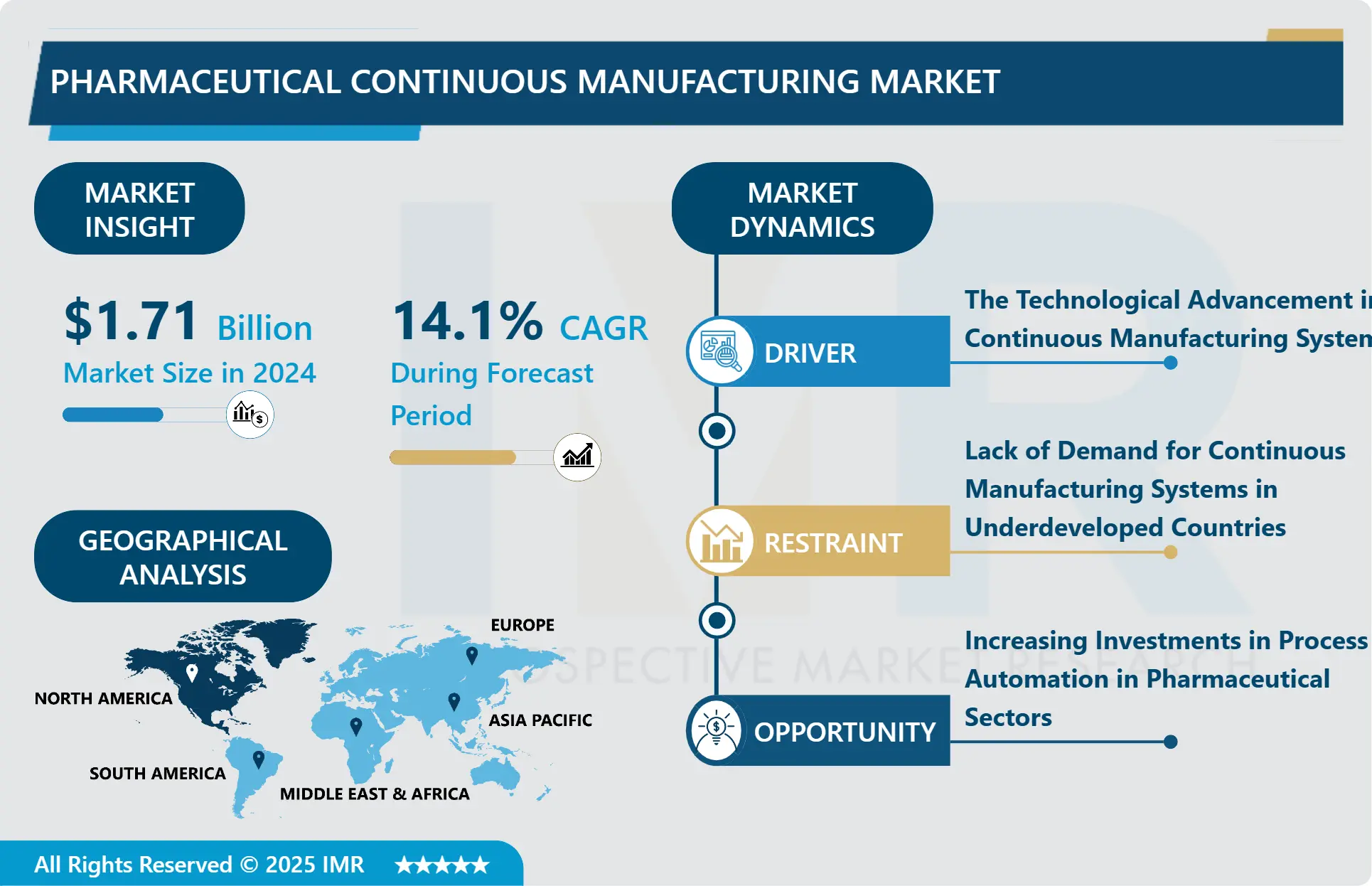
The Global Pharmaceutical Continuous Manufacturing Market size was reasonably estimated to be approximately USD 1.71 Billion in 2024 and is poised to generate revenue over USD 4.91 Billion by the end of 2032, projecting a CAGR of around 14.1% from 2025 to 2032.
Continuous Manufacturing is also known as continuous flow chemistry. Continuous manufacturing is an advanced manufacturing approach with the potential to increase the consistency and quality of pharmaceuticals while lowering their cost. The manufacturing processes on this production line are fully integrated and run in a continuous flow.
Pharmaceutical continuous manufacturing is an end-to-end method of producing medications that improve the consistency and quality of a variety of innovative pharmaceuticals and vaccines while requiring little capital outlay. It operates in a continuous flow as opposed to batch processing, is simpler to scale, gives producers more control and a higher level of automation, and forgoes manual interaction.
Effective medicines are produced in small, closed units using continuous pharmaceutical manufacturing technology using automation. Therefore, it requires less manual intervention. A continuous process combines production steps that are usually performed as a batch process. All this contributes to the continuous utilization of industrial capacity. Fluctuations in production are reduced, yields are improved, and operating and equipment costs are reduced. Because of these advantages, the approach is steadily gaining popularity.
Pharmaceutical continuous manufacturing also helps to reduce the time it takes to formulate medicines, the danger of human mistakes, monitor production processes, and enhance product quality to comply with regulatory standards. In order to create active pharmaceutical ingredients (API) and medicines, pharmaceutical corporations and contract manufacturing organizations (CMOs) frequently use this technology. Integrated, semi-continuous, and control types are the ones that are now offered.
The Pharmaceutical Continuous Manufacturing Market Trend Analysis- The Technological Advancement in Continuous Manufacturing System
Significant technological advancements such as rapid automation in drug manufacturing methodology and extensive integration of artificial intelligence solutions are contributing to the growth of the market. Other factors such as significant advances in the pharmaceutical sector, ongoing recent development activities and awareness of the availability of Food and Drug Administration (FDA) approved drugs drive the market growth.
One of the major factors driving the continuous drug production market is the growing demand for efficient drug production systems that can produce a variety of potent biologics at lower costs. The reason for this is the ever-increasing shortage of medicines and the prevalence of several chronic diseases in various parts of the world. In addition, growing health concerns, especially during the outbreak of the coronavirus disease (COVID-19) pandemic, have encouraged pharmaceutical companies to use continuous production methods to produce new vaccines, acting as another growth engine.
Increasing Investments in Process Automation in Pharmaceutical Sectors
As the demand for new drugs increases, manufacturers are changing their production methods to increase productivity. Continuous production has several advantages, including greater efficiency, and productivity made possible by the linking of unit operations. Improved product quality and safety enabled by continuous automated process monitoring. It helps reduce environmental impact by reducing waste due to high reaction efficiency and space-saving due to the compact size of the kits.
All these factors support the adoption of automated production systems in the pharmaceutical industry. In addition, many leading pharmaceutical manufacturers are expanding their API business in developing countries, which will further support market expansion during the forecast period. Many pharmaceutical companies are investing in this sector creating a growth opportunity for market expansion. For instance, Thermo Fisher will invest USD 82.5 million to increase production capacity at its biological drug substance manufacturing facility in St. Louis. The investment will increase the company’s entire manufacturing capacity two-fold, serving both short- and long-term COVID-19 requirements.
pharmaceutical manufacturing systems reduce production variability, improve yields, and lower operational and equipment costs, which are expected to create profitable opportunities for market expansion. For instance, in 2019, Caperion launched the next generation of high-precision vibrating feeder technology with higher precision and faster product changeover.
Segmentation Analysis of The Pharmaceutical Continuous Manufacturing Market
Pharmaceutical Continuous Manufacturing market segments cover the Product Type, Formulation, Application, Distribution Channels, and End User. By Formulation, the Solid Formulation segment is anticipated to dominate the Market Over the Forecast period.
Solid formulations dominated during the forecast period. As of November 2018, five fixed-dose drugs have received FDA approval and are in continuous production. This led to the dominance of this segment. In addition, companies such as Merck, GEA Group, and Pfizer are developing new products such as Pfizer’s Portable Continuous Miniaturized and Modular System (PCMM), which is expected to increase the use of this manufacturing process in fixed-dose manufacturing.
In addition, as many oral solid dosage products are now off-patent and new oral solid dosage forms are manufactured in smaller quantities, the pharmaceutical industry increasingly requires continuous manufacturing processes for manufacturing solid dosage products. The adoption of continuous manufacturing processes for liquid dosage forms is slow compared to solid dosage forms. Due to the growth of continuous production processes for solid dosage forms, manufacturers and companies offering products in this segment are receptive to the development of production methods for their liquid dosage forms.
Regional Analysis of The Pharmaceutical Continuous Manufacturing Market
North America is Expected to Dominate the Market Over the Forecast Period.
Due to the presence of major market players and the availability of advanced technology North America is excepted to dominate the market. In addition, favorable regulatory infrastructure and high demand for medicines are anticipated to drive market growth in the region. Additionally, high R&D investments by pharmaceutical and biotechnology companies in the region are anticipated to boost market growth in the region. For instance, in June 2022, National Resilience Inc. raised $625 million in Series D funding, which would be used in part for the continuous production of biological substances.
Also, strategies of players in emerging markets such as collaboration to gain more market share are expected to boost the market growth in this region. For instance, Agilent partnered with APC Ltd to combine their technologies to provide customers with unique workflows that support automated process analysis using liquid chromatography. Moreover, increasing support from government organizations is expected to stimulate the growth of the market under study in this region.
The largest share of the regional market was accounted for by growing end users who have implemented or plan to implement CM technology in their facilities in North American countries. In addition, regulators play a key role in driving revenue growth in this industry.
Top Key Players Covered in The Pharmaceutical Continuous Manufacturing Market
Hosokawa Micron Group (US)
Robert Bosch GmbH (Germany)
Thermo Fisher Scientific Inc (US)
GEA Group (Germany)
Coperion GmbH (Netherlands)
Baker Perkins (UK)
Scott Equipment (US)
Eli Lilly (US)
Chemtrix (Netherland)
Novartis AG (Switzerland)
Siemens (Germany)
Glatt GmbH (Germany), and Other Active Players
Key Industry Developments in the Pharmaceutical Continuous Manufacturing Market???????
In August 2023, Siemens acquired continuous manufacturing software firm, Xtelligent, for an undisclosed amount. This acquisition allows Siemens to offer integrated solutions for continuous manufacturing processes.
In July 2023, GSK and Pfizer partnered with MIT to develop a continuous manufacturing platform for next-generation vaccines. This collaboration aims to improve vaccine production speed and efficiency.
In June 2023, Lonza acquired Bend Research, a leading continuous manufacturing technology provider, for $400 million. This acquisition bolsters Lonza’s CDMO offerings and expands its continuous manufacturing expertise.
In March 2023, Merck acquired continuous manufacturing specialist, Pharmaron, for $1.5 billion. This move strengthens Merck’s biologics capabilities and expands its continuous manufacturing footprint.
Chapter 1: Introduction
1.1 Scope and Coverage
Chapter 2:Executive Summary
Chapter 3: Market Landscape
3.1 Market Dynamics
3.1.1 Drivers
3.1.2 Restraints
3.1.3 Opportunities
3.1.4 Challenges
3.2 Market Trend Analysis
3.3 PESTLE Analysis
3.4 Porter’s Five Forces Analysis
3.5 Industry Value Chain Analysis
3.6 Ecosystem
3.7 Regulatory Landscape
3.8 Price Trend Analysis
3.9 Patent Analysis
3.10 Technology Evolution
3.11 Investment Pockets
3.12 Import-Export Analysis
Chapter 4: Pharmaceutical Continuous Manufacturing Market by Product Type (2018-2032)
4.1 Pharmaceutical Continuous Manufacturing Market Snapshot and Growth Engine
4.2 Market Overview
4.3 Integrated Systems
4.3.1 Introduction and Market Overview
4.3.2 Historic and Forecasted Market Size in Value USD and Volume Units
4.3.3 Key Market Trends, Growth Factors, and Opportunities
4.3.4 Geographic Segmentation Analysis
4.4 Semi-Continuous Systems
4.5 Controls
Chapter 5: Pharmaceutical Continuous Manufacturing Market by Formulation (2018-2032)
5.1 Pharmaceutical Continuous Manufacturing Market Snapshot and Growth Engine
5.2 Market Overview
5.3 Solid Formulation
5.3.1 Introduction and Market Overview
5.3.2 Historic and Forecasted Market Size in Value USD and Volume Units
5.3.3 Key Market Trends, Growth Factors, and Opportunities
5.3.4 Geographic Segmentation Analysis
5.4 Liquid & Semi-solid Formulation
Chapter 6: Pharmaceutical Continuous Manufacturing Market by Application (2018-2032)
6.1 Pharmaceutical Continuous Manufacturing Market Snapshot and Growth Engine
6.2 Market Overview
6.3 API manufacturing
6.3.1 Introduction and Market Overview
6.3.2 Historic and Forecasted Market Size in Value USD and Volume Units
6.3.3 Key Market Trends, Growth Factors, and Opportunities
6.3.4 Geographic Segmentation Analysis
6.4 Final Drug Product Manufacturing
Chapter 7: Pharmaceutical Continuous Manufacturing Market by Distribution Channel (2018-2032)
7.1 Pharmaceutical Continuous Manufacturing Market Snapshot and Growth Engine
7.2 Market Overview
7.3 Hospital Pharmacy
7.3.1 Introduction and Market Overview
7.3.2 Historic and Forecasted Market Size in Value USD and Volume Units
7.3.3 Key Market Trends, Growth Factors, and Opportunities
7.3.4 Geographic Segmentation Analysis
7.4 Retail Pharmacy
7.5 Online Pharmacy
Chapter 8: Pharmaceutical Continuous Manufacturing Market by End Users (2018-2032)
8.1 Pharmaceutical Continuous Manufacturing Market Snapshot and Growth Engine
8.2 Market Overview
8.3 Research & Development Departments
8.3.1 Introduction and Market Overview
8.3.2 Historic and Forecasted Market Size in Value USD and Volume Units
8.3.3 Key Market Trends, Growth Factors, and Opportunities
8.3.4 Geographic Segmentation Analysis
8.4 Pharmaceutical Companies
8.5 CMO
Chapter 9: Company Profiles and Competitive Analysis
9.1 Competitive Landscape
9.1.1 Competitive Benchmarking
9.1.2 Pharmaceutical Continuous Manufacturing Market Share by Manufacturer (2024)
9.1.3 Industry BCG Matrix
9.1.4 Heat Map Analysis
9.1.5 Mergers and Acquisitions
9.2 AESCULAP INC. (GERMANY)
9.2.1 Company Overview
9.2.2 Key Executives
9.2.3 Company Snapshot
9.2.4 Role of the Company in the Market
9.2.5 Sustainability and Social Responsibility
9.2.6 Operating Business Segments
9.2.7 Product Portfolio
9.2.8 Business Performance
9.2.9 Key Strategic Moves and Recent Developments
9.2.10 SWOT Analysis
9.3 ARTHREX (USA)
9.4 CONMED CORPORATION (USA)
9.5 DJO GLOBAL (USA)
9.6 EXACTECH (USA)
9.7 INTEGRA LIFESCIENCES (USA)
9.8 JOHNSON & JOHNSON (USA)
9.9 MEDTRONIC (IRELAND)
9.10 NUVASIVE (USA)
9.11 ORTHOFIX MEDICAL INC. (USA)
9.12 ÖSSUR (ICELAND)
9.13 SMITH & NEPHEW (UK)
9.14 STRYKER CORPORATION (USA)
9.15 WRIGHT MEDICAL GROUP N.V. (USA)
9.16 ZIMMER BIOMET (USA)
9.17 OTHER KEY PLAYERS.
Chapter 10: Global Pharmaceutical Continuous Manufacturing Market By Region
10.1 Overview
10.2. North America Pharmaceutical Continuous Manufacturing Market
10.2.1 Key Market Trends, Growth Factors and Opportunities
10.2.2 Top Key Companies
10.2.3 Historic and Forecasted Market Size by Segments
10.2.4 Historic and Forecasted Market Size by Product Type
10.2.4.1 Integrated Systems
10.2.4.2 Semi-Continuous Systems
10.2.4.3 Controls
10.2.5 Historic and Forecasted Market Size by Formulation
10.2.5.1 Solid Formulation
10.2.5.2 Liquid & Semi-solid Formulation
10.2.6 Historic and Forecasted Market Size by Application
10.2.6.1 API manufacturing
10.2.6.2 Final Drug Product Manufacturing
10.2.7 Historic and Forecasted Market Size by Distribution Channel
10.2.7.1 Hospital Pharmacy
10.2.7.2 Retail Pharmacy
10.2.7.3 Online Pharmacy
10.2.8 Historic and Forecasted Market Size by End Users
10.2.8.1 Research & Development Departments
10.2.8.2 Pharmaceutical Companies
10.2.8.3 CMO
10.2.9 Historic and Forecast Market Size by Country
10.2.9.1 US
10.2.9.2 Canada
10.2.9.3 Mexico
10.3. Eastern Europe Pharmaceutical Continuous Manufacturing Market
10.3.1 Key Market Trends, Growth Factors and Opportunities
10.3.2 Top Key Companies
10.3.3 Historic and Forecasted Market Size by Segments
10.3.4 Historic and Forecasted Market Size by Product Type
10.3.4.1 Integrated Systems
10.3.4.2 Semi-Continuous Systems
10.3.4.3 Controls
10.3.5 Historic and Forecasted Market Size by Formulation
10.3.5.1 Solid Formulation
10.3.5.2 Liquid & Semi-solid Formulation
10.3.6 Historic and Forecasted Market Size by Application
10.3.6.1 API manufacturing
10.3.6.2 Final Drug Product Manufacturing
10.3.7 Historic and Forecasted Market Size by Distribution Channel
10.3.7.1 Hospital Pharmacy
10.3.7.2 Retail Pharmacy
10.3.7.3 Online Pharmacy
10.3.8 Historic and Forecasted Market Size by End Users
10.3.8.1 Research & Development Departments
10.3.8.2 Pharmaceutical Companies
10.3.8.3 CMO
10.3.9 Historic and Forecast Market Size by Country
10.3.9.1 Russia
10.3.9.2 Bulgaria
10.3.9.3 The Czech Republic
10.3.9.4 Hungary
10.3.9.5 Poland
10.3.9.6 Romania
10.3.9.7 Rest of Eastern Europe
10.4. Western Europe Pharmaceutical Continuous Manufacturing Market
10.4.1 Key Market Trends, Growth Factors and Opportunities
10.4.2 Top Key Companies
10.4.3 Historic and Forecasted Market Size by Segments
10.4.4 Historic and Forecasted Market Size by Product Type
10.4.4.1 Integrated Systems
10.4.4.2 Semi-Continuous Systems
10.4.4.3 Controls
10.4.5 Historic and Forecasted Market Size by Formulation
10.4.5.1 Solid Formulation
10.4.5.2 Liquid & Semi-solid Formulation
10.4.6 Historic and Forecasted Market Size by Application
10.4.6.1 API manufacturing
10.4.6.2 Final Drug Product Manufacturing
10.4.7 Historic and Forecasted Market Size by Distribution Channel
10.4.7.1 Hospital Pharmacy
10.4.7.2 Retail Pharmacy
10.4.7.3 Online Pharmacy
10.4.8 Historic and Forecasted Market Size by End Users
10.4.8.1 Research & Development Departments
10.4.8.2 Pharmaceutical Companies
10.4.8.3 CMO
10.4.9 Historic and Forecast Market Size by Country
10.4.9.1 Germany
10.4.9.2 UK
10.4.9.3 France
10.4.9.4 The Netherlands
10.4.9.5 Italy
10.4.9.6 Spain
10.4.9.7 Rest of Western Europe
10.5. Asia Pacific Pharmaceutical Continuous Manufacturing Market
10.5.1 Key Market Trends, Growth Factors and Opportunities
10.5.2 Top Key Companies
10.5.3 Historic and Forecasted Market Size by Segments
10.5.4 Historic and Forecasted Market Size by Product Type
10.5.4.1 Integrated Systems
10.5.4.2 Semi-Continuous Systems
10.5.4.3 Controls
10.5.5 Historic and Forecasted Market Size by Formulation
10.5.5.1 Solid Formulation
10.5.5.2 Liquid & Semi-solid Formulation
10.5.6 Historic and Forecasted Market Size by Application
10.5.6.1 API manufacturing
10.5.6.2 Final Drug Product Manufacturing
10.5.7 Historic and Forecasted Market Size by Distribution Channel
10.5.7.1 Hospital Pharmacy
10.5.7.2 Retail Pharmacy
10.5.7.3 Online Pharmacy
10.5.8 Historic and Forecasted Market Size by End Users
10.5.8.1 Research & Development Departments
10.5.8.2 Pharmaceutical Companies
10.5.8.3 CMO
10.5.9 Historic and Forecast Market Size by Country
10.5.9.1 China
10.5.9.2 India
10.5.9.3 Japan
10.5.9.4 South Korea
10.5.9.5 Malaysia
10.5.9.6 Thailand
10.5.9.7 Vietnam
10.5.9.8 The Philippines
10.5.9.9 Australia
10.5.9.10 New Zealand
10.5.9.11 Rest of APAC
10.6. Middle East & Africa Pharmaceutical Continuous Manufacturing Market
10.6.1 Key Market Trends, Growth Factors and Opportunities
10.6.2 Top Key Companies
10.6.3 Historic and Forecasted Market Size by Segments
10.6.4 Historic and Forecasted Market Size by Product Type
10.6.4.1 Integrated Systems
10.6.4.2 Semi-Continuous Systems
10.6.4.3 Controls
10.6.5 Historic and Forecasted Market Size by Formulation
10.6.5.1 Solid Formulation
10.6.5.2 Liquid & Semi-solid Formulation
10.6.6 Historic and Forecasted Market Size by Application
10.6.6.1 API manufacturing
10.6.6.2 Final Drug Product Manufacturing
10.6.7 Historic and Forecasted Market Size by Distribution Channel
10.6.7.1 Hospital Pharmacy
10.6.7.2 Retail Pharmacy
10.6.7.3 Online Pharmacy
10.6.8 Historic and Forecasted Market Size by End Users
10.6.8.1 Research & Development Departments
10.6.8.2 Pharmaceutical Companies
10.6.8.3 CMO
10.6.9 Historic and Forecast Market Size by Country
10.6.9.1 Turkiye
10.6.9.2 Bahrain
10.6.9.3 Kuwait
10.6.9.4 Saudi Arabia
10.6.9.5 Qatar
10.6.9.6 UAE
10.6.9.7 Israel
10.6.9.8 South Africa
10.7. South America Pharmaceutical Continuous Manufacturing Market
10.7.1 Key Market Trends, Growth Factors and Opportunities
10.7.2 Top Key Companies
10.7.3 Historic and Forecasted Market Size by Segments
10.7.4 Historic and Forecasted Market Size by Product Type
10.7.4.1 Integrated Systems
10.7.4.2 Semi-Continuous Systems
10.7.4.3 Controls
10.7.5 Historic and Forecasted Market Size by Formulation
10.7.5.1 Solid Formulation
10.7.5.2 Liquid & Semi-solid Formulation
10.7.6 Historic and Forecasted Market Size by Application
10.7.6.1 API manufacturing
10.7.6.2 Final Drug Product Manufacturing
10.7.7 Historic and Forecasted Market Size by Distribution Channel
10.7.7.1 Hospital Pharmacy
10.7.7.2 Retail Pharmacy
10.7.7.3 Online Pharmacy
10.7.8 Historic and Forecasted Market Size by End Users
10.7.8.1 Research & Development Departments
10.7.8.2 Pharmaceutical Companies
10.7.8.3 CMO
10.7.9 Historic and Forecast Market Size by Country
10.7.9.1 Brazil
10.7.9.2 Argentina
10.7.9.3 Rest of SA
Chapter 11 Analyst Viewpoint and Conclusion
11.1 Recommendations and Concluding Analysis
11.2 Potential Market Strategies
Chapter 12 Research Methodology
12.1 Research Process
12.2 Primary Research
12.3 Secondary Research
Q1: What would be the forecast period in the Pharmaceutical Continuous Manufacturing Market research report?
A1: The forecast period in the Pharmaceutical Continuous Manufacturing Market research report is 2025-2032.
Q2: Who are the key players in the Pharmaceutical Continuous Manufacturing Market?
A2: Hosokawa Micron Group (US), Robert Bosch GmbH (Germany), Thermo Fisher Scientific Inc (US), GEA Group (Germany), Coperion GmbH (Netherland), Baker Perkins (UK), Scott Equipment (US), Eli Lilly (US), Chemtrix (Netherland), Novartis AG (Switzerland), Siemens (Germany), Glatt GmbH (Germany), and Other Active Players
Q3: What are the segments of the Pharmaceutical Continuous Manufacturing Market?
A3: The Pharmaceutical Continuous Manufacturing Market is segmented into Product Type, Formulation, Application, Distribution Channels, End-user, and region. By Product Type, the market is categorized into Integrated Systems, Semi-Continuous Systems, and Controls. By, Formulation, the market is categorized into Solid Formulation, Liquid, and Semi-solid Formulation. By Application, the market is categorized into API manufacturing, Final Drug Product Manufacturing. By Distribution Channel, the market is categorized into Hospital Pharmacy, Retail Pharmacy, and Online Pharmacy. By End-user, the market is categorized into Research and Development Departments, Pharmaceutical Companies, and CMO. By region, it is analyzed across North America (US, Canada, Mexico), Eastern Europe (Bulgaria, The Czech Republic, Hungary, Poland, Romania, Rest of Eastern Europe), Western Europe (Germany, UK, France, Netherlands, Italy, Russia, Spain, Rest of Western Europe), Asia Pacific (China, India, Japan, South Korea, Malaysia, Thailand, Vietnam, The Philippines, Australia, New Zealand, Rest of APAC), Middle East & Africa (Turkey, Bahrain, Kuwait, Saudi Arabia, Qatar, UAE, Israel, South Africa), South America (Brazil, Argentina, Rest of SA).
Q4: What is the Pharmaceutical Continuous Manufacturing Market?
A4: Continuous Manufacturing is also known as continuous flow chemistry. Continuous manufacturing is an advanced manufacturing approach with the potential to increase the consistency and quality of pharmaceuticals while lowering their cost. The manufacturing processes on this production line are fully integrated and run in a continuous flow. Pharmaceutical continuous manufacturing is an end-to-end method of producing medications that improve the consistency and quality of a variety of innovative pharmaceuticals and vaccines while requiring little capital outlay.
Q5: How big is the Pharmaceutical Continuous Manufacturing Market?
A5: The Global Pharmaceutical Continuous Manufacturing Market size was reasonably estimated to be approximately USD 1.71 Billion in 2024 and is poised to generate revenue over USD 4.91 Billion by the end of 2032, projecting a CAGR of around 14.1% from 2025 to 2032.
How to Buy a Report from eminsights.jp
On the product page, choose the license you want: Single-User License, Multi-User License or Enterprise License.
If you required report in your native language, then you can click on Translated Report button and fill out the form with report name and language you want, then our team will contact you as soon as possible.
Click the Buy Now button.
You will be redirected to the checkout page. Enter your company details and payment information.
Click Place Order to complete the purchase.
Confirmation: You’ll receive an order confirmation and our team will contact you shortly with your ordered report.
If you have any questions, fill out the contact form below or email us at [email protected].
Thank you for choosing eminsights.jp!