Stay Ahead in Fast-Growing Economies.
Browse Reports Now
Tracking as a Service Market-Global Industry Growth and Trend Analysis
Tracking as-a-service is a solution based on the cloud that helps any organization track their day-to-day business activity and monitor the business operation. It allows to build, monitoring, and evaluate the workflows in the company efficiently. Tracking as-a-service is a cloud platform that is commonly used to monitor goods and products remotely.

IMR Group
Description
Tracking as a Service Market Synopsis
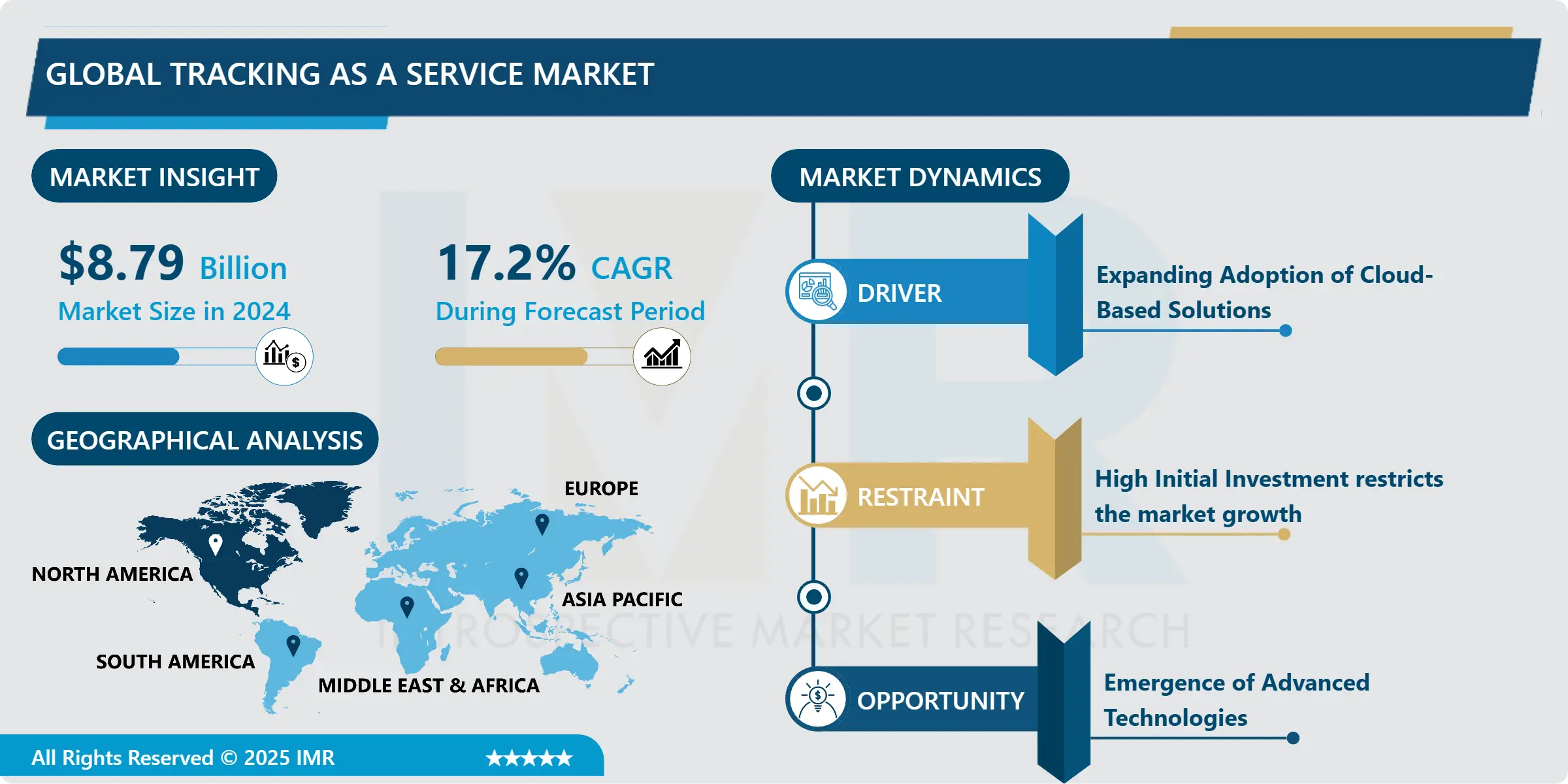
Tracking as a Service Market Size Was Valued at USD 7.5 Billion in 2023, and is Projected to Reach USD 31.3 Billion by 2032, Growing at a CAGR of 17.2% From 2024-2032.
A particular type of cloud-based digital monitoring system, tracking as a service, was developed to help many industries with everyday enterprise activities. Tracking-as-a-service systems offer an ideal tracking solution, which helps businesses monitor the desired aspects of their operations and assets. Tracking-as-a-service is an essential concept that may help a company enhance its production and supply chain and reduce expenses. These services include system integration tools, optimization tools, and end-user job management skills. Also, the tracking service technology seeks to identify the real-time location of all the assets in service. They give us an obvious picture of the support used as a result. It is anticipated that the need for enhanced fleet operator efficiency systems will increase in the course of the projected period, thereby resulting in clear advancement in the tracking-as-a-service market.
The tracking as a service must be imperative in an organization so that it can increase its financial profitability through the increase of manufacturing and logistic strategies. These services include system integration instruments, optimization instruments, and end-user task management skills. Additionally, tracking service technology aims to keep track of the location of all assets on the premises. Thus, they paint a vivid picture of how various assets have been used in the organization.
These factors including real-time tracking, data analytics, optimization, logistics, healthcare, transport, and third-party supply chain management have been the key demand driving factors for the market growth. This growth is supported by development in the sensors industry, IoT, and the cloud which has enabled the development of perfect and cheap methods of tracking. It helps enterprise reach an unprecedented level of accuracy in terms of tracking assets, vehicles, shipments and people which in turn decreases the level of risk, increases the efficiency of the resources, and brings down the cost of operations.
Another major consideration that is attributed to the increasing demand for tracking solutions is the increasing importance accorded to data and analytics when deciding a way of gaining a competitive edge. New and emerging opportunities such as the increasing digitalization of many sectors including the logistics industry will work in favor of the market. For instance, in June 2022, Accenture conducted a survey of over 600 logistics executives as well as a series of interviews with 14 industry leaders to evaluate the industry’s digital maturity. According to the survey of the leaders, they spend 2. Research shows that it is five times more difficult to catapult laggards to a higher level of digital maturity than to overcome low-spending nations.
The tracking-as-a-service market is expected to gain growth at a significant pace in the near future because of increasing demand for a better fleet operator efficiency system. Moreover, the growth of the market is anticipated to be stimulated by advancements in eye-tracking systems combined with the increased adoption of smartphones. Furthermore, the actual increase in the volume of investments in better logistics and supply chain infrastructure is expected to boost the market rapidly.
Tracking as a Service Market Trend Analysis
Tracking as a Service Market Drivers- Increasing application of technology in manufacturing
It is estimated that the industry will grow as more businesses adopt technology in their production lines, in health sectors, commerce, and other logistic JIT industries, and advancement of smart-smartphone technology. On the same note, the ability to navigate inventories, assets, and vehicles through an application that can be installed in a smartphone is among the features that have boosted the growth of the market, particularly in the logistics and supply chain management area. Telecommunications companies in the Asia-Pacific region and North America are the leading regions for creating and delivering tracking service solutions associated with the 5G mobile network. The fact that 5G tracking infrastructure is available for enhanced tracking solutions is also the reason that the deployment of tracking as a service in China, Japan, the U. S, and South Korea has increased, this aspect is one of the more influential aspects boosting the global tracking as a service technology market.
Tracking as a Service Market Opportunity- Rise in the use of IoT
The tracking as a service market has become more popular with IoT-based locating system solution offerings over the recent past. Hence, the Internet of Things technology facility of real-time location tracking of inventory shipments, assets, and items tends to be very accurate and cheap in comparison to conventional approaches. As such, there is increased usage of applications that use the Internet of Things to track services. In the same way, it was forecasted that tracking-as-a-service technology will see its growth further instigated by the increasing number of 5G network-based application requirements in retail, manufacturing, and industrial segments in the forecasted period.
Tracking as a Service Market Segment Analysis:
Tracking as a Service Market is segmented based on Component, Enterprise Size, Asset Type, and, End-User.
By Component, the software segment is expected to dominate the market during the forecast period
The software segment held the largest market share in 2022 and was followed by the hardware segment, which captured more than 35% share. It yet contributes 0% of the global revenue. Thus, the development of the software segment can be explained by the following factors: advancement in the technological field has brought about more complex tracking software solution capacities. Such software tools include tracking capabilities for real-time tracking, data analysis and modeling, and the ability to link to other business systems. These software offerings are appealing to businesses because of their ability to deliver value in the form of customer insights, better organizational functioning, and enhanced decision-making capabilities.
The services segment has been predicted to grow at a faster rate than other segments in the forecast period. Professional and managed services are experiencing growth because they help clients integrate solutions that align with business objectives and needs. These services target the complex requirements of the corporate world through customization, integrations, and ongoing management of tracking services. By outsourcing their tracking-related work, businesses can concentrate on their key activities, as well as adapt to the constant technological advancements in tracking technologies with the help of MSPs. These services also include risk management, compliance, and flexibility, guaranteeing that tracking systems follow implemented regulations and adapt as the business evolves.
By Enterprise Size, large enterprises segment held the largest share in 2024
The large enterprise segment held the major market size in the tracking-as-a-service market in the year 2022 and has emerged with a share of more than 65%. The growth could be attributed to the advanced usage of tracking-as-a-service software and services across various opportunities for value creation, including real-time tracking by massive firms. These solutions provide real-time tracking and monitoring of operations, enabling businesses to reduce costs by minimizing distances, mitigating risks, and adhering to the set rules and regulations. By using tracking systems, entities are able to incorporate updated accurate information that helps in decision-making while at the same time improving the customer experience by offering transparency.
Touting the small and medium enterprise (SME) segment is projected to grow at the highest CAGR over the forecast period. SMEs are attracted to tracking-as-a-service solutions and services because they offer low financial commitments to gain access to sophisticated tracking tools. These solutions also enhance business operations and management, effectively utilizing resources in a manner suitable to the flexible operations of SMEs. Thanking tracking technologies will help SMEs to better meet customers’ demand in a timely update and reduce risk by gaining more visibility in the supply chain.
Tracking as a Service Market Regional Insights:
North America is Expected to Dominate the Market Over the Forecast period
North America held the largest share in the tracking-as-a-service market during the year 2022 and registered a value share of over 29 percent. 0%. This growth can be attributed to market players like Rockwell Automation Inc., and MicroMain Corporation which has added its charm. A strong technological foundation in the region to adapt to tracking-as-a-service is a proper solution for the nature of number tracking real-time requirements and dataset analysis. Its focus on the efficiency of decision-making using information technology and the use of advanced technology promotes the use of tracking solutions which improve on supply chain of goods, customer experience, and efficiency of operations within this region and environment characterized by high competition.
Active Key Players in the Tracking as a Service Market
Rockwell Automation
MicroMain
Sortly
EZO
Finale Inventory
Infor
Midmark Co.
Mojix
PCCW Solutions
Trimble Inc., and Other Active Players
Chapter 1: Introduction
1.1 Scope and Coverage
Chapter 2:Executive Summary
Chapter 3: Market Landscape
3.1 Market Dynamics
3.1.1 Drivers
3.1.2 Restraints
3.1.3 Opportunities
3.1.4 Challenges
3.2 Market Trend Analysis
3.3 PESTLE Analysis
3.4 Porter’s Five Forces Analysis
3.5 Industry Value Chain Analysis
3.6 Ecosystem
3.7 Regulatory Landscape
3.8 Price Trend Analysis
3.9 Patent Analysis
3.10 Technology Evolution
3.11 Investment Pockets
3.12 Import-Export Analysis
Chapter 4: Tracking as a Service Market by Component (2018-2032)
4.1 Tracking as a Service Market Snapshot and Growth Engine
4.2 Market Overview
4.3 Software
4.3.1 Introduction and Market Overview
4.3.2 Historic and Forecasted Market Size in Value USD and Volume Units
4.3.3 Key Market Trends, Growth Factors, and Opportunities
4.3.4 Geographic Segmentation Analysis
4.4 Services
Chapter 5: Tracking as a Service Market by Enterprise Size (2018-2032)
5.1 Tracking as a Service Market Snapshot and Growth Engine
5.2 Market Overview
5.3 Large Enterprises
5.3.1 Introduction and Market Overview
5.3.2 Historic and Forecasted Market Size in Value USD and Volume Units
5.3.3 Key Market Trends, Growth Factors, and Opportunities
5.3.4 Geographic Segmentation Analysis
5.4 Small & Medium Enterprises
Chapter 6: Tracking as a Service Market by Asset Type (2018-2032)
6.1 Tracking as a Service Market Snapshot and Growth Engine
6.2 Market Overview
6.3 Electronics & IT Assets
6.3.1 Introduction and Market Overview
6.3.2 Historic and Forecasted Market Size in Value USD and Volume Units
6.3.3 Key Market Trends, Growth Factors, and Opportunities
6.3.4 Geographic Segmentation Analysis
6.4 In-transit Equipment
6.5 Manufacturing Assets
6.6 Others
Chapter 7: Tracking as a Service Market by End-User (2018-2032)
7.1 Tracking as a Service Market Snapshot and Growth Engine
7.2 Market Overview
7.3 Transportation & Logistic
7.3.1 Introduction and Market Overview
7.3.2 Historic and Forecasted Market Size in Value USD and Volume Units
7.3.3 Key Market Trends, Growth Factors, and Opportunities
7.3.4 Geographic Segmentation Analysis
7.4 Manufacturing
7.5 Healthcare
7.6 Food & Beverage
7.7 Retail
7.8 IT & Telecom
7.9 Others
Chapter 8: Company Profiles and Competitive Analysis
8.1 Competitive Landscape
8.1.1 Competitive Benchmarking
8.1.2 Tracking as a Service Market Share by Manufacturer (2024)
8.1.3 Industry BCG Matrix
8.1.4 Heat Map Analysis
8.1.5 Mergers and Acquisitions
8.2 CISCO SYSTEMS (U.S.)
8.2.1 Company Overview
8.2.2 Key Executives
8.2.3 Company Snapshot
8.2.4 Role of the Company in the Market
8.2.5 Sustainability and Social Responsibility
8.2.6 Operating Business Segments
8.2.7 Product Portfolio
8.2.8 Business Performance
8.2.9 Key Strategic Moves and Recent Developments
8.2.10 SWOT Analysis
8.3  
8.4 GOOGLE INC. (U.S.)
8.5  
8.6 QUALCOMM (U.S.)
8.7  
8.8 LOCATION LABS (U.S)
8.9  
8.10 LOCATIONSMART (U.S)
8.11  
8.12 MICROSOFT CORP. (U.S.)
8.13  
8.14 ERICSSON (SWEDEN.) IBM CORP. (U.S.)
8.15  
8.16 ORACLE CORP. (U.S.)
8.17  
8.18 ESRI (U.S)
8.19  
8.20 ACCELERITE (U.S)
8.21 HERE TECHNOLOGIES (NETHERLANDS)
8.22 TOMTOM N.V. (NETHERLANDS)
8.23 APPLE INC. (U.S.)
8.24 AMAZON WEB SERVICES (AWS) (U.S.)
8.25 SAMSUNG ELECTRONICS (SOUTH KOREA)
8.26 INTEL CORPORATION (U.S.)
8.27 NOKIA CORPORATION (FINLAND)
8.28 TELENAV INC. (U.S.)
8.29 TRIMBLE INC. (U.S.)
8.30 GARMIN LTD. (SWITZERLAND)
Chapter 9: Global Tracking as a Service Market By Region
9.1 Overview
9.2. North America Tracking as a Service Market
9.2.1 Key Market Trends, Growth Factors and Opportunities
9.2.2 Top Key Companies
9.2.3 Historic and Forecasted Market Size by Segments
9.2.4 Historic and Forecasted Market Size by Component
9.2.4.1 Software
9.2.4.2 Services
9.2.5 Historic and Forecasted Market Size by Enterprise Size
9.2.5.1 Large Enterprises
9.2.5.2 Small & Medium Enterprises
9.2.6 Historic and Forecasted Market Size by Asset Type
9.2.6.1 Electronics & IT Assets
9.2.6.2 In-transit Equipment
9.2.6.3 Manufacturing Assets
9.2.6.4 Others
9.2.7 Historic and Forecasted Market Size by End-User
9.2.7.1 Transportation & Logistic
9.2.7.2 Manufacturing
9.2.7.3 Healthcare
9.2.7.4 Food & Beverage
9.2.7.5 Retail
9.2.7.6 IT & Telecom
9.2.7.7 Others
9.2.8 Historic and Forecast Market Size by Country
9.2.8.1 US
9.2.8.2 Canada
9.2.8.3 Mexico
9.3. Eastern Europe Tracking as a Service Market
9.3.1 Key Market Trends, Growth Factors and Opportunities
9.3.2 Top Key Companies
9.3.3 Historic and Forecasted Market Size by Segments
9.3.4 Historic and Forecasted Market Size by Component
9.3.4.1 Software
9.3.4.2 Services
9.3.5 Historic and Forecasted Market Size by Enterprise Size
9.3.5.1 Large Enterprises
9.3.5.2 Small & Medium Enterprises
9.3.6 Historic and Forecasted Market Size by Asset Type
9.3.6.1 Electronics & IT Assets
9.3.6.2 In-transit Equipment
9.3.6.3 Manufacturing Assets
9.3.6.4 Others
9.3.7 Historic and Forecasted Market Size by End-User
9.3.7.1 Transportation & Logistic
9.3.7.2 Manufacturing
9.3.7.3 Healthcare
9.3.7.4 Food & Beverage
9.3.7.5 Retail
9.3.7.6 IT & Telecom
9.3.7.7 Others
9.3.8 Historic and Forecast Market Size by Country
9.3.8.1 Russia
9.3.8.2 Bulgaria
9.3.8.3 The Czech Republic
9.3.8.4 Hungary
9.3.8.5 Poland
9.3.8.6 Romania
9.3.8.7 Rest of Eastern Europe
9.4. Western Europe Tracking as a Service Market
9.4.1 Key Market Trends, Growth Factors and Opportunities
9.4.2 Top Key Companies
9.4.3 Historic and Forecasted Market Size by Segments
9.4.4 Historic and Forecasted Market Size by Component
9.4.4.1 Software
9.4.4.2 Services
9.4.5 Historic and Forecasted Market Size by Enterprise Size
9.4.5.1 Large Enterprises
9.4.5.2 Small & Medium Enterprises
9.4.6 Historic and Forecasted Market Size by Asset Type
9.4.6.1 Electronics & IT Assets
9.4.6.2 In-transit Equipment
9.4.6.3 Manufacturing Assets
9.4.6.4 Others
9.4.7 Historic and Forecasted Market Size by End-User
9.4.7.1 Transportation & Logistic
9.4.7.2 Manufacturing
9.4.7.3 Healthcare
9.4.7.4 Food & Beverage
9.4.7.5 Retail
9.4.7.6 IT & Telecom
9.4.7.7 Others
9.4.8 Historic and Forecast Market Size by Country
9.4.8.1 Germany
9.4.8.2 UK
9.4.8.3 France
9.4.8.4 The Netherlands
9.4.8.5 Italy
9.4.8.6 Spain
9.4.8.7 Rest of Western Europe
9.5. Asia Pacific Tracking as a Service Market
9.5.1 Key Market Trends, Growth Factors and Opportunities
9.5.2 Top Key Companies
9.5.3 Historic and Forecasted Market Size by Segments
9.5.4 Historic and Forecasted Market Size by Component
9.5.4.1 Software
9.5.4.2 Services
9.5.5 Historic and Forecasted Market Size by Enterprise Size
9.5.5.1 Large Enterprises
9.5.5.2 Small & Medium Enterprises
9.5.6 Historic and Forecasted Market Size by Asset Type
9.5.6.1 Electronics & IT Assets
9.5.6.2 In-transit Equipment
9.5.6.3 Manufacturing Assets
9.5.6.4 Others
9.5.7 Historic and Forecasted Market Size by End-User
9.5.7.1 Transportation & Logistic
9.5.7.2 Manufacturing
9.5.7.3 Healthcare
9.5.7.4 Food & Beverage
9.5.7.5 Retail
9.5.7.6 IT & Telecom
9.5.7.7 Others
9.5.8 Historic and Forecast Market Size by Country
9.5.8.1 China
9.5.8.2 India
9.5.8.3 Japan
9.5.8.4 South Korea
9.5.8.5 Malaysia
9.5.8.6 Thailand
9.5.8.7 Vietnam
9.5.8.8 The Philippines
9.5.8.9 Australia
9.5.8.10 New Zealand
9.5.8.11 Rest of APAC
9.6. Middle East & Africa Tracking as a Service Market
9.6.1 Key Market Trends, Growth Factors and Opportunities
9.6.2 Top Key Companies
9.6.3 Historic and Forecasted Market Size by Segments
9.6.4 Historic and Forecasted Market Size by Component
9.6.4.1 Software
9.6.4.2 Services
9.6.5 Historic and Forecasted Market Size by Enterprise Size
9.6.5.1 Large Enterprises
9.6.5.2 Small & Medium Enterprises
9.6.6 Historic and Forecasted Market Size by Asset Type
9.6.6.1 Electronics & IT Assets
9.6.6.2 In-transit Equipment
9.6.6.3 Manufacturing Assets
9.6.6.4 Others
9.6.7 Historic and Forecasted Market Size by End-User
9.6.7.1 Transportation & Logistic
9.6.7.2 Manufacturing
9.6.7.3 Healthcare
9.6.7.4 Food & Beverage
9.6.7.5 Retail
9.6.7.6 IT & Telecom
9.6.7.7 Others
9.6.8 Historic and Forecast Market Size by Country
9.6.8.1 Turkiye
9.6.8.2 Bahrain
9.6.8.3 Kuwait
9.6.8.4 Saudi Arabia
9.6.8.5 Qatar
9.6.8.6 UAE
9.6.8.7 Israel
9.6.8.8 South Africa
9.7. South America Tracking as a Service Market
9.7.1 Key Market Trends, Growth Factors and Opportunities
9.7.2 Top Key Companies
9.7.3 Historic and Forecasted Market Size by Segments
9.7.4 Historic and Forecasted Market Size by Component
9.7.4.1 Software
9.7.4.2 Services
9.7.5 Historic and Forecasted Market Size by Enterprise Size
9.7.5.1 Large Enterprises
9.7.5.2 Small & Medium Enterprises
9.7.6 Historic and Forecasted Market Size by Asset Type
9.7.6.1 Electronics & IT Assets
9.7.6.2 In-transit Equipment
9.7.6.3 Manufacturing Assets
9.7.6.4 Others
9.7.7 Historic and Forecasted Market Size by End-User
9.7.7.1 Transportation & Logistic
9.7.7.2 Manufacturing
9.7.7.3 Healthcare
9.7.7.4 Food & Beverage
9.7.7.5 Retail
9.7.7.6 IT & Telecom
9.7.7.7 Others
9.7.8 Historic and Forecast Market Size by Country
9.7.8.1 Brazil
9.7.8.2 Argentina
9.7.8.3 Rest of SA
Chapter 10 Analyst Viewpoint and Conclusion
10.1 Recommendations and Concluding Analysis
10.2 Potential Market Strategies
Chapter 11 Research Methodology
11.1 Research Process
11.2 Primary Research
11.3 Secondary Research
Q1: What would be the forecast period in the Tracking as a Service Market research report?
A1: The forecast period in the Tracking as a Service Market research report is 2025-2032.
Q2: Who are the key players in the Tracking as a Service Market?
A2: Rockwell Automation; MicroMain; Sortly; EZO; Finale Inventory; Infor; Midmark Co.; Mojix; PCCW Solutions; Trimble Inc, and Other Active Players.
Q3: What are the segments of the Tracking as a Service Market?
A3: The Tracking as a Service Market is segmented into components, enterprise size, asset type, industry, and region. By component, the market is categorized into software and services. By enterprise size, the market is categorized into large enterprises and small & medium enterprises. By asset type, the market is categorized into electronics & its assets, in-transit equipment, manufacturing assets, and others. By region, it is analyzed across• North America (U.S., Canada, Mexico) • Eastern Europe (Russia, Bulgaria, The Czech Republic, Hungary, Poland, Romania, Rest of Eastern Europe) • Western Europe (Germany, UK, France, The Netherlands, Italy, Spain, Rest of Western Europe) • Asia Pacific (China, India, Japan, South Korea, Malaysia, Thailand, Vietnam, The Philippines, Australia, New Zealand, Rest of APAC) • Middle East & Africa (Türkiye, Bahrain, Kuwait, Saudi Arabia, Qatar, UAE, Israel, South Africa) • South America (Brazil, Argentina, Rest of SA)
Q4: What is the Tracking as a Service Market?
A4: Tracking as a Service (TaaS) can be described as a SaaS model that enables the tracking of elements such as assets, activities, or processes in real time, where the vendor is responsible for the management and analytics of the data collected. This service targets using technology such as GPS, the Internet of Things, and data analysis to offer details about the location, condition, and productivity of the entities in question. primarily and is widely applied in logistics, fleet monitoring, supply chains tracking, and other industries connected with effective assets tracking and management
Q5: How big is the Tracking as a Service Market?
A5: Tracking as a Service Market Size Was Valued at USD 7.5 Billion in 2023, and is Projected to Reach USD 31.3 Billion by 2032, Growing at a CAGR of 17.2% From 2024-2032.
How to Buy a Report from eminsights.jp
On the product page, choose the license you want: Single-User License, Multi-User License or Enterprise License.
If you required report in your native language, then you can click on Translated Report button and fill out the form with report name and language you want, then our team will contact you as soon as possible.
Click the Buy Now button.
You will be redirected to the checkout page. Enter your company details and payment information.
Click Place Order to complete the purchase.
Confirmation: You’ll receive an order confirmation and our team will contact you shortly with your ordered report.
If you have any questions, fill out the contact form below or email us at [email protected].
Thank you for choosing eminsights.jp!