Stay Ahead in Fast-Growing Economies.
Browse Reports Now
AI Audio and Video SoC Market- Global Size, Share & Industry Trends 2024-2032
Technological advancements over the last decade have made artificial intelligence (AI) one of the most fascinating technologies. Artificial intelligence growth necessitates that semiconductor companies redesign their system-on-chip (SoC) architectures to enable higher scalable levels of performance, flexibility, efficiency, and integration.

IMR Group
Description
AI Audio and Video SoC Market Synopsis
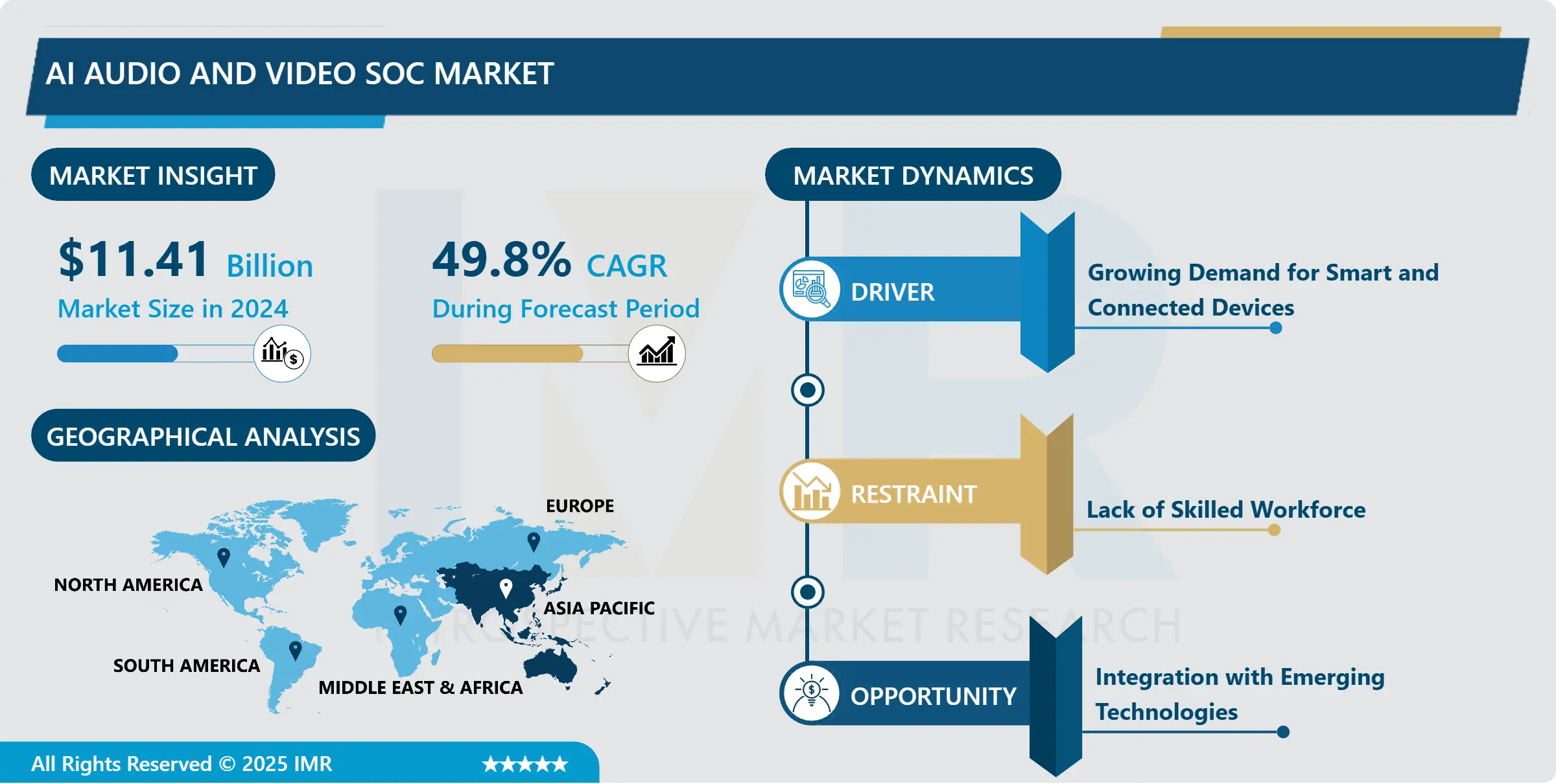
Global AI Audio and Video SoC Market Size Was Valued at USD 11.41 Billion in 2023 and is Projected to Reach USD 289.32 Billion by 2032, Growing at a CAGR of 49.8% From 2025-2032.
An AI Audio Video SoC, also known as a System on Chip, is a single integrated circuit that includes all of the parts needed to process both AI and video and audio data. Better performance, less power consumption, and increased efficiency when managing multimedia tasks are all made possible by this integration. AI Audio Video SoCs process, analyze, and manipulate audio and video content in real-time, enabling a wide range of applications.
AI Audio and Video chips enable real-time processing of audio and video data, allowing for advanced features like content recognition, personalized recommendations, and immersive multimedia experiences. In the consumer electronics industry, AI Audio Video Integrated SoCs power a wide range of devices such as smart TVs, streaming devices, gaming consoles, and smartphones, increasing demand for intelligent and connected multimedia solutions.
AI Audio Video Integrated SoCs are used in the industrial, automotive, healthcare, and surveillance sectors to promote efficiency and innovation. These chips improve connectivity, safety, and entertainment on the road by supporting advanced driver assistance systems (ADAS), in-vehicle infotainment (IVI) systems, and autonomous driving technologies in automotive applications.
Rapid technological advancements, driven by the growing demand for AI-driven multimedia solutions and the expansion of IoT (Internet of Things) ecosystems, characterize the market for AI Audio Video Integrated SoCs. Research and development expenditures by semiconductor manufacturers are aimed at improving AI algorithms, maximizing the performance of audiovisual processing, and incorporating extra features like sensor fusion and connectivity options.
AI Audio and Video SoC Market Trend Analysis
AI Audio and Video SoC Market Growth Drivers- Growing Demand for Smart and Connected Devices
Technology is transforming products through information. Products that were once only made of mechanical and electrical components have evolved into complex structures that include a variety of components such as hardware, sensors, data storage, microprocessors, software, and networking. The widespread availability of wireless connectivity, as well as significant advancements in processing power and device miniaturization, have enabled the emergence of “smart, connected products,” which have unleashed
Smart, connected products exponentially increase the potential for new functionality, much higher reliability, far higher product utilization, and capabilities that cross and transcend traditional product boundaries. Value chains are being disrupted by the changing nature of products, forcing businesses to reconsider and retool almost every internal process.
The increasing need for sophisticated audio and video processing capabilities in smart and connected devices is being driven by the development of artificial intelligence (AI) and machine learning (ML) technologies. It is anticipated that the demand for sophisticated audio and video processing capabilities in smart and connected devices will increase as 5G connectivity is integrated.
AI Audio and Video SoC Market Opportunities- Integration with Emerging Technologies
AI SoCs are being integrated with advanced technologies such as 5G, Blockchain, and Sensor Technologies to open up new possibilities such as low-latency edge computing, enhanced data processing, secure data transactions, and intelligent sensor fusion. 5G’s high bandwidth can facilitate faster data transmission from sensors to AI SoCs, enabling quicker analysis and response times.
Additionally, blockchain technology can be leveraged to create decentralized AI networks where AI SoCs collaborate on data processing tasks while ensuring data privacy and security. AI algorithms running on SoCs can process sensor data locally at the edge, eliminating the need for data transmission to centralized servers and allowing for real-time insights and responses in applications like industrial IoT and wearable devices.
The market for AI Audio and Video SoCs is growing because of the integration of these technologies, which opens up possibilities for innovative products and services in a variety of industries, including telemedicine, smart cities, smart manufacturing, and digital transformation. This leads to a future that is more intelligent, connected, and secure.
AI Audio and Video SoC Market Segment Analysis:
AI Audio and Video SoC Market Segmented on the basis of Type, Product, Technology, and End-Users.
By Type, AI Audio Video Integrated SoC segment is expected to dominate the market during the forecast period
AI Audio Video Integrated SoCs (AI AV SoCs) are a subset of AI SoCs that integrate audio and video processing capabilities onto a single chip. This integration provides several advantages over separate audio and video SoCs, including improved performance, lower power consumption, smaller form factor, and lower cost, i.e. Manufacturing a single chip can be less expensive than producing separate audio and video SoCs.
Moreover, these integrated chips are used in voice assistants, infotainment systems, automobile ADAS, and smart homes with networked appliances. Consumer electronics include smartphones, tablets, headsets, cameras, and automation robots. Industrial electronics include machine vision, predictive maintenance, and robotic automation. additional industries that use it include healthcare, retail, education, aerospace, and defense.
Integrated audio and video processing solutions are becoming more and more necessary as smart devices, connected homes, and sophisticated multimedia applications become more widely used. The capabilities of AI AV SoCs are further enhanced by advancements in chip design and AI algorithms. This market is expected to grow as a result of ongoing technological advancements, rising demand for smart devices, and sophisticated multimedia experiences.
By Application, Consumer Electronics segment is expected to dominate the market during the forecast period
Consumer electronics refers to a broad category of electronic devices designed for personal use and entertainment. This includes smartphones, tablets, laptops, televisions, smartwatches, and other devices. The sector has grown significantly over the years, as consumers rely more on these devices for communication, information, and entertainment.
Consumer electronics have had a significant impact on the AI Audio and Video SoC market, influencing consumer expectations, changing business models, and creating new market opportunities. As consumers become more accustomed to using smart devices in their daily lives, their expectations and demands for smart and intuitive electronics grow. They expect seamless integration, personalized experiences, and enhanced functionality.
Next-generation smart devices, which offer increased productivity and personalized experiences, are expected to drive further advancements across industries. Real-time user data monitoring and analysis will also be enabled by the increasing integration of AI SoCs with 5G and blockchain. reducing the need for cloud services and enabling faster processing. Real-time decision-making is now possible thanks to improved data privacy.
AI Audio and Video SoC Market Regional Insights:
Asia Pacific is Expected to Dominate the Market Over the Forecast Period
Developing economies like India China and Japan are leading the region’s increased consumer spending on electronics and smart home technologies. To meet this demand, major players in the region include Samsung Electronics, TSMC, MediaTek, and SK Hynix. These companies have extensive experience in semiconductor design, manufacturing, and fabrication, allowing them to create advanced SoC solutions that incorporate AI capabilities.
The development of the AI Audio and Video SoC market in Asia-Pacific is also supported by the availability of a trained labor force and government initiatives that encourage innovation and technological advancement. Businesses in the area are making significant R&D investments to improve AI algorithms, maximize the performance of audiovisual processing, and integrate new features into SoC solutions.
With the increasing popularity of connected cars, smart homes, and industrial automation, there is a greater need for intelligent multimedia solutions that can process audio and video data in real time. As technology advances and regional economies develop, this market is likely to witness even more explosive growth in the coming years.
AI Audio and Video SoC Market Top Key Players:
Intel (US)
AMD (US)
Broadcom (US)
Micron (US)
Qualcomm (US)
Texas Instruments (US)
Nvidia (US)
NXP (Netherlands)
Analog Devices (US)
Kneron (US)
Ambarella (US)
Synaptics (US)
Infineon (Germany)
STMicroelectronics (Switzerland)
Synaptics (US)
Samsung (South Korea)
SK Hynix (South Korea)
Renesas (Japan)
TSMC (Taiwan)
MediaTek (Taiwan)
HiSilicon (China)
Other Active Players
Key Industry Developments in the AI Audio and Video SoC Market:
In January 2024, At ISE 2024, AMD introduced cutting-edge audio and video processing, AV-over-IP standards (IPMX, NDI®, and Dante AV Ultra™), machine learning applications, and new interface IP on advanced FPGA-based SoC platforms.
In May 2023, Ambarella partnered with Micron to develop a SoC platform for next-generation edge AI perception. Utilizing Micron’s state-of-the-art 1? tech node, Micron’s LPDDR5/LPDDR5X provides the speed and capacity required to enable Ambarella’s CV5 SoC family’s edge AI capabilities.
Chapter 1: Introduction
1.1 Scope and Coverage
Chapter 2:Executive Summary
Chapter 3: Market Landscape
3.1 Market Dynamics
3.1.1 Drivers
3.1.2 Restraints
3.1.3 Opportunities
3.1.4 Challenges
3.2 Market Trend Analysis
3.3 PESTLE Analysis
3.4 Porter’s Five Forces Analysis
3.5 Industry Value Chain Analysis
3.6 Ecosystem
3.7 Regulatory Landscape
3.8 Price Trend Analysis
3.9 Patent Analysis
3.10 Technology Evolution
3.11 Investment Pockets
3.12 Import-Export Analysis
Chapter 4: AI Audio and Video SoC Market by Type (2018-2032)
4.1 AI Audio and Video SoC Market Snapshot and Growth Engine
4.2 Market Overview
4.3 AI Audio SoC
4.3.1 Introduction and Market Overview
4.3.2 Historic and Forecasted Market Size in Value USD and Volume Units
4.3.3 Key Market Trends, Growth Factors, and Opportunities
4.3.4 Geographic Segmentation Analysis
4.4 AI Video SoC
4.5 AI Audio Video Integrated SoC
Chapter 5: AI Audio and Video SoC Market by Product (2018-2032)
5.1 AI Audio and Video SoC Market Snapshot and Growth Engine
5.2 Market Overview
5.3 Application Processors (APs)
5.3.1 Introduction and Market Overview
5.3.2 Historic and Forecasted Market Size in Value USD and Volume Units
5.3.3 Key Market Trends, Growth Factors, and Opportunities
5.3.4 Geographic Segmentation Analysis
5.4 Graphics Processing Units (GPUs)
5.5 Neural Processing Units (NPUs)
5.6 Field-Programmable Gate Arrays (FPGAs)
Chapter 6: AI Audio and Video SoC Market by Technology (2018-2032)
6.1 AI Audio and Video SoC Market Snapshot and Growth Engine
6.2 Market Overview
6.3 Central Processing Unit (CPU) based
6.3.1 Introduction and Market Overview
6.3.2 Historic and Forecasted Market Size in Value USD and Volume Units
6.3.3 Key Market Trends, Growth Factors, and Opportunities
6.3.4 Geographic Segmentation Analysis
6.4 GPU based
6.5 Neuromorphic computing
Chapter 7: AI Audio and Video SoC Market by Application (2018-2032)
7.1 AI Audio and Video SoC Market Snapshot and Growth Engine
7.2 Market Overview
7.3 Automotive
7.3.1 Introduction and Market Overview
7.3.2 Historic and Forecasted Market Size in Value USD and Volume Units
7.3.3 Key Market Trends, Growth Factors, and Opportunities
7.3.4 Geographic Segmentation Analysis
7.4 Industrial
7.5 Smart Home
7.6 Consumer Electronics
7.7 Healthcare
Chapter 8: Company Profiles and Competitive Analysis
8.1 Competitive Landscape
8.1.1 Competitive Benchmarking
8.1.2 AI Audio and Video SoC Market Share by Manufacturer (2024)
8.1.3 Industry BCG Matrix
8.1.4 Heat Map Analysis
8.1.5 Mergers and Acquisitions
8.2 ANSYS (UNITED STATES)
8.2.1 Company Overview
8.2.2 Key Executives
8.2.3 Company Snapshot
8.2.4 Role of the Company in the Market
8.2.5 Sustainability and Social Responsibility
8.2.6 Operating Business Segments
8.2.7 Product Portfolio
8.2.8 Business Performance
8.2.9 Key Strategic Moves and Recent Developments
8.2.10 SWOT Analysis
8.3 AZURE (UNITED STATES)
8.4 ABB GROUP (SWITZERLAND)
8.5 AMAZON WEB SERVICES INC. (UNITED STATES)
8.6 SIEMENS AG
8.7 DASSAULT SYSTÈMES SE
8.8 PTC INCROBERT BOSCH GMBH
8.9 IBM CORPORATION
8.10 ORACLE CORPORATION
8.11 GENERAL ELECTRIC
8.12 SAP SE
Chapter 9: Global AI Audio and Video SoC Market By Region
9.1 Overview
9.2. North America AI Audio and Video SoC Market
9.2.1 Key Market Trends, Growth Factors and Opportunities
9.2.2 Top Key Companies
9.2.3 Historic and Forecasted Market Size by Segments
9.2.4 Historic and Forecasted Market Size by Type
9.2.4.1 AI Audio SoC
9.2.4.2 AI Video SoC
9.2.4.3 AI Audio Video Integrated SoC
9.2.5 Historic and Forecasted Market Size by Product
9.2.5.1 Application Processors (APs)
9.2.5.2 Graphics Processing Units (GPUs)
9.2.5.3 Neural Processing Units (NPUs)
9.2.5.4 Field-Programmable Gate Arrays (FPGAs)
9.2.6 Historic and Forecasted Market Size by Technology
9.2.6.1 Central Processing Unit (CPU) based
9.2.6.2 GPU based
9.2.6.3 Neuromorphic computing
9.2.7 Historic and Forecasted Market Size by Application
9.2.7.1 Automotive
9.2.7.2 Industrial
9.2.7.3 Smart Home
9.2.7.4 Consumer Electronics
9.2.7.5 Healthcare
9.2.8 Historic and Forecast Market Size by Country
9.2.8.1 US
9.2.8.2 Canada
9.2.8.3 Mexico
9.3. Eastern Europe AI Audio and Video SoC Market
9.3.1 Key Market Trends, Growth Factors and Opportunities
9.3.2 Top Key Companies
9.3.3 Historic and Forecasted Market Size by Segments
9.3.4 Historic and Forecasted Market Size by Type
9.3.4.1 AI Audio SoC
9.3.4.2 AI Video SoC
9.3.4.3 AI Audio Video Integrated SoC
9.3.5 Historic and Forecasted Market Size by Product
9.3.5.1 Application Processors (APs)
9.3.5.2 Graphics Processing Units (GPUs)
9.3.5.3 Neural Processing Units (NPUs)
9.3.5.4 Field-Programmable Gate Arrays (FPGAs)
9.3.6 Historic and Forecasted Market Size by Technology
9.3.6.1 Central Processing Unit (CPU) based
9.3.6.2 GPU based
9.3.6.3 Neuromorphic computing
9.3.7 Historic and Forecasted Market Size by Application
9.3.7.1 Automotive
9.3.7.2 Industrial
9.3.7.3 Smart Home
9.3.7.4 Consumer Electronics
9.3.7.5 Healthcare
9.3.8 Historic and Forecast Market Size by Country
9.3.8.1 Russia
9.3.8.2 Bulgaria
9.3.8.3 The Czech Republic
9.3.8.4 Hungary
9.3.8.5 Poland
9.3.8.6 Romania
9.3.8.7 Rest of Eastern Europe
9.4. Western Europe AI Audio and Video SoC Market
9.4.1 Key Market Trends, Growth Factors and Opportunities
9.4.2 Top Key Companies
9.4.3 Historic and Forecasted Market Size by Segments
9.4.4 Historic and Forecasted Market Size by Type
9.4.4.1 AI Audio SoC
9.4.4.2 AI Video SoC
9.4.4.3 AI Audio Video Integrated SoC
9.4.5 Historic and Forecasted Market Size by Product
9.4.5.1 Application Processors (APs)
9.4.5.2 Graphics Processing Units (GPUs)
9.4.5.3 Neural Processing Units (NPUs)
9.4.5.4 Field-Programmable Gate Arrays (FPGAs)
9.4.6 Historic and Forecasted Market Size by Technology
9.4.6.1 Central Processing Unit (CPU) based
9.4.6.2 GPU based
9.4.6.3 Neuromorphic computing
9.4.7 Historic and Forecasted Market Size by Application
9.4.7.1 Automotive
9.4.7.2 Industrial
9.4.7.3 Smart Home
9.4.7.4 Consumer Electronics
9.4.7.5 Healthcare
9.4.8 Historic and Forecast Market Size by Country
9.4.8.1 Germany
9.4.8.2 UK
9.4.8.3 France
9.4.8.4 The Netherlands
9.4.8.5 Italy
9.4.8.6 Spain
9.4.8.7 Rest of Western Europe
9.5. Asia Pacific AI Audio and Video SoC Market
9.5.1 Key Market Trends, Growth Factors and Opportunities
9.5.2 Top Key Companies
9.5.3 Historic and Forecasted Market Size by Segments
9.5.4 Historic and Forecasted Market Size by Type
9.5.4.1 AI Audio SoC
9.5.4.2 AI Video SoC
9.5.4.3 AI Audio Video Integrated SoC
9.5.5 Historic and Forecasted Market Size by Product
9.5.5.1 Application Processors (APs)
9.5.5.2 Graphics Processing Units (GPUs)
9.5.5.3 Neural Processing Units (NPUs)
9.5.5.4 Field-Programmable Gate Arrays (FPGAs)
9.5.6 Historic and Forecasted Market Size by Technology
9.5.6.1 Central Processing Unit (CPU) based
9.5.6.2 GPU based
9.5.6.3 Neuromorphic computing
9.5.7 Historic and Forecasted Market Size by Application
9.5.7.1 Automotive
9.5.7.2 Industrial
9.5.7.3 Smart Home
9.5.7.4 Consumer Electronics
9.5.7.5 Healthcare
9.5.8 Historic and Forecast Market Size by Country
9.5.8.1 China
9.5.8.2 India
9.5.8.3 Japan
9.5.8.4 South Korea
9.5.8.5 Malaysia
9.5.8.6 Thailand
9.5.8.7 Vietnam
9.5.8.8 The Philippines
9.5.8.9 Australia
9.5.8.10 New Zealand
9.5.8.11 Rest of APAC
9.6. Middle East & Africa AI Audio and Video SoC Market
9.6.1 Key Market Trends, Growth Factors and Opportunities
9.6.2 Top Key Companies
9.6.3 Historic and Forecasted Market Size by Segments
9.6.4 Historic and Forecasted Market Size by Type
9.6.4.1 AI Audio SoC
9.6.4.2 AI Video SoC
9.6.4.3 AI Audio Video Integrated SoC
9.6.5 Historic and Forecasted Market Size by Product
9.6.5.1 Application Processors (APs)
9.6.5.2 Graphics Processing Units (GPUs)
9.6.5.3 Neural Processing Units (NPUs)
9.6.5.4 Field-Programmable Gate Arrays (FPGAs)
9.6.6 Historic and Forecasted Market Size by Technology
9.6.6.1 Central Processing Unit (CPU) based
9.6.6.2 GPU based
9.6.6.3 Neuromorphic computing
9.6.7 Historic and Forecasted Market Size by Application
9.6.7.1 Automotive
9.6.7.2 Industrial
9.6.7.3 Smart Home
9.6.7.4 Consumer Electronics
9.6.7.5 Healthcare
9.6.8 Historic and Forecast Market Size by Country
9.6.8.1 Turkiye
9.6.8.2 Bahrain
9.6.8.3 Kuwait
9.6.8.4 Saudi Arabia
9.6.8.5 Qatar
9.6.8.6 UAE
9.6.8.7 Israel
9.6.8.8 South Africa
9.7. South America AI Audio and Video SoC Market
9.7.1 Key Market Trends, Growth Factors and Opportunities
9.7.2 Top Key Companies
9.7.3 Historic and Forecasted Market Size by Segments
9.7.4 Historic and Forecasted Market Size by Type
9.7.4.1 AI Audio SoC
9.7.4.2 AI Video SoC
9.7.4.3 AI Audio Video Integrated SoC
9.7.5 Historic and Forecasted Market Size by Product
9.7.5.1 Application Processors (APs)
9.7.5.2 Graphics Processing Units (GPUs)
9.7.5.3 Neural Processing Units (NPUs)
9.7.5.4 Field-Programmable Gate Arrays (FPGAs)
9.7.6 Historic and Forecasted Market Size by Technology
9.7.6.1 Central Processing Unit (CPU) based
9.7.6.2 GPU based
9.7.6.3 Neuromorphic computing
9.7.7 Historic and Forecasted Market Size by Application
9.7.7.1 Automotive
9.7.7.2 Industrial
9.7.7.3 Smart Home
9.7.7.4 Consumer Electronics
9.7.7.5 Healthcare
9.7.8 Historic and Forecast Market Size by Country
9.7.8.1 Brazil
9.7.8.2 Argentina
9.7.8.3 Rest of SA
Chapter 10 Analyst Viewpoint and Conclusion
10.1 Recommendations and Concluding Analysis
10.2 Potential Market Strategies
Chapter 11 Research Methodology
11.1 Research Process
11.2 Primary Research
11.3 Secondary Research
Q1: What would be forecast period in the AI Audio and Video SoC Market research report?
A1: The forecast period in the AI Audio and Video SoC Market research report is 2025-2032.
Q2: Who are the key players in AI Audio and Video SoC Market?
A2: Intel (US), AMD (US), Broadcom (US), Micron (US), Qualcomm (US), Texas Instruments (US), Nvidia (US), NXP (Netherlands), Analog Devices (US), Kneron (US), Ambarella (US), Synaptics (US), Infineon (Germany), STMicroelectronics (Switzerland), Synaptics (US), Samsung (South Korea), SK Hynix (South Korea), Renesas (Japan), TSMC (Taiwan), MediaTek (Taiwan), HiSilicon (China) and Other Active Players.
Q3: What are the segments of the AI Audio and Video SoC Market?
A3: The AI Audio and Video SoC Market is segmented into Type, Nature, Application, and region. By Type, the market is categorized into AI Audio SoC, AI Video SoC, and AI Audio Video Integrated SoC. By Product, the market is categorized into Application Processors (APs), Graphics Processing Units (GPUs), Neural Processing Units (NPUs), and Field-Programmable Gate Arrays (FPGAs). By Technology, the market is categorized into Central Processing Unit (CPU) based, GPU-based, and Neuromorphic computing. By Application, the market is categorized into Automotive, Industrial, Smart Home, Consumer Electronics, and Healthcare. By region, it is analyzed across• North America (U.S., Canada, Mexico) • Eastern Europe (Russia, Bulgaria, The Czech Republic, Hungary, Poland, Romania, Rest of Eastern Europe) • Western Europe (Germany, UK, France, The Netherlands, Italy, Spain, Rest of Western Europe) • Asia Pacific (China, India, Japan, South Korea, Malaysia, Thailand, Vietnam, The Philippines, Australia, New Zealand, Rest of APAC) • Middle East & Africa (Türkiye, Bahrain, Kuwait, Saudi Arabia, Qatar, UAE, Israel, South Africa) • South America (Brazil, Argentina, Rest of SA)
Q4: What is the AI Audio and Video SoC Market?
A4: An AI Audio Video SoC, also known as a System on Chip, is a single integrated circuit that includes all of the parts needed to process both AI and video and audio data. Better performance, less power consumption, and increased efficiency when managing multimedia tasks are all made possible by this integration. AI Audio Video SoCs process, analyze, and manipulate audio and video content in real time, enabling a wide range of applications
Q5: How big is the AI Audio and Video SoC Market?
A5: Global AI Audio and Video SoC Market Size Was Valued at USD 11.41 Billion in 2023 and is Projected to Reach USD 289.32 Billion by 2032, Growing at a CAGR of 49.8% From 2025-2032.
How to Buy a Report from eminsights.jp
On the product page, choose the license you want: Single-User License, Multi-User License or Enterprise License.
If you required report in your native language, then you can click on Translated Report button and fill out the form with report name and language you want, then our team will contact you as soon as possible.
Click the Buy Now button.
You will be redirected to the checkout page. Enter your company details and payment information.
Click Place Order to complete the purchase.
Confirmation: You’ll receive an order confirmation and our team will contact you shortly with your ordered report.
If you have any questions, fill out the contact form below or email us at [email protected].
Thank you for choosing eminsights.jp!